Whether You're Just Getting Started or Your Leads Have Gone Quiet, Passive Marketing Is Not the Answer
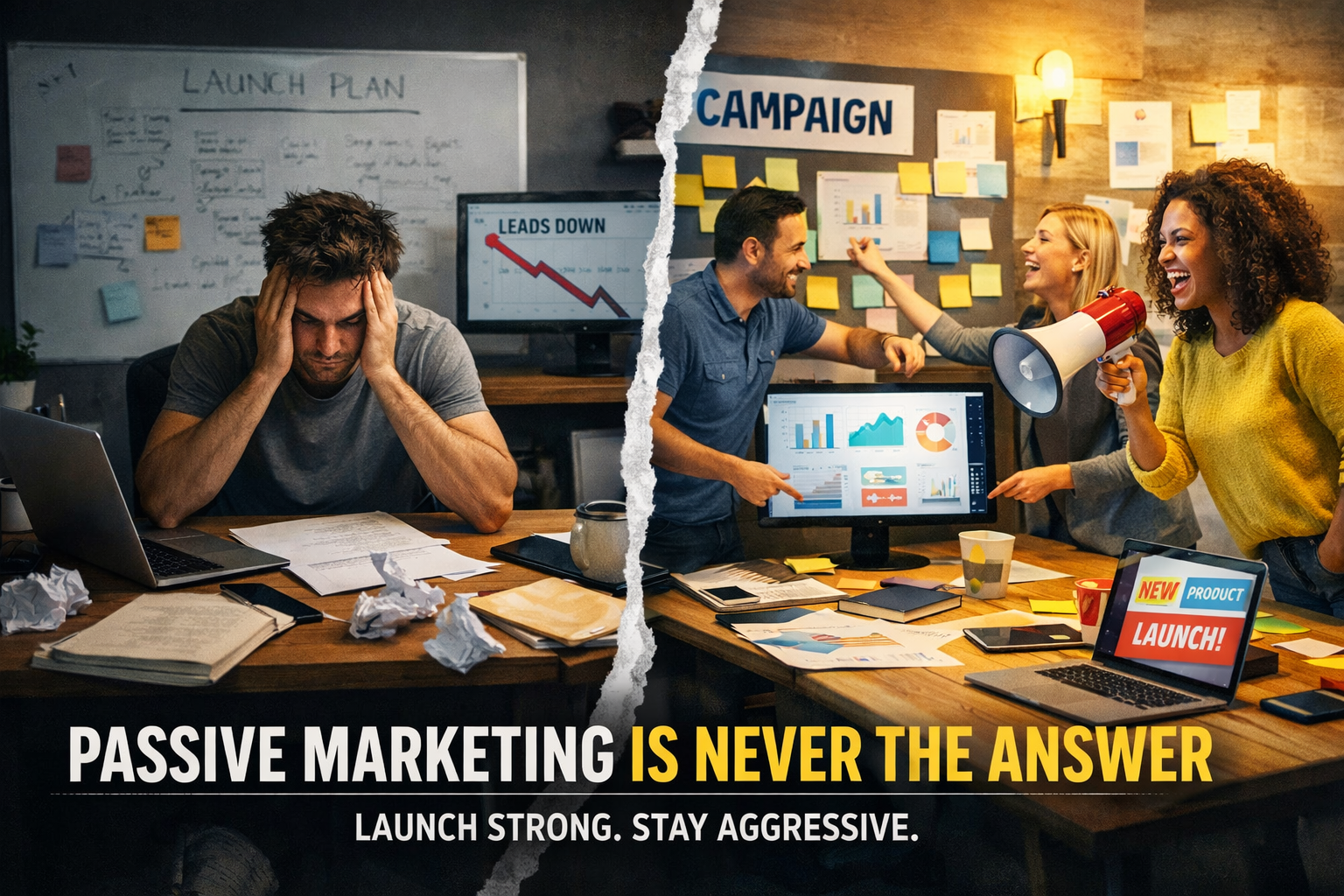
There are two moments in the life of a business when the stakes of marketing are highest and the temptation to underinvest is strongest.
The first is the beginning. You have a product or service you believe in, a market you've identified, and the pressure of turning an idea into a revenue-generating company as quickly as possible without burning through your runway. The list of things competing for your attention and your budget is long, and marketing — which doesn't always produce immediate, attributable results — is easy to defer in favor of things that feel more urgent.
The second is a plateau or a decline. You built something real. You have customers, a track record, a reputation. But the leads that used to come reliably are coming less reliably. The referrals are slower. The channels that used to work aren't working the way they did. Revenue is flat or declining and you're not entirely sure why, which makes it hard to know what to do about it. And in that uncertainty, the instinct is often to wait — to see if things pick back up, to avoid spending money on marketing when revenue is already under pressure, to hope that whatever caused the slowdown corrects itself.
Both of these instincts are understandable. Both of them are wrong. And both of them lead to the same place: a business that is invisible to the customers it should be reaching, losing ground to competitors who are not making the same mistake, and falling further behind with every month that passes without an aggressive, intentional marketing strategy.
This is a piece about why aggressive marketing partnership matters at both of these inflection points — why the go-to-market company that doesn't build its marketing infrastructure early is making a mistake that compounds, and why the established company watching its leads dry up is not facing a sales problem or a product problem but almost always a marketing problem. And it's about what that partnership with a team like Ritner Digital actually looks like when it's done right.
The Go-To-Market Illusion: Why "We'll Figure Out Marketing Later" Is Never a Strategy
Every go-to-market company tells itself some version of the same story. The product is good enough that it will sell itself once people try it. The network is strong enough to generate early customers through relationships and referrals. The marketing budget will be allocated once revenue starts coming in, because it doesn't make sense to spend on marketing before there's anything to market.
This story is seductive because it contains partial truths. A genuinely good product does create word of mouth. A strong network does generate early customers. And capital discipline in the early stages of a company is genuinely important. But the conclusion the story leads to — defer marketing until later — is wrong in a way that creates compounding problems the longer it continues.
The market doesn't wait for you to be ready. While you are building your product and serving your first customers through referrals and relationships, your competitors are building brand recognition, domain authority, social proof, and customer acquisition infrastructure. SEO compounds over time — the company that starts publishing content and building links today will have a meaningful search presence in twelve to eighteen months that the company starting then cannot replicate quickly. Brand awareness works the same way. Paid media builds audience data over time. Every month you defer building the marketing infrastructure is a month your competitors are ahead of you on the metrics that determine who gets found, who gets considered, and who gets chosen.
Referrals are not a marketing strategy. They are a byproduct of a marketing strategy executed well. Referrals come from customers who are delighted enough to recommend you, who are embedded in networks where their recommendation reaches the right people, and who have enough context about what you do and who you serve to make an accurate referral. A company with a strong brand, a clear value proposition, and a content strategy that educates its existing customers gives those customers the tools to refer accurately and enthusiastically. A company that is invisible online and has no marketing infrastructure gets referrals that are vague, infrequent, and often not well matched to what the company actually does best.
The cost of customer acquisition only goes up over time. In almost every digital marketing channel — paid search, paid social, content marketing, influencer — the companies that built audience and infrastructure early pay less for attention than the companies entering later. Keyword competition increases. Ad costs rise as more advertisers enter the market. The content gap between the company that has been publishing for two years and the one just starting is enormous and expensive to close. The go-to-market company that invests in marketing infrastructure early is not spending money before it's ready. It is buying a cost advantage that compounds for years.
First mover advantage in marketing is real. In most industries, the first brand to own a specific topic in search, to build the definitive resource on a category question, to establish the association between a specific problem and a specific solution, holds that position for a long time. Being second to own "electrolyte science for endurance athletes" or "digital marketing for HVAC companies" or whatever the relevant category is means fighting for a position that someone else already holds. Getting there first is worth the investment.
What Aggressive Go-To-Market Marketing Actually Looks Like
For a company in launch or early growth mode, aggressive marketing is not about spending the most money. It is about building the right infrastructure in the right sequence with the right level of intensity given the resources available.
Start with positioning before anything else. The most expensive mistake a go-to-market company makes in marketing is spending money before the positioning is clear. If you don't know exactly who you're for, what problem you solve better than anyone else, and why a specific customer should choose you over every alternative including doing nothing — no amount of paid media, content, or brand building will generate the returns it should. Every dollar spent on marketing before the positioning is right is a dollar working at reduced efficiency. Getting the positioning right first is not a delay. It is the prerequisite that makes everything else work.
Build the digital foundation in parallel with sales. Website, SEO infrastructure, content strategy, email capture and nurture — these should be built as early as possible because they take time to produce results and the clock starts when you start. A go-to-market company that waits until month six to launch its website and month twelve to start its content strategy has given away a year of compounding that it can never recover. The website does not need to be perfect. The content does not need to be comprehensive. It needs to exist, to be indexed, and to be growing — because something growing from an early start will always be ahead of something starting later.
Use paid media to learn, not just to acquire. Early-stage paid media for a go-to-market company is as much a research tool as an acquisition tool. Running paid search and paid social campaigns tells you which messages resonate, which audiences convert, which offers generate action, and which assumptions about your customer were wrong. That data is extraordinarily valuable and impossible to get any other way at speed. The company that uses its early paid media investment to learn and refine its positioning and creative will run more efficient campaigns at every subsequent stage of growth than the company that skips paid media entirely in the early stages and goes in blind later.
Create content that answers the questions your customers are already asking. Every business has a set of questions that its best potential customers are actively searching for answers to. What does X cost. How do I choose between Y and Z. What should I look for in a provider of W. The company that publishes the most useful, most accurate, most genuinely helpful answers to those questions becomes the trusted resource in its category — and trusted resources convert at dramatically higher rates than cold traffic from brands the customer has never encountered before. This is the SEO and content strategy case made simply: be the answer to the question your customer is already asking, and you get found at the moment of highest intent.
Build the brand from day one. Brand is not a luxury that go-to-market companies earn the right to invest in once they've achieved a certain revenue threshold. Brand is the accumulated impression that every customer and prospective customer has of your company — and it is being formed from the first moment someone encounters you, whether you are intentionally shaping it or not. A go-to-market company that doesn't invest in brand is not avoiding the brand-building process. It is leaving that process to chance, and chance produces inconsistent, weak, and often inaccurate brand impressions that are much harder to correct later than to build correctly from the start.
The Established Company Trap: Why Slowing Leads Feel Like a Sales Problem But Almost Always Aren't
The established company with slowing leads is in a different situation from the go-to-market company, but the underlying dynamic is often surprisingly similar: a business that has been relying on a set of marketing inputs that used to work reliably and is now experiencing the consequences of those inputs becoming less effective without a plan for what comes next.
The mistake most established companies make when leads slow down is diagnosing it as a sales problem. The sales team isn't following up fast enough. The CRM isn't being used correctly. The proposals aren't competitive enough. The close rate has dropped. So the response is to hire another salesperson, to retrain the existing team, to adjust the pricing — to work harder on converting the leads that are coming in rather than addressing the fact that fewer leads are coming in.
Sales optimization on a declining lead flow is the business equivalent of bailing water from a leaking boat without fixing the leak. The effort is real and the intention is right but the diagnosis is wrong and so the problem continues.
Why do established company leads dry up?
The most common causes are consistent enough to be worth naming directly.
Referral networks mature and slow. The network that generated referrals reliably in the company's early years was the network of the founder and early team — active, engaged, and enthusiastic about a new company they believed in. Networks mature. People change jobs. Enthusiasm fades. The referral that felt organic and consistent in year two is structurally different in year seven, and the company that hasn't built marketing channels beyond its referral network finds itself exposed when that network naturally slows.
The competitive landscape changed. New competitors entered the market. Existing competitors got more sophisticated in their marketing. A well-funded new entrant started spending aggressively on paid search and content and is now appearing ahead of the established company in the searches where the established company used to be found. The established company didn't get worse. The competitive context got harder and the company's marketing didn't evolve to meet it.
The channels that worked stopped working. Google algorithm updates. Changes to how Meta distributes organic content. The decline of a platform the company was heavily invested in. The shift from desktop to mobile search behavior. Digital marketing channels change constantly and the strategies that produced results two years ago frequently don't produce the same results today. Companies that set their marketing infrastructure and leave it tend to find that it has decayed significantly by the time they notice the lead volume declining.
The brand hasn't kept pace with the business. The company has grown, evolved its offering, moved upmarket, expanded into new geographies or verticals — but the marketing hasn't kept up. The website still positions the company the way it was positioned three years ago. The content still speaks to the customer profile the company had rather than the customer profile it's targeting now. The brand impression the market has of the company is accurate to an older version of the business and outdated relative to what the company has become.
The company stopped being findable. This sounds simple but it is the most common underlying cause of lead decline in established companies. The website hasn't been updated. The content strategy went dormant. The SEO that was working has decayed as competitors produced more content and earned more links. The Google Business Profile hasn't been touched in two years. The company is invisible in the places where its potential customers are looking, and the customers who would have found it aren't finding it — they're finding someone else.
What Aggressive Marketing Looks Like for the Established Company With Slowing Leads
The established company's marketing challenge is different from the go-to-market company's in one important way: there is existing infrastructure, existing brand equity, and existing customer relationships to build on. The go-to-market company is building from zero. The established company is rebuilding from a position that has value but has been allowed to decay or has failed to keep pace with a changing market. The approach needs to reflect that difference.
Start with a genuine audit, not a surface refresh. The established company's instinct when it decides to invest in marketing is often to refresh the website — new design, new copy, new photos — and call it done. A website refresh is sometimes necessary. It is rarely sufficient. What the established company actually needs before it spends a dollar on marketing is a clear-eyed assessment of why the leads dried up in the first place. Where is the company being found and where is it invisible? What does the competitive landscape look like in search? What does the brand impression actually communicate versus what the company thinks it communicates? What channels are producing any results at all and which have been abandoned or are underperforming? Without that audit, the marketing investment that follows is working with incomplete information and is likely to address the symptoms rather than the underlying causes.
Rebuild the digital foundation with current best practices. An established company's digital infrastructure was often built at a point in time and hasn't been maintained with the rigor it requires. The website may be slow, may not be mobile optimized, may have technical SEO issues that are suppressing its search visibility. The content may be thin, outdated, or poorly targeted. The Google Business Profile may be incomplete or inconsistently managed. The email list may be aging and unengaged. Each of these is a drag on marketing performance that compounds over time, and fixing them is not glamorous work but it is frequently the highest ROI investment an established company can make before spending on new acquisition channels.
Reactivate the existing customer base before hunting for new ones. The established company has something the go-to-market company doesn't: an existing base of customers who already trust it. Those customers are the most efficient source of new revenue — through repeat purchase, through expansion into additional services, and through referrals that are better qualified than cold lead generation because they come with the credibility of a trusted recommendation. Most established companies with slowing leads are underinvesting in their existing customer relationships relative to what those relationships could produce. A thoughtful email reactivation campaign, a customer success check-in sequence, a referral program with genuine incentives — these are often faster to revenue than any new acquisition channel.
Go on offense in search. When leads are slow, the natural instinct is to wait and preserve budget. The companies that recover fastest from lead slowdowns are the ones that go on offense in search at precisely the moment when the instinct says to hold back. This means content production that fills the gaps in the company's search presence. It means paid search campaigns that ensure the company appears for the high-intent queries where its competitors are currently winning. It means local SEO investment if the company competes locally. It means rebuilding the domain authority that may have decayed through a period of marketing dormancy. The results of this investment are not immediate — SEO in particular takes months to produce measurable results — which is exactly why the time to start is now and not when the situation has become more urgent.
Audit and repair the brand impression. The established company that has grown and evolved but hasn't updated its marketing to reflect that growth is invisible to the customer it's now trying to serve. A company that moved upmarket is still positioned as a small business provider. A company that expanded its service offering is still known only for the thing it did first. A company that has built an impressive client roster and track record has testimonials buried on a page nobody finds. The brand impression the market has is a lagging indicator of what the company actually is, and closing the gap between the brand impression and the current reality is often the single most impactful marketing investment an established company can make.
Build the channels that don't exist yet. The established company that relied on referrals has no paid media infrastructure. The one that relied on paid media has no content or SEO presence. The one that was strong in search has no social or email strategy. Wherever the gap is, filling it creates a new source of leads that the company has never had access to before — and new lead sources, when they start producing, can more than compensate for the decline in the channels that have slowed. The company that adds a functioning content and SEO strategy on top of an existing paid media program, or that adds a paid media program on top of an existing content strategy, creates a compounding effect where each channel amplifies the others.
The Costs of Waiting Are Not Abstract
For both the go-to-market company and the established company with slowing leads, the instinct to wait — to see how things develop, to be conservative with budget, to avoid committing to a marketing investment before the timing feels right — carries costs that are real even though they're not immediately visible.
Every month a go-to-market company defers building its marketing infrastructure is a month its competitors are building domain authority, brand recognition, and customer acquisition efficiency that the go-to-market company will have to overcome later at greater expense. The cost of being six months behind in SEO is not six months of effort — it is potentially two years of catching up because the gap compounds.
Every month an established company allows its lead flow to decline without an aggressive response is a month the competitive gap widens. Competitors who are marketing aggressively are appearing in places the established company used to appear. They are building relationships with customers the established company used to win. They are building brand recognition in a market the established company used to own. The established company that waits for things to get better on their own is not standing still — it is falling further behind relative to a competitive set that is not waiting.
The businesses that recover from lead slowdowns fastest are not the ones that waited until the situation became critical. They are the ones that recognized the early signs — a gradual decline in inbound leads, a longer sales cycle, a lower close rate on the leads that do come in — and responded aggressively before the decline became a crisis. The businesses that launched successfully and scaled efficiently are not the ones that figured out marketing after the fact. They are the ones that built the marketing infrastructure in parallel with the product and the sales process, so that when they were ready to grow, the machinery to grow was already in place.
What an Aggressive Marketing Partner Actually Does
The word aggressive in the context of marketing partnership doesn't mean reckless spending or high-volume low-quality tactics. It means intentional, strategic, and committed — a partner who is as invested in the outcome as the business itself, who pushes harder than a passive vendor relationship allows, and who builds the kind of marketing infrastructure that compounds over time rather than producing short-term activity with no lasting value.
Here is what that looks like with Ritner Digital specifically.
We start with strategy before tactics. Every engagement begins with a clear understanding of the business — the market, the competition, the customer, the goals, the timeline, and the budget — before we recommend a single channel or spend a single dollar. The strategy determines the tactics. The tactics without the strategy are just activity.
We build for the long term while delivering in the short term. The go-to-market company needs to generate leads now while building the infrastructure that will compound over the next two years. The established company needs to address the immediate lead decline while rebuilding the foundation that will prevent the next one. We hold both timeframes simultaneously and build marketing programs that do both — delivering near-term results through paid channels and immediate conversion optimization while building the SEO, content, and brand infrastructure that generates compounding returns over time.
We own the outcome, not just the activity. A passive marketing vendor delivers reports. An aggressive marketing partner is accountable for results. We track the metrics that connect marketing activity to business outcomes — leads generated, cost per lead, lead quality, conversion rate from lead to customer, revenue attributed to marketing channels — and we use those metrics to make the strategy better continuously rather than to justify the work that has already been done.
We push back when pushing back is right. The go-to-market company that wants to skip positioning and go straight to paid media needs a partner who will tell them that's the wrong sequence and why. The established company that wants to refresh the website without auditing the underlying marketing problems needs a partner who will tell them the website isn't the problem and what actually is. We are not a vendor that executes whatever the client asks. We are a partner that brings genuine strategic perspective to the relationship and is willing to have the harder conversation when the situation calls for it.
We scale with the business. The go-to-market company's marketing needs at month six are different from its needs at month eighteen. The established company's needs after the lead recovery are different from its needs during the rebuilding phase. We build marketing programs that evolve with the business rather than locking clients into a fixed scope that stops serving them when the situation changes.
The Businesses That Win Are the Ones That Market Like They Mean It
The go-to-market company that builds marketing infrastructure from day one doesn't just get leads faster. It builds a competitive position in its market that late-moving competitors will struggle to overcome. It learns what works earlier and refines it faster. It builds brand recognition that makes every subsequent sales conversation easier. It creates compounding returns that grow in value every month the infrastructure is in place.
The established company that responds aggressively to slowing leads doesn't just recover to its previous baseline. It emerges from the rebuilding process with a more diversified marketing program, a stronger competitive position, a clearer brand, and a customer acquisition infrastructure that is less vulnerable to the kind of channel-specific decay that caused the slowdown in the first place.
In both cases the outcome — a business that markets with intention, aggression, and consistency — is the same. And the partner that gets them there is the one that is willing to do the strategic and executional work required to build marketing that actually moves the business forward.
That is what Ritner Digital does. For the company just getting started and for the company that needs to get moving again, we are the partner that shows up with a plan, executes it with discipline, and stays accountable to the results.
If your leads have slowed down or you're trying to get to market and need a partner who will push as hard as you do, reach out. The conversation costs nothing. Waiting does.
Frequently Asked Questions
Why does marketing matter so much at the very beginning of a business when there's so much else to focus on?
Because the cost of deferring it compounds in a way that most founders don't fully appreciate until they're paying it. Every month a go-to-market company waits to build its marketing infrastructure is a month its competitors are building domain authority, brand recognition, and customer acquisition efficiency that will take significantly more than a month to overcome later. SEO in particular is a time-compounding asset — the company that starts building its search presence today will have a meaningful advantage over the company that starts in a year, and that advantage grows rather than closes over time. Marketing is not something you figure out after the product is ready and the first customers are in. It is something you build in parallel with the product, so that when you are ready to grow, the machinery to grow is already in place.
What's wrong with relying on referrals as the primary lead source for a new business?
Referrals are a byproduct of marketing done well, not a substitute for it. They come from customers who are delighted enough to recommend you, embedded in networks where their recommendation reaches the right people, and equipped with enough context about what you do to make an accurate referral. A company with a strong brand, clear positioning, and a content strategy that educates its existing customers gives those customers the tools to refer accurately and enthusiastically. A company that is invisible online and has no marketing infrastructure gets referrals that are infrequent, vague, and often poorly matched to what the company actually does best. More importantly, referral networks mature and slow — the enthusiasm of a founder's early network is not a renewable resource, and the company that hasn't built marketing channels beyond referrals finds itself exposed when that natural slowdown happens.
Why do so many established companies misdiagnose slowing leads as a sales problem?
Because the symptoms of a marketing problem and a sales problem can look similar from the inside. Close rates drop, pipeline slows, revenue flattens — and the natural assumption is that the sales team needs to work harder, follow up faster, or price more competitively. But if the underlying cause is that fewer qualified leads are entering the top of the funnel, optimizing the sales process is working on the wrong variable. Sales optimization on a declining lead flow is the business equivalent of bailing water from a leaking boat without fixing the leak. The effort is real but the diagnosis is wrong and so the problem continues. The first question to ask when leads slow is not how we convert more of what's coming in — it is why less is coming in than used to.
What are the most common reasons established company leads dry up?
The patterns are consistent enough to be predictable. Referral networks mature and slow as the founder's early enthusiasm network naturally becomes less active over time. The competitive landscape changes as new entrants spend aggressively and established competitors get more sophisticated, appearing in places the company used to own. The channels that used to work stop working as Google algorithm updates, social platform changes, and shifting search behavior erode the performance of strategies that were built for a different environment. The brand hasn't kept pace with the business as the company has grown and evolved but the marketing still positions it the way it was positioned years ago. Or the company simply stopped being findable — the website hasn't been updated, the content strategy went dormant, the SEO has decayed, and the customers who would have found the company are now finding someone else.
Is a website refresh enough to fix slowing leads for an established company?
Almost never on its own. A website refresh is sometimes necessary — an outdated site can undermine credibility and hurt conversion — but it is rarely the underlying cause of a lead decline and therefore rarely sufficient as a response to one. What the established company actually needs before spending on a website or any other marketing investment is a clear-eyed audit of why leads slowed in the first place. Where is the company visible and where is it invisible? What does the competitive landscape look like in search? What does the brand actually communicate versus what the company thinks it communicates? What channels are producing any results and which have been abandoned or allowed to decay? Without that diagnosis the marketing investment that follows addresses symptoms rather than causes.
Why is now always the right time to invest in marketing rather than waiting for conditions to improve?
Because the cost of waiting is not neutral — it is actively negative and it compounds. For the go-to-market company, every month of deferral is a month competitors are building the search presence, brand recognition, and customer acquisition infrastructure that the company will have to overcome later at greater expense. For the established company with slowing leads, every month without an aggressive response is a month the competitive gap widens as competitors who are marketing actively appear in places the company used to appear and build relationships with customers the company used to win. The businesses that recover from lead slowdowns fastest are not the ones that waited until the situation became critical. They are the ones that recognized the early signs and responded before the decline became a crisis.
What does aggressive marketing actually mean — is it just spending more money?
No. Aggressive marketing means intentional, strategic, and committed — a marketing program that is built around a clear strategy, executed with discipline, measured against outcomes that matter, and refined continuously based on what the data shows. It means going on offense rather than waiting. It means building across multiple channels rather than depending on one. It means treating marketing as a core business function rather than a support activity. It means working with a partner who is as invested in the outcome as the business itself rather than a vendor who delivers activity reports and waits to be told what to do next. The spend level is a function of the strategy and the market — aggressive marketing at a modest budget is dramatically more effective than passive marketing at a large one.
What should go-to-market companies prioritize first when building their marketing infrastructure?
Positioning before anything else. If you don't know exactly who you're for, what problem you solve better than the alternatives, and why a specific customer should choose you over everything else including doing nothing — no amount of paid media, content, or brand building will generate the returns it should. Every dollar spent on marketing before the positioning is right is a dollar working at reduced efficiency. Once positioning is clear, the sequence is: digital foundation — website, SEO infrastructure, content strategy — built in parallel with early sales activity, because these take time to compound and the clock starts when you start. Then paid media, used initially as much as a learning and research tool as an acquisition tool. Then brand building that reflects the positioning consistently across every touchpoint. The instinct to skip to tactics before the strategy is right is the most expensive mistake a go-to-market company makes in marketing.
Why is paid media useful as a learning tool for go-to-market companies, not just an acquisition channel?
Because it produces signal faster than any other marketing channel. Running paid search and paid social campaigns tells you which messages resonate with your actual target customer, which audiences convert and which don't, which offers generate action, and which assumptions about your customer were wrong — and it tells you all of this within weeks rather than the months that organic channels require to produce comparable data. The go-to-market company that uses its early paid media investment to learn and refine its positioning and creative will run significantly more efficient campaigns at every subsequent stage of growth than the company that skips paid media in the early stages and goes in blind later. The learning value of early paid media is often worth more than the direct revenue it produces.
How important is content marketing for a go-to-market company with limited resources?
More important than most go-to-market companies budget for, because it is the channel that produces the most compounding returns over time and the one where starting early matters most. Every business has questions its best potential customers are actively searching for answers to. The company that publishes the most useful, most accurate, most genuinely helpful answers to those questions becomes the trusted resource in its category — and trusted resources convert at dramatically higher rates than cold traffic from brands the customer has never encountered before. A go-to-market company with limited resources doesn't need a comprehensive content operation from day one. It needs a focused content strategy built around the highest-intent questions in its specific market, executed consistently, and optimized for search. That investment compounds every month and creates a distribution channel that doesn't shut off when the ad spend stops.
What should an established company do first when it realizes its leads have slowed?
Audit before acting. The instinct is to do something — refresh the website, hire another salesperson, run some ads — and the urgency to act is understandable. But acting without diagnosis is how companies spend money addressing the wrong problems. The audit should answer several specific questions: Where is the company visible in search and where has it lost ground? What has changed in the competitive landscape? Which marketing channels are producing any results and which have been allowed to decay? What does the brand actually communicate to a first-time visitor versus what the company believes it communicates? What does the existing customer base look like in terms of engagement, retention, and referral activity? The answers to those questions determine what the right marketing investment actually is — and they frequently reveal that the highest-ROI first move is not a new acquisition channel but a fix to something that has been quietly broken for longer than anyone realized.
Why should an established company reactivate its existing customer base before hunting for new leads?
Because the existing customer base is the most efficient source of new revenue available and most established companies are dramatically underinvesting in it relative to what it could produce. Existing customers already trust the company. They have already made the decision to buy. Selling them additional services, bringing them back for repeat purchases, or activating them as referral sources requires a fraction of the cost and effort of acquiring a new customer from scratch. A thoughtful email reactivation campaign, a customer success check-in sequence, a referral program with genuine incentives — these are frequently faster to revenue than any new acquisition channel and they often reveal that the lead problem is less severe than it appeared once the existing base is properly engaged.
How long does it take to see results from an aggressive marketing investment?
It depends on the channel and the starting point, and any partner who gives you a single answer without qualification is oversimplifying. Paid media produces results faster — within weeks for initial data, within two to three months for meaningful optimization and efficiency. SEO and content take longer — three to six months to begin showing meaningful movement, six to twelve months to produce substantial organic traffic, twelve to twenty-four months to fully compound into a significant distribution channel. Brand building is the longest arc of all but also the one that produces the most durable returns. The right answer for most companies is a portfolio approach — paid channels that produce results while organic channels build, so the business is never entirely dependent on channels that take time to produce results or entirely dependent on channels that stop working when the spend stops.
What makes Ritner Digital different from a standard marketing agency relationship?
The accountability structure and the strategic depth. A standard agency relationship produces activity — campaigns launched, content published, reports delivered — and measures success by the volume of that activity. We measure success by the business outcomes the activity produces: leads generated, cost per lead, lead quality, conversion rate from lead to customer, revenue attributed to marketing channels. We own the outcome rather than just the execution. We also bring genuine strategic perspective rather than channel-specific execution — we start with the business problem and build the marketing strategy around it, rather than starting with the services we sell and fitting the business into them. And we push back when pushing back is right, which is a thing a vendor does not do and a genuine partner does.
How does Ritner Digital approach the difference between a go-to-market company and an established company with slowing leads?
The starting point and the sequencing are different but the underlying approach is the same. For the go-to-market company we start with positioning, build the digital foundation in parallel with early sales activity, use paid media as a learning tool while organic channels build, and create the compounding infrastructure that will generate returns for years. For the established company we start with an audit that diagnoses the actual cause of the lead decline rather than the apparent one, address the highest-impact fixes first, reactivate the existing customer base as a near-term revenue lever, and then build the new channels and rebuild the decayed ones that create the diversified marketing program the company should have had all along. In both cases the goal is the same: a marketing infrastructure that compounds over time, produces results across multiple channels, and makes the business less vulnerable to the kind of single-channel dependency that created the problem in the first place.
When is the right time to bring in an aggressive marketing partner?
Earlier than feels comfortable and sooner than feels necessary. For the go-to-market company, the right time is before the product launches — so the marketing infrastructure is being built in parallel with the sales process rather than catching up to it. For the established company, the right time is the moment leads start feeling slower than they used to — not when the decline has become a crisis, not after six months of hoping things improve on their own, but at the first signal that something has changed. The businesses that come out of marketing downturns strongest are the ones that responded earliest. The businesses that struggled longest are the ones that waited until the situation felt urgent enough to justify the investment — by which point the competitive gap had widened significantly and the recovery required more time and more resources than an earlier response would have.