One Product, Three Brands: The Strategy Behind Taking the Same Formula to Completely Different Markets
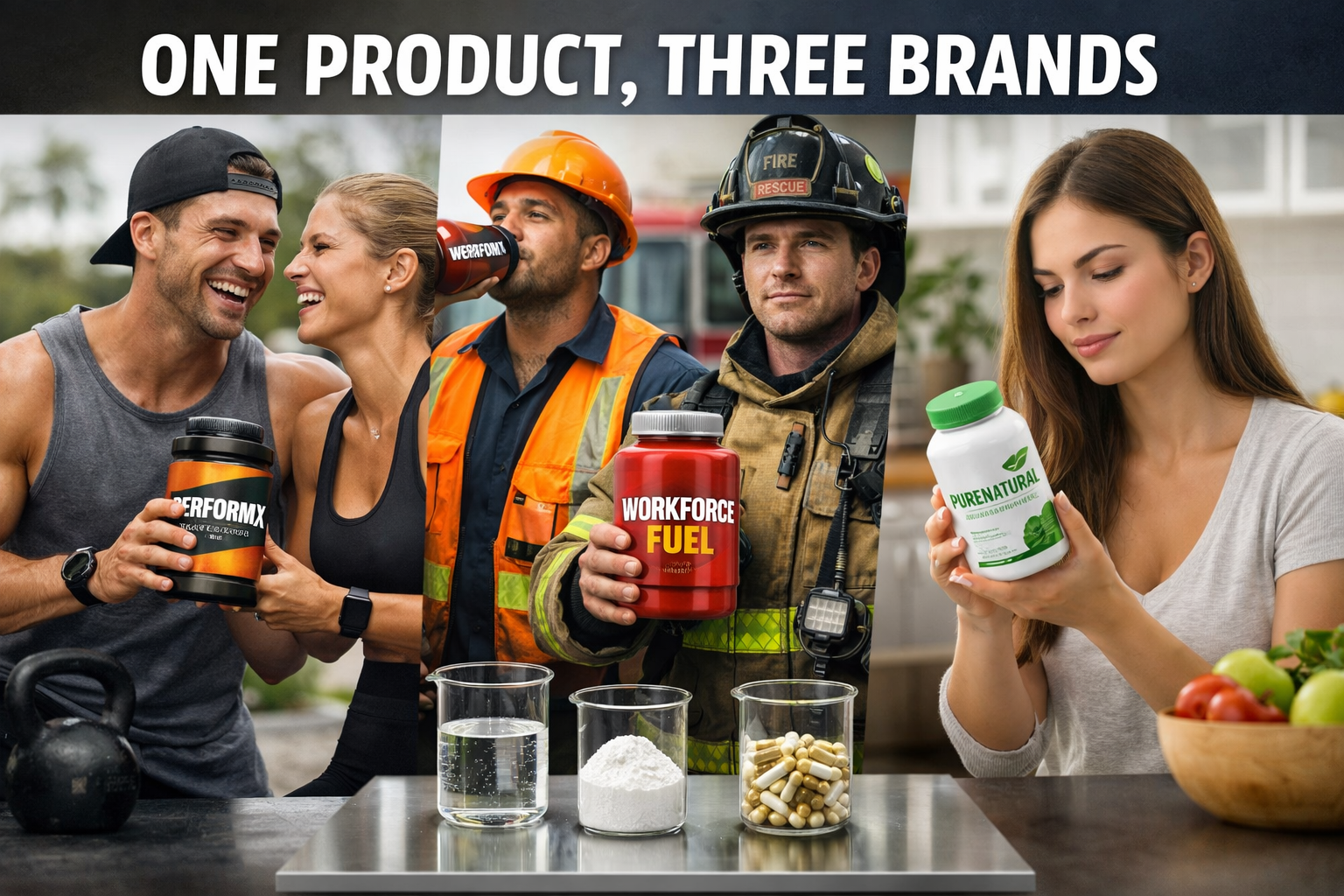
There is a strategy that the most sophisticated consumer product companies in the world have been executing for decades that most small and mid-sized brands never consider because it feels counterintuitive at first glance. The strategy is this: take one product — one formula, one manufacturing relationship, one supply chain — and build multiple distinct brands around it, each aimed at a completely different consumer segment with completely different positioning, aesthetics, messaging, and distribution channels.
This is not a new idea. Procter and Gamble has been doing it with detergent and shampoo for generations. Marriott does it with hotels. Toyota does it with cars — the same platform architecture underpins vehicles sold under Lexus, Toyota, and Scion to buyers who would never consider the other brands. The insight behind all of it is the same: the same underlying product can mean completely different things to completely different people, and trying to make one brand mean everything to everyone is usually the fastest way to make it mean nothing to anyone.
In the supplement and functional nutrition space specifically, this strategy is underutilized and underappreciated. And for a hydration or electrolyte brand sitting on a strong formula with broad potential appeal, it represents one of the most compelling growth opportunities available — if it's executed correctly.
This piece is about what that execution actually looks like. Specifically, we're going to walk through what it means to take a single high-quality supplement formula and build three distinct brands around it: one for the active lifestyle and fitness consumer, one for blue-collar workers like firefighters, construction crews, and tradespeople, and one for the clean supplement and wellness purist market. Three completely different consumers. Three completely different brands. One product underneath all of it.
Why One Brand Can't Serve All Three Segments
Before getting into how to execute the multi-brand strategy, it's worth understanding deeply why a single brand trying to speak to all three of these segments simultaneously doesn't work — because the temptation to try is strong and the failure mode is predictable.
The active lifestyle consumer and the firefighter have genuinely different relationships with hydration and supplementation. The active lifestyle consumer — the CrossFit regular, the recreational runner, the gym-goer who thinks carefully about what they put in their body — is purchasing in a context of optimization. They're not depleted. They're performing. They want to perform better. The brand they choose is part of their identity as someone who takes their health seriously, and the aesthetic and community signals of that brand matter enormously. They follow fitness influencers. They are on Instagram and TikTok. They read ingredient labels with genuine interest. They will pay a premium for a brand that feels like it was made for them specifically.
The firefighter working a 24-hour shift, the ironworker finishing a ten-hour day in August heat, the construction foreman who sweats through two shirts before lunch — these people are not optimizing. They are surviving. They are genuinely, seriously depleted in a way that the recreational athlete rarely is, and their relationship with a hydration product is functional rather than aspirational. They don't care about the brand's Instagram aesthetic. They care whether it works, whether it's easy to use in a work environment, and whether it's something their crew will actually adopt. They are deeply skeptical of anything that looks like a lifestyle product, because lifestyle products are for people with different lives than theirs. A brand that signals "fitness influencer" to a construction worker is a brand he will not buy.
The clean supplement consumer is different from both. This is the consumer who reads every ingredient panel, who searches for third-party certifications, who cares deeply about what is not in the product as much as what is. They want no artificial sweeteners, no synthetic dyes, no proprietary blends that obscure ingredient quantities, no association with the performance supplement world that they associate with synthetic compounds and aggressive marketing. Their trust is earned slowly through ingredient transparency, sourcing stories, certification logos, and the quiet credibility of a brand that doesn't oversell. A brand that looks like a sports supplement — with the bold typography and aggressive performance imagery of the fitness market — will not earn their trust regardless of how clean the formula actually is.
Now imagine one brand trying to speak authentically to all three of these consumers simultaneously. The fitness consumer finds it too functional and utilitarian. The blue-collar worker finds it too lifestyle and premium. The clean supplement consumer finds it too sporty and aggressive. You end up with a brand that is a compromise — that doesn't fully resonate with anyone because it's trying not to alienate everyone. The middle of the market is the most crowded and least differentiated place to be. Owning a specific segment with a brand built precisely for that consumer is dramatically more valuable than occupying a generic middle ground.
The Parent Brand Architecture
Before building the three consumer-facing brands, the parent company needs to establish its architecture clearly — because the relationship between the parent and the sub-brands has significant implications for everything from manufacturing and legal to marketing and consumer perception.
There are two primary models to consider.
The invisible parent model — sometimes called a house of brands — is where the parent company owns and operates multiple brands that have no visible connection to each other in the consumer's experience. The consumer buying Brand A has no idea that Brand B exists, that they're made by the same company, or that they're the same formula. This is the Procter and Gamble model. It maximizes each brand's ability to be precisely positioned for its target consumer without any cross-contamination of brand associations. The tradeoff is that you're building brand equity in multiple places simultaneously with no shared lift between them.
The endorsed brand model is where the parent brand is visible but secondary — a small "by [Parent Company]" line on the packaging or in the about section of the website. This gives each sub-brand its own distinct identity while allowing the parent company to build some aggregate credibility and allowing consumers who discover one brand to find the others if they choose. For a growing company with limited resources, this model offers some efficiency advantages while preserving most of the segmentation benefits.
For most independent supplement companies executing this strategy, the endorsed brand model is the more practical starting point. It allows the company to build manufacturing and operational infrastructure under one entity, to share certain back-end resources like customer service and fulfillment, and to establish some company-level credibility that benefits all three brands — while keeping the consumer-facing identities fully distinct.
What matters most is that the consumer-facing brands are genuinely separate in every dimension that the consumer experiences: name, visual identity, tone of voice, distribution channels, pricing, packaging, influencer relationships, and retail placement. A brand that shares too many visible elements across its sub-brands loses the segmentation benefit entirely.
Brand One: The Active Lifestyle Brand
This is the most crowded segment and the one with the highest marketing costs, but it's also the one with the most established consumer demand and the clearest playbook. The active lifestyle consumer is already buying hydration and electrolyte products. Your job is to give them a reason to buy yours.
Positioning
The active lifestyle brand should not try to be Liquid IV or LMNT. Both of those brands have spent years and significant capital building the associations they own. Trying to out-Liquid IV Liquid IV is a losing strategy. The opportunity is in the specific sub-segments and occasions that the dominant brands aren't serving as precisely as they could.
What does the active lifestyle consumer feel is missing from the current market? For some it's taste — the dominant electrolyte products use sweetener profiles that a significant portion of the market doesn't love. For others it's format — packets are convenient but not always the right solution for a long training session. For others it's the brand culture — they want something that feels more serious and less lifestyle-y than Liquid IV, or more accessible and less dogmatic than LMNT. Identify the gap and own it specifically rather than trying to compete on the same positioning the established brands already occupy.
Visual Identity and Tone
The active lifestyle brand can lean into performance aesthetics — bold typography, high-energy photography, a color palette that signals vitality and movement — but it should have a specific visual point of view rather than defaulting to the category standard. What does this brand believe about performance? What kind of athlete is it for? A brand built for endurance athletes looks and sounds different from one built for team sport athletes, which looks and sounds different from one built for the recreational fitness consumer who works out four times a week and takes their health seriously without being a competitive athlete. The visual and tonal specificity of the brand should reflect a precise consumer rather than a broad category.
Distribution and Channel Strategy
The active lifestyle brand lives on DTC, Amazon, specialty retail like running stores and CrossFit affiliates, and select gym partnerships. Social media — particularly Instagram and TikTok — is the primary acquisition channel, and the influencer strategy should be built around creators with genuine credibility in the specific athletic communities the brand is targeting. Paid social supports and amplifies the organic content strategy. SEO and content build long-term authority around training, performance nutrition, and recovery topics that the target consumer is already searching for.
What Ritner Digital Brings to This Brand
The active lifestyle supplement space is a paid media and creative execution game at its core. We build the paid social infrastructure — the Meta and TikTok campaign architecture, the creative testing framework, the audience segmentation — that turns ad spend into customer acquisition efficiently. We build the DTC website with the conversion architecture that takes a visitor who discovered the brand through an influencer or an ad and moves them from first visit to first purchase to subscription as smoothly as possible. And we build the content and SEO strategy that creates compounding organic distribution over time so the brand isn't entirely dependent on paid acquisition for growth.
Brand Two: The Blue-Collar and First Responder Brand
This is the most underserved segment in the hydration market and the one with the most compelling genuine need. Firefighters, construction workers, ironworkers, roofers, landscapers, military personnel, and tradespeople of every kind are among the most physically demanding jobs in existence. They sweat more, work longer, and deplete their electrolytes more severely than most recreational athletes ever will. And the hydration market has largely ignored them in favor of the more aesthetically appealing and social-media-friendly fitness consumer.
The brands that do target this segment tend to do it badly — either by taking a fitness brand aesthetic and putting a hard hat on it, which reads as inauthentic to anyone who actually works these jobs, or by leaning so hard into the toughness and grit angle that the messaging becomes a parody of the consumer rather than a genuine reflection of who they are.
Positioning
This brand is not about optimization. It is not about performance gains or reaching your potential or getting the most out of your workout. It is about finishing the job. About being functional at hour nine when hour one already took everything you had. About taking care of your body not because you're a wellness enthusiast but because your body is your livelihood and you cannot afford for it to fail you.
The positioning should be direct, unpretentious, and genuinely respectful of the work these people do. Not performatively reverent — the firefighter or the ironworker has no patience for a brand that seems to be trying too hard to honor them. Just honest. This product was made for people who work this hard. It works. Here's why. That's the whole message.
There is also a safety and occupational health angle that is worth owning carefully. Heat-related illness is a genuine and serious occupational hazard for outdoor workers and first responders. A brand that positions itself around preventing that — that speaks the language of safety officers, union reps, and procurement managers as well as individual workers — has a distribution channel that no lifestyle brand can access.
Visual Identity and Tone
The visual identity should reflect the actual aesthetic of the work environment rather than a stylized version of it. Real job sites. Real equipment. Real people who look like they actually do this work. Photography that has dirt and sweat in it rather than the clean, bright studio aesthetic of the fitness market. Typography that is legible and direct rather than designed. A color palette that feels industrial and functional rather than vibrant and energetic.
The tone of voice is the most important element of this brand. It should be economical. These are not people who respond to marketing copy that talks around the point. Say what the product does, why it matters for this specific kind of work, and what makes it the right choice. No lifestyle language. No wellness vocabulary. No fitness influencer energy. Just direct, honest communication from a brand that clearly understands what the workday actually feels like.
Distribution and Channel Strategy
This brand does not live primarily on Instagram. It lives in the break room, in the fire station, in the union hall, and in the safety supply catalog. Distribution strategy for the blue-collar brand is about institutional and workplace channels: safety supply distributors, procurement relationships with construction companies and municipalities, partnerships with first responder organizations and unions, placement in the kind of trade-specific retailers where the target consumer actually shops.
Digital presence still matters — these consumers are on social media, they watch YouTube, they are reachable online — but the platforms and content types are different. Facebook and YouTube over Instagram and TikTok. Content that is genuinely useful and informative about occupational health and hydration rather than aspirational lifestyle content. Partnerships with first responder and trades organizations rather than fitness influencers.
The brand that establishes procurement relationships with fire departments, construction companies, and municipalities has a B2B revenue stream that no lifestyle brand has access to and that compounds in a completely different way than DTC consumer sales. A fire department that starts buying this product for its stations is not going to switch brands because a competitor runs a better Instagram campaign. That institutional loyalty is extraordinarily valuable and extraordinarily difficult for a consumer-facing brand to replicate.
What Ritner Digital Brings to This Brand
The blue-collar brand requires a different marketing playbook than the active lifestyle brand, and executing both simultaneously under one company requires a partner who can hold both strategies without letting one bleed into the other. We build the institutional marketing infrastructure — the website that speaks to both individual buyers and procurement managers, the content strategy that establishes the brand as a genuine authority on occupational health and hydration, the B2B outreach strategy that opens doors with safety officers and union purchasers. We also manage the digital consumer channels with the tonal discipline this audience requires, because a single piece of content that sounds like a fitness brand will undermine months of credibility building with the blue-collar consumer.
Brand Three: The Clean Supplement Brand
The clean supplement consumer is the most demanding customer in the functional nutrition space and the most loyal once earned. They do not make purchase decisions quickly. They read labels carefully. They research brands. They check for certifications. They look for red flags — artificial sweeteners, synthetic dyes, proprietary blends, aggressive marketing claims — with the same attention that other consumers bring to the price per serving. But once they trust a brand, they stay. They subscribe. They recommend to their community. They are resistant to switching because switching requires re-earning the trust they extended to you, and that process is effortful.
Positioning
The clean supplement brand is not a performance brand. It is not an athletic brand. It is a purity brand. The positioning is built entirely around what is in the product and what is not, around sourcing transparency, around third-party certifications, and around the brand's values as a company. This is the brand that tells you exactly where the ingredients come from, exactly why each one is included in the specific amount it's included, and exactly what they chose not to include and why.
The positioning should acknowledge that this consumer has been burned before — by brands that used clean aesthetics to sell products that weren't clean, by proprietary blends that obscured ingredient quantities, by certifications that turned out to be meaningless. The brand earns trust by being transparent before it's asked to be, by publishing its third-party lab results without prompting, by explaining its ingredient sourcing in language that shows genuine knowledge rather than marketing vocabulary.
There is also a lifestyle philosophy dimension to this brand that the other two don't have. The clean supplement consumer is often making choices about food and supplementation as part of a broader set of values about how they want to live — about environmental impact, about supporting companies whose practices they believe in, about the relationship between what they put in their body and how they feel in the world. The brand that understands and reflects those values without being preachy about them has a connection with this consumer that goes beyond the product itself.
Visual Identity and Tone
The visual identity of the clean supplement brand is the opposite of the active lifestyle brand in almost every dimension. Where the active lifestyle brand is bold and energetic, the clean brand is restrained and considered. Muted color palette. Clean typography with significant white space. Photography that is natural and unmanipulated — ingredients in their raw form, natural light, nothing that looks like it came from a sports supplement photo shoot. Packaging that prioritizes ingredient information and certification marks over bold claims and performance imagery.
The tone of voice is educated and measured. This brand doesn't make aggressive claims because the consumer it's speaking to is skeptical of aggressive claims. It provides information and lets the consumer draw their own conclusions. It uses the language of nutrition science accurately rather than aspirationally. It sounds like a knowledgeable friend who respects your ability to evaluate evidence rather than a brand trying to convince you of something.
Distribution and Channel Strategy
The clean supplement brand distributes through channels that carry credibility signals with the target consumer: natural food retailers, specialty wellness stores, curated DTC with a strong brand story, and select e-commerce platforms that the clean consumer trusts. The brand should not be on every platform and in every retailer — selective distribution is itself a credibility signal, and a clean supplement brand that appears in the same retail context as mass-market sports supplements loses some of the premium positioning it has built.
Content marketing and SEO are extraordinarily important for this brand because the clean supplement consumer does significant research before purchasing. They are actively searching for information about ingredients, about certifications, about the difference between clean and conventional supplements, about what specific compounds do and don't do in the body. The brand that owns those informational queries — that is the source the consumer finds when they're doing their pre-purchase research — has already won a significant portion of the purchase decision before the consumer ever lands on a product page.
Community is the other critical channel. The clean supplement consumer lives in specific communities — functional medicine communities, holistic health communities, ancestral diet communities, specific fitness communities with clean nutrition orientations. Getting into those communities authentically — through genuine partnerships with practitioners, educators, and community figures rather than paid influencer arrangements — is how this brand builds the credibility that its consumer requires.
What Ritner Digital Brings to This Brand
The clean supplement brand's marketing success depends almost entirely on the quality of its content, the integrity of its brand voice, and the patience to build trust over time rather than buying attention in the short term. We build the content strategy and SEO infrastructure that positions the brand as a genuine authority in clean supplementation — the kind of deep, well-researched content that the clean consumer finds credible and shares within their communities. We build the brand voice guidelines that ensure every piece of communication, from the website to the email flows to the social content, sounds like it came from a brand that genuinely understands and shares this consumer's values. And we build the digital marketing infrastructure — the DTC website, the email retention system, the community partnership framework — that turns the trust the brand earns into long-term customer relationships.
Managing Three Brands Under One Roof
The operational and strategic demands of running three distinct brands simultaneously are real and should not be minimized. This is not a strategy for a founder who wants to keep things simple. It is a strategy for a company that is willing to invest in the infrastructure required to execute it properly, because the returns from doing it well are significant and the returns from doing it halfway are minimal.
The firewall between brands must be maintained rigorously. The most common failure mode for multi-brand strategies is brand bleed — where the aesthetics, messaging, or associations of one brand start to contaminate the others. The active lifestyle brand's energy leaking into the clean supplement brand's social channels. The blue-collar brand's utilitarian messaging showing up in a context where it signals low quality to the fitness consumer. Each brand needs its own creative guidelines, its own tone of voice documentation, its own channel strategy, and its own content calendar managed independently. Shared creative resources need to be disciplined enough to hold three completely different brand voices simultaneously without defaulting to a generic middle ground.
The manufacturing and operational efficiency is the whole point. The financial case for the multi-brand strategy rests on the fact that one manufacturing relationship, one supply chain, one quality control process, and one regulatory compliance framework is serving three revenue streams. If operational complexity erodes those efficiencies — if managing three brands requires three times the overhead of managing one — the strategy loses its economic logic. The shared infrastructure needs to be genuinely shared, and the brand-specific resources need to be targeted precisely at the consumer-facing differentiation that justifies the strategy.
Pricing architecture matters across all three brands. The active lifestyle brand, the blue-collar brand, and the clean supplement brand should not be at the same price point — because their consumers have different price sensitivities and different frameworks for evaluating value. The clean supplement brand commands the highest retail price because the consumer values purity and transparency and is willing to pay for certifications and sourcing integrity. The active lifestyle brand sits at a competitive premium price point within the sports supplement market. The blue-collar brand may need to be priced with institutional purchasing in mind as well as individual consumption, which has different margin dynamics. Getting the pricing architecture right across all three is a strategic decision that affects positioning as much as it affects economics.
The agency partner needs to understand all three simultaneously. This is where most multi-brand supplement companies hit a wall. They work with a CPG specialist who knows the active lifestyle market but doesn't understand the institutional procurement dynamics of the blue-collar segment. Or they work with a clean beauty and wellness agency that understands the clean consumer but has never built a paid social acquisition funnel for a DTC sports brand. Managing three distinct brand marketing strategies requires either three separate agency relationships — which creates coordination overhead and no unified strategic vision — or a single partner who can hold the full complexity of the strategy.
This is exactly the kind of work Ritner Digital was built for. We don't specialize in one category or one channel. We bring the full strategic and executional stack to every engagement, and we build marketing infrastructure that functions as a connected system rather than a collection of independent tactics. For a company running three brands with three different consumers and three different channel strategies, that unified approach is not just more efficient — it's the difference between a multi-brand strategy that compounds and one that creates three mediocre brands instead of one.
Why This Strategy Wins Long-Term
The multi-brand strategy for a single formula is not a shortcut. It is a longer, more complex path than building one brand well. But the destination it leads to is one that a single-brand strategy cannot reach.
A single brand occupying the middle of the hydration and supplement market will always be partially relevant to a large number of consumers. Three brands each owning a specific segment will be deeply relevant — the obvious choice, the brand that feels like it was made for me — to three distinct groups of consumers. Deep relevance converts better, retains better, and generates the kind of word-of-mouth that middle-of-the-market brands never produce.
The blue-collar brand that becomes the standard hydration product in fire stations across a region is not going to be displaced by a lifestyle competitor's Instagram campaign. The clean supplement brand that earns the trust of a functional medicine community has a distribution channel that paid acquisition cannot replicate. The active lifestyle brand that owns a specific athletic sub-community has a loyalty that a general fitness brand will never achieve. Each of these positions is more defensible than the one that tries to be all three at once.
The companies that figure this out — that understand their formula as an asset that can be leveraged across multiple distinct brand architectures rather than as a single product with a single audience — are the ones that build category-defining businesses out of products that their competitors are selling for less with less loyalty and less margin.
The strategy is available. The execution is hard. The returns are real. And the brands that get there first in each segment will make it significantly harder for the next entrant to compete — because brand loyalty, once earned with a specific consumer through a brand that genuinely speaks to who they are, is the most durable competitive advantage in the consumer products business.
Ritner Digital works with supplement and functional nutrition brands at every stage — from positioning and brand architecture to full-funnel digital marketing execution. If you're sitting on a strong formula and thinking about how to take it to multiple markets, we're the partner built for that conversation.
Frequently Asked Questions
What is a multi-brand strategy and why would a supplement company use one?
A multi-brand strategy is when one parent company builds multiple distinct consumer-facing brands around the same underlying product or formula, each positioned for a completely different consumer segment. A supplement company uses this approach because the same formula can genuinely mean different things to different people — and trying to make one brand communicate all of those meanings simultaneously almost always results in a brand that resonates deeply with no one. The multi-brand strategy trades the simplicity of one brand for the depth of several, each of which can be precisely positioned for a specific consumer in a way that a single brand serving multiple segments never can be.
Doesn't it cost more to run three brands than one?
In the consumer-facing marketing sense, yes — you are building and maintaining three distinct brand identities, three content strategies, three channel presences, and three sets of creative assets rather than one. But the operational and manufacturing infrastructure underneath all three brands is shared, which is the entire economic logic of the strategy. One formula, one supply chain, one manufacturing relationship, one quality control process, one regulatory compliance framework — serving three revenue streams. If the shared infrastructure is genuinely shared and the brand-specific resources are targeted precisely at the consumer-facing differentiation, the economics are significantly more favorable than running three completely independent product companies.
Why can't one brand just speak to all three segments with different messaging?
Because the consumer sees through it. The firefighter who encounters a brand that looks and sounds like a fitness influencer product does not feel seen — he feels marketed at by a brand that doesn't understand his life. The clean supplement consumer who encounters a brand that also markets aggressively to the sports performance crowd starts questioning whether the clean positioning is genuine or cosmetic. The active lifestyle consumer who encounters a brand that also markets to blue-collar workers may start to feel the brand isn't premium enough for their identity. Segmented messaging within one brand creates inconsistency that the most valuable consumers in each segment — the discerning, high-loyalty ones — will notice and respond to negatively. Separate brands eliminate the inconsistency entirely.
What is the difference between a house of brands and an endorsed brand model?
A house of brands is where the parent company is entirely invisible to the consumer — each brand stands completely alone with no visible connection to the others. Procter and Gamble is the classic example. The consumer buying Tide has no idea it shares a parent company with Head and Shoulders. An endorsed brand model keeps the parent company visible but secondary — a small "by [Parent Company]" designation on the packaging or about page. For most independent supplement companies executing this strategy, the endorsed model is more practical at the start because it allows some shared credibility building at the parent level while keeping the consumer-facing brands fully distinct. As the individual brands grow in equity, the company can decide whether the parent endorsement is still adding value or whether removing it allows each brand to stand more fully on its own.
Who is the active lifestyle segment and what does that brand need to look like?
The active lifestyle consumer is the gym-goer, recreational athlete, runner, cyclist, or CrossFit regular who thinks carefully about what they put in their body and sees their supplement choices as part of their identity as someone who takes health and performance seriously. This brand needs to have a specific point of view within the performance space rather than trying to compete broadly against Liquid IV and LMNT on their own positioning. Bold but distinctive visual identity. A tone that speaks with genuine athletic credibility rather than generic fitness marketing language. Distribution through DTC, Amazon, specialty athletic retail, and gym partnerships. Acquisition through paid social and influencer relationships with creators who have genuine credibility in the specific athletic communities the brand is targeting.
Who is the blue-collar and first responder segment and why is it so underserved?
Firefighters, construction workers, ironworkers, roofers, landscapers, military personnel, and tradespeople of all kinds are among the most physically demanding workers in existence. They sweat more, deplete more severely, and work in conditions that create genuine occupational health risk from dehydration and electrolyte loss. And the hydration market has largely ignored them in favor of the more aesthetically appealing fitness consumer. The brands that do attempt to target this segment usually do it inauthentically — taking a fitness brand aesthetic and putting a hard hat on it — which the blue-collar consumer sees through immediately. A brand built genuinely for this segment, with the right aesthetic, the right tone, and the right distribution channels, has access to institutional and B2B revenue streams — fire departments, construction companies, municipalities — that no lifestyle brand can reach.
What tone of voice does the blue-collar brand need?
Direct, economical, and genuinely unpretentious. This consumer has no patience for marketing that talks around the point, uses wellness vocabulary, or sounds like it was written by someone who has never worked a physical job. The brand should say what the product does, why it matters for this specific kind of work, and what makes it the right choice — and nothing more. No aspirational language. No lifestyle imagery. No fitness influencer energy. The photography should reflect the actual aesthetic of real work environments — real job sites, real equipment, real people who look like they actually do this work — rather than a stylized version of it. The brand that gets this tone right earns a loyalty that is extraordinarily difficult for lifestyle competitors to disrupt.
What is the institutional sales opportunity for the blue-collar brand?
A fire department, construction company, or municipality that adopts this product for its crews is not going to switch brands because a competitor runs a better Instagram campaign. Institutional purchasing decisions are slow, relationship-driven, and sticky in a way that DTC consumer sales are not. A brand that establishes procurement relationships with first responder organizations, construction companies, safety supply distributors, and union purchasing programs has a revenue channel with compounding loyalty that no consumer-facing brand can replicate. This requires a marketing approach that speaks to safety officers, procurement managers, and union representatives as well as individual workers — which is a completely different set of messages and channels than the DTC consumer strategy, and one that requires a partner who understands both.
Who is the clean supplement consumer and what does earning their trust actually require?
The clean supplement consumer reads every ingredient panel, researches brands before purchasing, looks for third-party certifications, and is as interested in what is not in the product as what is. They have been burned before by brands that used clean aesthetics to sell products that weren't actually clean, and their skepticism is earned. Earning their trust requires being transparent before being asked — publishing third-party lab results proactively, explaining ingredient sourcing in detail, being explicit about why certain ingredients were excluded, and maintaining a brand voice that sounds like a knowledgeable friend rather than a marketer. Once earned, this consumer's loyalty is extraordinary. They subscribe, they stay, and they recommend within communities where a single trusted recommendation travels further than any paid campaign.
What should the clean supplement brand's visual identity look like?
The opposite of the active lifestyle brand in almost every dimension. Restrained rather than bold. Muted color palette rather than vibrant and energetic. Clean typography with significant white space rather than aggressive performance graphics. Photography that is natural and unmanipulated — ingredients in raw form, natural light, nothing that looks like it came from a sports supplement shoot. Packaging that prioritizes ingredient information and certification marks over performance claims. The visual identity should signal purity, transparency, and considered quality — not speed, power, or athletic achievement. Every design decision should reinforce the brand's core positioning around what is in the product and what is not, and should look credible to a consumer who is actively looking for reasons not to trust you.
Why is content marketing so important for the clean supplement brand specifically?
Because this consumer does significant research before purchasing and the brand that shows up as the most credible, most transparent, most genuinely informative source during that research process has already won a large portion of the purchase decision before the consumer ever lands on a product page. They are actively searching for information about ingredients, certifications, the difference between clean and conventional supplements, and what specific compounds do in the body. The brand that owns those informational queries — through deep, accurate, well-researched content that treats the reader as an intelligent adult rather than a marketing target — is building a distribution channel that paid acquisition cannot replicate and that compounds in value over time.
How do you keep three brands from bleeding into each other?
With rigorous brand firewall discipline that is maintained actively rather than assumed. Each brand needs its own documented creative guidelines, its own tone of voice standards, its own channel strategy, and its own content calendar managed independently of the others. Shared creative resources — designers, writers, social media managers — need to be disciplined enough to hold three completely different brand voices without defaulting to a generic middle ground that doesn't fully represent any of them. The most common failure mode for multi-brand strategies is brand bleed — the active lifestyle brand's energy contaminating the clean supplement brand's channels, or the blue-collar brand's utilitarian messaging showing up in a context where it signals low quality to the fitness consumer. Preventing this requires more process and more discipline than most companies budget for at the start.
How should pricing be structured across the three brands?
Each brand should be priced for its specific consumer's price sensitivity and value framework rather than at a uniform price point across all three. The clean supplement brand commands the highest retail price because the consumer values purity, certifications, and sourcing transparency and is willing to pay for them. The active lifestyle brand sits at a competitive premium price point within the sports supplement market — high enough to signal quality, competitive enough to win against established brands on value. The blue-collar brand may need a pricing structure that works for both individual consumer purchases and institutional procurement, which often involves volume pricing and different margin dynamics than DTC retail. Getting the pricing architecture right across all three is a positioning decision as much as a financial one — price is one of the signals consumers use to evaluate whether a brand is for them.
What does the agency partner need to understand to manage this strategy well?
Everything simultaneously. The active lifestyle brand's paid social and influencer strategy. The blue-collar brand's institutional marketing and occupational health positioning. The clean supplement brand's content authority and community trust-building. And critically — how to keep all three distinct without letting any one of them contaminate the others. Most agencies specialize in one category or one channel, which means a company running this strategy either works with three separate agency relationships and accepts the coordination overhead and absence of unified strategic vision, or finds a single partner who can hold the full complexity of all three brands as a connected system. The latter is harder to find and more valuable when you do.
Is this strategy right for every supplement company?
No. It is right for companies that have a formula with genuine broad appeal across distinct consumer segments, the operational infrastructure to support multiple brand builds, the patience to invest in brand building over a longer timeline than a single-brand DTC launch requires, and the discipline to execute multiple distinct brand identities without letting them blur into each other. For a company that is still finding product-market fit with one brand, the multi-brand strategy is premature. For a company that has established one brand successfully and is looking for the next growth vector without starting from scratch on the product side, it is one of the most compelling strategies available. The returns from doing it well are significant. The returns from doing it halfway are minimal.
Where does Ritner Digital fit into executing this strategy?
We bring the full strategic and executional stack across all three brands simultaneously — brand positioning and architecture, website and conversion optimization, paid social and search, SEO and content strategy, email and SMS retention, influencer and community strategy — and we manage it as a connected system rather than as three independent marketing programs. We build the brand firewall discipline into the process from the start so the segmentation benefit is preserved as the brands scale. And we think about the strategy at the business level, not just the marketing level, which means we're in the conversation about pricing architecture, distribution channel strategy, and parent brand structure — not just executing campaigns. For a company building this kind of multi-brand architecture, that unified strategic partnership is what makes the difference between a strategy that compounds and one that creates three underfunded brands instead of one.