The Hydration Market Is One of the Most Competitive Shelves in Consumer Health — and Marketing Is the Only Thing Separating the Winners From the Noise
The functional beverage market didn't used to be complicated. You were either drinking water, a sports drink, or a soda. The category was owned by two or three giants with distribution deals that made competition essentially impossible for anyone without a nine-figure marketing budget.
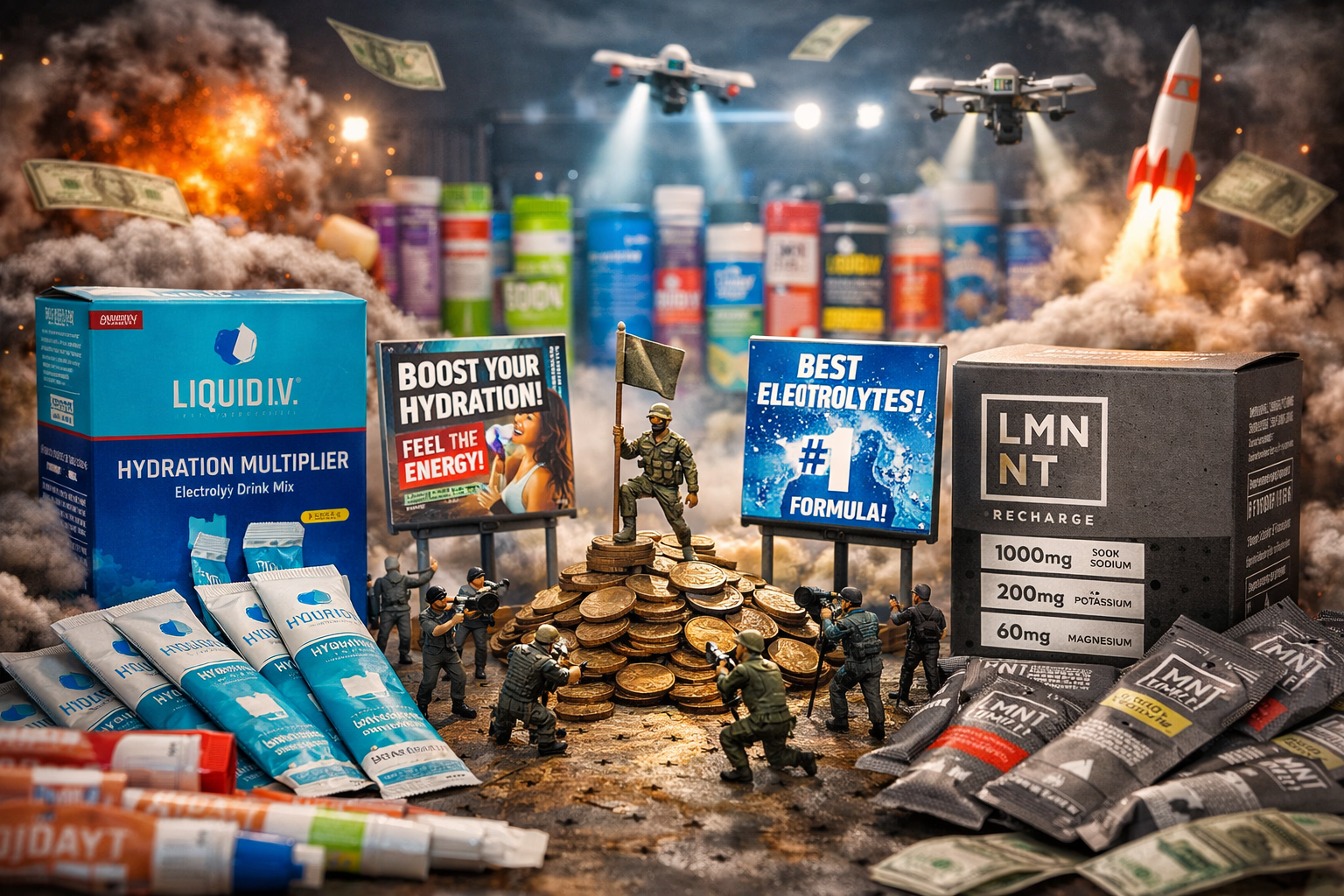
That world is gone. What replaced it is one of the most dynamic, crowded, and marketing-dependent product categories in all of consumer health. The hydration market — electrolyte packets, hydration multipliers, functional water enhancers, and everything adjacent — has exploded into a space where hundreds of brands are fighting for the same consumer, the same shelf space, the same Amazon search results, and the same social media moment. Liquid IV turned electrolyte packets into a lifestyle brand and got acquired by Unilever for a reported billion dollars. LMNT built a cult following among the keto and carnivore communities by going against conventional wisdom on sodium content. DripDrop carved out a serious position in medical and clinical hydration. Nuun quietly built one of the most loyal communities in endurance sports. Hydrant, Cure, Pedialyte Sport, Electrolit, and dozens of others are all competing for the same consumer attention and retail placement.
In a market like this, the product is necessary but not sufficient. The marketing is everything. And the brands that understand that — and find the right partners to execute on it — are the ones that scale. The ones that don't are the ones that have a great formula, decent packaging, and no one who knows they exist.
Understanding What the Hydration Market Actually Is in 2026
Before you can market effectively in this space, you have to understand what you're actually competing in — because the hydration market is not one market. It's four or five distinct consumer segments that happen to buy similar products for very different reasons.
The performance and athletic segment is the oldest and most established. These are runners, cyclists, CrossFit athletes, endurance competitors, and gym regulars who think about hydration as part of their training protocol. They read labels. They care about electrolyte ratios. They have strong opinions about sucralose vs. stevia vs. no sweetener. They are loyal to brands that speak their language authentically and deeply skeptical of brands that don't. Nuun and LMNT own significant mindshare here. Competing in this segment requires credibility, not just visibility.
The wellness and lifestyle segment is the fastest growing and the most influenced by social media. These are consumers who don't think of themselves as athletes but have absorbed enough wellness content to care about hydration, gut health, and what they put in their bodies. They bought Liquid IV because they saw it on TikTok or because it was in their Costco cart next to their vitamin C gummies. They're motivated by convenience, by aesthetics, by the feeling of doing something good for themselves. They're also the most fickle segment — they'll try a new brand the moment the algorithm serves them something more compelling than what they're currently using.
The functional health segment is where medical credibility matters most. DripDrop built its position here. This is the consumer who is recovering from illness, managing a chronic condition, or has been specifically told by a healthcare provider to focus on hydration and electrolyte intake. Clinical language, medical partnerships, and evidence-based messaging carry weight in this segment in a way they don't in lifestyle marketing. Getting this segment wrong — sounding too clinical for a lifestyle audience or too casual for a medical one — is a marketing problem that tanks otherwise strong products.
The hangover and recovery segment is real, growing, and underserved by marketing that takes it seriously. Pedialyte accidentally stumbled into this segment years ago when adults started using a children's rehydration product for post-drinking recovery and the brand eventually leaned into it. There are now brands built specifically for this occasion — Morning Recovery, Drinkwel, and others — but the marketing in this segment often either leans too hard into the party angle or is too embarrassed about the use case to market it directly. The brand that figures out how to speak to this consumer with the same sophistication that, say, a premium alcohol brand speaks to its audience will have a significant market opportunity.
The kids and family segment is dominated by legacy brands but increasingly disrupted by better-for-you alternatives targeting parents who don't want to give their kids artificially colored sports drinks. This segment is driven heavily by pediatrician recommendations, school and sports program partnerships, and parent community word of mouth.
Understanding which segment or segments you're competing in is the foundational marketing decision for any hydration brand. Get it wrong and every dollar you spend is working against you, because you're talking to a consumer who isn't yours or sending a message that doesn't resonate with the one who is.
The Liquid IV Playbook and Why Everyone Is Trying to Copy It
Liquid IV is the most instructive case study in the hydration market because it demonstrates exactly how a commodity-adjacent product — flavored electrolyte powder — becomes a billion-dollar brand. The formula isn't proprietary. The ingredients aren't magic. The differentiation is almost entirely marketing.
What Liquid IV did right:
They owned a specific claim. Cellular Transport Technology. It doesn't matter whether every nutritionist agrees with the framing — what matters is that it gave consumers a reason to believe the product did something specific and different. In a category full of "electrolytes and hydration," having a named mechanism of action created a perception of superiority that commanded a premium price and justified the purchase.
They built a lifestyle identity, not just a product. The Liquid IV aesthetic — the bright packaging, the active lifestyle imagery, the association with travel, hustle, and taking care of yourself — was aspirational in a way that a commodity supplement brand is not. People carried the packets visibly. They photographed them. They recommended them. The product became a signal about the kind of person you were, which is the highest form of consumer brand equity.
They executed influencer and affiliate marketing before it was standard practice in the category. Liquid IV's early growth was driven heavily by influencer seeding, affiliate codes, and the kind of organic word-of-mouth amplification that comes from getting a product into the hands of people with engaged audiences. By the time competitors noticed the strategy, Liquid IV had already built the brand recognition that made its influencer marketing reinforce something already known rather than introduce something new.
They cracked the Costco and mass retail code. Getting into Costco is a brand credibility signal that changes how consumers perceive a product. It says the brand has been vetted, that the quality meets a standard, and that enough people are buying it to justify bulk packaging. For Liquid IV, Costco placement was a growth accelerator that compressed what might have been years of brand building into a much shorter timeline.
The brands trying to copy this playbook — and there are many — are learning that copying the tactics without the underlying brand clarity doesn't work. You can seed influencers, run a Costco pitch, and put CTT on your packaging, but if your brand doesn't have a coherent identity, a genuine point of view, and a consumer who recognizes themselves in your marketing, none of those tactics generate the compounding returns that made Liquid IV what it became.
What LMNT Did Differently and Why It Worked
LMNT is the most interesting counter-example to the Liquid IV playbook because it succeeded by doing almost everything differently and being aggressively opinionated in a way that consumer brands rarely are.
LMNT was built on a thesis that mainstream nutrition advice about sodium was wrong — that active, low-carb, and ketogenic consumers were chronically under-salting themselves, and that the electrolyte products built around conventional wisdom were making the problem worse by including too little sodium and too much sugar. This is a genuinely controversial position in nutrition science. LMNT didn't soften it. They led with it.
This created a brand with a specific, passionate, defensible audience. LMNT found its people in the keto, carnivore, and performance communities — people who were already skeptical of mainstream nutrition advice, already predisposed to trust contrarian positions backed by data, and already embedded in communities where a trusted recommendation travels fast. LMNT partnered with Robb Wolf, a figure with deep credibility in exactly these communities, and built from there.
The lessons from LMNT for any hydration brand are about the power of genuine positioning. LMNT didn't try to be for everyone. They tried to be the obvious choice for a specific someone, and they executed that positioning with enough consistency and conviction that it compounded into a brand that commands extraordinary loyalty and charges a significant price premium in a category full of cheaper alternatives.
Most hydration brands are too afraid to do this. They want the CrossFit athlete and the wellness mom and the hangover recovery customer and the youth sports parent all at the same time, which means their marketing speaks to no one in particular with any real resonance. LMNT's willingness to alienate people who weren't their customer in order to be unmistakably relevant to the people who were is one of the most important marketing lessons the category has produced.
Why the Hydration Market Is a Marketing-First Category
There is a question worth asking directly: does the product actually matter in this category?
The honest answer is yes, up to a threshold, and no, beyond it. The product has to work. It has to taste acceptable. It has to be safe, credibly formulated, and do what it says it does. Below that threshold, no amount of marketing saves you — consumers who try a product that doesn't deliver don't come back and don't recommend it.
But above that threshold — and most legitimate hydration products operating at scale are above it — the product itself is not the differentiating factor. The electrolyte ratios between competing premium products are not so dramatically different that a consumer can feel the difference. The functional outcomes of a well-formulated hydration product are roughly similar across brands in the same tier. The consumer choosing between Liquid IV, LMNT, Nuun, and Hydrant in a moment of purchase decision is not making a biochemistry decision. They're making a brand decision. And brand decisions are marketing decisions.
This is what makes the hydration market so interesting and so demanding from a marketing perspective. You are selling a product where the emotional and identity-based reasons for purchase consistently outweigh the functional reasons, even though the functional positioning is how most brands try to differentiate. The brands that understand this — that they are in the business of selling belonging, identity, and aspiration alongside electrolytes — are the ones that scale. The ones that think they're just selling the superior electrolyte formula are the ones with great products that nobody knows about.
The Digital Marketing Stack a Hydration Brand Actually Needs
Understanding the market is one thing. Executing on it is another. Here's what a hydration brand's digital marketing infrastructure actually needs to look like to compete in this environment.
Brand foundation before everything else. Before a dollar goes to paid media or influencer partnerships, the brand needs to know exactly who it's for, what it believes, what it sounds like, and what it's not. This isn't a logo exercise. It's a positioning exercise. What is the specific person who is most likely to love this product, and what does that person need to hear to feel seen by the brand? Every downstream marketing decision flows from this, and brands that skip it end up with creative that looks fine but doesn't convert, campaigns that generate impressions but not customers, and influencer partnerships that produce content nobody shares.
A DTC website built to convert, not just to exist. The hydration brand's website is where the brand story and the purchase decision meet. It needs to do both jobs simultaneously and without friction. Product pages need to answer the real questions a skeptical consumer has — what's actually in this, why does the ratio matter, why is this better than what I'm already using — while making the purchase as easy as possible. The subscription mechanic is critical in this category because repeat purchase is where the economics work, and the path from first purchase to subscription needs to be as smooth as the brand can make it. This is a conversion rate optimization problem as much as it is a design problem, and most hydration brands' websites are leaving significant revenue on the table.
Paid social that understands the funnel. Meta and TikTok are the primary acquisition channels for DTC hydration brands, and the creative strategy for each is different. TikTok rewards authentic, native-feeling content — product integrations that feel like organic recommendations, educational content about hydration and electrolytes that happens to feature the brand, humor and relatability that builds brand affinity before it asks for a purchase. Meta rewards creative that is tested rigorously, audience targeting that is refined constantly, and retargeting sequences that bring back the consumer who visited the site but didn't convert. Running these channels without a sophisticated understanding of creative testing, audience segmentation, and funnel stage is how brands spend significant money without getting the return that the channels are capable of producing.
Influencer and creator strategy that's built for the long game. The biggest mistake hydration brands make with influencer marketing is treating it as a media buy rather than a brand building tool. Paying for a single post from a large creator and expecting it to move the needle on sales is almost always a disappointment. What works is a systematic approach to creator relationships — identifying micro and mid-tier creators with genuinely engaged audiences in the target segments, building authentic relationships rather than transactional post-for-payment arrangements, giving creators enough creative freedom to integrate the product in ways that feel natural to their audience, and measuring the right outcomes rather than just impressions and reach.
Amazon presence managed as a brand channel, not just a sales channel. For most consumer hydration brands, Amazon is not optional — it's where a significant portion of first and repeat purchases happen regardless of how good the DTC experience is. But Amazon brand management for a premium product is not just listing optimization. It's a full brand expression exercise: A+ content that tells the brand story, a storefront that mirrors the DTC experience, review management that surfaces the brand's best social proof, advertising that protects the brand's own search terms while expanding into adjacent queries. Brands that treat Amazon as an afterthought end up having their customers found by their competitors when they search for a reorder.
SEO and content that builds the brand's authority over time. The hydration consumer does research. They google electrolyte ratios. They look up sodium and athletic performance. They read about cellular hydration and the science behind absorption. The brand that owns these informational queries in search — and increasingly in AI-generated search results — is building a distribution channel that compounds over time and doesn't shut off when the ad spend stops. Content marketing in the hydration category is an under-invested channel relative to its long-term value, and the brands that start building it now will have a significant advantage in two to three years over the ones that are still entirely dependent on paid acquisition.
Email and SMS that drives repeat purchase. Acquisition is expensive. Retention is where the hydration brand's economics actually work. The consumer who buys once and doesn't come back is an acquisition cost with no payoff. The consumer who subscribes or buys monthly for two years is the entire business model. Email and SMS flows — post-purchase sequences, subscription upgrade offers, win-back campaigns for lapsed customers, educational content that reinforces the brand's positioning while keeping the customer engaged — are the infrastructure that turns a DTC business with interesting acquisition numbers into a DTC business with interesting unit economics.
Where Most Hydration Brand Marketing Falls Apart
Having worked across consumer health and DTC brands, the failure patterns in this category are consistent enough to be worth naming directly.
Founder-led positioning that doesn't translate to consumer-facing messaging. A lot of hydration brands were started by founders who are deeply passionate about the science — the electrolyte ratios, the absorption research, the formulation philosophy. That passion is real and it should inform the brand. But translated directly into consumer-facing marketing, it often produces messaging that sounds like a nutrition paper rather than a brand. The founder knows why the sodium-to-potassium ratio matters. The consumer needs to feel why it matters for them specifically in their life. Bridging that gap is a marketing problem, not a product problem, and it requires a partner who can listen to the founder's story and translate it into language that resonates with someone who isn't already sold.
Creative that looks like everyone else in the category. The hydration category has developed a visual language — bright colors, active lifestyle imagery, clean ingredient callouts, someone sweaty and athletic looking satisfied after a workout. It works in the sense that it communicates category membership immediately. It fails in the sense that it doesn't differentiate. When every brand looks roughly similar at a glance, the consumer defaults to price, to the brand they've heard of, or to whatever Amazon is surfacing at the top of the results. Standing out visually and tonally in a crowded category requires creative courage that most brand teams and most agencies don't push hard enough for.
Treating paid acquisition as the entire marketing strategy. Paid social and search can build a hydration brand to a certain scale. They cannot build one to enduring scale on their own, because they stop the moment the spend stops and they get more expensive over time as the category gets more competitive. The brands that will own this market in five years are the ones building brand equity through content, community, earned media, retail relationships, and category authority in addition to paid channels. That takes longer and the returns aren't immediate, which is why so many brands don't do it — but the ones that do end up in a position where the paid channels work better and cost less because the brand is doing some of the work for them.
Underinvesting in retention infrastructure. Acquiring a new hydration customer costs real money. Keeping them is dramatically cheaper and dramatically more valuable. But most hydration brands spend the vast majority of their marketing budget on acquisition and a fraction on retention. Post-purchase email sequences, subscription programs, loyalty mechanics, win-back campaigns — these are not glamorous marketing investments. They are frequently the highest ROI ones. The brand that figures out how to keep its customers buying for longer wins the economics of the category regardless of acquisition cost.
Where Ritner Digital Fits in the Hydration Market
We are not a beverage-specific agency. We are a full-service digital marketing partner that works across industries, and that breadth is part of what makes us valuable to a hydration brand rather than a limitation.
The agencies that specialize exclusively in CPG and beverage bring deep category knowledge and existing relationships. What they sometimes lack is the ability to see the brand's marketing challenges through a lens that isn't already shaped by how the category has always operated. When you've only ever worked on hydration brands, you have a very good sense of what the category does. You have a less fresh perspective on what it could do differently.
We bring the full digital marketing stack — brand strategy and positioning, website design and conversion optimization, SEO and content strategy, paid social and search, email and SMS, influencer strategy, Amazon brand management — and we apply it to the specific challenges of a brand competing in a crowded consumer health market with the same rigor and strategic thinking we'd bring to a B2B software company or a regional healthcare system.
For a hydration brand specifically, here is what that looks like in practice:
We start with positioning before tactics. If we don't know exactly who you're for and what you believe, we will not recommend a single marketing channel or spend a single dollar until we do. The positioning work is the foundation and it has to be right.
We build for conversion, not just for traffic. Every piece of digital infrastructure we build — the website, the landing pages, the email flows, the paid creative — is built with a specific conversion outcome in mind. Beautiful marketing that doesn't move people toward purchase is expensive brand art. We build marketing that works.
We think about the full funnel simultaneously. Acquisition without retention is a treadmill. Brand building without performance marketing is slow. SEO without paid support takes too long to matter at the scale you need. We manage the entire funnel as a connected system rather than as a collection of independent channels, which is how the compounding returns actually happen.
We measure the right things. Impressions are not sales. Followers are not customers. We build reporting infrastructure that connects marketing activity to business outcomes, so you always know what's working, what isn't, and where the next dollar should go.
The Brands That Will Win This Market
The hydration market is not going to get less crowded. The functional beverage space broadly is attracting capital, attracting founders, and attracting consumer attention at a rate that is producing new competitors faster than the market is consolidating old ones. The barriers to formulation are low. The barriers to manufacturing are lower than they used to be. The barriers to DTC distribution are essentially zero.
The only durable barrier to entry in this market is brand. And brand is built through marketing — through the consistency of the message, the quality of the creative, the intelligence of the channel strategy, and the depth of the customer relationships that the brand builds over time.
The brands that win the hydration market in the next five years will not necessarily have the best formula. They will have the clearest positioning, the most compelling creative, the most efficient acquisition infrastructure, the strongest retention economics, and the most coherent brand experience across every touchpoint where a consumer encounters them. Those are marketing advantages. They are built intentionally. And they require a partner who understands both the strategic and the executional dimensions of what it takes to build them.
That is what Ritner Digital does. For hydration brands ready to compete seriously in one of the most marketing-dependent categories in consumer health, we are the partner built for that work.
If you're building or scaling a hydration brand and want to talk through where your marketing infrastructure needs to go, reach out. We're happy to start with a conversation.
Frequently Asked Questions
Why is marketing so important in the hydration category specifically?
Because above a basic quality threshold, the product itself is not the differentiating factor. The electrolyte ratios between competing premium hydration products are not dramatically different enough that a consumer can feel the distinction. The functional outcomes of well-formulated products in the same tier are roughly comparable. What separates the brands consumers choose, recommend, and stay loyal to is not the formula — it's the brand identity, the community, the story, and the consistency of the marketing. Liquid IV is worth a billion dollars not because it invented electrolytes but because it built a brand that made people feel something about a flavored powder packet. That is a marketing achievement, not a formulation achievement.
What makes the hydration market so competitive right now?
Three things converging simultaneously. First, the barriers to entry are lower than they've ever been — formulation, manufacturing, and DTC distribution are all accessible to founders without nine-figure budgets in a way they weren't a decade ago. Second, consumer interest in functional health and wellness has created genuine demand that didn't exist at this scale before. Third, the success of brands like Liquid IV and LMNT demonstrated that the category could produce outsized returns, which attracted capital and new entrants rapidly. The result is a market where the consumer has more choices than they can meaningfully evaluate, which means brand recognition and marketing quality are doing more of the purchase decision work than ever.
What are the main consumer segments in the hydration market?
The market is really four or five distinct segments that happen to buy similar products for very different reasons. The performance and athletic segment cares about electrolyte science and brand credibility in sports communities. The wellness and lifestyle segment is driven by social media influence, aesthetics, and the aspiration of taking care of themselves. The functional health segment responds to medical credibility and clinical positioning. The hangover and recovery segment is real and growing but largely underserved by sophisticated marketing. The kids and family segment is driven by parental trust signals and pediatrician recommendations. Understanding which segment you're competing in — and speaking to that consumer specifically rather than trying to reach all of them at once — is the foundational marketing decision every hydration brand has to make.
What did Liquid IV do right from a marketing perspective?
Several things simultaneously and consistently. They owned a specific proprietary claim with Cellular Transport Technology that gave consumers a reason to believe the product did something distinct, regardless of how nutrition scientists felt about the framing. They built a lifestyle identity rather than just a product identity, making the brand a signal about the kind of person you were rather than just something you drank. They executed influencer and affiliate marketing early and aggressively before it became standard practice in the category. And they cracked mass retail placement through Costco, which compressed years of brand building into a much shorter timeline by giving the brand a credibility signal that DTC alone cannot provide. The lesson isn't to copy the tactics — it's to understand that every one of those moves was downstream of very clear brand positioning.
What did LMNT do differently and why did it work?
LMNT succeeded by being aggressively opinionated in a way that consumer brands rarely are. They built on a specific thesis — that conventional nutrition advice about sodium was wrong and that active and low-carb consumers were chronically under-salting themselves — and they led with it rather than softening it. This created a brand with a passionate, specific, defensible audience in the keto and performance communities who were already predisposed to trust contrarian positions backed by data. The lesson from LMNT is that genuine positioning — being willing to alienate people who aren't your customer in order to be unmistakably relevant to the ones who are — is one of the most powerful things a brand can do. Most hydration brands are too afraid to take that kind of stand. LMNT proved that the fear is misplaced.
What does a hydration brand's digital marketing stack actually need to include?
At minimum: a brand positioning foundation that knows exactly who the product is for and what it believes. A DTC website built for conversion with a clear path from first visit to subscription. Paid social on Meta and TikTok with creative that is tested rigorously and audience targeting that is refined continuously. An influencer and creator strategy built around authentic relationships with engaged communities rather than transactional single-post arrangements. An Amazon presence managed as a brand channel with optimized listings, A+ content, and a storefront that mirrors the DTC experience. SEO and content that builds category authority and compounds over time. And email and SMS retention infrastructure that turns first-time buyers into long-term subscribers. Missing any one of these creates a hole in the funnel that the others can't fully compensate for.
Why is retention so important for hydration brands specifically?
Because the unit economics only work at scale if customers keep buying. Acquiring a new hydration customer through paid social or influencer marketing costs real money — often more than the margin on the first purchase. The business model only becomes profitable when that customer buys again, and again, and ideally subscribes. A brand with strong acquisition numbers and weak retention is essentially running a very expensive sampling program. The brands with sustainable economics are the ones where the post-purchase experience — the email flows, the subscription program, the loyalty mechanics, the educational content that keeps the customer engaged with the brand between purchases — is as well-built as the acquisition infrastructure.
How should hydration brands think about influencer marketing?
As brand building first and direct response second. The biggest mistake brands in this category make is treating influencer marketing as a media buy — paying for a post and expecting it to drive measurable sales immediately. That occasionally works for a large creator with an unusually engaged audience, but it's not a reliable or scalable strategy. What works consistently is a systematic approach to creator relationships: identifying micro and mid-tier creators with genuinely engaged audiences in your target segment, building authentic relationships rather than purely transactional arrangements, giving creators enough creative freedom to integrate the product in ways that feel natural rather than scripted, and measuring brand awareness and sentiment alongside conversion metrics. The compounding effect of consistent creator relationships over time is what produces the kind of organic word-of-mouth that Liquid IV benefited from in its early growth phase.
Is Amazon important for hydration brands even if they have a strong DTC presence?
Yes, and underestimating it is a mistake many DTC-first brands make. A significant portion of hydration purchases happen on Amazon regardless of how good the brand's own website is, because Amazon is where a large segment of the consumer population defaults for repeat purchases of consumable products. More importantly, Amazon is where consumers who discover a brand through social media or word of mouth often go to actually buy it — and if the brand's Amazon presence is weak, that consumer will find a competitor in the search results before they find the brand they were looking for. Amazon brand management for a premium hydration product means optimized listings, A+ content that tells the brand story, a storefront that mirrors the DTC experience, active review management, and advertising that protects branded search terms while expanding into category queries.
Why do so many hydration brands struggle with their website conversion rates?
Usually because the website was built to showcase the product rather than to convert a skeptical consumer. There is a significant difference between a website that looks beautiful and communicates brand values and a website that actually answers the questions a first-time visitor has — what's in this, why does the ratio matter, why is this better than what I'm already using, what do other people who tried it think — while making the purchase decision as easy as possible. Most hydration brand websites over-invest in aesthetics and under-invest in the persuasion architecture: the social proof placement, the subscription value proposition, the objection handling, the mobile experience, and the post-click flow from paid ad to purchase. These are conversion rate optimization problems and fixing them is frequently the highest ROI marketing investment a growing brand can make.
How does SEO and content marketing fit into a hydration brand's strategy?
It fits as the long-term distribution channel that everything else is building toward. The hydration consumer does research — they google electrolyte ratios, they look up sodium and athletic performance, they read about hydration science and what actually makes a product effective. The brand that owns those informational search queries, and increasingly those AI-generated search results, is building an acquisition channel that compounds over time and doesn't shut off when the ad spend stops. Content marketing in the hydration category is chronically underinvested relative to its long-term value, because the returns are slower and less immediately attributable than paid channels. The brands that start building content authority now will have a meaningful competitive advantage in three to five years over brands that remained entirely dependent on paid acquisition throughout that period.
What's the biggest creative mistake hydration brands make?
Looking exactly like every other brand in the category. The hydration space has developed a visual and tonal language — bright colors, active lifestyle imagery, clean ingredient callouts, someone athletic looking satisfied after exertion — that communicates category membership immediately but differentiates nothing. When every brand looks roughly similar at a glance the consumer defaults to price, to name recognition, or to whatever the algorithm is surfacing at the top of the results. The brands that break through visually and tonally — that have a genuine point of view expressed through creative that feels distinct from the category default — earn attention in a way that the category-standard playbook no longer does. This requires creative courage, which means being willing to look different enough that it feels risky, because anything that doesn't feel at least slightly risky in a crowded category probably isn't differentiated enough.
Why should a hydration brand work with Ritner Digital specifically?
Because we bring the full strategic and executional stack — brand positioning, website and conversion optimization, paid social and search, SEO and content, email and SMS, influencer strategy, Amazon brand management — and we apply it as a connected system rather than as a collection of independent channels. We don't specialize exclusively in beverage or CPG, which means we bring a perspective that isn't already shaped by how the category has always operated. And we start with positioning before tactics, which means every dollar we spend in every channel is working in the same direction rather than pulling against itself. For a hydration brand competing in one of the most marketing-dependent consumer categories in the market, that integrated approach is the difference between campaigns that produce results and campaigns that produce activity.
What does working with Ritner Digital on a hydration brand actually look like?
It starts with a deep positioning engagement — understanding the product, the founder's vision, the target consumer, the competitive landscape, and where the genuine differentiation lives. From there we build or audit the digital infrastructure: website, email flows, paid channel accounts, content strategy, Amazon presence. Then we execute and optimize across channels simultaneously, with reporting that connects activity to business outcomes so the strategy can be refined continuously based on what the data is actually showing. We work as a true partner rather than a vendor, which means we're in the business strategy conversations, not just the marketing execution conversations. For a brand at the stage where marketing is the primary growth lever, that kind of partnership is what moves the numbers.
Is the hydration market still a good market to enter in 2026?
Yes, with clear eyes about what it takes to compete. The market is crowded and getting more crowded, which means the days of winning purely on product quality or DTC channel execution are over. But the consumer demand is real, growing, and not going away — functional health and wellness as a category is a generational shift in how consumers think about what they put in their bodies, not a trend that will reverse. The brands that enter the market now with a genuinely differentiated position, a well-built digital marketing infrastructure, and a realistic plan for building brand equity over time — not just optimizing acquisition metrics in the short term — have a real opportunity. The ones that enter with a great formula and no marketing strategy will find out quickly that the formula was the easy part.