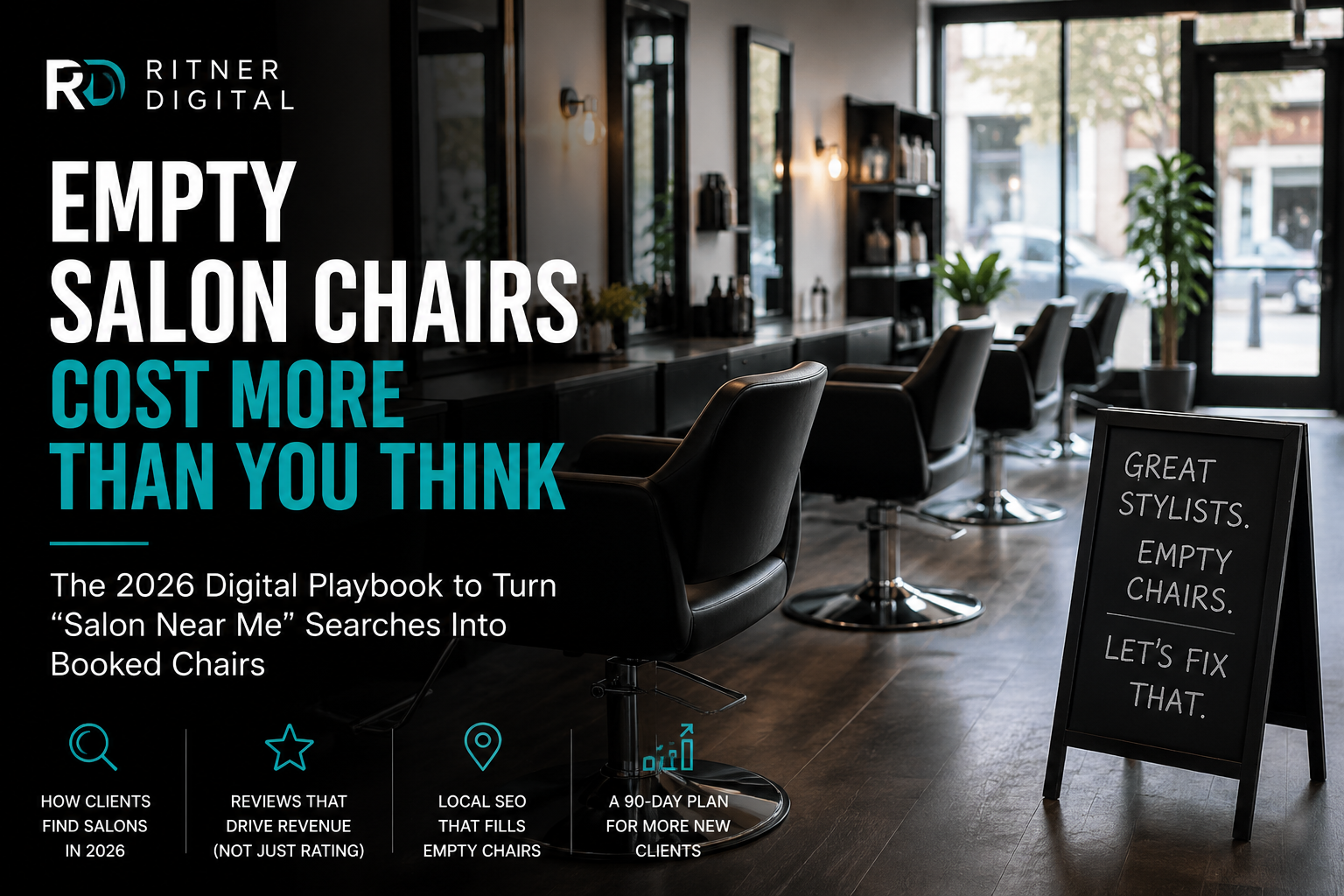
There is a moment that plays out thousands of times a day across South Jersey. Someone pulls out their phone, types "hair salon near me" or "best balayage in [their town]," and within about eight seconds decides where they're going to spend their next $80, $150, or $300. They don't flip through a phonebook. They don't ask a neighbor. They look at a small cluster of businesses Google shows them, glance at the star ratings, skim a few recent reviews, and tap "call" or "book."
That moment is the entire ballgame. And for a lot of talented salons, it's a game they're losing before their stylists ever pick up a pair of shears.
The uncomfortable truth is that skill behind the chair and visibility in front of the customer are two completely different competitions. You can have the best colorists in the county, spotless stations, and a loyal client base built over decades, and still watch new clients walk into a less-talented competitor down the road simply because that competitor showed up first when it mattered. As one industry guide put it bluntly, that gap between talent and visibility costs the average salon thousands in lost bookings every month. theStacc
This post is about closing that gap. It's written for salon owners, especially those running multiple locations, who know their craft cold but suspect their digital presence isn't pulling its weight. Let's get into the numbers, the mistakes, and the concrete moves that turn online searches into booked appointments.
The Search Behavior That Decides Your Month
Start with how people actually find salons now, because the data is stark. According to BIA/Kelsey research, 97% of people search online before choosing a local business. If your salon isn't showing up in search results, you're invisible to most potential clients. Zoca
Being invisible isn't a slow leak. It's an immediate loss, because local searchers act fast. Google's own data shows that 76% of people who search for a local business on their phone visit that business within 24 hours. For a salon, that visit usually means a booked appointment. Every day you're not visible is a day those ready-to-book clients are handed to whoever ranks above you. Rework
And position matters enormously. 69% of people will click on one of the top 3 search results. If your salon is sitting on page two, the practical reality is harsh: to the vast majority of searchers, you effectively don't exist. Salons that land in Google's local "map pack" — that top cluster of three businesses with the map — capture the lion's share of attention. Industry data indicates salons in the Google map pack receive 70% of the click-through traffic from local beauty searches. The Salon BusinessRework
Here's why this should feel urgent rather than academic. Most salon owners lean on Instagram and word-of-mouth referrals. Both are real, and both matter. But as one 2026 salon SEO guide pointed out, neither one scales: referrals depend on your current clients remembering to mention you. Instagram depends on an algorithm you do not control. Search, by contrast, delivers clients who are already searching for your exact services in your exact area. That is the highest-intent traffic a salon can get. theStacctheStacc
That last point is the whole argument in one sentence. Nobody types "keratin treatment near me" out of idle curiosity. They type it because they want a keratin treatment, soon, near them. Showing up for that search isn't marketing in the vague brand-awareness sense — it's putting your business directly in front of a person with a credit card already halfway out of their wallet.
The Market Is Huge, Growing, and Brutally Crowded
If you're going to invest in visibility, it helps to understand the field you're competing on.
The U.S. hair and nail salon market is enormous. Recent industry figures put hair and nail revenue at $90.4B in 2024, edging to $90.9B in 2025 — a huge, fragmented, and growing market where access often beats price. The broader U.S. salon industry has been projected to reach $69.9 billion by 2025. BoulevardSEO Sandwitch
But "growing" doesn't mean "easy." That same market data counts roughly 1,051,796 hair salons and 1,398,250 hair & nail salons in the U.S. in 2024. Over a million salons are chasing the same local clients. The competition isn't national — it's the three or four other salons within a ten-minute drive of each of your locations. Boulevard
And here's the opening. Despite how much discovery has moved online, most salons still aren't playing the game well. Industry surveys suggest only 38% of salons have an active SEO strategy, and that 45% of beauty professionals lack basic SEO knowledge. Meanwhile, 62% of salon businesses plan to increase SEO budgets in the next 12 months. Translation: the smart money is moving into this space right now, and the salons that move first in their local market grab ground that's expensive to take back later. The ones that treat digital as an afterthought are the ones whose chairs sit empty between 2 and 4 p.m. SEO Sandwitch + 2
Your Reviews Are Your Storefront Now
Before a new client sees your beautiful renovation, your product wall, or a single before-and-after photo, they see a number: your star rating. It has quietly become the single most powerful filter in the entire customer journey.
The behavior data here is overwhelming. In 2026, 94% of customers rely on reviews when selecting a new salon, and 88% read reviews before booking a service. With 74% of salon guests using Google Search to find a provider, a salon's star rating is often the first impression a potential client receives before seeing a single photo, reading a service menu, or visiting the website. Voted Number one
And clients are ruthless about it. A significant share of potential clients — by one estimate 88% — will skip a salon with less than a 4-star rating on Google. Ratings don't just influence the click; they influence whether Google shows you at all, since reviews and ratings are a known local ranking input worth roughly 10% of local ranking weight. Clicks GeekShapo
Now here's where it gets financially concrete, and where a lot of owners underestimate the stakes. Star ratings map almost directly onto revenue. According to 2026 benchmark data, a 0.5-star increase in Google rating correlates with a 5 to 9% increase in salon revenue. For a salon generating $325,000 annually, moving from 4.2 to 4.7 stars represents an estimated $16,000 to $29,000 in additional annual revenue. Voted Number one
Read that again, then multiply it across four locations. A half-star improvement isn't a vanity metric. It's potentially six figures a year across a small group of salons.
Two more findings make reputation management feel less like a chore and more like an obvious win. First, engagement pays: salons that actively manage their reviews see 26% higher booking rates compared to those that do not engage with customer feedback. Second, and this is the opportunity hiding in plain sight, 52% of salons never respond to negative reviews, representing the single largest missed opportunity in the industry. Voted Number oneVoted Number one
Half your competitors are letting negative reviews sit unanswered. Simply responding — professionally, promptly, without defensiveness — puts you ahead of them in the eyes of both Google and every prospective client reading along.
One nuance that trips salons up: recency matters as much as volume. 73% of consumers only trust reviews from the last 30 days. Fifty glowing reviews from 2021 do less for you than five from this month. As one 2026 setup guide put it, 5 reviews this month signals more activity than 50 from two years ago. The move is to build a steady drip — aiming for something like 2 to 4 new reviews per month consistently — rather than one big burst that goes stale. Shapo + 2
The Google Business Profile Is the Highest-ROI Real Estate You Own (For Free)
If reviews are the filter, your Google Business Profile (GBP) is the storefront they attach to. It's free, it ranks for the exact high-intent searches you want, and it converts extraordinarily well because the people looking at it are actively trying to book right now.
The problem, as one 2026 GBP guide observed, is that most salon owners set up their Google Business Profile once, forget about it, and wonder why they're not ranking. The salons that dominate local search treat it as an active marketing channel, updating it weekly, posting content, managing reviews, and monitoring which searches are driving traffic. Rework
The gap between a neglected profile and an active one is not subtle. Consider photos, which are the most underused lever most salons have. Listings with robust photo libraries dramatically outperform bare ones: profiles with more than 100 photos receive 520% more calls than those with fewer than 10 photos. Your team's before-and-afters, your space, your happy clients — that content isn't decoration, it's a conversion engine. Rework
Then there's the friction between "I found this salon" and "I booked." Every extra tap loses people. Integrating online booking directly into the profile — so a "Book" or "Reserve" button appears right there — collapses that path. Supported booking integrations as of 2026 include Fresha, Booksy, Square Appointments, Vagaro, and others, and one salon reportedly increased bookings by 30 percent through seamless GBP integration. ReworkDietz Group
A well-optimized profile isn't complicated, but it does require attention to the fields that carry weight. The highest-impact ones, per current guidance, are your business name matching your signage, categories (a primary plus two secondary), service area, hours, photos, services with prices, and your website URL. Leaving fields blank — even ones that feel optional, like the business description — leaves ranking signals on the table. The Local Gem
For a multi-location salon group, there's a particular landmine here worth naming: NAP consistency, meaning your Name, Address, and Phone number formatted identically everywhere online. When you run four locations, each with its own listings across Google, Yelp, Facebook, and various directories, inconsistencies multiply fast. And they cost you. Industry data indicates inconsistent NAP information is responsible for a meaningful share of local ranking problems, with one analysis attributing over 40 percent of certain ranking issues to it. A phone number that reads one way on Yelp and another on Google, an old address format lingering on a directory — these quietly suppress your rankings across every location. Dietz Group
Speed, Mobile, and the Website That Actually Closes
Your website is where a good chunk of the final decision happens, and in 2026 the technical basics are non-negotiable — especially because your prospective client is almost certainly on a phone.
Two realities drive this. First, mobile dominates: mobile devices generated nearly 59% of global web traffic in the last quarter of 2023, and salon searches skew even more heavily mobile because they're so often "near me" and on-the-go. Second, patience is nonexistent. A one-second delay in load time can cause a 7% drop in conversions. For a salon, as one guide framed it, a slow website is the fastest way to lose a new client. Ronkot + 2
Salons face a specific trap here: they're image-heavy by nature. All those gorgeous transformation photos, if left as massive unoptimized files, can drag load times into the danger zone. The fix is straightforward — compress images, use a genuinely mobile-first design, make sure nobody has to pinch and zoom to read your prices or find your booking button. As one 2025 salon SEO resource put it, if a visitor has to pinch and zoom, you've already created a frustrating experience. Clicks Geek
There's also a lingering myth worth killing, since some owners still wonder whether a Facebook or Instagram page is enough on its own. The current consensus is clear: you absolutely need a website to build good visibility in search engines like Google, Yelp, ChatGPT, and other AI tools in 2025 and beyond. Your social profiles rent space on someone else's platform. Your website is the one piece of digital property you actually own — and increasingly, it's what AI-powered search tools read to decide whether to recommend you. The Salon Business
Why This Pays: The Economics of Getting Found
Let's tie the numbers together, because the case for investing here isn't a leap of faith — it's arithmetic.
Search traffic converts better than almost anything else you can buy. SEO leads have a 14.6% close rate, dramatically higher than cold outbound methods, because you're reaching people at the exact moment of intent. The reported average return on SEO investment in the beauty industry specifically has been cited at 275%. And the compounding effect is real: salons with dedicated SEO management grow roughly 2x faster in client acquisition, while 83% of top-performing salon websites invest in ongoing SEO updates. SEO Sandwitch + 3
Notice the word "ongoing." This is the part that separates salons that pull ahead from salons that plateau. Digital visibility isn't a one-time project you check off. Rankings shift, competitors invest, Google changes its rules, and reviews go stale in 30 days. The salons winning their local market are the ones treating this as a living system — fresh reviews every month, weekly profile activity, current photos, consistent listings, a fast site. The good news is that most of your competition isn't doing it, which is precisely why the door is open.
What This Looks Like in Practice
Pulling it all together, here's the honest shape of a plan that actually moves bookings for a multi-location salon:
Own the map pack in every town you serve. Each location needs its own fully optimized, actively managed Google Business Profile — not one central listing, but a distinct, complete presence for every neighborhood you want clients from. That means location-specific pages on your website too, so you rank for "hair salon in [each town]" rather than blending into a single generic listing.
Build review velocity, not just a review pile. Put a simple system in place to ask happy clients at the right moment — right after a compliment, before they leave the chair — and keep a steady flow of fresh reviews coming in across every location. Then respond to all of them, especially the critical ones, since half your competitors won't.
Fix the invisible stuff. Audit NAP consistency across every directory for every location. Compress your images. Make sure every site is fast and genuinely mobile-first. Put a booking button everywhere a client might look, and remove every unnecessary tap between "found you" and "booked."
Treat it as ongoing, not one-and-done. Weekly profile activity, monthly review goals, fresh photos, and regular check-ins on which searches are actually driving calls. Small, consistent inputs compound into a local footprint that's very hard for competitors to dislodge.
None of this replaces the craft behind the chair. It makes sure the people searching for exactly what you're brilliant at can actually find you — and choose you — before they book somewhere else.
The chairs are going to fill up somewhere in your area today. The only question is whether the person searching "best salon near me" finds you at the top, with a stack of glowing recent reviews and a one-tap booking button, or finds the salon down the street instead. That outcome isn't decided by talent. It's decided by visibility. And visibility is something you can win.
Ready to Fill the Empty Chairs?
Ritner Digital helps local service businesses turn online searches into booked appointments through local SEO, reputation management, and conversion-focused websites. If empty mid-week chairs and "why aren't we showing up on Google" sound familiar, that's exactly the gap we close.
Let's talk about what your local market looks like and where the fastest wins are hiding. Get in touch with Ritner Digital →
Frequently Asked Questions
How do most new clients find a salon in 2026?
Overwhelmingly through online search. Research indicates 97% of people search online before choosing a local business, and 74% of salon guests use Google Search to find a provider. They typically look at Google's local map pack, scan star ratings and recent reviews, and book — often within a day. In fact, 76% of people who search for a local business on their phone visit that business within 24 hours. Zoca + 2
How much do online reviews actually affect salon bookings?
A lot — reviews have become the primary filter clients use. In 2026, 88% of customers read reviews before booking a service, and roughly 88% will skip a salon with less than a 4-star rating on Google. The financial link is direct: a 0.5-star increase in Google rating correlates with a 5 to 9% increase in salon revenue. Voted Number one + 2
Is a Google Business Profile really worth the effort?
It's arguably the highest-return free asset a salon has. Salons in the Google map pack capture roughly 70% of the click-through traffic from local beauty searches, and profiles with large photo libraries — over 100 photos — reportedly receive 520% more calls than those with fewer than 10. The catch is that it has to be actively managed, not set up once and forgotten. ReworkRework
How many reviews does my salon need, and how often?
Recency matters more than a big one-time pile. Around 73% of consumers only trust reviews from the last 30 days, so a steady flow beats a stale stack — aim for 2 to 4 new reviews per month consistently. Just as important, respond to them: 52% of salons never respond to negative reviews, which is a wide-open opportunity to stand out. Shapo + 2
Do I really need a website if I have Instagram and Facebook?
Yes. The current consensus is that you absolutely need a website to build good visibility in search engines like Google, Yelp, ChatGPT, and other AI tools in 2025 and beyond. Social profiles rent space on platforms you don't control; your website is the one piece of digital property you own, and it's increasingly what AI-powered search reads to decide whether to recommend you. The Salon Business
What's different about digital marketing for a multi-location salon?
Each location needs its own optimized presence — a distinct Google Business Profile and location-specific website pages — so you rank in every town you serve rather than blending into one generic listing. Multi-location groups also face bigger risks around NAP consistency (identical Name, Address, and Phone formatting everywhere), since inconsistencies multiply across locations and directories, and inconsistent data is tied to over 40 percent of certain local ranking issues. Dietz Group
Is investing in SEO actually profitable for a salon?
The numbers suggest yes. SEO leads have a 14.6% close rate because they reach people at the moment of intent, and the reported average ROI from SEO in the beauty industry is 275%. Salons with dedicated SEO management also grow roughly 2x faster in client acquisition. SEO Sandwitch + 2
Sources