GEO vs. AEO: What's the Difference and What Does Your Business Actually Need?
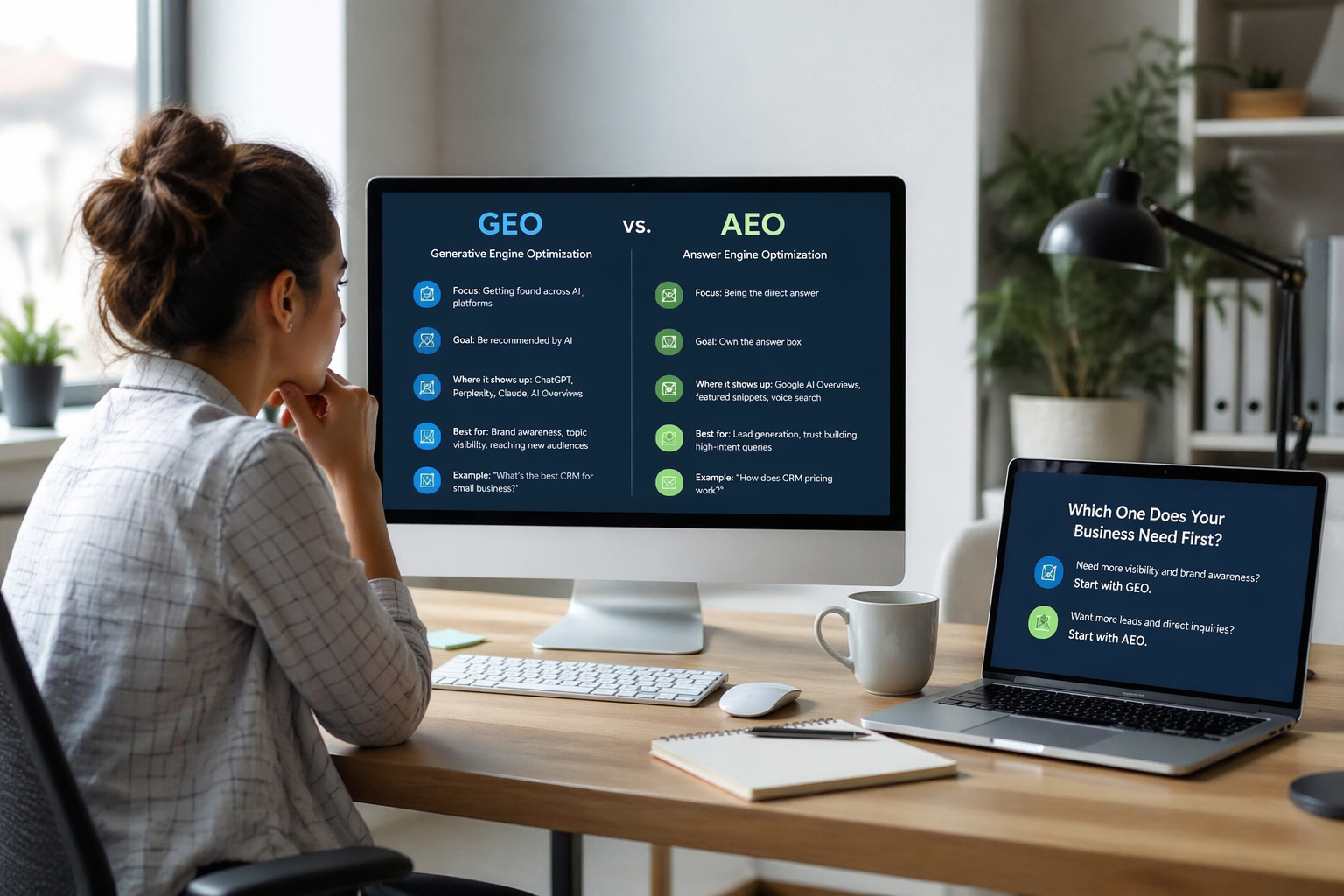
If you've been paying attention to the digital marketing conversation lately, you've almost certainly encountered two acronyms being thrown around with increasing urgency: GEO (Generative Engine Optimization) and AEO (Answer Engine Optimization). Depending on who you're talking to, they're either the same thing, completely different disciplines, or the replacement for SEO as we know it.
The truth is more nuanced — and more actionable — than any of those takes. This guide cuts through the noise, explains what each term actually means, and helps you figure out what your business needs to stay visible in a search landscape that is changing faster than at any point in the last decade.
The Search Landscape Has Already Shifted Under Your Feet
Before the definitions, some context on why this conversation matters right now.
AI tools like ChatGPT, Perplexity, and Google's AI Overviews are changing how search discovery works entirely. Ahrefs found that AI Overviews reduced click-through rates for top-ranking Google content by 58%. Why? Because Google gives users the information they need without requiring them to leave the search page. Jasper
ChatGPT processes 2.5 billion prompts daily, 65% of which qualify as search. Jasper
Nearly a third of the US population will use generative AI search in 2026, according to an EMARKETER forecast, pushing marketers to optimize for platforms like ChatGPT, Google AI Overviews, and Perplexity alongside traditional search engines. eMarketer
This is not a future trend to plan for. It is the current reality. The businesses building visibility strategies that account for AI-driven discovery today are pulling ahead of competitors who are still treating 2019 SEO playbooks as the complete answer.
What Is AEO (Answer Engine Optimization)?
Answer Engine Optimization refers to optimizing content so it gets surfaced in direct-answer systems. The term predates generative AI and originally described optimization for Google's answer boxes, featured snippets, and voice assistants. It now includes optimization for AI products like ChatGPT and Perplexity. Instant Press
Think of AEO as optimizing for the moment when someone asks a specific, pointed question and expects a fast, direct response. Examples of answer-first results most important to small businesses are Google AI Overviews, featured snippets, and knowledge panels. Voice search with Siri and Amazon Alexa is another AEO consideration. CORE Search
AEO is built around the assumption that users want immediate, concise answers rather than just a list of websites. To succeed in AEO, content must directly address common user questions, use clear scannable formatting like lists, tables, and FAQs, and establish authority and credibility especially for topics in the "Your Money, Your Life" category. Nowspeed
In practical terms, AEO is what gets your business selected when someone asks Google Assistant "What's the best immigration attorney near me?" or when a featured snippet answers "How long does a personal injury case take in DC?" with your firm's content — not your competitor's.
What Is GEO (Generative Engine Optimization)?
Generative Engine Optimization aims for a deeper level of influence. It's about optimizing your content to be incorporated, synthesized, and referenced by large language models and generative AI search experiences like Google's AI Overviews. TUYA Digital
GEO is the process of creating comprehensive, authoritative website content so that LLMs cite your website in AI results. Examples of LLM search engines are ChatGPT, Perplexity, Claude, and Grok. CORE Search
Where AEO is about being the direct answer to a specific question, GEO is about being the trusted source an AI draws from when generating a longer, more complex response. When someone asks ChatGPT "What should I look for when hiring a digital marketing agency in Washington DC?" — GEO is what determines whether your business gets named or cited in that response.
The headline takeaway: generative AI products reward content that looks like real, authoritative writing, with citations and data, rather than content optimized for keyword matching. Instant Press
So Are GEO and AEO the Same Thing?
This is where the marketing industry has gotten itself tangled up. The honest answer is: mostly, with meaningful distinctions.
Both GEO and AEO refer to the work of showing up in AI-generated responses, and they're mostly describing the same practice with different labels. But there are subtle differences worth understanding. Instant Press
The clearest way to separate them is by objective and structure. AEO prioritizes the direct answer for specific queries, while GEO focuses on being a foundational citation source for complex generative summaries. Answer optimization relies heavily on schema markup and microdata, whereas generative optimization requires authoritative, entity-dense narrative content. Jeff Pastorius
A useful analogy: GEO is your brand's ambassador in AI conversations. AEO is the briefing document that keeps that ambassador accurate. One governs presence. The other governs precision. Busylike
For most businesses, the practical implication is not choosing one over the other — it's understanding that they require slightly different content approaches and that both are necessary components of a modern visibility strategy.
How Both Differ From Traditional SEO
Traditional SEO is not dead. Let's be direct about that. SEO is still important and impactful, and when it's paired with a strategy for GEO and AEO, marketers can build on what they've already established while optimizing for the AI era. Jasper
But traditional SEO alone is no longer sufficient. According to a March 2026 study, AI Overviews appear in 20% of all Google search results, and AI search is responsible for 34% of monthly website sessions. CORE Search That's a massive and growing share of discovery happening outside the traditional blue-link results your existing SEO strategy was designed to capture.
The strategic difference is this: traditional SEO optimizes for ranking. GEO and AEO optimize for being cited and referenced by AI systems as a trusted source. The mechanics overlap significantly — authoritative content, strong technical foundations, quality backlinks — but the content structure, depth, and framing requirements differ in important ways.
What GEO and AEO Actually Require: The Tactical Picture
Authority and Entity Clarity
AI search visibility is influenced by how clearly your brand is defined as an entity, the quality and structure of your content, your topical authority, your presence across trusted sources, and how well your content aligns with user intent. Busylike
This means your website needs to clearly establish who you are, what you do, where you operate, and who you serve — in language that is consistent across every page, every directory listing, and every external mention of your brand. Vague positioning and generic messaging are not just bad marketing — they are invisible to AI systems trying to categorize and cite your business.
Structured Content and Schema Markup
Research from Princeton University shows that GEO methods can boost visibility by up to 40% in generative engine responses. Meanwhile, AI-friendly content structured with FAQ formats and schema markup significantly increases citation rates across platforms like ChatGPT, Perplexity, and Google's AI systems. Sheai
Schema markup is the technical layer that tells AI systems precisely what your content means — not just what words it contains. LocalBusiness schema, FAQ schema, Service schema, and Review schema all play a role in signaling relevance and authority to both traditional search engines and generative AI platforms.
Depth Over Volume
Big companies lose at AEO because their websites are bloated, unclear, and full of marketing jargon. AI assistants love local clarity more than global complexity. The business with the best answer wins — not the biggest brand. Medium
This is genuinely good news for small and mid-size businesses. You don't need to out-publish a Fortune 500 company. You need to out-answer them on the specific topics your ideal clients are actually searching. One clear, comprehensive, well-structured page on a topic you genuinely own beats ten shallow blog posts optimized for keyword density every time.
E-E-A-T: Experience, Expertise, Authoritativeness, Trustworthiness
Both GEO and AEO reward what Google's guidelines call E-E-A-T. Showcasing industry expertise and experience on your website with employee bios, business credentials, case studies, and customer reviews builds credibility with AI engines as well as real people in your audience. CORE Search
For service businesses in particular, this means your team bios, client results, credentials, and real-world case examples are not just nice-to-have trust signals — they are the substance AI systems use to evaluate whether your content is worth citing.
The Business Case: Why This Matters Now
Initial reports indicate that visitors who come from LLMs convert at twice the rate in one-third the number of sessions compared to traditional channels, validating AI visibility as a critical new performance channel. Conductor
The verdict is nearly unanimous: 97% of surveyed marketing leaders reported a positive impact from AEO in 2025, and 94% plan to increase their AEO investments in 2026. Conductor
The window to build first-mover advantage in your market is not permanently open. Brands that fail to adopt AEO risk losing visibility in a world where AI assistants deliver answers — often without users clicking on websites at all. Emarketingassociation Early adopters in competitive local and professional service markets are already establishing the citation authority that will be difficult for latecomers to displace.
What Does Your Business Actually Need?
The answer depends on your business type, competitive landscape, and current digital foundation. Here's a practical framework:
If you're a local service business — attorney, contractor, healthcare provider, financial professional — AEO should be your immediate priority. Getting your business correctly represented in Google AI Overviews, featured snippets, and voice search results for high-intent local queries is the highest-ROI place to start. GEO becomes increasingly important as AI platforms like ChatGPT and Perplexity grow as discovery channels for your category.
If you're a B2B company or professional services firm — GEO is likely your bigger opportunity. Your clients are increasingly using AI to research vendors, compare solutions, and shortlist providers before ever visiting a website. Being the firm that ChatGPT names when someone asks "What should I look for in a [your service] provider in [your market]?" is a significant competitive advantage.
If you're an e-commerce or consumer brand — both matter, and the urgency is acute. AI-driven retail traffic surged 1,200% since last summer according to Adobe Emarketingassociation, and the brands building AI visibility now are capturing a channel that is growing at an extraordinary rate.
For virtually every business, the foundation is the same: clear brand entity definition, structured content that directly answers the questions your clients are asking, consistent presence across authoritative external sources, and the technical implementation (schema, site speed, mobile optimization) that allows AI systems to easily crawl, understand, and cite your content.
The Relationship Between GEO, AEO, and Traditional SEO
SEO is still the foundation, but it's no longer the only layer. To win in 2026, businesses must combine classic SEO fundamentals with GEO and AEO strategies — or risk being invisible in the AI search era. Store Transform
The most effective approach is not treating these as three separate initiatives requiring three separate budgets. The content, authority signals, and technical foundations that support strong traditional SEO are largely the same foundations that support GEO and AEO performance. The difference is in how content is structured, how thoroughly it addresses user intent, and how clearly your brand's expertise and positioning is communicated throughout.
Start with AEO for immediate wins and capturing direct answers — ensure your high-value content has clear, concise answers to frequently asked questions, supported by robust schema markup. Then elevate with GEO by creating deeper, more authoritative content that positions your brand as a leader, which will be invaluable for generative AI models seeking to synthesize comprehensive responses. TUYA Digital
The Common Mistakes to Avoid
Common mistakes include treating GEO and AEO like traditional SEO, producing generic or unstructured content, failing to maintain consistent brand positioning, and not monitoring how AI platforms represent your brand. Busylike
That last point deserves emphasis. Right now, AI platforms may already be generating responses about your business or your category — and those responses may be inaccurate, incomplete, or actively steering potential clients toward competitors. Understanding your current AI visibility is a prerequisite to improving it.
Additionally, ignoring freshness and source credibility is a critical mistake. Industry trends, especially with AI advancements, can quickly change. It's important to keep your website content fresh and updated. CORE Search AI systems prefer to cite current, relevant sources. A blog post from 2020 with outdated information is not just a missed opportunity — it's a potential liability if an AI cites it as authoritative.
The Bottom Line
GEO and AEO are not just new acronyms for an industry that loves acronyms. They represent a genuine structural shift in how people find businesses, evaluate options, and make decisions about who to hire and what to buy.
The businesses that get this right early will build compounding AI citation authority that becomes increasingly difficult for competitors to overcome. The businesses that wait will spend significantly more catching up — in a landscape where the early positions are already occupied.
Traditional SEO built your foundation. GEO and AEO are the next floor of the building. The question is not whether you need both — it's whether you start building now or later.
Ready to Build Your AI Visibility Strategy?
At Ritner Digital, we help businesses get found in the places their clients are actually searching — including Google AI Overviews, ChatGPT, Perplexity, and every platform where your next client might be asking about your services right now.
Book a free AI visibility audit with Ritner Digital and let's assess where your business currently stands — and what it will take to own your space in the AI search landscape.
Sources: Instant Press, TUYA Digital, Nowspeed, eMarketer, Jasper, Jeff Pastorius, Conductor, Store Transform, Core Search Marketing, Busylike
Frequently Asked Questions
What is the simplest way to explain the difference between GEO and AEO?
AEO is about being the direct answer to a specific question. When someone asks Google "what does a trademark attorney do?" and a featured snippet or AI Overview answers that question with your content — that's AEO at work. GEO is about being the trusted source an AI draws from when generating a longer, more complex response. When someone asks ChatGPT "help me find a digital marketing agency in DC that specializes in law firms" and your business gets named or cited — that's GEO. One is about precision. The other is about presence.
Is traditional SEO still worth investing in?
Absolutely. Traditional SEO is the foundation that both GEO and AEO are built on. The technical health of your site, your backlink authority, your on-page optimization, and your content quality all feed directly into how AI platforms evaluate and cite your business. The shift is not away from SEO — it's that SEO alone is no longer sufficient. Businesses that abandon traditional SEO in favor of chasing AI visibility exclusively will find their foundation eroding beneath them.
How do I know if AI platforms are already talking about my business?
The most straightforward way is to test it yourself. Open ChatGPT, Perplexity, and Google's AI Overview by searching in an incognito window, then ask the kinds of questions your ideal clients would ask — "best [your service] in [your city]," "what should I look for when hiring a [your profession]," or simply your business name. What comes back tells you a great deal about your current AI visibility, how accurately your brand is being represented, and where the gaps are. A professional AI visibility audit goes deeper, but manual testing is a fast and free starting point.
How long does it take to see results from GEO and AEO?
Faster than most people expect, and slower than vendors often promise. On the AEO side, structural changes like adding FAQ schema markup and restructuring content to directly answer common questions can produce featured snippet and AI Overview appearances within a few weeks of Google recrawling your pages. GEO-driven citation authority in platforms like ChatGPT and Perplexity builds more gradually, typically over three to six months as your content establishes topical authority and earns external references. Both timelines are significantly shorter than the six to twelve months traditionally associated with competitive SEO gains.
Do small businesses have a realistic shot at competing with larger companies in AI search?
Yes — and this is one of the most genuinely exciting aspects of the GEO and AEO landscape. AI systems reward the clearest, most helpful, most specific answer — not the biggest brand or the largest marketing budget. A well-structured local service business with a clear niche, authoritative content, and consistent entity signals across the web can out-cite a national competitor that has a bloated, generic website built for impressions rather than answers. The playing field is not perfectly level, but it's considerably more level than traditional paid search where budget is a dominant factor.
What content changes make the biggest immediate impact for AEO?
The highest-leverage moves are adding a well-structured FAQ section to your key service pages, implementing schema markup for FAQs, LocalBusiness, and your specific service type, and rewriting your page introductions to directly answer the primary question a visitor has when they land on that page. AI systems extract and surface the clearest, most direct answers — content that buries the key point three paragraphs in will consistently lose to content that leads with the answer and then supports it with depth.
Does GEO and AEO replace the need for a strong website?
No — it makes your website more important, not less. AI platforms cite sources. When an AI Overview or ChatGPT references your business, the citation links back to your website. If a motivated potential client follows that citation and lands on a slow, outdated, or confusing site, the AI visibility that drove them there is wasted. Your website is still where the conversion happens. GEO and AEO expand the number of paths that lead to your site — but the site itself still has to close the deal.
How does Ritner Digital approach GEO and AEO for clients?
We start with an AI visibility audit — assessing where your business currently appears across major AI platforms, how accurately your brand is represented, and where competitors are capturing citations you should own. From there we build a structured content and technical strategy that addresses the specific gaps: schema implementation, content restructuring, entity consistency across directories and external sources, and an ongoing content plan built around the questions your clients are actually asking AI. Everything is measured against real AI citation performance, not just traditional ranking metrics.