DC Law Firm Web Design: What Your Website Must Do to Win Clients in the Nation's Capital
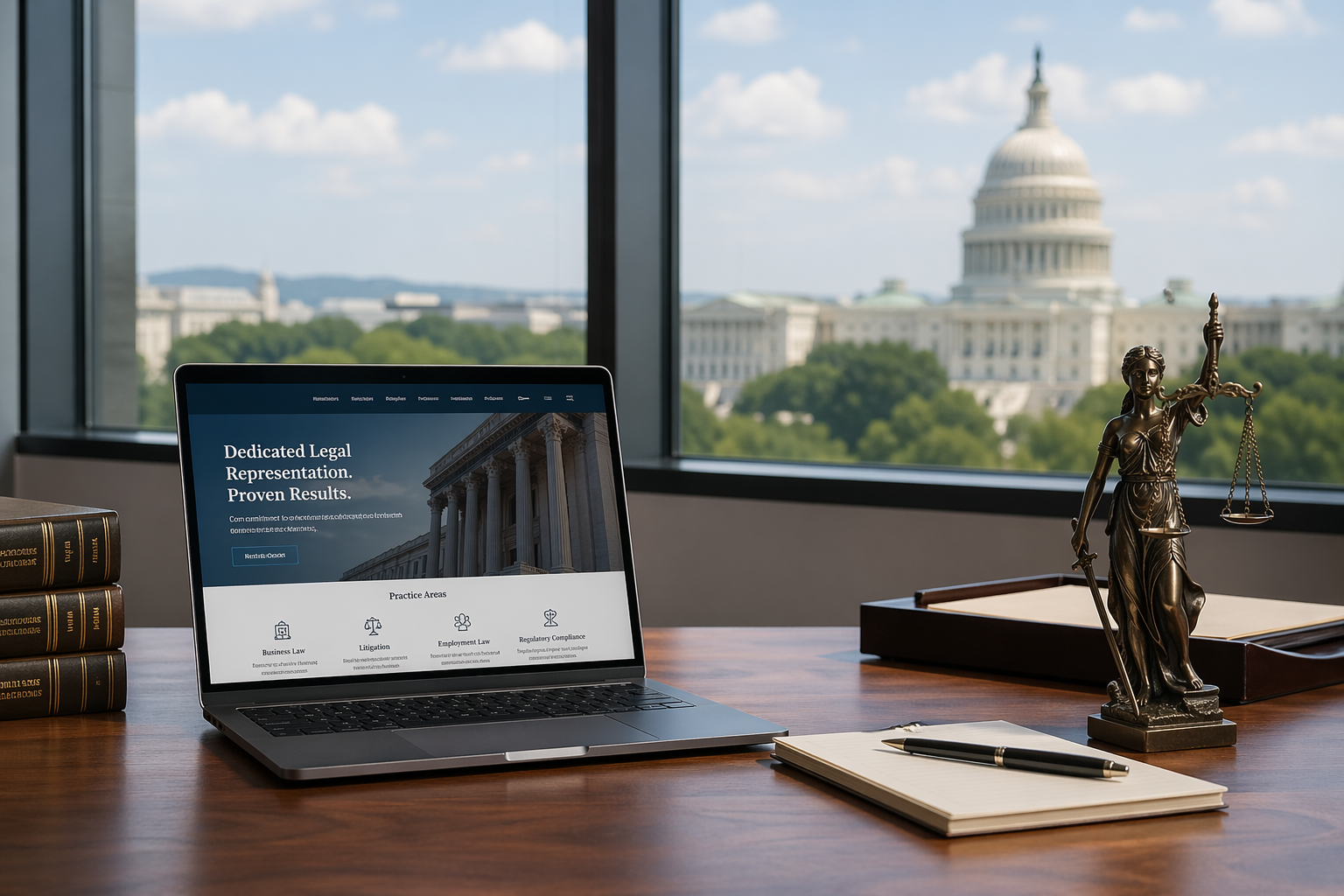
Washington, DC is unlike any other legal market in the country. It's a city where a single Google search might return results from a solo immigration practitioner, a 500-attorney white-collar defense firm, and every specialty in between — all competing for the same client at the same moment. If your law firm's website isn't purpose-built to cut through that noise, you're already ceding ground to competitors who are.
This guide breaks down exactly what effective DC law firm web design looks like in 2025 and beyond — and why getting it right is one of the highest-ROI investments your firm can make.
The DC Legal Market Is Not a Normal Playing Field
Before we talk design, it's worth understanding what your firm is actually up against.
Washington, DC has nine times more lawyers per capita than New York City. 9Sail That stat alone should reframe how you think about your digital presence. In most industries, a decent-looking website is a baseline. In DC's legal market, it's a competitive weapon — or a liability, depending on how it's built.
DC law firms frequently find themselves at the intersection of legal practice and government work, navigating a complex and often politically charged environment. 9Sail The client base here is educated, discerning, and accustomed to sophistication. Washington DC law firm websites must meet higher sophistication standards due to the educated client base and competitive environment, with stronger emphasis on credentials, federal practice experience, and compliance with DC Bar regulations governing attorney advertising. Milemarkmedia
In short: what works for a personal injury firm in a mid-size regional market will not cut it here.
First Impressions Are Decided in Seconds
Your law firm's website is often the first impression a potential client has of your practice, and most visitors make a judgment within seconds of landing on your page. They expect a site that looks modern, is easy to navigate, and clearly communicates what your firm offers. If the experience feels outdated or confusing, many users will click away before they even learn how your practice can help. Good2BSocial
That judgment is ruthless and it's irreversible. A slow-loading homepage, a cluttered layout, or attorney bios that read like LinkedIn profiles from 2012 — any of these signal to a potential client that your firm may not be as sharp as the competition. In a city where clients are choosing between firms that argue before federal agencies and the Supreme Court, your website needs to project the same level of precision your attorneys bring to a brief.
The Non-Negotiables: What Every DC Law Firm Website Must Have
1. Mobile-First Design — No Exceptions
Over 60% of legal searches happen on mobile. 1SEO Digital Agency Yet many law firm websites are still designed primarily for desktop and treated as an afterthought on smaller screens. That's a critical mistake, because Google's mobile-first indexing means your mobile site is now your primary site in the eyes of search engines. Kaleidico
A mobile-first approach isn't just about shrinking your desktop site to fit a phone. It means simplifying navigation for touch interfaces, keeping forms short and thumb-friendly, and ensuring your phone number is tappable from every page. If a potential client is searching for a DC employment attorney from their phone during a lunch break and your site is difficult to navigate, they're gone — and they're calling someone else.
2. Speed That Doesn't Test Patience
Even a one-second delay in load time can reduce conversions by up to 7%. Milemarkmedia In DC's competitive market, slow websites don't just frustrate visitors — they hand leads directly to faster competitors. Page speed is also a direct Google ranking factor, meaning a sluggish site gets penalized twice: once by the algorithm and once by the impatient visitor who bounced before your hero image finished loading.
Optimized images, clean code, reliable hosting, and a proper caching strategy aren't optional technical details. They're the foundation your entire digital presence is built on.
3. Design That Communicates Trust Before a Word Is Read
Design choices that feel human, calm, and intentional — rather than loud or flashy — are what win in today's legal market. Attorney at Work The era of dark suits against marble courthouse backdrops as a default aesthetic is over. Modern DC law firm websites use intentional typography, restrained color palettes, and professional photography to communicate confidence without screaming.
Sliders, once a popular design option, are now a usability nightmare — they considerably slow down your website's load time and studies show users frequently ignore them. Attorney at Work The same goes for stock photos of gavels, generic courtroom imagery, and animated intros that make visitors wait before they can find your phone number. Clean, purposeful design wins every time.
4. Attorney Bios That Actually Convert
Clients aren't hiring your firm — they're hiring a person. Attorney bios with headshots, credentials, and practice focus are your best digital equivalent of a firm handshake. They provide the background, qualifications, and personality that potential clients look for before making contact. Kaleidico
In DC specifically, this matters more than in most markets. A client who needs help navigating a federal regulatory matter wants to see that your attorney spent eight years at the DOJ — and they want that information surfaced immediately, not buried three clicks deep. Each bio should be its own conversion asset: professional photo, clear practice focus, notable experience, bar admissions, and a direct path to get in touch.
5. Practice Area Pages Built for Both Humans and Search Engines
A common mistake is treating practice area pages as a checklist. A bullet list of services under a heading that reads "Practice Areas" is not a page — it's a missed opportunity. Detailed practice area pages with FAQs, outcomes, and client benefits are essential Kaleidico — both to help visitors understand exactly how your firm can help them and to signal to Google that your site has substantive, authoritative content on the topic.
Each practice area should have its own dedicated page, written for the specific client who has that legal problem. A person searching for a DC non-compete attorney and a person searching for a government contracts lawyer have entirely different needs, different vocabularies, and different anxieties. Speak to each of them directly.
Local SEO: How DC Clients Find You Before They Ever See Your Site
A beautifully designed website that no one can find is just expensive art. For DC law firms, local search visibility is the mechanism that connects your design investment to actual client acquisition.
Beyond keywords, your law firm's website must be built to be understood by both Google and generative AI models. Voice search, AI summaries, and zero-click search results are reshaping how clients find legal services, and your content needs to be structured and semantically rich to appear in these emerging formats. Kaleidico
Practically, that means:
Schema markup. Structured data tells search engines — and increasingly, AI platforms — exactly what your firm does, where you're located, who your attorneys are, and what practice areas you cover. Semantic URL structure, schema markup for legal services, attorney bios, and reviews, and featured snippet-ready answers to common legal questions Kaleidicoare table stakes for competitive DC search rankings.
Google Business Profile. Your GBP listing is often the first thing a potential client sees — before they ever click to your website. It needs to be fully built out, consistently updated, and actively managed with responses to reviews.
Location-specific content. Local SEO elements help your firm appear in location-based searches, including proper schema markup, Google Business Profile integration, and location-specific content that signals relevance to DC-area legal searches. Milemarkmedia Generic content that could apply to any city in America will always lose to content written specifically for the DC market.
Reviews. Online reviews significantly impact a law firm's ability to attract new clients. In Washington DC, where legal representation is highly scrutinized, firms need to actively manage their online reputation — encouraging positive client reviews and responding to negative ones professionally. 1SEO Digital Agency
Conversion: The Part Most Law Firm Websites Get Wrong
Here's a hard truth: most law firm websites are designed to look impressive rather than to convert. They're built for managing partners, not for the anxious person at 11pm googling what to do after a wrongful termination.
Only 30% of law firm websites provide clear guidance on the hiring process. Just 14% display any pricing information. Potential clients visiting these sites leave confused about next steps and move on to competitors who communicate more clearly. Toppe Consulting
Only 30% of clients find the information they need on law firm websites, and just 10% find pricing info. When key details are missing or the design is clunky, visitors bounce — taking your potential revenue with them. American Bar Association
Effective conversion design means:
A clear primary call-to-action above the fold on every page
Multiple contact pathways: phone, form, live chat, and email
A frictionless intake process — long, complicated contact forms kill leads
Trust signals woven throughout: bar admissions, case results, client testimonials, and recognitions
Transparent communication about what happens after someone reaches out
For those seeking legal help, reducing anxiety and cognitive load through simple, clear design is essential. Presenting visitors with an overwhelming number of choices or excessively long forms can cause cognitive overload, leading to indecision and potentially prompting visitors to abandon a task before completing a critical action like contacting you. Justia
Content Strategy: The Engine Behind Long-Term Visibility
A great website is not a one-time project. It's a platform. Informative blog posts answering common legal questions, local SEO strategies to rank in city-specific searches, and strong internal linking to enhance website structure Torro Mediaare all components of a content strategy that compounds in value over time.
For DC law firms, content strategy should reflect the market's unique character. The federal government, lobbying ecosystem, regulatory environment, and international business presence in DC create content opportunities that simply don't exist in other markets. A firm that publishes genuinely useful, authoritative content on federal contractor compliance or DC employment law will earn both search visibility and client trust that generic blog posts never will.
The firms that thrive won't be the ones chasing trends. They'll be the ones designing systems — a clear position, a focused message, and a website that does a few things exceptionally well. Attorney at Work
The ROI Is Real
If you're skeptical about the return on investing in professional web design and SEO, the data is instructive. Law firms that combine strategic redesigns with smart marketing have seen organic traffic grow by over 700%, with some reporting lead increases exceeding 1,000% and significant ROI on advertising spend. DesignRush
Firms using client intake technology report 51% more leads and 52% higher revenue than those relying solely on traditional methods. Toppe Consulting
And the cost of inaction is equally concrete. When someone searches for a lawyer, they usually contact only one or two firms from the first page of Google. If your website does not appear in top search results, your competitors receive the calls instead. Asad Khan SEO
What to Look for in a DC Law Firm Web Design Partner
Not every web design agency understands the legal industry. Not every agency that understands the legal industry understands the DC market specifically. When evaluating a partner, ask:
Do they have demonstrated experience designing for law firms — not just professional services generally?
Do they understand DC Bar advertising rules and ethical guidelines for attorney marketing?
Do they build with SEO integrated from the ground up, or as an afterthought?
Do they handle content, or will you need to manage that separately?
Do they provide ongoing performance reporting, or do they hand off the site and disappear?
Your website should be a living, evolving asset — not a static brochure that collects digital dust.
The Bottom Line
In Washington, DC, your website is your first pitch to every potential client. It's working while you're in court, while you're in depositions, and at 2am when someone is deciding whether to call your firm in the morning. It either earns that call — or sends it to a competitor.
The firms winning in DC's legal market have websites that are fast, mobile-optimized, locally targeted, content-rich, and built to convert. They treat their digital presence with the same rigor they bring to their legal work.
If your current website doesn't reflect that standard, the cost isn't just a missed aesthetic opportunity. It's missed cases, missed clients, and missed revenue — every single day.
Ready to Build a Website That Works as Hard as You Do?
At Ritner Digital, we specialize in high-performance web design and digital strategy for DC-area law firms. We build websites that rank, convert, and reflect the caliber of your practice — not cookie-cutter templates that blend into the crowd.
Schedule a free strategy call with Ritner Digital today and let's talk about what your firm's website should actually be doing for you.
Sources: Kaleidico, Torro.io, Good2bSocial, Attorney at Work, Justia, Clio/American Bar Association, DesignRush, 9Sail, 1SEO Digital Agency, MileMark Media
Frequently Asked Questions
How much does a professional law firm website cost in Washington, DC?
Most custom law firm websites range from $5,000 to over $20,000 depending on the size of the firm, the number of practice area pages, and the level of custom design and content involved. Firms prioritizing SEO, custom branding, and ADA compliance typically land at the higher end of that range. For DC firms competing in a saturated market, a template-based website is rarely a sound long-term investment — the cost of lost leads far outpaces the savings on a cheaper build.
How long does it take to build a law firm website?
A professionally designed law firm website typically takes between six and twelve weeks from kickoff to launch. That timeline accounts for discovery and strategy, design mockups, development, content creation, and pre-launch QA and SEO setup. Rushing the process often leads to a site that looks finished but underperforms — particularly on the SEO and conversion side.
Do I need a separate page for each practice area?
Yes — and this is one of the most common mistakes DC law firms make. A single "Practice Areas" page with a bulleted list does almost nothing for your search visibility or your potential clients. Each practice area deserves its own dedicated page with substantive content, relevant FAQs, and a clear call to action. This structure is better for users trying to self-qualify, and it's significantly better for ranking in Google for the specific terms your clients are actually searching.
How important is local SEO for a DC law firm?
It's foundational. Potential clients aren't searching for "best attorney in the United States" — they're searching for "DC employment lawyer" or "federal criminal defense attorney Washington DC." Local SEO ensures your firm appears in those searches through optimized Google Business Profile listings, location-specific content, local schema markup, and a consistent presence in DC-area legal directories. In a market with DC's attorney density, local SEO is what separates visible firms from invisible ones.
What makes a DC law firm website different from other markets?
Several things. DC's legal market has a uniquely educated and sophisticated client base that expects a higher level of credibility and polish from the firms they research online. There's also a stronger emphasis on federal practice credentials, government agency experience, and regulatory expertise — elements that need to be surfaced prominently in your design and content. Additionally, DC Bar rules governing attorney advertising have specific requirements that your website and any marketing materials must comply with.
How do I know if my current law firm website is costing me clients?
A few clear warning signs: your site loads slowly on mobile, your bounce rate is high, you're not appearing on the first page of Google for your core practice areas, your contact form submissions are low relative to your traffic, and your attorney bios lack professional photography or substantive credential detail. A professional website audit can quantify exactly where your site is underperforming and what it's costing you in lost leads.
Should my law firm invest in SEO or paid ads — or both?
For most DC law firms, the answer is both — but with different timelines and roles. SEO is a long-term investment that builds compounding visibility and reduces your dependence on paid spend over time. Paid advertising through Google Ads and Local Service Ads delivers immediate visibility for high-intent searches, particularly useful for newer firms or competitive practice areas where organic rankings take time to build. A well-integrated strategy uses paid advertising to generate leads now while SEO builds durable, lower-cost visibility for the long term.
How often should a law firm update its website?
Your website should never be fully "done." At minimum, attorney bios should be updated as credentials evolve, practice area pages should be refreshed as the law changes, and a consistent stream of blog content should be published to support SEO and demonstrate ongoing thought leadership. A full design and strategic review every two to three years is a reasonable baseline — though in a fast-moving market like DC, firms that treat their website as a dynamic platform rather than a static brochure consistently outperform those that don't.