The Other Side of the Summer Slump: What the Data Actually Says About Fall Traffic and Q4 for B2B Websites
Everyone in B2B marketing knows the summer slowdown. It shows up every year like clockwork — sometime around Memorial Day the pipeline tightens, form submissions drop, and decision-makers become suddenly unreachable. The conventional wisdom says to accept it, wait it out, and gear back up in September.
But here's the question most teams never think to ask: if we know what the slump looks like on the way down, what does the data say about the climb back up?
The answer is more interesting — and more actionable — than most B2B marketers realize. September and October aren't just a return to baseline. For companies that positioned themselves correctly during the slow months, fall represents a genuine performance surge. And Q4, long dismissed as B2C territory, turns out to be one of the most undertapped opportunities in B2B marketing.
Let's look at what the numbers actually say.
First: How Bad Is the Summer Dip, Really?
Before we can talk about the recovery, we need to establish the baseline. Two-thirds of B2B companies see lead volume fall 20% or more every summer. Ritner Digital That's not a fringe phenomenon — it's the majority of the industry moving in the same direction at the same time.
The traffic data backs this up across multiple channels. An analysis of over 475 million sessions across 193 web properties found that B2B organic traffic fell by 6.1% in August alone, while B2C organic traffic actually grew by 1.7% during the same period — showing how user behavior shifted in distinctly different directions depending on the audience. Siege Media The same analysis found that B2B-heavy ChatGPT referral traffic fell even more sharply at 9.8%, reflecting historical trends in which business-related queries and intensive research projects slow down as decision-makers and professionals take vacations. Siege Media
This is the reality on the ground: those who engage during July and August tend to be high-intent, strategic buyers planning for Q4 Hunter — which means the volume is thin but the quality of the remaining traffic is often higher. The visitors still showing up in July are not casual browsers. They're doing real research.
The teams that understand this distinction are the ones who emerge from summer in a position to accelerate, not scramble.
September: The Strongest Single Month in B2B
Here's the data point that surprises most people: September doesn't just recover from the summer slowdown. It tends to outperform everything that came before it.
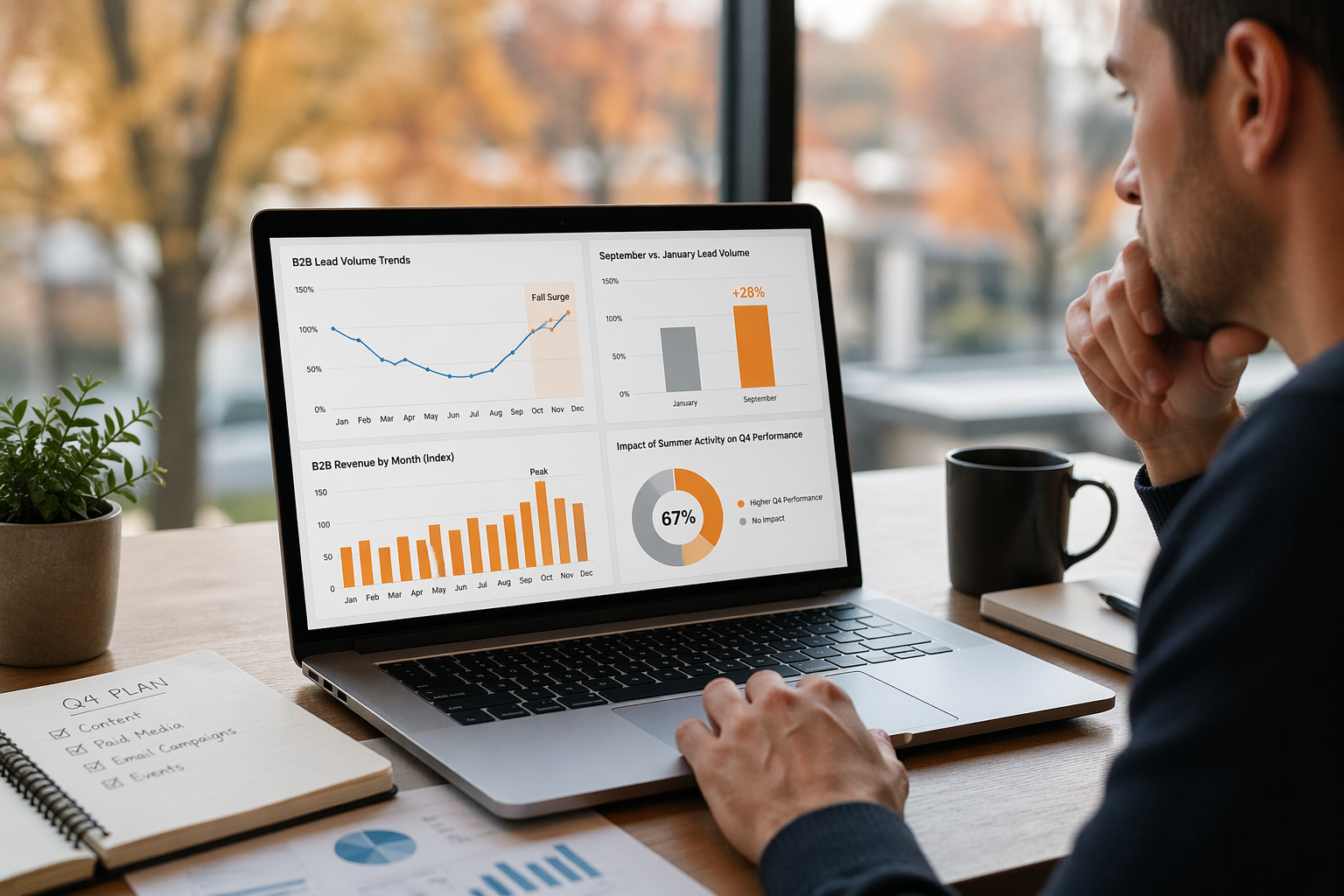
September consistently delivers the strongest single-month performance of the year in B2B lead generation, surpassing even the Q1 peak. SQL conversion rebounds powerfully, and cost per lead drops to annual lows. Ritner Digital
Read that again. Not just a bounce back. Not just a return to May or June numbers. September regularly outperforms January — the month that most B2B marketers treat as the gold standard of high-intent buyer activity.
September and October tend to have the best productivity going into the end of the year, Avid Demand and that tracks with what we know about how corporate buying decisions actually work. Q4 budget decisions don't start in October. They start now. Decision-makers who were checked out in August come back to work with a list of vendors they want to evaluate, initiatives they want to launch, and problems they want to solve before December 31.
The buyers didn't disappear in summer. They were thinking. And in September, they start doing.
The October Inflection: From Traffic to Intent
October is where fall traffic gets interesting from a conversion standpoint. By this point in the year, buyers aren't just researching — they're deciding. The same forces that create urgency in Q4 (fiscal year deadlines, use-it-or-lose-it budget pressure, implementation timelines) push leads that have been sitting in the pipeline for months toward real action.
Sales cycles that seemed stalled in Q2 or Q3 often pick up speed as fiscal deadlines approach. Prospects that previously hesitated may be more willing to commit in order to secure pricing, lock in services, or use remaining funds before they expire. IN2communications
This is why October should be treated as a conversion month, not just a traffic month. The leads coming in have shorter consideration windows and higher intent than at almost any other point in the year. The question isn't whether they're ready to buy — it's whether your content and sales infrastructure are ready to meet them.
Q4: The Most Misunderstood Quarter in B2B
Here is the biggest myth in B2B marketing: that Q4 is a B2C quarter.
The assumption is that November and December are for holiday shopping, not enterprise software decisions or B2B service contracts. So B2B brands scale back their campaigns, cut ad spend, and wait for January. It sounds reasonable. It's leaving significant revenue on the table.
The data from MNTN Research on their B2B advertiser base tells a different story. B2B advertisers saw notable improvements from Q3 to Q4 2024, including lower cost-per-visit, higher visit rates, increased revenue, and stronger ROAS. MNTN Research
More surprisingly: in 2024, the highest B2B revenue came in November — not December, and not January. November stood out across key B2B engagement metrics including visit rate and conversions, with the catalyst being Cyber Week. MNTN Research
This may be the most counterintuitive finding in recent B2B data. The week of Black Friday and Cyber Monday — widely assumed to be irrelevant to enterprise buyers — turned out to be a peak performance window for B2B brands. Business decision-makers are just as responsive to the buying momentum of the season — they're just shopping for services and solutions instead of stocking stuffers. MNTN Research
The psychological shift that happens during Cyber Week — the sense that deals are available, that decisions should be made, that the calendar is running out — applies to B2B buyers too. They're human. They feel urgency. And if your brand is present and positioned correctly during that window, they'll respond.
The Budget Deadline Effect: Why Q4 Closes Deals
There's a structural reason Q4 drives B2B conversions that goes beyond seasonal momentum. It's fiscal reality.
With 75% of companies ending their fiscal year during this period, the pressure and potential are higher than at any other time. Decision-makers review budgets, evaluate vendor performance, and finalize contracts for the next year. Q4 is when many relationships built throughout the year finally convert into signed deals. IN2communications
This is the "use it or lose it" dynamic. Budget that isn't deployed by December 31 doesn't roll over — it disappears. Procurement teams and department heads who have approved budget allocations for tools, services, and solutions feel genuine pressure to act before year-end. Budget urgency messaging around "use it or lose it" budget scenarios, annual contract incentives, and fast deployment promises resonate particularly well with B2B buyers in Q4. TechDella
This creates a window that doesn't exist at any other point in the year: buyers who have already secured internal approval and are looking for the right vendor to say yes to. The decision infrastructure is already in place. Your job is just to be the most compelling option in front of them.
The Compounding Effect: What Happens to Brands That Stay Active
Perhaps the most important finding across recent Q4 research isn't about what happens in Q4 itself — it's about what happens in Q1 for brands that remained active through the end of the year.
Brands that run evergreen campaigns throughout Q4 see stronger visit rates and sustained growth into January. Those who remained active through the end of the year started Q1 with more site traffic and higher conversion volume than brands who paused. MNTN Research
Research shows that B2B brands that maintained campaigns through the end of the year saw a 10% boost in conversion rates heading into Q1. Eyefulmedia
This is the compounding logic of consistent marketing. The relationships you build in October convert in November. The content you publish in November ranks in December. The campaigns you run in December prime the Q1 pipeline. Every month you stay active is building infrastructure for the months ahead.
The brands that go dark in November and December don't just miss Q4 opportunities. They show up to January behind the brands that didn't.
Why Content Published in Summer Matters for Fall Traffic
There's one more element of the fall traffic surge that most B2B teams underweight: the SEO lag effect. Organic search doesn't respond in real time. Content published today starts gaining traction over the coming weeks and months as Google indexes, assesses, and ranks it.
This means the September traffic surge — the strongest single-month performance in B2B — is partially built from content created in July and August. A blog post published in July will rank in September. A post not published in July won't rank in September, or October, or November. Consistency in content production through summer is one of the highest-leverage things you can do to own Q4 traffic. Ritner Digital
The data on content frequency reinforces this: companies publishing 16 or more blog posts monthly generate 4.5 times more leads than infrequent publishers. Olivermunro That advantage doesn't switch on and off by season. It accumulates. The brands that kept publishing through the slow months have a compounding SEO advantage that shows up in the fall numbers.
This is why the summer slowdown strategy isn't really about summer at all. It's about whether your content engine was running when the traffic came back.
The Paid Search Opportunity Nobody's Talking About
One underappreciated aspect of the fall and Q4 window is what it means for paid advertising efficiency — specifically for B2B brands willing to think ahead.
Q4 typically shows 30% higher efficiency in paid search for B2B companies — a pattern worth building into your budget framework in advance rather than reacting to mid-quarter. Cometly
At the same time, the competition dynamic shifts. Google Ads cost-per-click rates typically rise 20–30% during November and December as B2C advertisers flood the market. LinkedIn advertising, particularly relevant for B2B companies, experiences dramatic cost escalation as businesses compete for the attention of decision-makers making year-end purchases. Thelmbmarketinggroup
The implication: September and early October are the sweet spot. B2B buyer intent is surging, but before the B2C holiday blitz drives up CPCs across all platforms. Brands that get their Q4 paid campaigns live in September — rather than scrambling to launch in November — capture more volume at lower cost. By the time B2C advertisers are bidding up LinkedIn in November, B2B brands that started early already have retargeting audiences built, conversion data accumulated, and campaigns optimized.
What This Means for Your Strategy Right Now
The summer-to-fall cycle in B2B isn't a problem to solve. It's a predictable pattern to leverage. The brands that treat the slow months as a setup period — building content, warming audiences, optimizing campaigns, and preparing infrastructure — are the ones who show up to September ready to capture the surge rather than scramble for it.
The data is consistent across sources: the summer dip isn't a sign of failure; it's a predictable cycle. Use the quieter months to conduct content audits, build your digital calendar, and focus on content marketing best practices. Siege Media Then double down when the market returns.
And when it comes to Q4 specifically, the strategic imperative is clear. Since 90% of B2B decision-makers buy from companies they knew at the start of the consideration process, getting in front of them early is critical. MNTN ResearchQ4 is when many of those relationships close — but only for the brands that built them all year long and didn't go quiet when everyone else did.
The fall lift is real. The Q4 opportunity is real. The question is whether you'll be positioned to capture it.
Ritner Digital helps B2B companies build the content, SEO, and paid strategy infrastructure to perform through every phase of the annual cycle — not just the easy months. If you want to talk about what your fall and Q4 traffic could look like, we're here.
Frequently Asked Questions
How much does B2B website traffic actually recover after the summer slowdown?
The recovery isn't just a return to baseline — it tends to overshoot it. September consistently ranks as the strongest single month of the year in B2B lead generation, outperforming even the traditional January spike that most marketers treat as the gold standard. SQL conversion rates rebound sharply and cost per lead drops to annual lows. If your September looks like it's just "getting back to normal," something in your content or campaign infrastructure likely underperformed during the summer months.
Is Q4 really worth investing in for B2B, or does it slow down like summer?
This is one of the most common misconceptions in B2B marketing. Q4 is not a slow quarter for B2B — it just looks like one on the surface because B2C brands dominate the holiday narrative. The data tells a different story: B2B advertisers consistently see higher visit rates, lower cost-per-visit, stronger revenue, and better ROAS in Q4 compared to Q3. In 2024, November was actually the highest-revenue month of the year for many B2B brands — driven in part by the buying momentum of Cyber Week, which affects business buyers just as much as consumers.
Why does September outperform January in B2B lead generation?
January feels strong because it follows the December holiday slowdown — any activity looks good by comparison. September is strong for structural reasons: decision-makers return from summer with clear initiatives, Q4 budget deadlines are now visible on the horizon, and buyers who were doing passive research in July and August are now actively evaluating vendors. The intent level in September is higher than almost any other month. January often represents new budget but ambiguous priorities. September represents existing budget with urgent timelines.
What is the "budget deadline effect" and how does it impact Q4 conversions?
About 75% of companies end their fiscal year on December 31. That means approved budget that isn't deployed before year-end simply disappears — it doesn't roll over. This creates a genuine urgency dynamic in Q4 where decision-makers who have already secured internal approval are actively looking for vendors to say yes to. Sales cycles that stalled in Q2 and Q3 often close rapidly in October and November because the external deadline forces a decision. Messaging around "use it or lose it" budget scenarios, fast implementation timelines, and year-end contract incentives resonates unusually well in this window.
Does the summer content slowdown affect fall organic traffic?
Yes, significantly — and this is the part most B2B teams miss. Organic search operates on a lag. A blog post published in July doesn't rank immediately; it earns traction over weeks and months. That means the September traffic surge is partially built on content created during the summer. Brands that stopped publishing in July and August are showing up to fall with an empty pipeline of new rankings. Brands that kept their content engine running all summer show up to September with new organic visibility ready to capture the surge. This is one of the highest-leverage arguments for maintaining content production through the slow months.
When should B2B companies launch their Q4 paid campaigns?
September, not November. By the time November arrives, B2C advertisers are flooding Google, LinkedIn, and Meta with holiday campaigns — driving up CPCs and CPMs across the board. B2B brands that launch Q4 campaigns in September get ahead of that cost inflation, accumulate conversion data, build retargeting audiences, and have optimized campaigns running by the time buyer intent peaks in October and November. Waiting until Q4 is officially underway to start Q4 advertising is one of the most common and costly mistakes in B2B paid media.
What happens to B2B brands that go dark in Q4?
They start January behind. Research consistently shows that brands maintaining active campaigns through the end of the year enter Q1 with more site traffic, larger retargeting audiences, and higher conversion volume than brands that paused. The effect isn't just about Q4 revenue — it's about pipeline continuity. B2B sales cycles are long. A prospect who engages with your brand in October may close in February. If you're not present in October, that February deal goes to someone who was.
How should we think about October specifically — is it more of a traffic month or a conversion month?
Both, but lean toward conversion. October sits at the intersection of peak fall traffic and the beginning of real Q4 budget urgency. Buyers who entered the research phase in September are now evaluating seriously. Deals that have been stalled since summer start moving again as year-end pressure builds. October is the month to be actively running demos, sending case studies, accelerating follow-up sequences, and pushing warm leads toward decisions. Traffic will come — your job in October is to make sure the conversion infrastructure is ready for it.
Does industry affect how pronounced the fall lift is?
Yes. The fall lift is most dramatic in industries with strict fiscal year cycles, large deal sizes, and longer sales cycles — enterprise software, professional services, technology, and financial services tend to see the sharpest September and October rebounds. Industries with more rolling or project-based buying (some construction, manufacturing, or government-adjacent verticals) may see a smoother curve. The Q4 budget deadline effect is strongest wherever "use it or lose it" budget dynamics apply, which is most pronounced in enterprise and mid-market B2B.
What's the single most important thing a B2B company can do right now to capture the fall lift?
Don't wait until September to start thinking about September. The traffic is coming regardless. The question is whether your content, paid campaigns, SEO rankings, and lead nurturing sequences are ready to catch it. The brands that win fall started building for it in summer — publishing content, warming audiences, and preparing campaigns while their competitors went quiet. If you're reading this and it's already August or September, the priority is to move fast on paid media (which is immediate) and double down on content production to start building the organic runway for October and November.