RFP Websites Look Like They Were Built in 2003. That's a Business Problem.
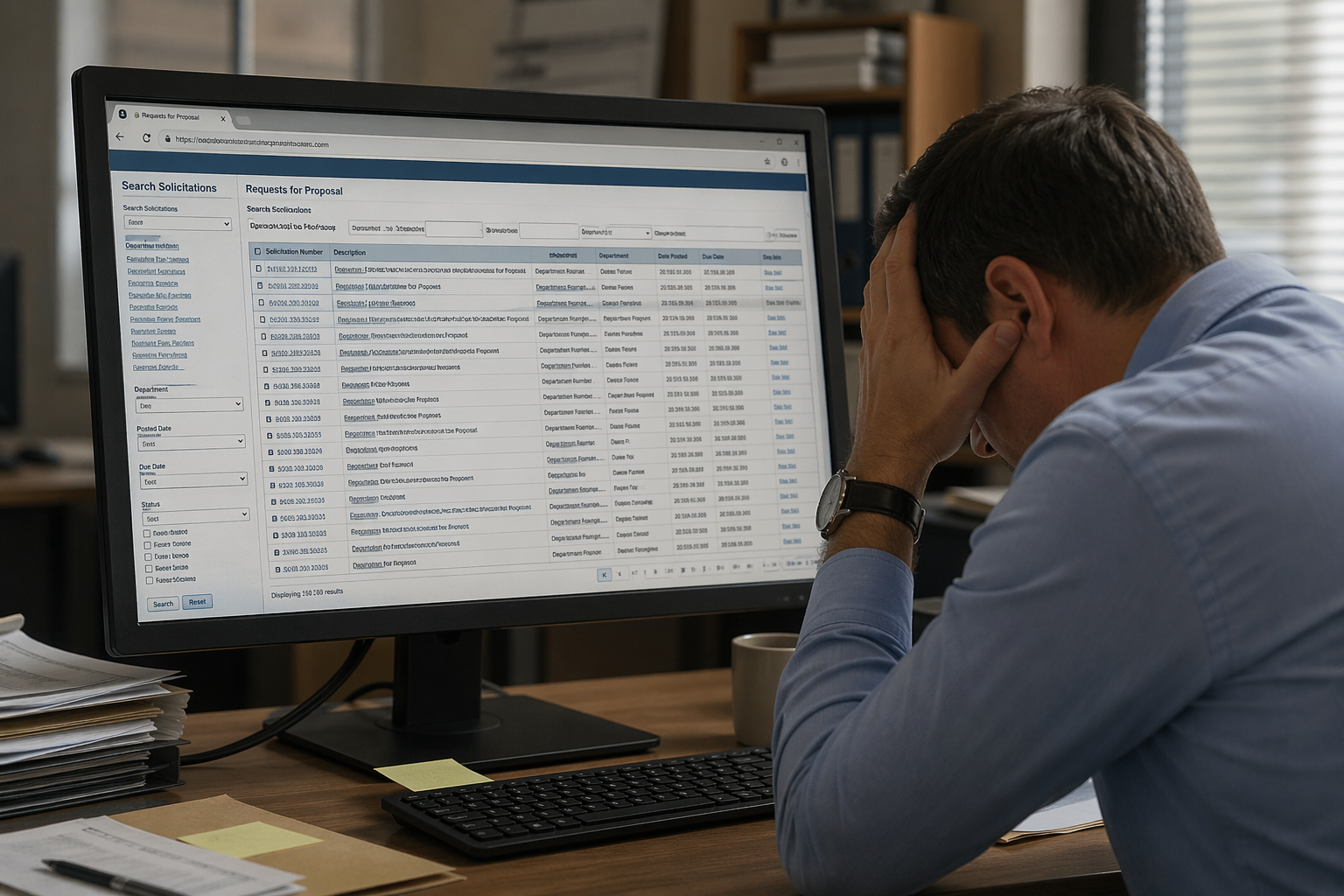
If you've ever had to navigate a government procurement portal or dig through an RFP aggregator site to find a bid opportunity, you already know the pain. The dense tables. The broken search filters. The PDFs buried three clicks deep. The registration walls that ask for your fax number. The color palettes that look like someone found a copy of FrontPage and never looked back.
It's not a small inconvenience. It's a systemic UX failure — and it's actively costing businesses time, money, and legitimate opportunities.
Let's break down exactly what's wrong, why it happened, and what it means for anyone trying to compete in the procurement space.
The Lowest Bidder Problem
The rot starts before a single line of code is written.
When a government department decides it needs a digital product, it floats an RFP — a document often 200+ pages long, written by people who have never spoken to users. The project then goes to the lowest bidder. Not the best team. Not the one with human-centered design experience. Just the cheapest one that ticks the boxes. UX design, user research, accessibility testing? Not even line items. Medium
This is the foundational problem. The platforms that are supposed to help vendors find and respond to opportunities were themselves built through processes that treat design as an afterthought. You end up with a tool that technically functions — in the same way a rotary phone technically makes calls — but fails the modern user at nearly every touchpoint.
Manual tools were not designed for the scale or complexity of modern government RFPs. In theory, evaluators should spend their time reviewing proposals and applying judgment. In practice, a significant portion of time is spent on logistics that don't improve decision quality — they simply keep the process moving. Rfp360 That friction gets passed downstream to vendors, who feel it in every clunky search, every failed filter, every form that times out before they can submit.
SAM.gov: The Country's Most Important Procurement Tool Is Also One of the Most Frustrating
SAM.gov is the federal government's central hub for contract opportunities. If you want to work with the U.S. government, you're in it whether you like it or not. And most people do not like it.
Finding information on SAM.gov is extremely difficult. Its complex navigation structure, poor search, and lack of user-friendly tools make using SAM.gov a painful experience. For most searches, it doesn't provide complete or even relevant results. Appian
SAM's update process requires entities to verify their business against a database of organizations and addresses, leaving plenty of room for mismatches, human error, and confusion. Morrison & Foerster Something as routine as a business name update can trigger a weeks-long delay — and since SAM registration is a prerequisite for payment on federal contracts, those delays aren't just annoying. They're financially damaging.
SAM was originally consolidated in 2012 from nine separate legacy systems and databases, with the stated goal of reducing the burden on those seeking to do business with the government. Wikipedia Noble intent. But consolidating nine bad systems doesn't give you one good one — it gives you one very large, very complicated bad one.
The Aggregator Sites Aren't Much Better
If SAM.gov is the primary federal option, a cottage industry of aggregator sites has grown up around it — platforms like Periscope S2G (formerly BidSync), RFPMart, FindRFP, and others that promise to centralize bid opportunities and save you hours of manual searching. In some cases they do. But the UX is, charitably, utilitarian.
For beginners, this software is not very intuitive — and for people who use a lot of proposal software, it shouldn't be hard, but it is. SoftwareAdvice AU
Every listing has a "See Bid Details" button that directs you to the place where the platform found the listing. Sometimes RFPs are posted directly within the platform. Most of the time, however, the platform found the RFP on another website — and some of those require you to create yet another account to view the materials, or even have a paid account to see the full details. Utley Strategies
So to respond to a single opportunity, a vendor might create accounts on three separate platforms, re-enter the same business information each time, and navigate three completely different (and equally dated) interfaces. The "solution" to fragmentation has created more fragmentation.
Some platforms have been described by users as having "lots of programming issues and problems yet to be resolved," with unreliable service and poor customer support. Capterra And yet businesses keep using them, because the alternative — manually checking individual agency websites — is even more painful.
The Specific UX Failures, Catalogued
Let's get specific. Here are the design failures that show up across virtually every RFP platform in the market:
Search that doesn't actually search. Most procurement portals rely on basic keyword matching against raw document text. There's no semantic understanding, no synonym handling, no contextual ranking. Search for "digital marketing services" and you'll get results that contain those words anywhere in a 200-page PDF — including in the footer of an unrelated document.
No mobile experience. As of late 2024 and early 2025, roughly the mid-40% of mobile web origins pass Core Web Vitals in the CrUX dataset, meaning most of the web still underperforms on mobile. DesignRush RFP portals are dramatically worse than the web average. Most were designed for desktop, in Internet Explorer, and were never updated. Trying to review a bid opportunity on your phone is an exercise in lateral scrolling and pinching.
Registration walls everywhere. Almost every platform requires registration before you can read bid details — and the registration process itself is rarely smooth. Multiple fields, email verification loops, and account setup flows that feel like applying for a mortgage.
PDF-dependent information architecture. Instead of structured, scannable data, the critical details of most RFPs live inside attached PDF documents. Due dates, scope, evaluation criteria, contact information — all buried in documents that can't be searched across, filtered, or compared side by side.
Inaccessible by design. WCAG 2.2 AA is now the standard for web accessibility, and as of June 28, 2025, the EU Accessibility Act is law. DesignRush Most RFP portals fail accessibility checks that would be obvious to any trained designer — poor color contrast, unlabeled form fields, no keyboard navigation, tables that don't work with screen readers.
Filter systems that don't work. Users have noted that filter options on these platforms can be so numerous and unclear that they worry about missing relevant opportunities entirely. Capterra When filters are present, they often return unexpected results, apply inconsistently, or reset without warning.
No transparency about what you're paying for. The free version of major aggregator platforms typically provides access to only around 2% of listings. Utley Strategies This isn't disclosed prominently upfront — users discover it after registering and browsing, then face an upsell to unlock the rest. It's a dark pattern dressed up as a freemium model.
Why This Matters Beyond Frustration
Bad UX isn't just annoying. It has real consequences for who wins and who loses in the procurement market.
When a platform is confusing, time-consuming, and poorly organized, smaller businesses get squeezed out first. They don't have the staff to dedicate hours to navigating broken systems, or the budget to pay for premium subscriptions to four different aggregators. An RFP "cattle call" on a poorly designed platform ensures that right-sized local companies are scared away, and only the largest, lowest-value, highest-cost out-of-state companies are left standing. O8
The data quality problem compounds this. Some RFP portals that claim to sell "qualified" RFPs are actually enormous databases of general-purpose projects scraped from thousands of government agencies. It can take an agency several hours just to sort through dozens of irrelevant listings. Folyo That time cost isn't shared equally — it falls hardest on lean teams without dedicated procurement staff.
And from the government side, bad UX on the solicitation portal means fewer vendors responding to bids, less competition, and ultimately worse outcomes for the public institutions trying to procure quality services at fair prices. Manual evaluation quietly shifts effort from decision-making to damage control. Rfp360 Bad vendor-side UX does the same thing to the businesses trying to participate.
The RFP Process Deserves Better Design Thinking
Here's what's ironic: many of the RFPs posted on these broken platforms are themselves RFPs for web design and digital services. Organizations issuing solicitations for modern, accessible, mobile-first websites are distributing those documents through platforms that are none of those things.
In 2026, redesign projects demand more than new visuals. Core Web Vitals, scalability, accessibility compliance, responsive-first UI, and clean information architecture have become non-negotiable. Businesses need websites that load fast, convert consistently, and scale with product growth. Novaeraagency These are the standards being written into solicitations — but the portals distributing those solicitations are still running on 2004's design philosophy.
The gap between what organizations are asking vendors to build and what the procurement infrastructure actually looks like is enormous. And it's closing too slowly.
What Good Looks Like
Good procurement UX isn't a mystery. It's just rarely prioritized. It looks like:
A clean, fast search experience with semantic matching and smart filtering. Structured data for bid details — not PDFs — that can be scanned, sorted, and compared. Mobile-responsive design that works on any device. Transparent pricing with a clear value proposition before registration. Accessible interfaces built to WCAG 2.2 AA standards. Dashboards that surface relevant opportunities based on your profile, not just your keywords.
None of this is technically complex. It's simply a matter of treating vendors like users whose experience matters — and funding design with the same seriousness as compliance.
The Opportunity Is There If You Know How to Navigate It
Until the platforms catch up, winning in the RFP space requires more than just finding opportunities — it requires building a digital presence and content strategy that makes you discoverable to the agencies issuing them.
That means showing up in search when procurement officers look for vendors in your category. It means having the SEO infrastructure to rank for the terms that matter in your industry. It means content that demonstrates expertise and builds authority before an RFP ever hits the portal. And it means making sure your own web presence doesn't have the same UX problems as the platforms you're frustrated with.
Ready to Win More Work — Without the Headache?
At Ritner Digital, we help businesses build the digital presence that gets them found before the competition even sees the RFP. From SEO and content strategy to web design that actually converts, we build systems that work — the way procurement portals should.
Ritner Digital is an AI Search & SEO agency built for businesses ready to scale. Based in the Philadelphia area, we grow brands through data-driven campaigns, creative strategy, and performance marketing.
Frequently Asked Questions
What is an RFP website or portal?
An RFP (Request for Proposal) website is a platform where government agencies and organizations post formal solicitations for vendors to bid on contracts and projects. Examples include SAM.gov for federal opportunities, and aggregator platforms like Periscope S2G (formerly BidSync), RFPMart, and FindRFP that pull listings from hundreds of agencies into one place.
Why do RFP websites have such poor UX and UI?
The short answer: the platforms were built the same way bad government websites always get built. Procurement decisions prioritize compliance and cost over user experience, meaning contracts go to the lowest bidder rather than the most qualified design team. UX research, accessibility testing, and modern design standards are rarely line items in a government tech procurement budget. The result is platforms that were functional in 2005 and never meaningfully evolved.
What are the biggest UX problems on RFP platforms?
The most common failures we see across virtually every major RFP portal include broken or keyword-only search with no semantic understanding, no mobile optimization, excessive registration walls before you can view bid details, critical information buried in PDF attachments rather than structured data, inaccessible design that fails basic WCAG standards, and filter systems that return inconsistent or overwhelming results. Any one of these would be a problem. Most platforms have all of them.
Does bad RFP portal UX actually affect who wins contracts?
Yes, significantly. When procurement platforms are confusing and time-intensive to navigate, smaller and leaner businesses get squeezed out first. They simply don't have the staff hours to burn through broken interfaces or the budget to subscribe to multiple aggregator platforms simultaneously. The businesses that end up winning are often the ones with dedicated procurement teams — not necessarily the most qualified vendors for the actual work.
What is SAM.gov and why is it so frustrating to use?
SAM.gov is the U.S. government's official System for Award Management — the mandatory registration and opportunity database for federal contracting. It was created in 2012 by consolidating nine separate legacy systems. While that sounds like an improvement, the consolidation largely inherited the design problems of each individual system rather than solving them. Navigation is complex, search results are often incomplete or irrelevant, and routine tasks like annual registration renewals can trigger delays that hold up payment on active contracts.
Are paid RFP aggregator subscriptions worth it?
It depends heavily on your industry and geography, but the UX problems don't disappear with a paid account. Most aggregators surface opportunities by scraping other websites, then redirect you back to those sites — sometimes requiring you to register for yet another platform — to view the full details or submit a response. Paid tiers unlock more listings, but the interface, search quality, and fragmented experience remain the same. For businesses targeting a specific niche or region, it's often more efficient to identify the five to ten agency procurement portals most relevant to your work and monitor those directly.
What can my business do to compete for RFPs without wasting hours on bad platforms?
The smartest approach is to get found before the RFP hits the portal. Procurement officers increasingly search online for qualified vendors before they even publish a solicitation — especially for marketing, digital, and creative services. That means your SEO, content, and web presence need to be doing active work. Ranking for the right search terms in your category, publishing content that demonstrates expertise, and maintaining a professional and fast-loading website all put you in front of decision-makers earlier in their process, when competition is lower and relationships are easier to build.
What does good RFP portal design actually look like?
It looks like what every other modern SaaS product figured out years ago: fast semantic search, mobile-responsive layouts, structured and scannable data instead of PDF dumps, transparent pricing before a registration wall, WCAG-compliant accessibility, and personalized dashboards that surface relevant opportunities based on your profile. None of this is cutting-edge technology. It's simply user-centered design applied to a space that has historically ignored it.
How can Ritner Digital help my business win more RFP-driven work?
We help businesses build the kind of digital presence that gets them discovered by the organizations issuing RFPs — before the competition even logs into the portal. That means SEO strategy, content that builds authority in your category, and web design that converts visitors into conversations. If you're tired of fighting broken platforms for opportunities, we can help you create a pipeline that works smarter. Get in touch here.