Predictive Ad Targeting: What It Is and How It Works
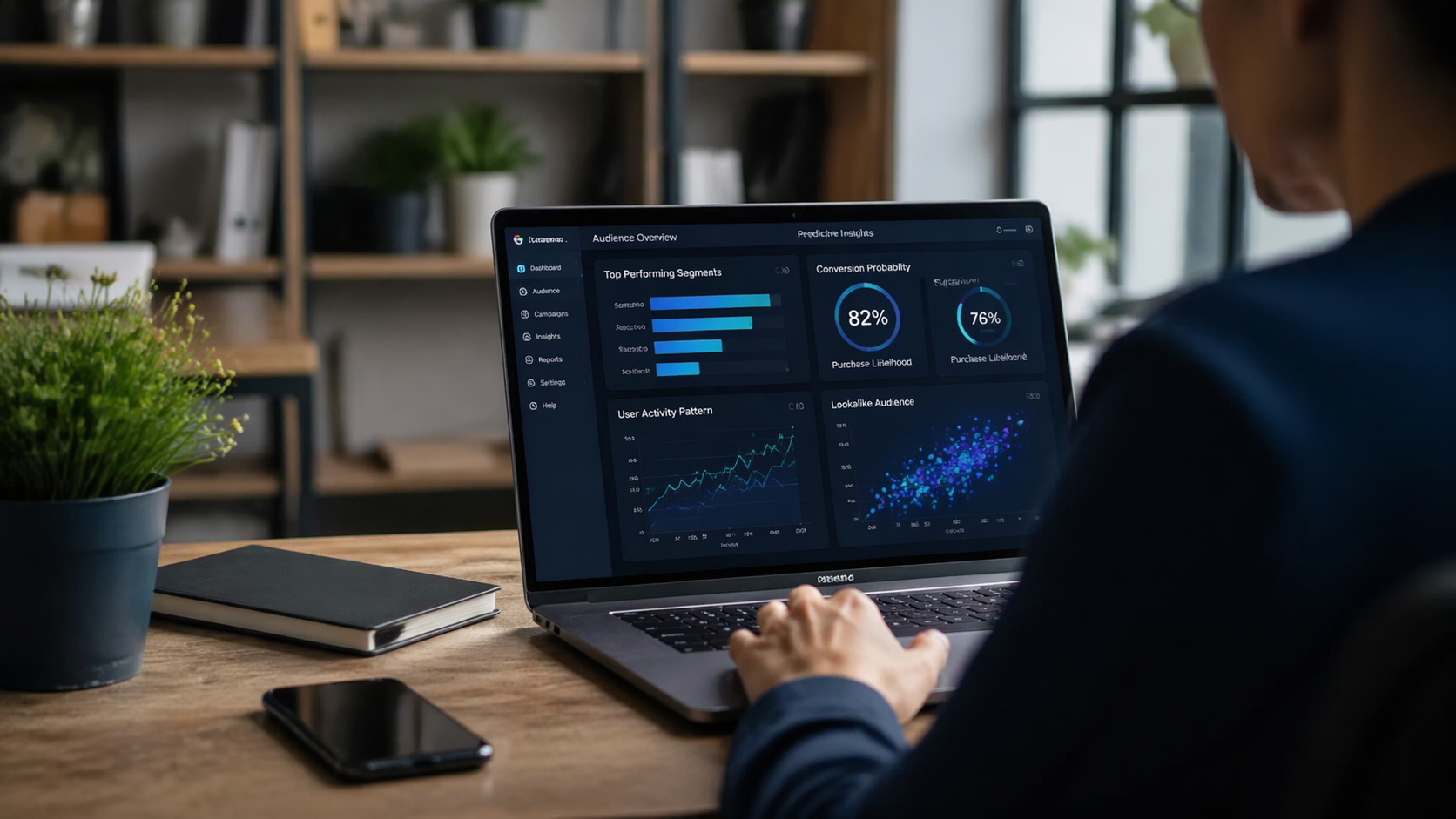
The Old Way of Targeting Is Losing Ground
For years, digital advertising ran on assumptions. You picked an age range, selected a handful of interests, maybe layered on some demographic filters, and hoped the right people saw your ads. It worked — sort of. But it was always an educated guess dressed up as strategy.
That's changing fast.
Instead of targeting based on who people were or what they did, predictive audiences use AI and machine learning to forecast who is most likely to take action in the future. Almostzero This shift — from reacting to the past to anticipating the future — is one of the most significant changes in how digital advertising actually works.
If you're running paid ads in 2025 and beyond and you're still relying entirely on manual interest stacks and demographic brackets, you're not just behind. You're spending more to get less.
So What Exactly Is Predictive Ad Targeting?
Predictive targeting uses machine learning and historical data to forecast who is most likely to convert, click, or take action. Instead of choosing who you think will buy, the algorithm analyzes behavioral signals, purchase history, on-site engagement, and broader contextual data to surface the most likely buyers automatically. Leadenforce
Think of it like this: traditional targeting is a billboard on the highway — you put it where a lot of people will drive by and hope your ideal customer is one of them. Predictive targeting is more like having a conversation with someone who already knows what you're looking for before you've said a word.
Netflix knows what show you'll binge next. Amazon suggests products you didn't know you needed. These companies use the same techniques — analyzing past interactions to forecast future buying decisions — that are now accessible to businesses of every size through major ad platforms. RapidLeadsPro
How It Actually Works: Under the Hood
Predictive targeting isn't one single feature — it's a pipeline. Here's how the process breaks down:
1. Data Collection
The AI analyzes your existing customer data — purchase history, browsing behavior, demographics, engagement patterns, and even the time of day they typically shop. Madgicx The more complete and clean that data is, the better the model performs.
2. Pattern Recognition
Machine learning algorithms study this data and identify what distinguishes your best customers from everyone else. Not just surface-level traits — deeper behavioral sequences. Broader third-party and contextual signals, where permitted, feed into models that predict the people most likely to take high-value actions. Leadenforce
3. Scoring and Segmentation
Supervised models score what you care about: propensity (likelihood to convert, churn, or upgrade), value (expected lifetime value or margin), and next-best action (the offer or product most likely to move someone forward). Unsupervised models cluster people into micro-segments that rule-based systems never would have captured. Aidigital
4. Audience Delivery
The system then matches those predicted patterns to new users and serves your ads automatically — continuously refining as more performance data comes in.
Where This Is Playing Out Right Now
Meta: Andromeda and Advantage+
Meta's targeting engine is powered by Andromeda, a deep learning architecture introduced in late 2024. Through the Meta Pixel and Conversions API, it processes user behavior signals across Facebook, Instagram, Messenger, and even external websites — generating real-time predictions for every single impression opportunity. mr.Booster
Meta GEM processes trillions of data points in real time to detect patterns in user behavior and predict who is most likely to buy. Meta Lattice generalizes learnings across campaigns, formats, and objectives — understanding the purchase journey whether a user engages with a Reel, a Story, or a Feed ad, and applying that knowledge to figure out how people move from awareness to purchase. Optimal Digital Ads
The practical takeaway? Advertisers who enabled Advantage+ features saw a 22% increase in return on ad spend compared to those using traditional targeting, according to internal Meta performance studies published in 2024. mr.Booster
Google: Performance Max and GA4 Predictive Audiences
On the Google side, Google Analytics 4 uses machine learning to analyze user behavior and predict what users will do next — focusing on three key metrics: purchase probability, churn probability, and predicted revenue. Napkyn These predictions feed directly into Google Ads campaigns, allowing you to target people based on what they're likely to do, not just what they've already done.
Performance Max campaigns work similarly — letting Google's algorithms determine the best placements, audiences, and creatives across Search, Display, YouTube, and beyond, all optimized toward your conversion goals.
Microsoft Advertising
Microsoft's Predictive Targeting uses the data you provide — like your existing ads and landing pages — combined with Microsoft's unique audience intelligence signals to deliver ads to relevant audiences, driving performance across MSN, Microsoft Start, Microsoft Edge, Outlook, and more. Microsoft Advertising
What Makes a Good Predictive Targeting Signal?
The system is only as smart as the data you feed it. AI is only as good as the signals you give it. Setting up your Pixel and Conversions API correctly, aiming for a high event quality score, and feeding clean first-party data are critical — ensuring that events like purchases, leads, and sign-ups are properly captured and passed to the platform. Optimal Digital Ads
Strong signals include:
Purchase events — actual completed transactions, not just page views
Lead form completions — with lead quality data fed back when possible
High-intent page visits — pricing pages, product configurators, contact pages
Email engagement — opens, clicks, and conversions tied back to your ad platform
CRM data — customer lifetime value, repeat purchase behavior, churn history
The more precisely you can tell the platform what a good outcome looks like, the better it gets at finding more of them.
Real-World Results
This isn't just theoretical. A retail brand that used predictive audiences to target "likely repeat buyers" boosted ROAS by 45%. An EdTech company that anticipated which free trial users would upgrade achieved a 3x increase in conversions. A real estate agency that forecasted high-intent leads increased site visits by 60%. Almostzero
These results don't happen by accident. They happen when the targeting model has clean data, a clear conversion goal, and enough volume to learn.
The Privacy Piece
One of the most common questions we hear: does this require third-party cookies or user tracking?
Not anymore. The next phase of targeting is less about tracking people across the open web and more about predicting intent from consented and contextual signals — then acting on those predictions without exposing individual identities. Privacy-preserving approaches like clean rooms, on-device processing, and first-party data partnerships are becoming the default infrastructure. Aidigital
GA4's predictive audiences, for example, work without relying on third-party cookies — keeping campaigns compliant with GDPR, CCPA, and other privacy regulations while still targeting the right people. Napkyn
This is actually good news for advertisers who have invested in building clean first-party data. That data becomes a competitive moat.
What This Means If You're Running Ads Today
Predictive targeting shifts your role from selector to signal shaper. Your main job becomes testing creative — emotional angles, brand storytelling, different formats — while keeping creative fresh to engage different predicted segments. Leadenforce
In practice, that means:
Stop micromanaging audience stacks with narrow interest layers that constrain what the algorithm can learn.
Start going broader on targeting, feeding the system high-quality conversion events, and testing creative more aggressively.
Invest in your first-party data infrastructure — your CRM, your pixel setup, your Conversions API — because that's what the prediction engine runs on.
Traditional targeting reacts to past actions. Predictive audiences anticipate future ones. Businesses that embrace predictive targeting today will gain a competitive edge tomorrow — while those who resist risk being left behind in a reactive past. Almostzero
The Bottom Line
Predictive ad targeting isn't a feature you turn on and forget. It's a shift in how you think about audience strategy — from manual selection to signal architecture. The platforms are doing more of the heavy algorithmic lifting than ever before, but they need you to give them something worth learning from.
Clean data. Clear conversion goals. Creative that actually connects. Those three things will determine who wins in an AI-driven advertising landscape.
Sources
Madgicx — Predictive Targeting for Ad Audiences: Boost ROAS Faster — madgicx.com
LeadEnforce — How Predictive Targeting Will Change the Way Advertisers Build Audiences — leadenforce.com
AI Digital — AI-Targeted Advertising: How It Works & Benefits — aidigital.com
Almost Zero — Why Predictive Audiences Are the Future of Targeting — almostzero.io
Microsoft Advertising — AI in Action: See the Future with Predictive Targeting — about.ads.microsoft.com
Insider One — Predictive Marketing Strategies and Tools for 2026 — insiderone.com
Optimal Digital Ads — Meta's Predictive Targeting and Diversification Strategy — blog.optimaldigitalads.com
mr.Booster — Meta Targeting in 2025: What's Changed and How to Stay Ahead — mrbooster.com
Rapid Leads Pro — Predictive Ad Targeting Strategies: Advanced Guide — rapidleadspro.com
Napkyn — GA4 Predictive Audiences: The Secret Weapon for Smarter Marketing — napkyn.com
Ready to Stop Guessing Who to Target?
Predictive ad targeting works best when your campaigns are built on a solid foundation — the right tracking setup, clean data flow, and a team that knows how to read what the algorithms are telling you.
That's exactly what we do at Ritner Digital.
Let's talk about your ad strategy →
Frequently Asked Questions
What's the difference between predictive targeting and regular audience targeting?
Traditional audience targeting is built on assumptions — you select demographics, interests, and behaviors based on who you think your customer is. Predictive targeting flips that. It analyzes actual behavioral data from your existing customers, identifies the patterns that predict a purchase, and finds new users who match those patterns automatically. One is manual selection based on guesswork. The other is a machine learning model that gets smarter over time.
Do I need a huge budget to use predictive targeting?
No, but you do need enough conversion data for the algorithms to learn from. Most platforms recommend at least 50 conversions per week at the campaign level before the system can optimize reliably. Budget size matters less than data quality and volume. A well-structured $3,000/month campaign with clean tracking will outperform a sloppy $15,000/month campaign every time.
How much data do I need before predictive targeting starts working?
It depends on the platform, but a general rule of thumb is at least 1,000 prior customers or conversions for a model to learn meaningful patterns. Google and Meta both have learning phases — typically 7 to 14 days — where performance may fluctuate while the algorithm gathers signal. The more historical conversion data you have feeding in, the faster and more accurately the system learns.
Is predictive targeting only for e-commerce?
Not at all. While e-commerce is often where it shows the most obvious results, predictive targeting works across industries — lead generation, SaaS, healthcare, real estate, home services, and more. The model doesn't care what you're selling. It cares about what behavioral patterns precede a conversion. As long as you have a defined conversion event and data to learn from, predictive targeting applies.
What happens to my targeting if I don't have a lot of first-party data yet?
You can still benefit from predictive targeting — you'll just be relying more on the platform's own signals rather than your proprietary customer data. Meta, Google, and Microsoft all have massive datasets they use to build predictive models even for newer advertisers. That said, your goal should be building your first-party data over time. Every pixel event, every CRM record, every email engagement is an asset that improves your targeting quality down the road.
Does predictive targeting work without third-party cookies?
Yes, and this is actually one of its advantages. Modern predictive systems are increasingly built on first-party data, on-device processing, and contextual signals — not cross-site tracking. Platforms like GA4 and Meta's Conversions API are specifically designed to maintain targeting accuracy in a cookieless environment. If your tracking is set up correctly, predictive targeting holds up well regardless of browser-level privacy changes.
Should I still test different audiences manually, or just let the algorithm decide?
Your energy is better spent testing creative than testing audiences. The algorithm will find your audience more efficiently than manual segmentation in most cases. What it can't do is generate compelling ad copy, design scroll-stopping visuals, or craft an offer that resonates emotionally — that's still your job. Feed the system good signals and great creative, and let it handle distribution.
How do I know if predictive targeting is actually working?
Look beyond click-through rates. The metrics that matter are cost per acquisition (CPA), return on ad spend (ROAS), and lead quality — not just lead volume. If your CPA is decreasing over time and the quality of leads or customers coming in is holding steady or improving, the model is working. If you're generating more clicks but worse outcomes, something upstream — data quality, conversion tracking, or creative — needs attention.
What's the biggest mistake businesses make with predictive targeting?
Starving the algorithm. The most common mistake is setting up narrow audiences, low budgets, or restrictive campaign constraints that prevent the system from gathering enough data to learn. Predictive targeting needs room to explore before it can optimize. Locking it down too early — or toggling settings constantly — resets the learning phase and keeps the model from ever reaching its potential.
Where do I start if I want to implement this for my business?
Start with your tracking foundation. Before anything else, make sure your Meta Pixel and Conversions API are firing correctly, your Google tag is capturing the right events, and your CRM is connected wherever possible. Bad data in means bad targeting out. Once your tracking is solid, define your primary conversion goal clearly, set a realistic budget with enough runway for the learning phase, and then focus on creative testing. If you want help building that foundation the right way, we're here for that conversation.