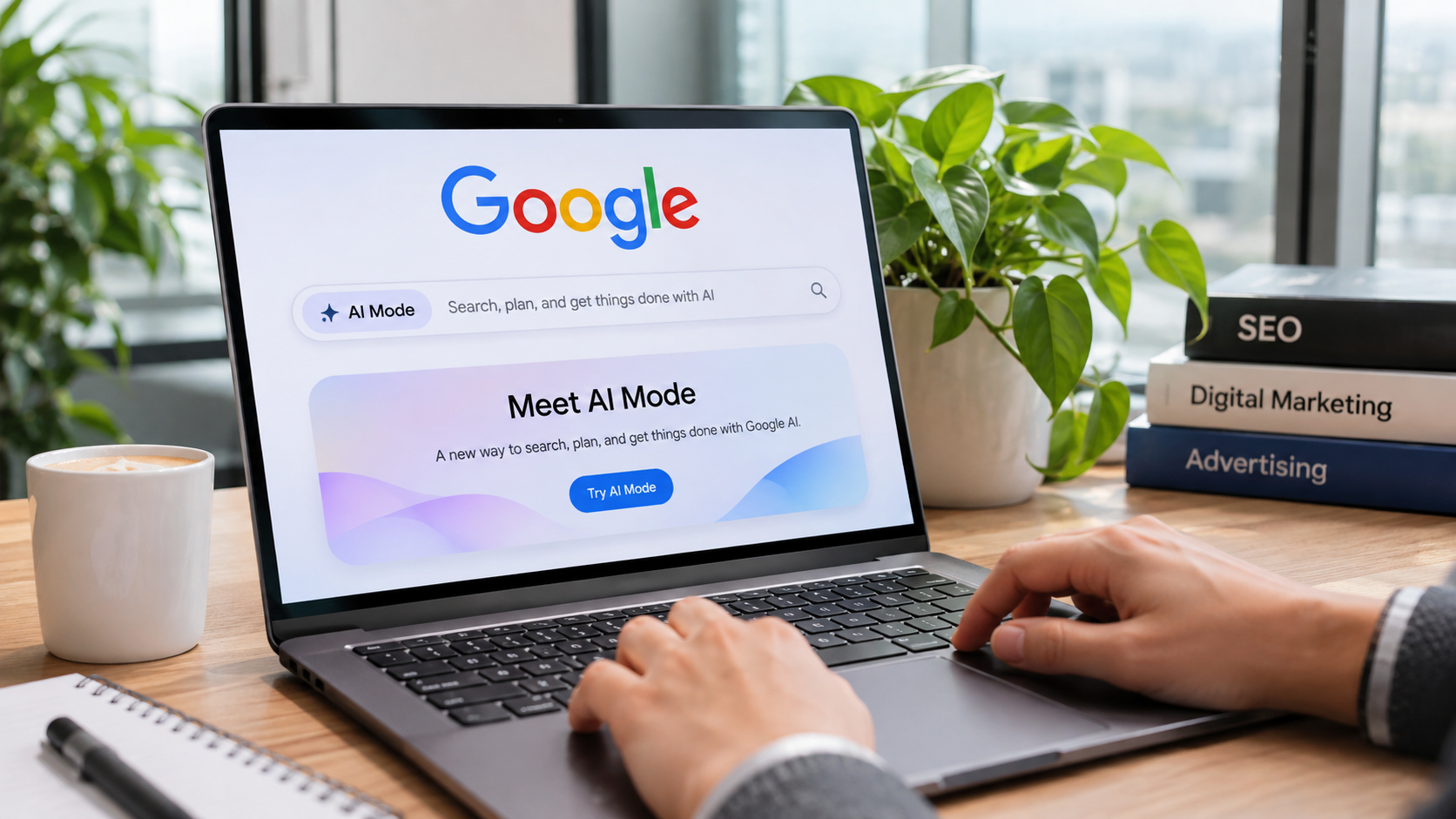
Google is facing a problem that would have sounded almost impossible a few years ago: people are searching more, but some of those searches are harder to monetize.
For decades, Google's search business has operated around a relatively straightforward exchange. Someone searches for information, a product, or a service. Google displays relevant results alongside advertising. Advertisers pay to reach potential customers, and businesses compete for visibility in the moments that influence purchasing decisions.
Artificial intelligence is changing that exchange.
Instead of entering a few keywords and browsing a page of links, users can now ask complex questions, receive synthesized answers, compare options, and continue a conversation without starting a new search.
That experience may be more convenient for users. It also creates a different economic challenge for Google.
During Alphabet's October 28, 2026, third-quarter earnings call, executives acknowledged that AI Mode's lower monetization contributed to a slowdown in Google Search advertising revenue growth.
The admission matters because Google also reported its fastest year-over-year search query growth in five years.
In other words, more search activity does not automatically translate into proportionally more advertising revenue.
For investors, that raises questions about Google's business model.
For publishers, it raises concerns about traffic and discoverability.
For advertisers and small-business owners, however, the more important question is practical:
What happens to customer acquisition when search engines increasingly answer questions, recommend businesses, and influence decisions before someone visits a website?
The answer is not that Google Ads is disappearing or that traditional SEO has become irrelevant.
It is that businesses need to rethink how visibility, advertising, and conversions work together.
This article examines what Google's latest earnings actually reveal, how AI-powered search is changing consumer behavior, and what businesses can do now to protect their visibility and marketing performance.
What Happened in Google's October 2026 Earnings?
Alphabet reported its third-quarter financial results on October 28, 2026, covering the period ending September 30.
According to Alphabet's official earnings release, the company generated $127.6 billion in consolidated revenue, an increase of 25% year over year.
Google Search and other advertising revenue grew 12% to approximately $63.3 billion.
Those numbers are important because they show that Google's core search business remains enormous and continues to grow.
The concern is not that search advertising revenue suddenly declined.
The concern is the relationship between search activity and advertising growth.
Search revenue growth slowed from 19% in the first quarter of 2026 to 17% in the second quarter and 12% in the third, according to Search Engine Journal's analysis of the results.
During the earnings call, Google Chief Business Officer Philipp Schindler explained that several factors contributed to that slowdown.
Foreign exchange was the largest factor in the deceleration from the previous quarter. Advertising spending patterns in retail and media also contributed.
But Schindler identified another factor: lower monetization within AI Mode.
That distinction is essential.
It would be inaccurate to attribute Google's entire search revenue slowdown to AI. The company specifically identified multiple contributing factors, and it did not disclose exactly how much less revenue AI Mode generates compared with traditional search.
Still, Google's acknowledgment confirms that the transition toward conversational search creates a real monetization challenge.
The company is attracting users and encouraging new search behavior while simultaneously building the advertising model that will support those interactions.
You can review management's explanation in Alphabet's Q3 2026 earnings call transcript.
For advertisers, the implication is straightforward: the way Google delivers commercial visibility is evolving, and existing performance assumptions may need to evolve with it.
Understanding Google's AI Search Monetization Problem
To understand why AI search monetization matters, it helps to look at the economics of traditional search.
Imagine someone types "best accounting software for small businesses" into Google.
In a traditional search experience, that person might see sponsored listings, comparison articles, review sites, software companies, and other relevant websites.
They may click several results before making a decision.
Each interaction creates opportunities for advertisers, publishers, and businesses to attract attention.
The advertising system is built around matching commercial intent with relevant placements and measuring the resulting interactions.
Now imagine the same person asks Google AI Mode:
"What accounting software should I use for a five-person consulting business that needs invoicing, payroll integration, and affordable monthly pricing?"
Instead of providing only a list of websites, Google can respond with an explanation tailored to the question.
The user might then ask which option integrates with their bank, which has the lowest fees, or which is easiest for a beginner.
Those follow-up questions may occur within the same conversational experience.
The user is still searching. Their intent may even become clearer as the conversation continues.
But the traditional sequence of searches, result pages, advertisements, and website visits may look very different.
That creates three challenges for monetization.
1. Fewer traditional advertising moments may occur
Traditional search presents familiar opportunities for displaying advertising alongside results.
Conversational search can combine research, comparison, and decision-making into fewer interactions.
Although a longer conversation can create additional advertising opportunities, Google needs ad formats that fit naturally into the experience without making the answers less useful.
The relationship between query volume and revenue is therefore becoming more complicated.
2. Commercial intent is harder to identify through simple keywords
Traditional search advertising often relies on the intent implied by particular searches.
Someone typing "emergency plumber near me" is demonstrating relatively clear commercial intent.
A conversational query can express several intentions at once.
Someone might ask about an appliance problem, describe symptoms, compare repair costs, and request recommendations before deciding whether they need a professional.
The advertiser's opportunity may emerge somewhere in the conversation rather than in the original query.
This creates the potential for more relevant advertising, but it also requires effective intent interpretation and placement.
3. AI experiences introduce different operating economics
Generative AI requires infrastructure capable of processing complex requests and producing responses.
Google is investing heavily in the computing infrastructure and technology that support these systems.
Its October earnings materials describe substantial ongoing investment in technical infrastructure, including AI-related capacity.
The precise operating cost of an individual AI Mode interaction has not been publicly established in the earnings data discussed here. Nevertheless, the infrastructure requirements make monetization efficiency an important part of the business discussion.
Google needs to build experiences that users value while maintaining an economically sustainable advertising model.
The central issue is not whether Google can attract search demand. It is whether the company can monetize new forms of search demand as effectively as the traditional formats they increasingly complement or replace.
Google AI Overviews vs. AI Mode vs. Traditional Search
One of the biggest mistakes businesses can make is treating all AI-powered search experiences as the same product.
Google's traditional Search, AI Overviews, and AI Mode overlap, but they are not identical.
Traditional Google Search
Traditional Search organizes information through familiar search results, including organic listings, sponsored results, local listings, shopping placements, and other features.
A user generally evaluates results and decides which websites or businesses to investigate.
Google has spent decades developing advertising formats and measurement systems around these interactions.
Traditional Search is still highly relevant for commercial queries, local discovery, and direct-response advertising.
Google AI Overviews
AI Overviews provide AI-generated summaries for certain searches, typically accompanied by links to supporting sources.
They can appear within the standard Google Search results experience.
A user might receive an immediate explanation while still having the option to explore websites and other results.
Because AI Overviews are integrated into standard Search, their advertising behavior should not automatically be confused with the economics of AI Mode.
Google's public disclosure about lower monetization specifically concerned AI Mode.
Google AI Mode
AI Mode is designed for more conversational and exploratory search behavior.
Users can submit detailed questions, ask follow-ups, and use different input formats to explore a subject.
On its October 2026 earnings call, Google reported that AI Mode queries were, on average, three times longer than traditional search queries.
It also stated that approximately one in five AI Mode searches globally used voice, images, or documents.
These figures illustrate how the structure of search behavior is changing.
Someone researching home remodeling may upload a photograph, describe a budget, request design suggestions, and then ask about nearby contractors.
Someone buying software may describe their business model before asking for suitable providers.
And someone choosing a financial service may ask for an explanation of fees before comparing companies.
These are valuable commercial interactions. They simply do not always resemble conventional keyword searches.
For businesses, the distinction matters because the strategies used to earn a traditional ranking, appear in an AI-generated answer, and generate a paid advertising conversion are related but not interchangeable.
Is AI Search Actually Reducing Website Traffic?
The concern about AI-powered search goes beyond Google's advertising revenue.
Businesses and publishers also want to know whether AI-generated answers reduce the number of people visiting websites.
Available research provides reasons to take this question seriously.
In July 2025, Pew Research Center published an analysis of Google search behavior based on browsing activity from 900 U.S. adults in March 2025.
The study found that users clicked a traditional search result in 8% of visits to pages containing an AI summary, compared with 15% of visits to pages without an AI summary.
Users clicked links directly within AI summaries during just 1% of visits to pages containing those summaries.
Pew also observed that users were more likely to end their browsing session after encountering an AI summary.
These results suggest that AI-generated answers can change how frequently people leave the search results page.
Additional industry research points in a similar direction.
In February 2026, Ahrefs published an updated analysis of AI Overviews and organic click-through rates.
Its research found that the presence of an AI Overview correlated with an approximately 58% lower average click-through rate for the top-ranking organic page compared with its modeled expectation.
That finding deserves attention, but it also requires context.
The Ahrefs analysis concerns organic results associated with AI Overviews. It is not a measurement of AI Mode advertising revenue, and the reported relationship does not establish that every site's traffic will decline by the same percentage.
Similarly, Pew's research examined observed user behavior in a particular period and sample. Its results should not be treated as a universal forecast for every industry or search query.
Still, the broader implication is difficult to ignore:
A business can remain visible in search while receiving a different volume and quality of website traffic than it would have under earlier search experiences.
For organizations that evaluate SEO exclusively through traffic growth, that creates a measurement problem.
A business might be mentioned in an AI-generated recommendation without receiving an immediate click.
A prospective customer might remember its name and return later through a branded search.
Another might receive enough information to decide against the business without ever visiting its website.
These outcomes are commercially different, yet conventional search metrics do not always explain the full journey.
That is why search visibility and customer acquisition need to be evaluated together.
The Bigger Shift: Search Is Becoming a Recommendation Experience
The most important transformation may not be the introduction of AI-generated summaries.
It may be the growing role that search systems play in evaluating options.
Traditional search often required users to do much of the comparison work themselves.
A search engine helped someone locate information. The user then reviewed pages, compared claims, and made a decision.
AI-powered search can participate more directly in that comparison process.
Consider a homeowner looking for a roofing contractor.
A traditional search might begin with "roofing companies near me."
A conversational search could begin with:
"I need a roofing company that handles storm damage, offers financing, and has experience with older homes. What should I look for?"
A follow-up might ask which local companies meet those criteria.
At that point, the search system is doing more than retrieving information.
It is helping establish the criteria used to evaluate the purchase.
That shift creates new marketing questions.
Is the business clearly associated with the services it offers?
Does its website explain who it serves, where it operates, and why customers choose it?
Are its service descriptions specific enough to support detailed recommendations?
Does its online reputation reinforce its claims?
And is its information consistent across its website, business listings, and other credible sources?
These questions have always mattered in marketing.
AI search makes them more visible because businesses are increasingly competing to be understood and considered, not merely discovered.
At Ritner Digital, this is the strategic connection between traditional SEO and generative engine optimization: building a business's discoverability across the different experiences people use to find and evaluate providers.
What Google's AI Search Changes Mean for Advertisers
The implications are not identical for every advertiser.
A local service company, an ecommerce retailer, a software provider, and a professional services firm may encounter different opportunities and risks.
Understanding those differences is more useful than assuming that AI search will affect every business equally.
Local service businesses
Local service providers depend heavily on geographic relevance, reputation, and timely demand.
For an emergency service, a user may still prefer to call a business directly from a standard search result or business listing.
But for a more considered purchase, such as selecting a remodeler or financial professional, AI-assisted research could play a larger role.
Businesses should make sure their websites describe their service areas, specialties, qualifications, and customer processes accurately.
Their Google Business Profiles also need complete information.
Google's local ranking guidance identifies relevance, distance, and prominence as key factors in local results.
AI-powered discovery does not eliminate the importance of those fundamentals.
Ecommerce brands
Ecommerce advertisers may see opportunities as AI-assisted shopping and product comparison expand.
Instead of searching for a broad product category, users may describe specific preferences, limitations, or intended uses.
That makes accurate product information increasingly important.
Product names, specifications, availability, pricing, shipping details, imagery, and return policies can all help a shopper understand whether an item is suitable.
Google's guidance for ads in AI-powered search experiences specifically emphasizes keeping Merchant Center product information accurate and current.
For retailers, better product data is not simply a technical housekeeping task.
It supports the ability to communicate product relevance across different shopping experiences.
B2B and professional services
Professional services and B2B purchases often involve substantial research before a buyer contacts a provider.
Prospects may compare approaches, assess industry experience, examine case studies, and look for evidence of expertise.
AI search can potentially consolidate some of this preliminary research.
That makes specificity valuable.
A page describing a company's experience with a particular industry, customer type, or business problem may be more useful than a generic page promising comprehensive solutions.
However, businesses should not assume that publishing more content automatically produces more AI visibility.
Credibility, clarity, usefulness, and genuine expertise matter more than producing large volumes of interchangeable articles.
Businesses with limited advertising budgets
Small businesses may be especially sensitive to changes in search performance.
A large advertiser can often experiment across multiple channels and campaign types.
A smaller organization may rely on one or two campaigns to generate a meaningful share of its monthly leads.
If the quality of those leads changes, the financial impact can be significant.
That does not mean small businesses should abandon Google Ads.
It means they need stronger measurement, better landing pages, and a clearer understanding of which campaigns produce profitable customers.
How Google Is Responding to the AI Advertising Challenge
Google is not waiting for a mature advertising model to appear on its own.
The company is actively expanding advertising within AI-powered experiences.
On October 28, 2026, Google announced the expansion of AI Mode advertising into additional international markets, including Australia, Canada, India, and several other countries.
It also announced multiturn advertisements in the United States, allowing advertising to appear in follow-up interactions within AI Mode.
These developments are significant because they illustrate Google's direction.
Advertising is being adapted to conversational experiences rather than restricted to conventional keyword-result pages.
Google also reported that click-through rates were similar between sponsored and organic product listing items within AI Mode during its internal research period.
That is a potentially encouraging signal, but it should be interpreted carefully.
The comparison concerns sponsored and organic product listings within AI Mode. It does not demonstrate that AI Mode monetizes as effectively as traditional Search, nor does it establish equivalent performance for every advertiser.
The company has not publicly supplied the complete figures needed to make those broader conclusions.
According to Google's documentation on advertising in AI-powered search, existing eligible Search, Shopping, and Performance Max campaigns can participate in AI Overviews and AI Mode advertising opportunities.
Advertisers generally do not need to create an entirely separate campaign solely to participate in these experiences.
However, Google also states that advertisers cannot currently target only AI Overviews or AI Mode, or opt out of those placements independently from Search.
Performance data from these experiences is included within aggregate Google Ads reporting rather than offered as a complete, standalone placement-level breakdown.
That creates an important practical limitation.
An advertiser may be participating in AI-powered placements without having the same level of visibility into their individual performance that they would prefer.
For this reason, campaign-level results and business outcomes remain more useful than speculation about what a particular AI search placement might be doing.
10 Things Businesses Should Do Now to Prepare for AI Search
The emergence of AI-powered search does not require every company to rebuild its marketing strategy.
It does require a more disciplined approach to how visibility becomes revenue.
The following actions provide a practical starting point.
1. Stop treating website traffic as the only measure of SEO success
Traffic remains important, but it is not the same as business growth.
A company can receive substantial search traffic from visitors who are unlikely to become customers.
Another can receive fewer visits from people with clearer purchasing intent.
The second situation may generate more valuable commercial results.
Google has itself encouraged website owners to evaluate conversions, engagement, and the value of visits when assessing AI search performance in its Search Central guidance.
Businesses should monitor qualified inquiries, booked appointments, sales, and other meaningful outcomes alongside rankings and organic sessions.
This is particularly important when AI-generated answers may satisfy some informational searches before users visit a website.
The goal is not simply to attract visitors.
It is to attract customers who are a good match for the business.
2. Build content around the questions customers actually ask
Traditional keyword research remains useful.
But businesses should also investigate the detailed questions prospective customers ask before making decisions.
A basic keyword such as "business insurance" reveals a topic.
A question such as "What insurance does a two-person consulting business need before signing its first enterprise client?" reveals a more specific problem.
That specificity helps businesses understand the circumstances, concerns, and decision criteria involved in customer research.
Useful content should answer those questions directly, explain important trade-offs, and provide accurate information that supports a decision.
Avoid publishing superficial pages that merely repeat similar keywords.
Search engines may change how they display answers, but customers still need trustworthy explanations.
3. Treat SEO and generative engine optimization as complementary disciplines
Search engine optimization helps websites become accessible, understandable, and relevant within search results.
Generative engine optimization, often called GEO, focuses on improving a brand's ability to be accurately represented and discovered within AI-generated experiences.
The two approaches overlap considerably.
In fact, Google's official AI search documentation explicitly states that established SEO best practices remain relevant to AI Overviews and AI Mode.
Google also says there are no special technical requirements or unique schema markup that guarantees appearance in these features.
That is an important corrective to some of the marketing hype surrounding GEO.
Businesses should not assume that purchasing an AI optimization package, adding a special file, or inserting hidden prompts will secure AI recommendations.
A stronger approach combines technically accessible pages, helpful content, clear business information, and credible supporting references.
At Ritner Digital, generative engine optimization is considered alongside traditional search visibility rather than as a replacement for it.
4. Strengthen the information on core service and product pages
Many businesses publish blogs while neglecting the pages that explain what they actually sell.
That is a missed opportunity.
A service page should make it easy to understand the business's offer, intended customer, service area, process, and relevant differentiators.
A product page should communicate essential specifications and purchasing information.
A professional services page should explain the problems the company solves and provide evidence for any important claims.
These details are valuable to visitors regardless of which channel brought them to the website.
They also make the information easier for search systems to interpret.
The objective should be clarity, not keyword density.
An informative page that accurately explains a specialized service is more useful than one filled with repetitive marketing language.
5. Keep business information accurate across the web
A business's website is not the only source people encounter during the discovery process.
Customers may consult business listings, review platforms, directories, industry publications, and social profiles.
Conflicting information across those sources can create confusion.
Businesses should regularly review their names, addresses where applicable, phone numbers, operating hours, service categories, and major business descriptions.
For local businesses, Google Business Profile deserves particular attention.
For ecommerce companies, product feeds need similar care.
Consistent, accurate information helps customers verify that they have found the right provider.
It also reduces the likelihood that outdated details create friction during the customer journey.
Consistency alone does not guarantee an AI citation or ranking.
It is simply part of maintaining a trustworthy digital presence.
6. Make expertise visible instead of merely claiming it
Every business can describe itself as reliable, experienced, or customer-focused.
Those statements are less persuasive without supporting evidence.
More useful content might include a documented case study, an explanation of a proprietary process, original photographs, professional qualifications, or detailed answers based on actual experience.
A marketing agency can explain how it evaluates campaign performance.
A contractor can document the considerations involved in choosing materials.
A software provider can explain how a particular feature works and when customers may not need it.
The best evidence depends on the industry.
The broader principle is that businesses should give potential customers something concrete to evaluate.
Credible external mentions and editorial coverage can also help establish awareness and reputation.
However, businesses should avoid treating backlinks or press coverage as guarantees of favorable AI-generated recommendations.
7. Reevaluate Google Ads performance using customer outcomes
As Google's advertising inventory evolves, businesses need to know what their campaigns are actually producing.
Clicks and impressions provide useful information, but they do not establish profitability on their own.
For a lead-generation business, valuable measurements may include cost per qualified lead, appointment-booking rate, sales conversion rate, and customer acquisition cost.
For ecommerce, relevant metrics may include purchase conversion rate, revenue, contribution margin, and return on advertising spend.
Google's conversion tracking documentation explains how conversion rate and conversion value metrics can be used to assess campaign performance.
Businesses should also review whether their tracking systems accurately distinguish meaningful actions from low-value events.
A form submission and a completed sale should not necessarily be assigned the same business value.
The better the underlying measurement, the easier it becomes to evaluate changes in campaign performance.
8. Test advertising automation without surrendering oversight
Google continues introducing automated advertising tools designed to interpret search intent and improve campaign delivery.
AI Max for Search campaigns, for example, includes enhancements involving query matching, creative customization, and landing-page selection.
Google describes these capabilities in its AI Max documentation.
Automation may help advertisers identify relevant opportunities that would be difficult to manage manually.
But broader matching and automated creative decisions also introduce potential risks if campaign goals, conversion tracking, or landing-page quality are weak.
Businesses should review search-term relevance, conversion quality, automatically generated assets, and destination pages.
They should also establish an appropriate testing period before drawing conclusions.
The objective is not to reject automation or adopt every new setting immediately.
It is to understand whether a particular tool improves measurable performance.
9. Diversify how customers discover the business
Dependence on a single acquisition channel creates risk.
That remains true whether the channel is organic Google Search, paid advertising, social media, or an AI assistant.
Businesses can reduce that dependence by building a connected marketing system.
Organic search may introduce a potential customer to the company.
A useful article may establish credibility.
A social profile may reinforce familiarity.
An email newsletter may maintain the relationship.
A direct inquiry or branded search may eventually lead to a sale.
Not every business needs every channel.
The right combination depends on its audience, business model, budget, and sales cycle.
The principle is to create multiple credible paths between customer discovery and conversion instead of relying entirely on one platform's algorithm.
10. Audit how your business appears in AI-generated answers
One of the most practical steps businesses can take is to investigate what potential customers see when using AI-powered search.
This does not require an expensive enterprise platform to begin.
Start by identifying a small set of commercially relevant questions.
Search those questions in traditional Google Search, Google AI Mode, and another relevant AI assistant.
Record which businesses appear, how they are described, what sources are referenced, and whether users have a clear next step.
Repeat the process periodically, using consistent conditions where possible.
AI responses can vary because of location, personalization, model behavior, and changes over time.
A single result should not be treated as conclusive evidence of a brand's market visibility.
But a structured audit can reveal useful questions for further investigation.
It may identify missing service information, competitor positioning, inconsistent business details, or topics that deserve stronger content.
A 25-Query Framework for Auditing AI Search Visibility
Businesses increasingly need to understand how their visibility changes across traditional search and conversational discovery.
A practical way to begin is with a controlled 25-query audit.
Important methodological distinction: The framework below is a recommended research process, not a completed Ritner Digital study. It does not represent measured results or claim that any platform consistently favors particular businesses.
To conduct the audit, select one business category, a defined geographic market if appropriate, and a consistent set of commercial questions.
For a local service business, the questions might cover five stages of the customer journey.
Initial discovery: What providers offer this service in my area? Which businesses specialize in this problem? What should I look for when choosing a provider? What qualifications matter most? What is the typical purchasing process?
Comparison: How do I compare providers? What separates a specialist from a generalist? Which features or services matter most? What questions should I ask before hiring? What are the trade-offs between different approaches?
Cost and value: What affects the price? What is typically included? Are there common additional charges? How do I evaluate whether a quote is reasonable? When might a more expensive option be worthwhile?
Trust and credibility: How can I verify a company's experience? What evidence should I look for? How do I assess reviews? What warning signs should I consider? What guarantees or commitments should I clarify?
Purchase readiness: Which providers meet my requirements? What information should I prepare before contacting them? How quickly can the service begin? What happens after the initial consultation? What is the most useful next step?
The exact wording should be adapted to the industry.
A business selling software may need questions about integrations and implementation costs. A roofing contractor may need questions about project scope, insurance, and local service availability.
Each query should be evaluated in the context of real customer needs.
What to document
For each question, record whether the target business appears in ordinary search listings, AI-generated responses, or supporting links.
Note which competitors appear.
Record whether the answer describes the business accurately.
Identify the sources associated with important claims.
Look for clear routes to the business's website or contact information.
Save dated screenshots where appropriate, along with relevant details such as geographic location, device, and whether personalization may have affected the results.
When comparing platforms, remember that a traditional search listing, an organic AI citation, and a sponsored placement are different types of visibility.
They should not be counted as interchangeable endorsements.
To improve reliability, repeat the audit on multiple dates and document any major changes in the responses.
If results are published as original research, the accompanying methodology should explain the category, query selection, collection dates, platforms, limitations, and measurement rules.
What the audit can reveal
The value of this exercise is not producing a dramatic percentage from a small sample.
A 25-query test is generally too limited to support broad claims about an entire industry.
Its value is diagnostic.
It can reveal which questions are commercially relevant, which competitors repeatedly appear, and whether a business's own information supports the answers customers need.
It can also help prioritize content improvements and establish a repeatable monitoring process.
For a business investing in both SEO and AI search visibility, those insights can inform a more coordinated strategy.
Why Traditional SEO Still Matters in an AI-Driven Search Market
Claims that AI has made SEO obsolete misunderstand how these systems work.
Google's own documentation explains that websites appearing as supporting links in AI Overviews and AI Mode must meet the usual requirements for Google Search indexing and snippet eligibility.
There are no special technical requirements that automatically secure inclusion.
Established practices such as crawl accessibility, useful content, internal linking, appropriate structured data, and accurate business information remain relevant.
That does not mean every business currently ranking on page one will automatically appear in AI-generated answers.
Nor does it mean that traditional ranking position and AI citations are equivalent.
It means the foundations of discoverability continue to matter.
Businesses still need search engines to understand their websites.
Customers still need reliable information.
And commercial pages still need to persuade people to take action.
The biggest change is that a website may influence the customer journey before a user visits it.
That makes the quality of publicly available information especially important.
A business should be able to explain what it does, whom it serves, why it is relevant, and what evidence supports its claims.
Those are basic marketing requirements that remain valuable regardless of the interface used to discover the business.
A Practical 90-Day Response Plan for Small Businesses
Businesses do not need to overhaul everything immediately.
A structured 90-day plan can help translate the changing search environment into manageable priorities.
Days 1–30: Establish your baseline
Begin by reviewing existing search performance.
Identify the organic pages generating relevant inquiries, the paid campaigns producing qualified customers, and the questions prospects frequently ask.
Review Google Search Console, Google Analytics, and Google Ads reporting where available.
Confirm that important conversion actions are being measured accurately.
Then perform a basic AI visibility review using commercially relevant questions.
Document the results without assuming that one day's AI outputs represent permanent rankings.
At the end of the first month, the business should understand its major search dependencies and most important measurement gaps.
Days 31–60: Improve the content and conversion experience
Prioritize improvements to the pages most closely connected to revenue.
Clarify service descriptions, answer common objections, improve calls to action, and make relevant evidence easier to find.
Update inaccurate business information and review product data or local profiles as needed.
Where appropriate, add useful articles that explain important customer decisions.
Avoid creating content simply to increase publishing volume.
During this stage, also review whether paid traffic is reaching appropriate landing pages and whether those pages make the next step obvious.
Days 61–90: Test, compare, and refine
Use the established baseline to evaluate changes.
Review qualified leads, conversion rates, acquisition costs, and relevant organic performance trends.
Repeat the AI visibility audit using the same documented questions and conditions.
Look for meaningful patterns rather than isolated mentions.
Evaluate whether advertising experiments are producing stronger commercial results.
If performance changes, investigate plausible causes instead of immediately attributing every fluctuation to AI search.
Seasonality, competition, campaign changes, website performance, and broader market conditions can also affect results.
The objective of the 90-day process is not to prove that a business has mastered AI search.
It is to establish a repeatable system for understanding and improving digital customer acquisition.
The Future of Google Search Advertising: Three Possible Outcomes
Google's long-term approach to AI search monetization is still developing.
Although the company has expanded AI advertising formats, there is not enough public information to declare how the transition will ultimately affect every advertiser.
Several outcomes are plausible.
Scenario one: AI advertising becomes more effective
As Google develops new formats and improves intent interpretation, advertisers may gain opportunities to reach customers during highly relevant conversational moments.
Detailed questions could help clarify what a user wants, potentially improving the relevance of sponsored recommendations.
If those interactions produce valuable conversions, advertisers may find new reasons to invest.
This scenario depends on effective execution and measurable business results, not merely higher AI usage.
Scenario two: Search visibility grows while website visits become less predictable
AI experiences may continue satisfying some information needs without requiring a website visit.
Businesses could encounter more complex relationships between rankings, mentions, branded demand, and conversions.
Marketing teams would then need to evaluate visibility across multiple stages of the customer journey.
This would make attribution and brand measurement more important.
Scenario three: Search becomes a more integrated transaction experience
Google is also developing AI experiences that help people complete tasks rather than simply research them.
During its earnings discussion, the company highlighted opportunities involving actions such as reservations, forms, and purchases.
If more tasks occur inside AI-assisted interfaces, businesses may need to reconsider how customers move from discovery to transaction.
The resulting opportunities would vary substantially by industry.
None of these scenarios should be treated as guaranteed.
The practical strategy is to remain adaptable while protecting the fundamentals of customer acquisition.
Frequently Asked Questions
Does Google AI Mode generate less advertising revenue than traditional Search?
During Alphabet's October 28, 2026 earnings call, Google acknowledged that AI Mode's lower monetization contributed to slower Search advertising revenue growth.
However, Google did not publish a precise comparison showing the revenue generated by an average AI Mode query versus an average traditional search.
It is therefore accurate to say that AI Mode was monetizing less effectively at the time of the disclosure, but not to assign a specific revenue gap without additional evidence.
Is Google Search advertising revenue declining?
No. Google's Search and other advertising revenue increased 12% year over year in the third quarter of 2026, reaching approximately $63.3 billion.
What slowed was the rate of revenue growth compared with previous quarters.
Google cited foreign exchange, advertising category dynamics, and lower AI Mode monetization among the contributing factors.
The distinction between declining revenue and slower revenue growth is important when interpreting the company's performance.
Are Google Ads appearing in AI Mode?
Yes. Google supports advertising within AI Mode and AI Overviews for eligible campaigns.
These placements can include sponsored results relevant to commercial questions.
Google has also announced an expansion of AI Mode advertising into additional markets and multiturn advertising in the United States.
Ads are labeled as sponsored, and Google states that paid advertising does not influence the organic responses generated by its AI systems.
Do businesses need a separate Google Ads campaign for AI Mode?
Generally, no.
According to Google's current advertising documentation, eligible existing Search, Shopping, and Performance Max campaigns can participate in AI-powered search advertising.
Businesses cannot currently create an AI Mode-only targeting strategy through a dedicated placement option or independently opt out of those placements.
The best approach is to review campaign eligibility, improve conversion tracking, and evaluate results using available reporting.
Can advertisers measure AI Mode performance separately?
Google currently includes AI Overviews and AI Mode advertising activity within aggregate campaign reporting.
That means advertisers can see relevant results reflected in their Google Ads data but do not have a complete, separate AI Mode reporting environment for every placement.
Businesses should avoid making unsupported claims about the precise performance of individual AI placements when the necessary breakdown is not available.
Instead, evaluate overall campaign effectiveness through meaningful conversion and revenue metrics.
Will AI search make traditional SEO obsolete?
There is no evidence that traditional SEO has become obsolete.
Google explicitly states that established SEO best practices remain relevant to AI Overviews and AI Mode.
Technical accessibility, helpful content, clear website structure, and accurate information still matter.
What is changing is the range of experiences through which customers discover businesses.
Organizations should therefore consider traditional SEO and AI search visibility together rather than treating them as competing strategies.
What is generative engine optimization?
Generative engine optimization, or GEO, refers to strategies intended to improve how a business or its content is discovered, understood, and represented within AI-generated search and recommendation experiences.
GEO commonly overlaps with SEO, content strategy, technical accessibility, entity consistency, and digital authority.
There is no guaranteed method for making an AI system cite or recommend a particular brand.
Businesses should be cautious of services promising automatic placement or guaranteed AI rankings.
Can a business appear in AI-generated answers without receiving website traffic?
Yes.
An AI system may describe a company, mention its products, or summarize information associated with it without the user immediately visiting the company's website.
This creates a distinction between brand visibility and measurable referral traffic.
A mention may influence awareness, but it should not automatically be counted as a lead, conversion, or sale.
Businesses need a balanced measurement approach that includes both visibility indicators and commercial outcomes.
Should small businesses reduce their Google Ads budgets because of AI Mode?
Not solely because AI Mode currently has lower monetization for Google.
Google's revenue per search experience is not the same measurement as an individual advertiser's return on investment.
A business could still generate profitable leads from Google Ads even while Google's overall monetization model evolves.
Budget decisions should be based on actual campaign performance, qualified customer acquisition, margins, and the availability of better alternatives.
Abrupt changes based on broad industry headlines can create unnecessary risk.
What should businesses prioritize first: SEO, GEO, or paid advertising?
The right priority depends on the business's current visibility, available budget, competitive environment, and revenue goals.
A company needing near-term leads may benefit from well-managed paid advertising.
A business seeking long-term discoverability may need stronger organic content and technical SEO.
An organization already investing in search may benefit from reviewing how it appears in AI-generated responses.
In many cases, the strongest strategy combines these activities rather than relying entirely on one.
The priority should be creating measurable customer acquisition, not adopting whichever marketing acronym is receiving the most attention.
The Bottom Line: More Searches Do Not Automatically Mean More Customers
Google's AI search monetization challenge is an important development, but its significance extends well beyond Alphabet's financial results.
It shows that one of the world's most established digital advertising models is adapting to a different kind of search behavior.
People are asking more detailed questions.
They are receiving synthesized answers.
They are comparing businesses within conversational experiences.
And they may reach purchasing decisions through journeys that look different from the traditional sequence of keywords, search results, and website clicks.
Google is working to build an advertising system around those behaviors.
Advertisers must learn how to operate effectively within the changing environment.
For small businesses, the most productive response is not panic.
It is preparation.
That means maintaining strong SEO fundamentals, improving content quality, understanding AI search visibility, reviewing advertising performance, and measuring the customer actions that actually support business growth.
A business does not need to predict the future of Google Search perfectly.
It needs to make sure potential customers can discover it, understand its value, and take the next step when they are ready.
Is Your Business Visible Where Customers Are Searching?
At Ritner Digital, we connect SEO, AI search visibility, content strategy, paid advertising, and performance measurement to help businesses improve how they are discovered and how that attention turns into meaningful results.
Whether you're concerned about declining organic clicks, unsure how AI-generated answers represent your business, or looking to make your advertising budget work harder, the starting point is understanding where your current strategy stands.
Want to understand how AI-powered search could affect your business?
Contact Ritner Digital to discuss your search visibility and customer acquisition strategy.
Sources and Further Reading
The following primary sources and independent research informed this article. Information about Google's financial performance is based on its October 28, 2026 disclosures.
Alphabet Investor Relations — Third Quarter 2026 Financial Results. Official revenue and financial performance data, October 28, 2026.
Alphabet Investor Relations — Q3 2026 Earnings Call Transcript. Executive discussion of AI Mode monetization, search growth, and advertising performance, October 28, 2026.
Google — Q3 2026 Earnings Call: Remarks From Our CEO. Google's discussion of AI search behavior and query growth, October 28, 2026.
Google — Ads in AI Mode Expand to New Markets. Official announcement about international expansion and multiturn advertising, October 28, 2026.
Google Ads Help — About Ads in AI-Powered Experiences in Google Search. Campaign eligibility, ad placement, controls, and reporting.
Google Search Central — AI Features and Your Website. Official guidance on AI Overviews, AI Mode, indexing, and SEO.
Pew Research Center — Google Users Are Less Likely to Click on Links When an AI Summary Appears. Independent analysis of observed search behavior, July 22, 2025.
Ahrefs — Update: AI Overviews Reduce Clicks by 58%. Industry analysis of organic click-through rates, February 4, 2026.
Google Search Central — Top Ways to Ensure Your Content Performs Well in Google's AI Experiences. Guidance on useful content, website engagement, and AI search performance.
Google Ads Help — About AI Max for Search Campaigns. Documentation about AI-enhanced search advertising.
Google Business Profile Help — Tips to Improve Your Local Ranking. Official local visibility recommendations.
Google Ads Help — Understand Your Conversion Tracking Data. Definitions and guidance for measuring advertising outcomes.