How Long Does It Take to Appear in ChatGPT Results?
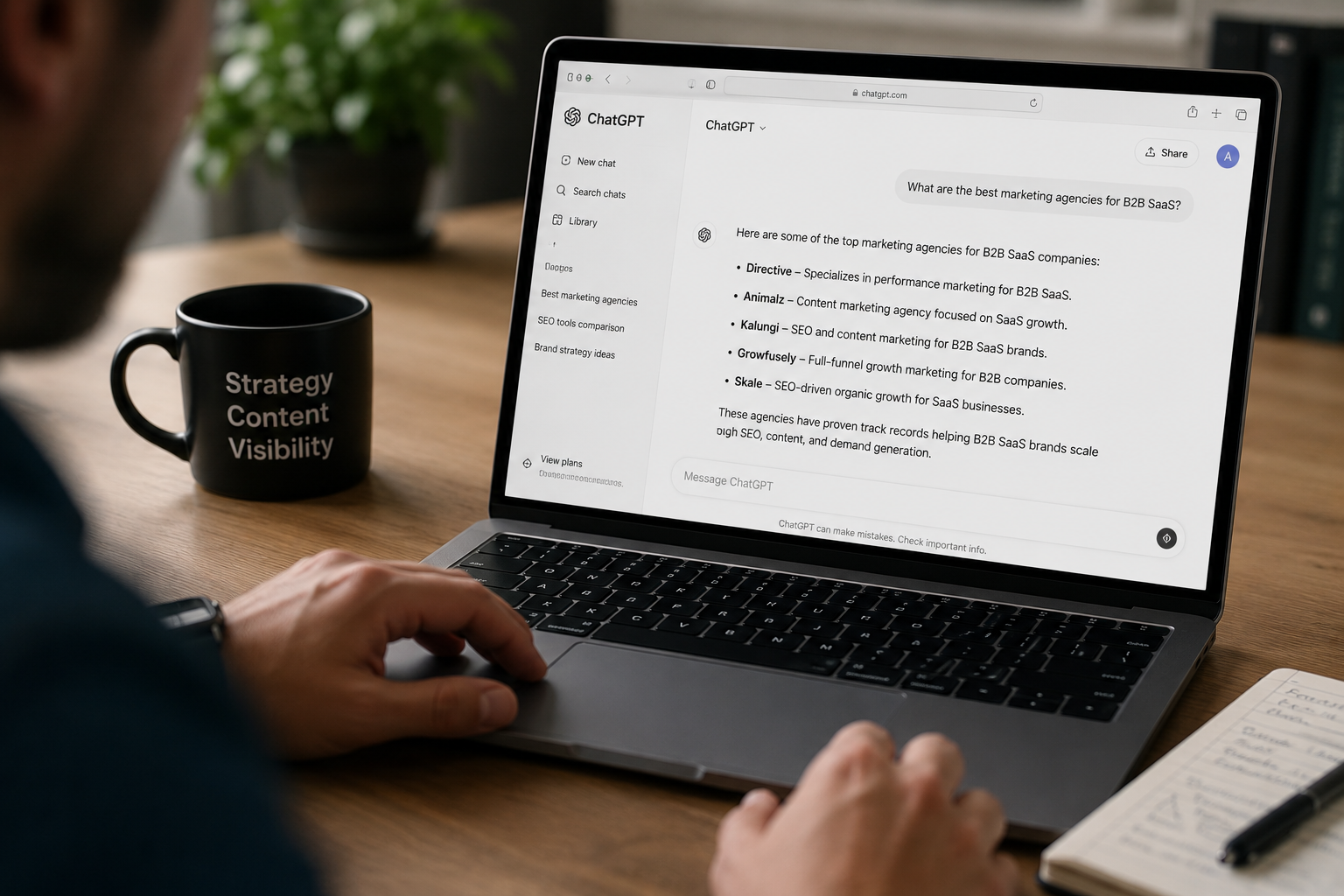
This is one of the most common questions we get from clients who are paying attention to where AI search is going. They've tried asking ChatGPT about their industry, their services, their category — and their brand doesn't come up. Competitors do. Generic recommendations do. But not them.
So they want to know: how long until that changes? What's the timeline? What do they need to do?
The answer is more nuanced than most people want to hear — and more actionable than most people expect.
First, Understand How ChatGPT Actually Surfaces Brands
To set a realistic timeline, you have to understand the mechanism. ChatGPT doesn't surface brands the way Google surfaces websites. There's no ranking algorithm you can reverse-engineer, no position one to aim for, no keyword you can optimize a page around and expect a predictable result.
ChatGPT — depending on which version and which mode you're using — draws from two distinct sources, and they work very differently.
Training data. The base model was trained on a massive corpus of text from across the internet up to a specific cutoff date. Brands, concepts, and information that appeared frequently and authoritatively in that training data are baked into the model's understanding of the world. If your brand was well-represented in high-authority publications, industry databases, forums, and web content before that cutoff, the model has a baseline awareness of you. If it wasn't, the model essentially doesn't know you exist — regardless of how good your website is today.
Real-time web search. ChatGPT with search enabled — available in various forms depending on the version — can retrieve current web content to supplement its responses. When a user asks a question that triggers a web search, ChatGPT pulls from live sources and can cite content published recently. This is the mechanism that makes appearing in ChatGPT results actionable in a shorter timeframe than waiting for a model retrain.
Understanding which of these two mechanisms is at play for a given query is the foundation of any realistic timeline conversation.
The Two Timelines You're Actually Working With
Timeline One: Training Data Inclusion — 12 to 24+ Months
If you want your brand baked into ChatGPT's base model knowledge — the kind of awareness that surfaces your name even when search isn't enabled — you are working on a timeline measured in years, not months.
Model training happens on large, infrequent cycles. The training data cutoff for any given model version represents a snapshot of the web at a specific point in time. Content published after that cutoff doesn't exist to the base model until the next training cycle incorporates it.
More importantly, appearing in training data isn't just about publishing content. It's about being represented in the sources that training data draws from heavily — major publications, authoritative industry sites, Wikipedia, well-cited research, forums with high engagement. A blog post on your own domain is unlikely to move the needle on training data inclusion. Coverage in a publication that is itself heavily represented in training data is what builds the kind of brand awareness that gets baked into the model.
This is a 12 to 24 month horizon at minimum, and it requires earned media and citation building, not just on-site content production.
Timeline Two: Search-Enabled Citations — 4 to 12 Weeks
When ChatGPT uses its web search capability to answer a question, it is retrieving and synthesizing current web content in real time. This is a meaningfully shorter timeline — and a much more actionable one.
If your content is indexed by Google, structured clearly enough for an AI system to extract and cite, authoritative enough to be selected over competing sources, and directly answers the specific question being asked — it can appear in ChatGPT search-enabled responses within weeks of publication.
The factors that determine speed here are indexation time, content quality, domain authority, and how well the content matches the query. A well-structured piece of content on a domain with reasonable authority, properly indexed and directly answering a specific question, can realistically start appearing in ChatGPT search citations within four to twelve weeks of publication.
That's the actionable window. That's where the work lives.
What Actually Determines Whether You Appear
Timeline matters less than the underlying conditions that determine eligibility. Even a perfectly timed piece of content won't get cited if the foundational requirements aren't met.
Your content has to directly answer the question being asked. ChatGPT search retrieves content that most efficiently answers a user's query. Content structured around clear questions and direct answers — not content that buries the answer in narrative paragraphs — gets selected more consistently. This is why FAQ-format content, structured guides, and explicit Q&A pages perform better for AI citation than blog posts optimized for keyword density.
Your domain needs baseline authority. ChatGPT search, like Google, is more likely to cite content from domains with established credibility. A domain with a real backlink profile, consistent publication history, and legitimate traffic signals is more citable than a new domain with thin content — even if the specific piece of content is excellent. This is why authority building is a prerequisite, not an afterthought.
Your brand needs to exist in third-party sources. ChatGPT is significantly more likely to mention a brand that appears across multiple credible, independent sources than one that exists only on its own website. Reviews on established platforms, mentions in industry publications, listings in authoritative directories, and coverage in legitimate press all contribute to the signal that your brand is real, credible, and worth referencing.
The query has to trigger a search. Not every question asked in ChatGPT triggers a web search. Conceptual or general knowledge questions often get answered from training data alone, with no web retrieval. Questions about current options, specific vendors, recent developments, pricing, and comparisons are more likely to trigger search — and those are the queries where appearing in results is most commercially valuable.
Your content has to be indexed. This sounds obvious but it's frequently the bottleneck. Content that isn't indexed by Google can't be retrieved by ChatGPT search. Checking Search Console to confirm indexation, submitting sitemaps, and fixing crawl issues are foundational steps that have to happen before any other optimization work matters.
The Queries Where Appearing Is Most Valuable — and Most Achievable
Not all ChatGPT queries are equal in terms of commercial value or achievability. Focusing effort on the right query types accelerates both the timeline and the impact.
Comparison and recommendation queries — "what's the best agency for X," "which tool should I use for Y," "compare options for Z" — are high commercial value and frequently trigger web search. These are the queries where appearing gives you a direct insertion into a buyer's consideration set.
Pricing and cost queries — "how much does X cost," "what should I budget for Y" — are extremely high intent and consistently trigger search retrieval. Content that directly answers these questions in a clear, structured format has a strong track record of AI citation.
How-to and process queries — "how do I do X," "what's the process for Y" — are well-suited to the kind of structured, step-by-step content that AI systems extract efficiently. These build topical authority even when they're not directly commercial.
Category definition queries — "what is X," "how does Y work," "what's the difference between X and Y" — are foundational for establishing your brand as an authority in a space. AI systems frequently cite definitional content when building synthesized answers.
What Doesn't Work
Just as important as what works is what doesn't — because a lot of the effort businesses are putting into AI search visibility isn't moving the needle.
Publishing more content without improving structure doesn't help. Volume without quality and organization is noise to an AI retrieval system. Thirty thin blog posts are less citable than three comprehensive, well-structured guides.
Optimizing only your own website without building external presence doesn't get you into training data. The web of external citations — publications, reviews, mentions, links — is what builds the multi-source brand presence that AI models treat as credible.
Targeting only branded queries is the wrong starting point. If someone asks ChatGPT specifically about your brand by name and you don't appear, that's a training data problem that content alone won't fix quickly. The higher-leverage opportunity is appearing for the category and comparison queries where buyers are actively forming their consideration set.
Expecting fast results without domain authority is unrealistic. A new domain publishing excellent content will almost always lose the citation battle to an established domain publishing good content. Authority is the ceiling on how quickly any of the other work can take effect.
A Realistic Roadmap
If you're starting from scratch — minimal brand presence in third-party sources, early-stage domain authority, limited existing content — here's what a realistic progression looks like:
Months one and two are foundational. Content audit, technical SEO cleanup, indexation verification, structured content production begins, entity signals established across GBP and key directories, initial digital PR outreach.
Months three and four are when search-enabled citations start becoming measurable. Well-indexed, well-structured content on a domain with baseline authority begins appearing in ChatGPT search responses for specific queries. Citation frequency is low but detectable.
Months six through twelve are where compounding begins. Content clusters build topical authority. Earned media starts accumulating third-party brand mentions. Domain authority grows. Citation frequency increases across more query types and more AI platforms.
Month twelve and beyond is where training data inclusion becomes a realistic consideration as the brand's web presence has grown substantial enough to register in the sources that inform model training.
None of this is a guarantee. AI systems are probabilistic, not mechanical. But this is what a disciplined program produces on a realistic timeline — and it's a significantly better outcome than waiting for visibility that never arrives on its own.
Ritner Digital tracks AI search visibility across ChatGPT, Perplexity, Google AI Overviews, and other platforms — and builds the content and authority infrastructure that drives it. If you want to know where you currently stand and what it would take to start appearing, the conversation starts here.
Frequently Asked Questions
If I publish a blog post today, how quickly can it appear in ChatGPT results?
For ChatGPT with search enabled, the realistic window is four to twelve weeks from publication — assuming the content is properly indexed by Google, your domain has baseline authority, and the content directly answers a question that triggers a web search. The bottleneck is usually indexation speed and domain authority rather than the content itself. A well-structured piece on a domain with reasonable authority and a clean technical setup can get indexed and start appearing in search-enabled citations faster than the same piece on a new domain with thin authority. For ChatGPT's base model — answers generated without a web search — a single blog post won't move the needle regardless of how quickly it's published. That requires a much longer-term presence building effort across third-party sources.
Does having a Wikipedia page help you appear in ChatGPT results?
Yes, meaningfully. Wikipedia is one of the most heavily represented sources in AI model training data, and a legitimate Wikipedia presence — one that meets Wikipedia's notability standards and is properly sourced — contributes significantly to a brand's baseline awareness in AI systems. It's not a shortcut and it can't be manufactured, but for brands that genuinely meet the notability threshold, establishing and maintaining a Wikipedia presence is one of the highest-leverage moves for training data inclusion. Beyond Wikipedia, Wikidata entity entries, Crunchbase profiles, and listings in other structured databases that AI training data draws from heavily also contribute to this kind of foundational model awareness.
Why does ChatGPT mention my competitors but not me when I ask about my industry?
Almost always because your competitors have a larger and more credible presence in the sources ChatGPT draws from — either in its training data, in the web content it retrieves via search, or both. They may have more coverage in industry publications. They may have more reviews on established platforms. They may have more authoritative backlinks pointing to content that directly answers the questions being asked. They may simply have been publishing relevant content for longer. The fix is building the same kind of multi-source credibility they have — not just producing more content on your own domain, but earning the third-party mentions, citations, and coverage that tell AI systems your brand is a credible reference in this space.
Is there a way to submit my website directly to ChatGPT to be included in results?
No. There is no submission process for ChatGPT the way there is for Google Search Console. OpenAI's web search functionality retrieves content through its own crawling and indexing infrastructure — GPTBot is OpenAI's crawler — and through partnerships with search providers. Making sure your site allows GPTBot in your robots.txt file is a basic step to ensure you're not accidentally blocking OpenAI's crawler from accessing your content. Beyond that, the path to appearing in ChatGPT results is the same as the path to appearing in any high-quality search result: authoritative content, strong domain signals, proper technical setup, and a credible presence across multiple sources.
Does blocking GPTBot in robots.txt hurt my chances of appearing in ChatGPT?
Yes, potentially. GPTBot is OpenAI's web crawler. If your robots.txt file disallows GPTBot — either intentionally or as a side effect of broad crawler blocking rules — you may be preventing OpenAI from crawling and indexing your content for use in ChatGPT's search-enabled responses. Many sites added GPTBot blocks during early discussions about AI training data, without distinguishing between training crawls and retrieval crawls. It's worth auditing your robots.txt to confirm you're not inadvertently blocking visibility you're simultaneously trying to build. Allowing GPTBot doesn't guarantee citation, but blocking it guarantees exclusion from at least some retrieval pathways.
Does the length of my content affect whether ChatGPT cites it?
Structure matters more than length, but the two are related. ChatGPT retrieval systems favor content that efficiently answers the specific question being asked — which means a concise, well-organized 800-word piece that directly addresses a query can outperform a sprawling 4,000-word post that buries the relevant answer five paragraphs in. That said, comprehensive content that covers a topic thoroughly tends to match more query variations and earns more external citations over time, both of which improve AI visibility. The practical principle is to lead with the direct answer, structure the content clearly with headers and explicit Q&A formatting, and let depth follow from there rather than using length as a proxy for quality.
Should I be optimizing for ChatGPT specifically or for AI search generally?
Generally. ChatGPT is currently the most widely used AI search tool, but the ecosystem is moving fast and buyers are distributed across multiple platforms — Perplexity, Google AI Overviews, Gemini, Claude, Microsoft Copilot, and others. The content and authority signals that make you citable in ChatGPT are largely the same ones that make you citable across other AI systems: authoritative content, strong domain signals, clear structure, and a credible multi-source presence. Building for one platform in isolation is a fragile strategy. Building the foundational content and authority infrastructure that earns citations across the ecosystem is both more durable and more efficient than platform-specific optimization.
How do I know if ChatGPT is already mentioning my brand?
Manual testing is the starting point — ask ChatGPT directly about your category, your services, and the specific questions your buyers are most likely to ask, both with and without web search enabled. Note which brands appear, how your brand is characterized if it does appear, and which competitors are being recommended. For systematic tracking over time, purpose-built AI visibility monitoring tools track citation frequency across multiple AI platforms and alert you to changes. This kind of ongoing monitoring matters because AI-generated answers shift as models update and as the web content they draw from changes — a brand that's being cited this month may not be cited next month if a competitor publishes stronger content in the interim.
What's the single highest-leverage thing I can do right now to start appearing in ChatGPT results faster?
Publish one genuinely comprehensive, well-structured piece of content that directly and thoroughly answers a high-intent question in your category — something your buyers are likely to ask an AI system — and make sure it's properly indexed and technically accessible. Not a list of tips. Not a keyword-optimized blog post. A real answer to a real question, structured so clearly that an AI system can extract and cite the key points without ambiguity. Then support it with internal links, submit it for indexation, and begin building external references to it. One excellent, well-distributed piece of content will do more for your AI search visibility in the near term than ten mediocre ones — and it gives you a concrete asset to build the surrounding authority infrastructure around.
Ritner Digital tracks AI search visibility and builds the content and authority infrastructure that drives citations across ChatGPT, Perplexity, Google AI Overviews, and beyond. If you want to know where you stand right now, start with a conversation.