How Much Does AI Search Optimization Cost?
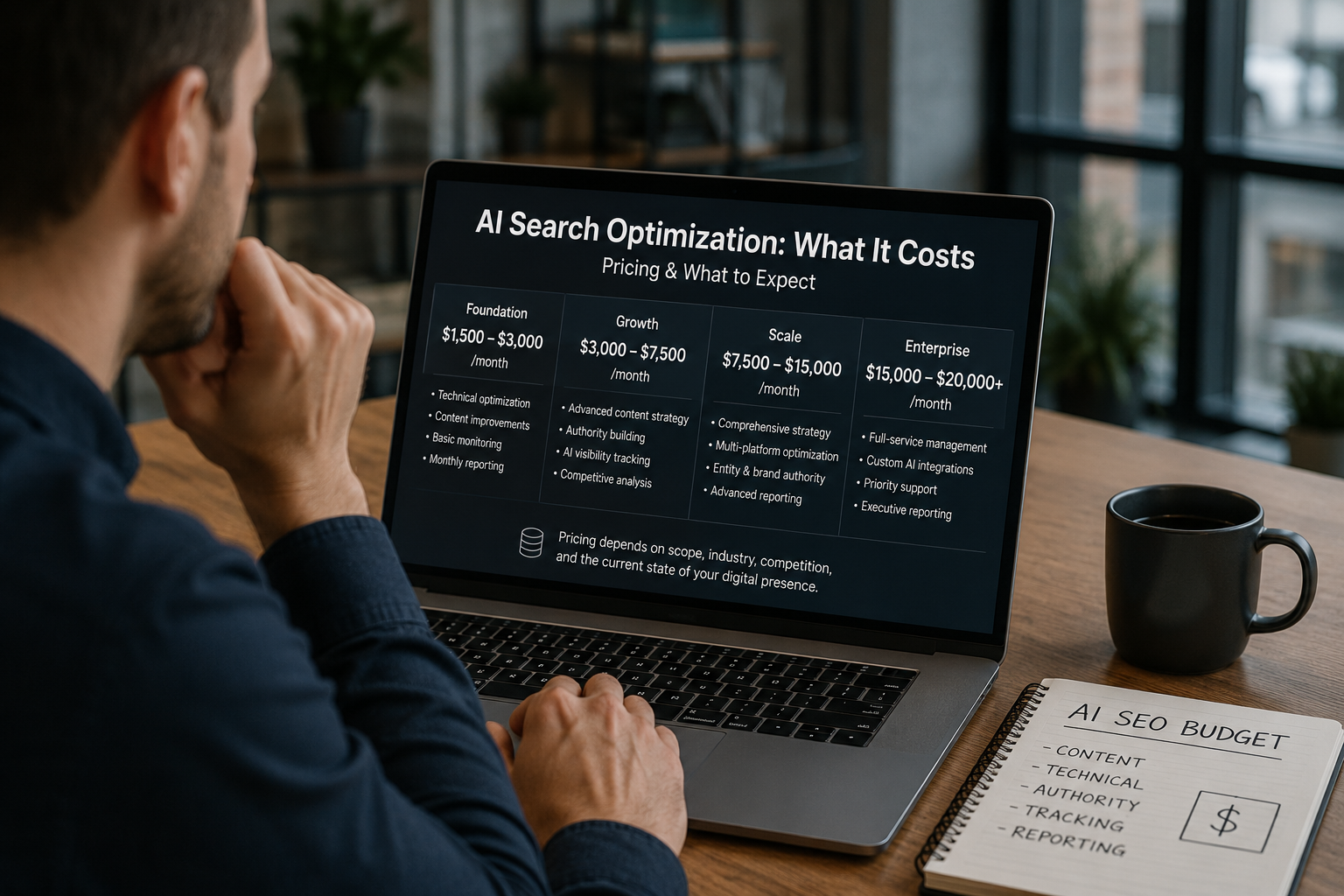
There's a new line item showing up in marketing budgets that didn't exist two years ago. Clients are asking about it. Agencies are packaging it. And most of the pricing you'll find online is either vague, inflated, or built around services that haven't fully caught up to what AI search actually requires.
So let's be direct about what AI search optimization costs, what drives that cost, and how to evaluate whether what you're being quoted is legitimate.
What AI Search Optimization Actually Is
Before pricing makes any sense, the scope needs to be clear — because "AI search optimization" is being used to describe several different things depending on who's selling it.
At its core, AI search optimization — sometimes called Generative Engine Optimization (GEO), Answer Engine Optimization (AEO), or AI visibility optimization — is the practice of making your brand, content, and expertise more likely to be cited, referenced, or recommended by AI-powered search tools. That includes Google's AI Overviews, ChatGPT search, Perplexity, Claude, Gemini, and any other system that synthesizes answers rather than simply returning a list of links.
The fundamental difference from traditional SEO is the output you're optimizing for. Traditional SEO optimizes for a ranked link. AI search optimization optimizes for a citation, a mention, a direct recommendation — or in some cases, for your content to be the source an AI model draws from when answering a question in your category.
That shift changes what the work looks like, which is a big part of why pricing varies so widely.
What the Work Actually Involves
A legitimate AI search optimization engagement typically covers some combination of the following:
Content restructuring for AI readability. AI models favor content that is authoritative, well-organized, directly answers specific questions, and is written in clear prose rather than keyword-stuffed fragments. This means auditing existing content and rewriting or restructuring it to match how AI systems extract and cite information.
Entity and schema optimization. AI systems build knowledge graphs. Making sure your brand, your people, your services, and your expertise are clearly defined as entities — with consistent structured data across your site — directly affects how AI models understand and represent you.
Citation and source authority building. AI models cite sources they trust. That trust is built through a combination of domain authority, backlink quality, brand mentions across the web, and presence in the publications and databases that AI training data draws from heavily.
Prompt and query monitoring. Knowing which AI-generated answers mention you, which mention your competitors, and which are answering questions in your category without referencing you at all is foundational to strategy. This requires specialized tracking tools that are distinct from traditional rank tracking.
Answer optimization for specific queries. Identifying the exact questions your buyers are asking AI tools — and then building content that makes your brand the most credible answer to those questions — is the core tactical loop of AI search optimization.
What AI Search Optimization Costs
Pricing falls into a few general tiers depending on scope, market, and provider.
Freelancers and solo consultants: $1,500 – $4,000/month At the lower end, you're typically getting content audits, basic schema implementation, and some monitoring. This can work for smaller businesses in less competitive categories, but the strategy depth and tooling access tends to be limited. Be cautious about anyone pricing AI search optimization below $1,500 — at that level the deliverables are usually surface-level and the methodology hasn't kept pace with how fast this space is moving.
Boutique and mid-size agencies: $3,500 – $8,000/month This is where most serious engagements live. A legitimate boutique agency brings dedicated tooling for AI visibility tracking, a content team that understands how to write for both human readers and AI citation, and strategic oversight that connects AI search to your broader demand generation picture. At this tier you should expect clear reporting on where you're being cited, where you're not, and what's being done about it.
Enterprise and full-service programs: $8,000 – $20,000+/month Enterprise engagements involve multi-brand or multi-location strategy, deep technical SEO integration, proprietary data and tooling, custom prompt testing frameworks, and ongoing content production at scale. At this level you're not just optimizing for AI search — you're building a sustained visibility infrastructure across every surface where AI-generated answers appear.
One-time audits and strategy projects: $2,500 – $10,000 Some businesses start with a standalone AI search audit before committing to a retainer. This typically includes a full inventory of where you currently appear in AI-generated answers, competitive gap analysis, a content and schema audit, and a prioritized roadmap. This is often the smartest entry point if you're evaluating the channel before committing budget.
What Drives the Price Up or Down
Several factors move the needle significantly on what you'll actually pay:
Competitive category. If you're in a space where multiple well-resourced companies are actively optimizing for AI search — legal, financial services, healthcare, SaaS — the work required to gain and hold visibility is substantially greater than in a less contested vertical.
Content production volume. AI search optimization without content is strategy without execution. If the engagement includes ongoing content production — articles, FAQ pages, structured Q&A content, thought leadership — that adds real cost. Agencies that quote low often exclude content production from the base fee and charge separately.
Tooling. Legitimate AI search monitoring requires specialized platforms that track citations across AI systems — not just Google rankings. Those tools carry real subscription costs that responsible agencies build into their pricing. Be skeptical of any provider claiming to offer AI search optimization without access to purpose-built tracking tools.
Technical complexity. Sites with significant technical debt, poor site architecture, or weak existing authority require more foundational work before AI optimization can gain traction. A technically clean site with strong existing domain authority is a much faster starting point.
Reporting depth. Basic reporting tells you your AI citation volume. Sophisticated reporting breaks down which content types are being cited, which competitor brands are appearing alongside or instead of you, what sentiment the AI is associating with your brand, and how visibility is trending over time. That depth requires more infrastructure and more analysis hours.
Red Flags to Watch For
This is a young enough category that pricing and positioning games are common. A few things to watch for:
Guaranteed AI rankings or citation promises. No one can guarantee where an AI model will cite you. The systems are probabilistic, constantly updated, and not subject to the same mechanical ranking logic as traditional search. Anyone offering guarantees is selling something they cannot deliver.
Repackaged SEO with an AI label. Some providers have simply renamed their existing SEO services as AI search optimization without meaningfully changing their methodology. If the deliverables look identical to what a standard SEO retainer offered two years ago — keyword research, link building, monthly blog posts — that's not AI search optimization. It's SEO with a new name on the invoice.
No mention of monitoring or tracking tools. If an agency can't tell you specifically how they measure AI search visibility — which tools they use, which AI systems they track, what the reporting cadence looks like — they're flying blind. Strategy without measurement in this space is guesswork.
Unusually low pricing with broad claims. AI search optimization done properly requires real expertise, real tooling, and real content investment. Pricing below $1,500 per month for a meaningful program should raise questions about what's actually being delivered.
Is It Worth the Investment?
For most businesses the honest answer depends on where your buyers are in their research journey and how much your category is being shaped by AI-generated answers.
If your buyers are already using ChatGPT, Perplexity, or Google's AI Overviews to research vendors, compare options, or get recommendations in your category — and you're not appearing in those answers — you are losing consideration before the conversation even starts. That's a compounding problem as AI search usage continues to grow.
If your category is still primarily transactional and local — someone searching "detailer near me" is going straight to Google Maps, not asking an AI — then traditional local SEO likely delivers better near-term ROI and AI optimization is a longer-term play.
The businesses getting the most out of AI search optimization right now are those in considered-purchase categories: B2B services, professional services, software, healthcare, financial services, and any vertical where buyers spend significant time researching before making contact. In those categories, showing up in AI-generated answers during the research phase shapes the shortlist before a single sales conversation happens.
That is an expensive place not to be.
Ritner Digital offers AI search optimization as part of integrated digital strategy — with transparent pricing, purpose-built tracking, and content that's built to earn citations, not just rank. If you want to understand where you currently stand in AI-generated answers and what it would take to improve it, let's talk.
Frequently Asked Questions
Is AI search optimization the same thing as SEO?
They overlap but they're not the same. Traditional SEO is primarily optimizing to rank as a link in a list of results. AI search optimization is about being cited, referenced, or recommended by systems that generate synthesized answers — Google AI Overviews, ChatGPT, Perplexity, Gemini, and others. Many of the foundational elements are shared: content quality, domain authority, technical health, and structured data all matter for both. But the strategic priorities, the content formats, the tracking methods, and the definition of success are different enough that treating them as identical is a mistake. A well-run program addresses both in an integrated way rather than treating them as competing priorities.
How long does it take to see results from AI search optimization?
Longer than most people want to hear, and shorter than people assume once the foundational work is in place. For businesses starting from a weak authority baseline, the first three to four months are largely foundational — technical cleanup, content restructuring, entity establishment, citation building. Measurable improvements in AI visibility typically start appearing between months three and six, with compounding gains from there as content authority builds. Businesses with strong existing domain authority and well-structured content can see movement faster. Anyone promising significant results within 30 to 60 days is either working with an unusually strong starting point or overpromising.
What's the difference between GEO, AEO, and AI search optimization — are these the same thing?
Largely yes, with slight variations in emphasis. Generative Engine Optimization (GEO) focuses specifically on appearing in AI-generated content and answers from large language model-based systems. Answer Engine Optimization (AEO) emphasizes optimizing for direct answer formats — featured snippets, voice search, AI Overviews. AI search optimization is the broader umbrella term that encompasses both. In practice, a serious engagement covers all of it: optimizing for how AI systems find, interpret, cite, and recommend your content across every surface where synthesized answers appear.
Can small businesses afford AI search optimization, or is this only for enterprise brands?
Small businesses can absolutely invest in AI search optimization, but scope has to match budget. A local service business competing in a defined geographic market has a very different AI search landscape than a national SaaS company competing for category-level recommendations. For smaller businesses, the most practical starting point is often a one-time audit and roadmap — typically in the $2,500 to $5,000 range — that identifies the highest-leverage opportunities before committing to a monthly retainer. In many cases, the foundational work of AI optimization overlaps significantly with strong content and local SEO, so the investment isn't purely additive.
How do I know if my business is currently showing up in AI-generated answers?
The most straightforward starting point is manual testing — ask ChatGPT, Perplexity, Google Gemini, and similar tools the questions your buyers are most likely to ask in your category, and see whether your brand appears in the answers. That gives you a directional read. For a more systematic picture, purpose-built AI visibility tracking tools monitor citation frequency, sentiment, and competitive share of voice across AI systems over time. A proper audit goes further, identifying which content assets are being cited, which competitor brands are appearing instead of you, and what gaps in your content or authority are creating the blind spots.
Should I pause my traditional SEO investment to fund AI search optimization?
Almost never. Traditional SEO and AI search optimization are complementary, not competing. The content authority, domain strength, and technical health that drive organic search rankings are the same foundations that make AI systems more likely to cite you. Gutting your SEO investment to fund AI optimization often undermines the very signals that AI visibility depends on. The more productive approach is to integrate AI search considerations into your existing content and SEO strategy — adjusting how content is structured, what questions it answers, and how entities are defined — rather than treating it as a separate budget line that displaces existing work.
What should a monthly AI search optimization report actually include?
At minimum it should show you where your brand is appearing in AI-generated answers, how that has changed over the reporting period, which competitor brands are appearing for the same queries, and what content is driving the citations you're earning. A more sophisticated report breaks down citation frequency by AI platform, tracks sentiment associated with your brand in AI responses, identifies specific queries where you're absent but should be present, and connects AI visibility trends to downstream metrics like organic traffic and inbound leads. If your report is just a summary of blog posts published and keywords tracked, you're not getting AI search reporting — you're getting standard content marketing reporting with a new label.
How is AI search optimization priced — hourly, retainer, or project-based?
Most legitimate providers work on monthly retainers for ongoing programs, with project-based pricing for one-time audits and strategy work. Hourly engagements are less common because the work is interdependent enough that isolated hours rarely move the needle. Retainers make sense because AI search visibility is not a one-time fix — it requires continuous monitoring, content production, and adaptation as AI systems update their models and ranking behavior. When evaluating retainer proposals, ask specifically what's included: content production, tooling access, reporting, and strategic oversight should all be accounted for, not treated as add-ons after the base fee is quoted.
What questions should I ask before hiring an agency for AI search optimization?
Ask them which AI platforms they track and what tools they use to measure citation visibility. Ask to see an example of a report they deliver to a current client. Ask what their content process looks like and whether content production is included in the fee or billed separately. Ask how they define success and on what timeline. Ask whether they've worked in your specific industry or a comparable one. And ask them to show you, concretely, where a current client is appearing in AI-generated answers that they weren't before the engagement began. Agencies that can answer all of those questions specifically are worth continuing the conversation with. Agencies that respond with generalities are selling a concept, not a service.
Ritner Digital builds AI search programs grounded in measurable visibility, not marketing language. If you want a straight answer about where you stand and what it would cost to improve it, start with a conversation.