What "Near Me" Queries in Your Search Console Actually Tell You About Your Business
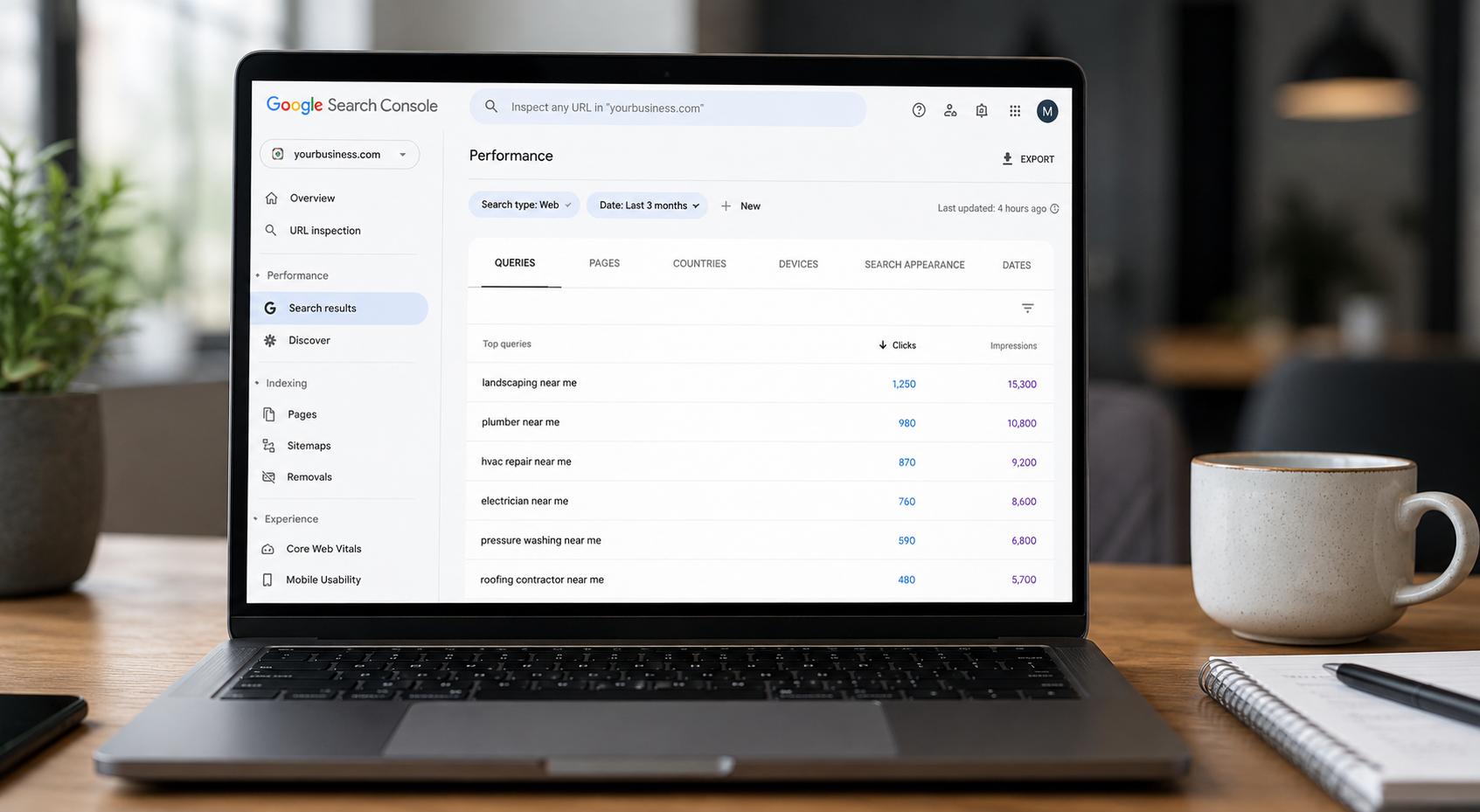
Pull up your Google Search Console right now and filter your top queries. If you run a local service business — a detailing shop, a law firm, a landscaping company, a med spa — there's one question worth asking before anything else: do you see "near me" queries in your data?
Not just one or two. A meaningful volume of them, at positions that suggest you're actually competing for the click.
The answer to that question tells you something far more important than your total impression count or your average position. It tells you whether Google has decided your business is relevant, trusted, and physically present enough to be served to people who are actively ready to spend money right now.
This is the diagnostic most businesses never run. Let's break down exactly what it means — and use two real Search Console datasets to show the difference in plain terms.
Why "Near Me" Queries Are Unlike Any Other Search
Most search queries carry some ambiguity. Someone searching "car detailing tips" might be a DIYer, a student, or a competitor doing research. Someone searching "what is ceramic coating" is in education mode — learning, not buying. These are legitimate impressions to earn, but they sit at the top of the funnel where intent is diffuse and conversion is low.
"Near me" queries are categorically different.
46% of Google searches have local intent, there are 1.5 billion monthly "near me" searches, and 28% of those local searches result in a purchase within 24 hours. Read that again: more than one in four people who search "near me" make a purchase the same day. Rank Tracker
76% of people who search on their smartphone for something nearby visit a related business within a day. These aren't browsers or researchers. These are buyers. They have their wallet in one hand and their phone in the other. The SEO Works
Conversion rates for local intent keywords are commonly 15 to 30% higher than general search terms. When you rank for "car detailing near me," you are not getting casual traffic. You are getting people who want the service, want it close, and want it soon. Marketing LTB
This is why appearing in "near me" searches is one of the highest-value positions in all of digital marketing for local businesses. And this is why the absence of those queries in your Search Console data is one of the clearest warning signs that something in your local presence is broken.
The Two Datasets: What the Contrast Reveals
To make this concrete, look at two real Search Console query profiles side by side.
Ritner Digital (ritnerdigital.com) is a marketing agency. Its top queries are dominated by informational terms: "generative engine optimization services," "SEO pricing," "social media management pricing," "best marketing podcasts," "Shopify vs WordPress." These are research-stage queries from people building knowledge — exactly right for an agency publishing content to establish thought leadership and attract clients who are educating themselves before making a vendor decision. The "near me" frame is irrelevant here. Nobody Googles "marketing agency near me" the way they Google "pizza near me." Agencies are chosen through content, reputation, and referral.
Underboss Detailing (underbossdetailing.com) is a mobile detailing business. And its Search Console tells a completely different — and instructive — story.
Look at the top queries: "auto detailing near me," "car detailing near me," "mobile detailing near me," "mobile car detailing near me," "car detailers near me," "ceramic coating near me," "detailing near me," "interior detailing near me." Scroll further and you see hyper-local specifics: "ceramic coating voorhees," "clear bra mount laurel," "car detailing gloucester township NJ," "ceramic coating haddonfield," "ceramic coating mount laurel."
This is a business that Google has recognized as a legitimate, geographically relevant answer to high-intent local queries. The "near me" terms are showing up — meaning Google's algorithm has connected this business to the physical proximity of searchers looking for this exact service right now.
That is the signal you want. That is what a healthy local SEO presence looks like in Search Console.
What It Means When "Near Me" Queries Are Present
When you see a strong cluster of "near me" and location-specific queries in your Search Console, it means several things are working simultaneously:
Google trusts your geographic relevance. Google's local search algorithm balances physical distance, query relevance, and established authority. Industry data shows that Google Business Profile signals can account for as much as 32% of all map pack ranking factors. Appearing for "near me" queries means your GBP is complete, verified, and sending strong proximity signals to the algorithm. Local Dominator
Your business category is correctly understood. In Google's semantic parsing, business names and signals create tokenized identity signals that determine eligibility for specific query types. When someone searches "smoothie near me," Google needs high confidence in eligibility to surface a result. Ranking for "auto detailing near me" means Google has confidently categorized you as an auto detailer — not a car wash, not an automotive repair shop — and is matching you to that exact intent. Search Engine Land
Your reviews and prominence are doing their job. Online reviews are a primary signal of prominence, and industry studies show they can make up as much as 16% of a business's local map pack ranking factors. Google doesn't surface businesses for high-intent local queries without a baseline of social proof. The reviews are part of why you're showing up. Local Dominator
You're competing for the highest-converting traffic available to a local business. 76% of consumers who search "near me" visit a business within a day. Local intent is a strong signal that someone is ready to take action. If your business appears in these searches, you have a high chance of turning online visibility into foot traffic — often within just hours. Sagapixel
What It Means When "Near Me" Queries Are Absent
If you run a local service business and you open Search Console to find only branded queries, informational terms, and generic category searches with zero location-modifier traffic — that's a diagnosis, not just a data gap.
It typically means one or more of the following:
Your Google Business Profile is incomplete, unverified, or underoptimized. The GBP is the cornerstone of local search eligibility. Your Google Business Profile is one of the primary ways Google decides who gets top billing for "near me" searches. Without a strong, verified, category-accurate GBP, you are simply not in the pool of candidates Google considers when a nearby user searches your service. Ignite Visibility
Your website isn't reinforcing your local signals. The Google local ranking algorithm cross-references your GBP with your website's content and authority to validate your listing. A website with no location-specific content, no service area pages, no local schema markup, and no NAP (name, address, phone) consistency is actively weakening your local eligibility — even if your GBP is solid. Local Dominator
You don't have enough reviews, or your reviews are stale. 97% of consumers read reviews for local businesses. But reviews aren't just a trust signal for humans — they're a prominence signal for Google's algorithm. A thin review profile puts a ceiling on how aggressively Google will surface you for competitive local queries. The SEO Works
Your competitors have done the work you haven't. Local search is a zero-sum game within a geographic radius. Every "near me" query returns a finite number of results. If you're not in them, someone else is — and they're getting the 76% who visit within a day.
The Underboss Detailing Picture: What's Working and What's Next
Looking at the Underboss Detailing query data, the local SEO foundation is clearly functioning. "Near me" queries are appearing across multiple service lines — standard detailing, mobile detailing, ceramic coating — and location-specific terms for Mount Laurel, Voorhees, Haddonfield, Cherry Hill, and Gloucester Township are showing impressions.
That's the signal that Google has accepted this business as a legitimate local answer in the South Jersey market. The work now is about improving position on the terms already showing impressions, converting those impressions into clicks, and expanding the geographic footprint into adjacent areas.
The queries showing impressions but no clicks — "car detailing near me" at position 8.4, "mobile detailing near me" at 5.4 — are the highest-priority opportunities. These aren't awareness plays. These are bottom-of-funnel buyers one rank change away from becoming customers.
The Google Local 3-pack appears in 93% of searches with local intent, and 42% of searchers click on Google Map Pack results. Moving from position 8 to the 3-pack on "car detailing near me" in a market like South Jersey isn't a vanity metric — it's a revenue event. Sagapixel
How to Read Your Own Search Console for This Signal
Here's a simple diagnostic framework:
Step 1 — Filter for "near me." In Search Console, go to Performance > Search Results, click the filter icon, and filter queries containing "near me." If you're a local business and this returns zero rows, you have an urgent local SEO problem.
Step 2 — Look at positions. Impressions without clicks at positions 6–15 means you're in the game but not the 3-pack. This is fixable. No impressions at all means you're not being considered — which requires foundational work on your GBP, citations, and on-page local signals.
Step 3 — Check for geographic specificity. Queries like "[city name] + service" or "[neighborhood] + service" showing up in your data means Google is matching you to real physical proximity. These are some of the strongest buying-intent signals a local business can receive in search data.
Step 4 — Compare your "near me" cluster to your informational cluster. If 90% of your impressions come from research-stage queries and fewer than 10% are local-intent, you're building an audience but not capturing buyers. Both matter — but the ratio tells you where your gaps are.
The Bottom Line
"Near me" queries in your Search Console aren't just interesting data points. They are Google's verdict on whether your business deserves to be shown to the highest-intent, closest-to-purchase customers in your market.
For a business like Underboss Detailing, those queries appearing is confirmation that the local SEO fundamentals are working. The growth lever now is position improvement — pushing from page two into the 3-pack on the terms that matter most.
For a local service business with no "near me" queries in sight, the message is clear: you are invisible to buyers who are ready to spend today. They are finding your competitors. And with 50 million people conducting "near me" searches every single day and 28% of those converting within 24 hours, every day that invisibility continues is revenue walking out the door. Rank Tracker
The fix isn't complicated. But it has to start with recognizing what the absence of those queries actually means.
Want to know where you stand in local search — and what it would take to show up when it matters most? Ritner Digital works with local and regional businesses to build the kind of presence that earns those "near me" rankings.
Frequently Asked Questions
What exactly is a "near me" query and why does it matter for my business?
A "near me" query is any search where someone explicitly signals they want a local result — "car detailing near me," "plumber near me," "ceramic coating near me." The reason they matter so much for local businesses is the intent behind them. Someone typing "near me" is not researching, comparing, or learning. They have already decided they want the service. They are now selecting a provider. That is the most valuable moment in the entire search funnel, and businesses that show up for those queries are positioned to capture it.
Does showing up for "near me" queries mean I'm ranking on Google Maps or in organic results?
Both, and the distinction matters. The Google Local 3-pack — the map results that appear at the top of local searches — is where most "near me" traffic goes. Impressions appearing in your Search Console for these terms typically means your Google Business Profile is surfacing in or near that pack. Your organic website rankings also play a role, but for true "near me" searches on mobile, the map pack is the primary battleground. Winning there requires a combination of GBP optimization, reviews, proximity, and website authority working together.
My Search Console shows impressions for "near me" queries but almost no clicks. What does that mean?
It means you're in the consideration set but not winning the click — which almost always points to position. If you're appearing at position 7 or 8 for "car detailing near me," you exist in the results but you're below the fold, below the 3-pack, and below the businesses getting the tap. The good news is this is a much easier problem to solve than having no impressions at all. You've already cleared the eligibility hurdle. The work now is improving your position through review volume, GBP engagement, website signals, and local content — the factors that separate a position 8 from a position 2.
I run a local service business but I don't see any "near me" queries in my Search Console at all. Where do I start?
Start with your Google Business Profile. An incomplete, unverified, or poorly categorized GBP is the single most common reason a local business fails to appear for "near me" searches. Make sure it's verified, that your primary and secondary categories are accurate, that your service list is complete, and that your photos are current. Then check that your website is reinforcing those signals — your address, service areas, and relevant local keywords should appear naturally in your on-page content. Finally, look at your reviews. A thin review profile puts a hard ceiling on how aggressively Google will surface you for competitive local queries.
How many "near me" queries showing up in Search Console is considered healthy?
There's no universal benchmark because it depends entirely on your market, your service category, and your geographic radius. What you're looking for is a cluster — multiple variations of the same local intent appearing together. For Underboss Detailing, seeing "auto detailing near me," "car detailing near me," "mobile detailing near me," "car detailers near me," and "ceramic coating near me" all in the same query report is a strong signal of local search health. One or two "near me" terms with low impressions suggests partial eligibility. Zero suggests you're not in the pool at all.
Do "near me" queries work differently for service area businesses versus businesses with a physical storefront?
Yes, with one key nuance. Businesses with a fixed address benefit from proximity signals tied to that location. Service area businesses — like a mobile detailing company that comes to the customer — can still rank for "near me" queries, but they need to properly configure their service area within their Google Business Profile rather than hiding their address. The same principles apply: GBP signals, reviews, website authority, and local content all drive eligibility. The difference is that a service area business needs to be more deliberate about communicating the geographic range it serves, both in its GBP settings and in its website content.
What's the relationship between "near me" rankings and reviews?
Tighter than most business owners realize. Reviews are a prominence signal in Google's local ranking algorithm, and prominence is one of the three primary factors — alongside relevance and proximity — that determine where you appear in local results. A business with 12 reviews and a 4.2 rating will almost always be outranked for competitive "near me" terms by a business with 140 reviews and a 4.7 rating, even if every other signal is equal. Volume matters, recency matters, and the content of your reviews matters — Google reads them, and so does every potential customer who sees your listing before they ever visit your website.
Can I rank for "near me" queries in cities or neighborhoods where I don't have a physical address?
To a limited degree, yes — but it requires deliberate effort. Location-specific service pages on your website that name the cities and neighborhoods you serve, combined with local citations and GBP service area settings, can extend your relevance into areas beyond your immediate address. This is especially important for service area businesses operating across multiple towns. However, proximity remains a dominant ranking factor, which means you will naturally rank more easily in the areas closest to where your business is registered. Expanding your footprint geographically takes time, content, and consistent effort.
My informational blog content gets impressions but my local service queries don't. Is that a problem?
It depends on your business model, but for most local service businesses it is a significant imbalance. Informational content — "how does mobile car detailing work," "what is ceramic coating" — builds awareness and can support your authority over time. But it attracts researchers, not buyers. If the bulk of your Search Console impressions come from educational queries while your "near me" and location-specific terms are thin or absent, you are investing in top-of-funnel visibility while leaving your bottom-of-funnel wide open for competitors to own. Both types of content have a role. The ratio should reflect where your revenue actually comes from.
Not sure what your Search Console data is telling you about your local presence? Ritner Digital can walk you through exactly what it means — and what to do about it.