LinkedIn 90K Followers vs. 50K Monthly Domain Clicks: Which Asset Actually Drives Inbound?
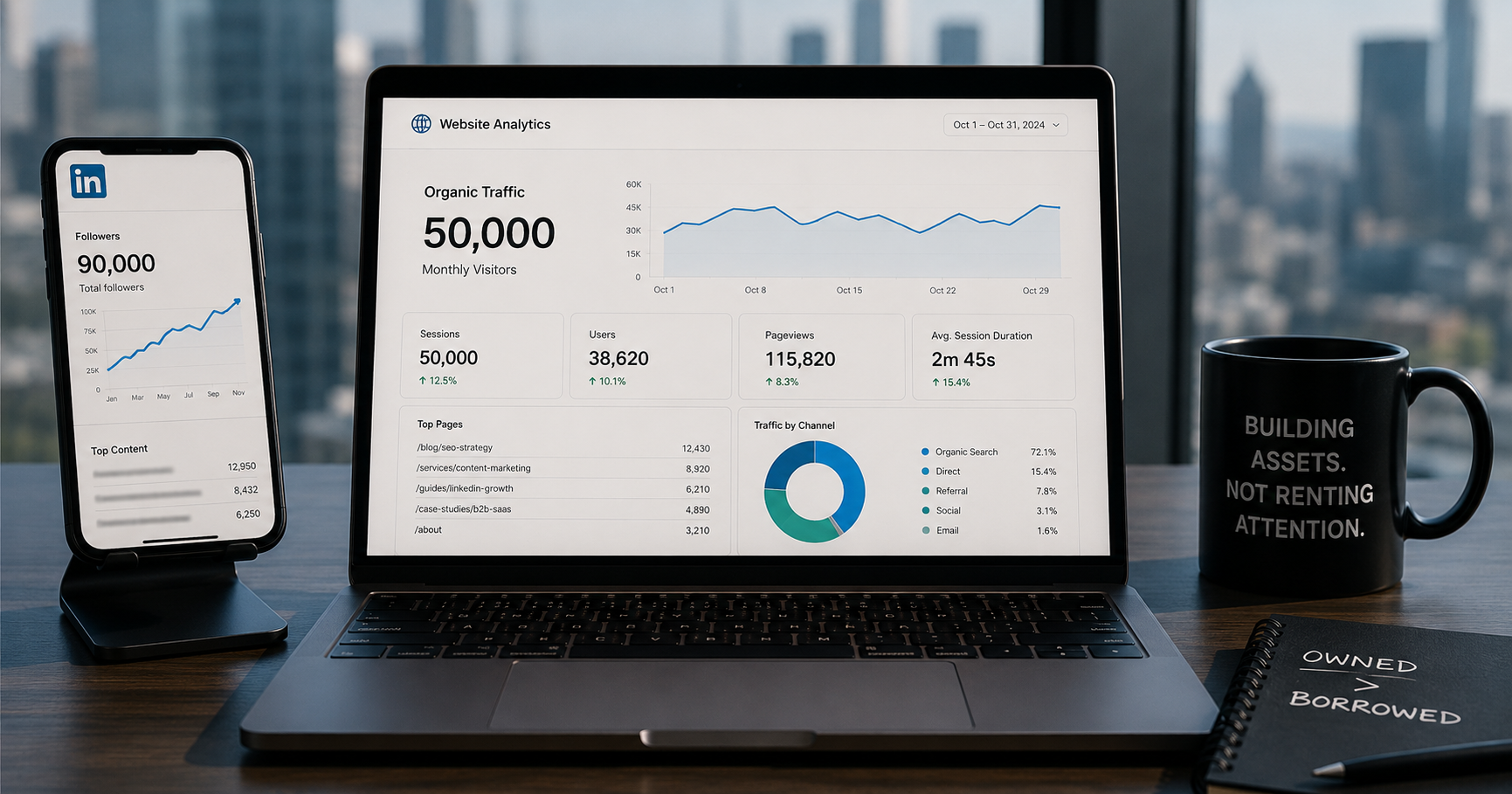
There's a debate happening in every marketing meeting, every founder Slack, and every strategy call right now. Someone has built a massive LinkedIn following — 90,000 people who see their face, read their takes, engage with their posts. Someone else has quietly been building a website that pulls 50,000 organic clicks a month from search. Both feel like wins. But if your goal is inbound revenue — real leads, real deals, real monetization — these two assets are not equal. Not even close.
Let's break it down with data, frameworks, and some uncomfortable truths.
The Fundamental Distinction: Owned vs. Rented
Before we get into the numbers, we need to establish the most important concept in this entire conversation: the difference between owned and rented media.
Your LinkedIn profile — the one with 90,000 followers you spent years building — is not yours. You are a tenant. LinkedIn is the landlord. These networks are incentivized to keep engagement on their platforms — throttling your reach, suppressing links off-property, and hoarding your followers. Every post you make is subject to an algorithm you didn't write, a feed you don't control, and terms of service that can change overnight. AudiencePlus
Your domain, on the other hand, is property. Owned media provides stability and control in a digital world that feels anything but predictable. Your owned media provides direct connections that are the bedrock of predictable, sustainable growth. Fame Connect
Think of it this way: rented media is like an apartment. You're stuck with the landlord's rules, your rent can go up without warning, and you could get kicked out at any time. We've watched this happen in real time. TikTok bans wiped out creators overnight. Algorithm shifts buried accounts that once had massive reach. Many creators with millions of followers are now moving to other platforms, but here's the catch: they're starting over. Fame ConnectClickiris Digital
Ninety thousand LinkedIn followers can become zero leverage in a single policy update. Fifty thousand monthly clicks to a domain you own? That's compounding equity.
The Traffic Reality: What the Numbers Actually Say
Let's ground this in hard data.
Organic search generates 53% of all B2B inbound leads. Twenty-three percent of B2B marketers cite organic search as their most effective channel for driving revenue, placing it at or near the top of the channel hierarchy for most firms. SEO Sherpa
Now compare that to social media's contribution to traffic overall. Organic search still leads at 46.98% of total traffic. The majority of social media traffic comes from a limited set of platforms — Facebook leads with 76.56% of all social traffic, followed by Instagram at 6.72%, TikTok at 5.50%, LinkedIn at 2.97%, and Pinterest at 2.61%. SeaRanks
LinkedIn, for all its B2B credibility, drives less than 3% of total social referral traffic globally. And social media as a whole? Organic search drives 53% of all website traffic, while social media accounts for only 5%. Inbound
A domain doing 50K clicks a month is operating in the dominant traffic channel. A LinkedIn profile with 90K followers is operating in a channel that drives roughly 5% of total web traffic — and then only if the algorithm decides to show your posts to your followers on any given day.
Lead Quality: The Metric That Actually Matters
Volume is vanity. Lead quality is what closes deals.
Here's the sharpest distinction between search traffic and social followers: intent.
Organic traffic tends to carry high intent. Someone searching for "cloud ERP software for manufacturing" is likely further along in their buying journey than someone scrolling through a LinkedIn feed. They have a specific problem they're trying to solve, and they're actively looking for solutions. This intent translates into higher conversion rates and better quality leads. Digital Thrive
The person who found your website by Googling a specific problem is already in buying mode. The person who saw your LinkedIn post in their feed was probably procrastinating.
The numbers back this up sharply. SEO leads close at a 14.6% rate, compared to just 1.7% for outbound marketing efforts. That's nearly a 9x difference in close rate. 81% of B2B marketers say SEO generates higher-quality leads than PPC. SEO SherpaOlivermunro
Meanwhile, on LinkedIn, high engagement profiles generate 2.5 times more leads than those with large followings — meaning that 90K follower count means almost nothing if the audience isn't tightly engaged and aligned with your offer. A 10K highly targeted following will often outperform a 90K general one. The Marketing Heaven
The ROI Case for Owned Domain Traffic
The return on investment data for organic search is staggering and consistently underappreciated.
SEO delivers 748% ROI for B2B companies, drives 76% of all trackable B2B website traffic, and generates 44.6% of total B2B revenue. Olivermunro
Let that sink in: nearly half of all B2B revenue is attributable to organic search. In B2B SaaS, the average ROI from SEO is 702%, with a break-even time of just 7 months. SeoProfy
And the compounding effect is what makes domain traffic truly powerful. Organic traffic is sustainable. While paid campaigns stop delivering the moment you stop spending, organic rankings can continue bringing visitors for months or even years after initial publication. A well-optimized blog post or product page can become a perpetual traffic source, delivering ROI that compounds over time. Digital Thrive
Your LinkedIn posts have a lifespan measured in hours. A well-ranked piece of content on your domain has a lifespan measured in years.
Companies publishing 16 or more blog posts monthly generate 4.5x more leads than infrequent publishers. The mechanism is simple: every piece of content you publish on your domain is a permanent asset. Every LinkedIn post is a sand castle at high tide. Olivermunro
Where LinkedIn's 90K Following Does Have Real Value
This isn't a hit piece on LinkedIn. It's a calibration exercise. And to be fair, a large LinkedIn following does carry meaningful strategic value — just not in the way most people think.
For B2B specifically, LinkedIn is the leading social platform for lead generation. 80% of LinkedIn users influence buying decisions at their companies, which means you're reaching people who can actually sign a contract. 62% of B2B marketers found LinkedIn twice as effective at generating leads versus the next-best social platform. prospeo
About 89% of B2B professionals use LinkedIn to generate leads. Martal Group
And personal profiles significantly outperform company pages. Personal profiles have a significantly higher engagement rate at 2.60%, compared to company pages at 1.74%. Personal profiles generate 8x more engagement than company pages, and users are 3x more likely to trust an individual than a brand account. Metricoolprospeo
So a 90K personal following isn't worthless. It's a powerful top-of-funnel awareness and trust-building tool. Thought leadership has become essential, with 75% of buyers being influenced by such content on the platform. Postdrips
The problem is when that LinkedIn following becomes the destination rather than the on-ramp. The followers live on LinkedIn's servers. The relationship, the data, the conversion — none of that belongs to you until you move it somewhere you own.
The Biggest Risk Most People Ignore: Platform Dependency
Even if nothing "breaks," organic visibility often declines over time because platforms create more space for ads. If you rely solely on rented media, you'll eventually pay the price. Berger+Team
This is the slow-burn risk that doesn't make headlines until it's too late. LinkedIn has been gradually reducing organic reach for years. What earned 50,000 impressions in 2021 might earn 12,000 today. The platform is building an advertising business, and your free organic reach is the inventory being quietly sold off.
Platform risk is the primary threat to businesses relying 100% on third-party social algorithms. Social media profiles have zero equity and are subject to account deactivation. Inbound
A domain, by contrast, builds what we might call digital equity — a compounding asset that appreciates as you publish more content, earn more backlinks, and accumulate more topical authority. At owned media, you collect sustainable assets: rankings, email lists, internal linking, content libraries. At rented media, you primarily attract short-term attention. Berger+Team
The Verdict: Which Drives More Inbound to Monetize?
If forced to choose strictly based on inbound revenue potential, 50K monthly domain clicks wins decisively — and it's not particularly close.
Here's the scorecard:
Domain (50K monthly clicks):
Traffic you own and control permanently
High-intent visitors actively searching for solutions
14.6% average lead close rate for SEO leads
Compounds over time with no ongoing spend
Platform-risk zero — you own the asset
Feeds email list, retargeting, and CRM directly
AI search engines cite domain content as authoritative sources
LinkedIn (90K followers):
Audience you rent from LinkedIn
Passive scrollers with mixed intent
Algorithm-dependent reach that's declining
Zero compounding — reach resets with every post
Account can be restricted or banned
Difficult to move followers off-platform
Strong for trust-building and awareness at top of funnel
But here's the real answer for 2026: the smartest operators use both — with a clear hierarchy. Use social posts as the top of the funnel and consistently lead to a stable conversion — such as appointment booking, newsletter, or lead magnet. LinkedIn is your distribution engine. Your domain is your conversion engine. Berger+Team
The 90K LinkedIn following becomes exponentially more valuable the moment you're using it to drive traffic to a domain you own, build an email list you control, and generate inbound inquiries that land in your CRM — not in LinkedIn's messaging inbox where you're one policy change away from losing access to the conversation.
Your top priority should be converting social media followers into email or podcast subscribers. That's the move that turns rented attention into a permanent asset. Fame Connect
The Bottom Line for Anyone Building a Digital Business
Stop thinking about followers as the finish line. Start thinking about them as fuel. The domain is the engine.
If you have 90K LinkedIn followers and no significant organic search presence, you've built an audience on borrowed land. If you have 50K monthly domain clicks and no social amplification, you're leaving distribution leverage on the table.
The goal is to make both work together — with your domain as the permanent foundation and LinkedIn as the acquisition channel that feeds it. Build that system right, and you've got an inbound machine that compounds while you sleep, survives algorithm changes, and generates leads you actually own.
Ready to build a digital presence that you actually own? Ritner Digital helps businesses move from rented visibility to owned authority — through strategy, content, and SEO that compounds.
Frequently Asked Questions
Is a large LinkedIn following completely worthless for driving business?
Not at all — but its value is almost entirely dependent on what you do with it. A 90K LinkedIn following is a powerful awareness and trust-building tool, especially in B2B. The problem is treating it as a destination rather than a starting point. Followers who never leave LinkedIn and never land on something you own — a website, an email list, a booking page — don't compound into revenue. Use the following as fuel. Drive it somewhere you control.
What counts as "owning" a digital asset?
Ownership means you control the data, the experience, and the relationship — independent of any third-party platform. Your domain and website are owned. Your email list is owned. Your podcast RSS feed is owned. Your LinkedIn followers, Instagram audience, YouTube subscribers, and even your Google Business Profile are not owned — they're rented. Any of those can be restricted, suppressed, or removed without warning and without recourse.
Can't I just use LinkedIn to capture leads directly without driving traffic to my site?
You can, and many people do — but you're building on sand. LinkedIn's native messaging, Lead Gen Forms, and DMs are all housed inside a platform that controls the rules. If LinkedIn changes its terms, limits your account, or simply reduces your organic reach (which it has been doing consistently), your pipeline gets disrupted. When leads come through your domain, they land in your CRM, your email system, and your analytics — infrastructure you own and can act on freely.
How do I convert LinkedIn followers into owned assets?
The most effective path is simple: consistently give LinkedIn followers a reason to go somewhere you own. That means linking to blog posts on your domain, offering a lead magnet that requires an email opt-in, promoting a newsletter, or driving people to a contact or booking page. The goal is to make your LinkedIn presence function as a top-of-funnel distribution channel — not the final destination. Every follower you convert into an email subscriber is a follower you actually keep regardless of what LinkedIn does next.
What kind of content drives organic domain traffic that converts?
High-intent content — meaning content that answers specific questions people are already searching for — consistently outperforms broad awareness content for lead generation. Think problem-specific blog posts, comparison pages, how-to guides, and service landing pages optimized for the exact terms your buyers are using. The closer your content matches what someone is actively searching for, the further along they are in the buying process when they land on your site.
How long does it take for domain traffic to start driving inbound leads?
Organic search is a long game. Most SEO campaigns hit their break-even point around the seven-month mark, with compounding returns building from there. Unlike LinkedIn posts — which spike and fade within 24 to 48 hours — content on your domain continues to rank, attract traffic, and generate leads for months or years after publication. The short-term cost of patience is paid back with interest.
Should I stop investing in LinkedIn and focus only on my domain?
No — the smartest approach is hierarchy, not abandonment. LinkedIn is an exceptional distribution and trust channel, particularly for B2B. The answer isn't to choose one over the other. It's to be clear about what each does: LinkedIn builds awareness and warms your audience. Your domain converts that audience into leads and clients. Run LinkedIn as the acquisition channel and your domain as the conversion engine, and you've built a system that works together instead of two isolated efforts fighting for the same budget.
What's the first thing someone should do if they have a strong LinkedIn following but weak domain traffic?
Start publishing content on your domain that directly serves the same audience your LinkedIn posts attract. If you're getting engagement on LinkedIn talking about a specific topic, there's search demand for that topic — and you should be capturing it on a domain you own. Then use your LinkedIn following to distribute that content, drive clicks back to your site, and begin building the email list and search authority that will outlast any algorithm change LinkedIn ever makes.
Questions about your specific situation? Ritner Digital offers strategy consultations tailored to where you are and where you want to go.