How to Do Keyword Research Specifically for Banks and Credit Unions
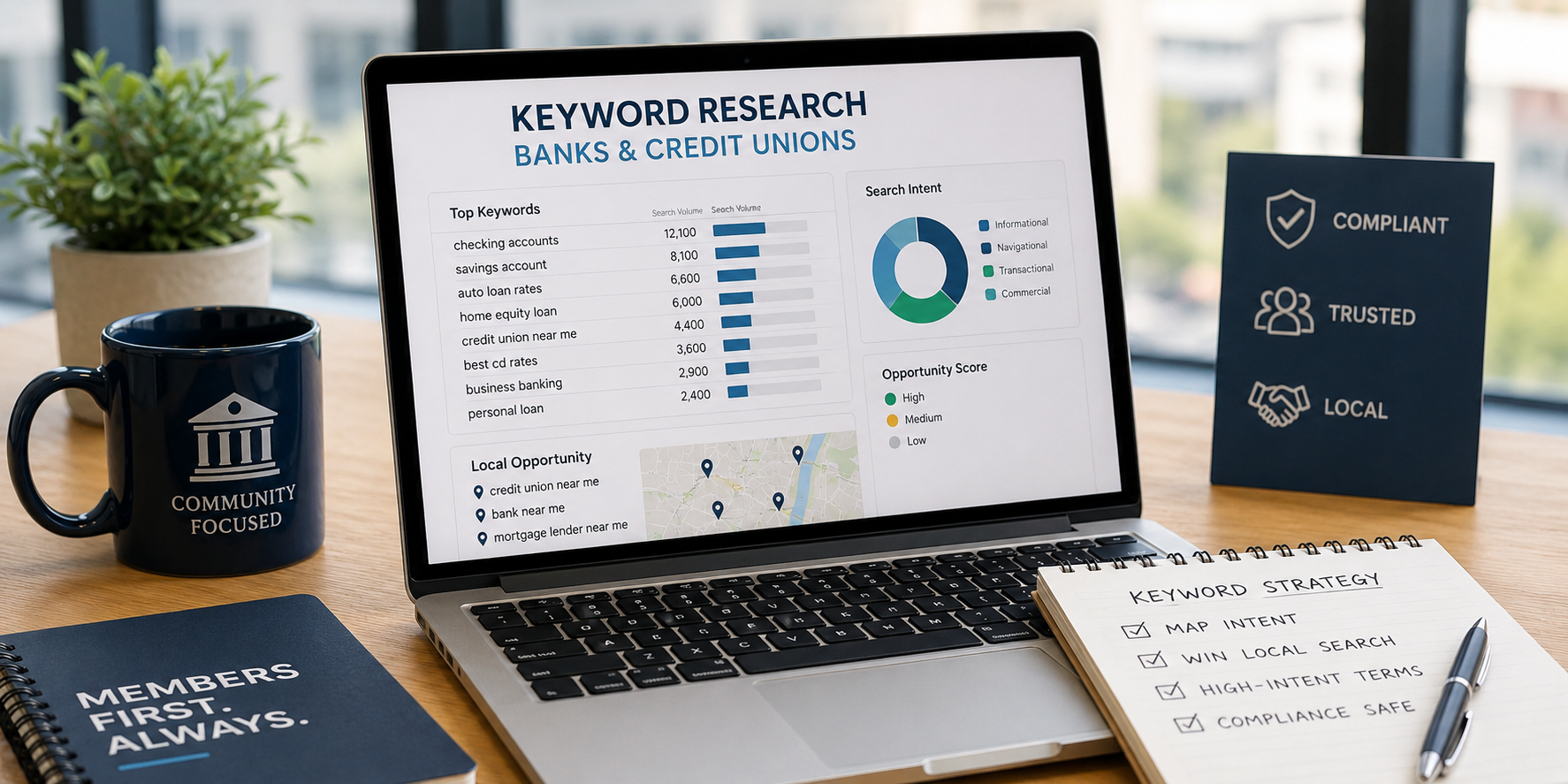
Keyword research for a bank or credit union looks deceptively similar to keyword research for any other business — until you actually try to do it. The moment you start, you run into the realities that make financial institutions unique: products are largely commoditized, compliance teams have veto power over your language, you're competing against national aggregators with enormous budgets, and the highest-volume terms are often the ones you're least allowed to target. The regulatory environment makes content production slower, compliance review adds friction to everything, and products are largely commoditized, which makes differentiation in search results genuinely difficult. Csp
But the payoff justifies the effort. Organic search delivers customers with higher lifetime value than almost any other channel, at a fraction of the acquisition cost. The institutions that win aren't doing anything exotic — they're doing disciplined keyword research that respects how their customers actually search and what their compliance teams will actually approve. This guide walks through that process step by step. Csp
Why Keyword Research Is Different for Financial Institutions
Before the how-to, it's worth being clear-eyed about the constraints, because they shape every decision that follows.
The first reality is that volume is not your north star. If you're a local institution competing with big national banks, search volume may not be the most important metric — your keyword strategy is a delicate balance that rarely boils down to targeting just the highest-searched terms. A national bank can afford to fight for "best savings account." A community credit union usually cannot, and shouldn't try. Figrow
The second reality is compliance. The most lucrative comparison terms — "best mortgage rates," "best credit cards" — are frequently off-limits. SEO for banks and credit unions has always struggled to rank for the "best" keywords because of strict regulations the industry is subject to, and legal teams may not approve of "best"-themed keywords the way aggregators can build them. That doesn't kill your strategy; it redirects it. This does not mean you cannot match the intent of the user in other ways — look for opportunities to build content around what is best for the customer, an approach legal and compliance usually have no problem with. iquantiiquanti
The third reality is that banks and credit unions aren't identical, even to each other. While both follow similar technical, on-page, and off-page principles, tailoring keyword strategy, content focus, and local authority signals differentiates the two — credit unions lean into community and membership language, while banks emphasize branch-based services, deposits, and loans. Keep your institution's identity in mind throughout; it changes which terms are even relevant. LinkGraph
Step 1: Map Keywords to the Customer Journey
The single most important shift in financial keyword research is to stop thinking about keywords as a flat list and start thinking about them as stages in a decision. This requires a sophisticated approach to keyword research that goes beyond volume metrics to understand intent. Digispot AI
A customer doesn't wake up ready to apply for a mortgage. They move through a journey, and each stage uses different language:
Awareness: "How to improve credit score for mortgage" — at this stage, users want education, not a sales pitch. Digispot AI
Consideration: "Fixed vs. variable rate home loans" — users are comparing options, so content should objectively weigh pros and cons. Digispot AI
Decision: "Best mortgage lenders near me with low closing costs" — these users are ready to convert. Digispot AI
The strategic takeaway is balance. Focusing exclusively on transactional keywords means missing the vast majority of search volume, while focusing only on informational content means attracting traffic that may never convert. You need presence across the whole funnel, with conversion-focused KPIs on the bottom and awareness-focused KPIs on the top. For your down-funnel terms, conversions could be a valid KPI, whereas your up-funnel pages can focus on brand awareness and getting people into the funnel. Cspiquanti
Step 2: Sort Every Keyword by Search Intent
Closely related to journey stage is search intent — what the searcher is actually trying to do. For financial institutions, intent falls into four buckets, and each one demands a different kind of page. Effective banking keyword strategy targets every stage of the customer journey, and every bank should be visible across all four categories. Csp
Informational: "How do CDs work as investments?" — target with educational content. These capture people early: informational keywords like "what credit score do I need for a mortgage" capture people during their research. Digispot AICsp
Navigational: "Chase bank downtown branch hours" — optimize location and branch pages. These protect your existing customers and your branded real estate. Digispot AI
Commercial: "Best high-yield savings accounts 2026" — develop comparison content (within your compliance constraints). Digispot AI
Transactional: "Apply for small business loan online" — streamline conversion funnels. Digispot AI
Don't overlook navigational and branded terms. Navigational keywords — people searching for your bank by name to find login pages, routing numbers, or branch hours — serve existing customers and protect your branded search real estate. These are some of the easiest wins you'll have, and ceding them is a costly mistake. Csp
Step 3: Prioritize Local and "Near Me" Keywords
For community banks and most credit unions, local intent is where the real opportunity lives. Most customers looking for banking services start their search with local intent, using terms like "best mortgage lender near me" or "credit unions in Dallas." New Media Advisors
These searches convert at remarkable rates. Research reveals that 78% of local searches result in an offline action, such as visiting a branch or making a phone call within 24 hours — which is exactly the kind of high-intent, ready-to-act traffic a financial institution wants. Phrases like "banks near me," "credit unions in [city]," or "mortgage lenders close to [neighborhood]" indicate a strong local intent, and "near me" phrases have become increasingly popular with the rise of mobile searches. Cross & CrownAmericaneagle
When building your local keyword list, layer geography onto your product and service terms:
City and region modifiers: use terms your customers are searching, such as "nearby credit union" or "bank branch in [City]." Americaneagle
Product + location combinations: "mortgage lenders in Chicago," "small business checking in Austin."
Neighborhood-level terms for dense metro areas where customers think in districts, not cities.
Each meaningful location deserves its own page with genuinely unique content — never duplicated boilerplate, which is one of the most common and damaging mistakes financial institutions make.
Step 4: Lean Into Long-Tail Keywords
Long-tail keywords — longer, more specific phrases — are where smaller institutions can realistically win. They have lower volume but far higher intent and much less competition. Long-tail keywords are especially valuable: "best credit union for small business loans" targets users with a clear need and higher conversion potential, and including location-based keywords like "credit union in [city]" further enhances relevance. Cross & Crown
Rather than fighting national aggregators for "personal loans," a regional credit union can own "personal loans for medical expenses in [region]" or "credit union auto loan for first-time buyers." Prioritize keywords with a lower difficulty score — these compound into meaningful traffic over time and are realistic to rank for with a focused content effort. Figrow
Step 5: Use the Right Tools — and Read Them Correctly
Solid keyword research is grounded in data, not guesswork. Tools like Google Keyword Planner and SEMrush can identify high-value keywords such as "personal loans," "low-interest mortgages," or "credit union membership benefits." Cross & Crown
A practical toolkit:
Google Keyword Planner for baseline volume and discovering related terms
SEMrush or Ahrefs for keyword difficulty scoring, competitor gap analysis, and tracking
Google Search Console to see the queries you already rank for — often an overlooked goldmine of low-effort opportunities
Google's own SERP — study who ranks now, what content format wins, and where the gaps are
The discipline that matters most is reading these tools through an intent lens, not a volume lens. At iQuanti, keywords are treated as directional cornerstones for what consumers are actually looking for — the power of keywords is in understanding the intent behind the queries. A 500-volume term you can rank for and convert beats a 50,000-volume term you'll never crack and couldn't legally target anyway. iquanti
Step 6: Group Keywords Into Topic Clusters
Once you have your list, don't scatter individual keywords across disconnected pages. Organize them into clusters that map to your site architecture. A hierarchical structure connects the homepage (root) to service categories (seed) like loans, accounts, or investment products, and then to individual product pages (nodes) covering specifics like mortgage types or checking account options. LinkGraph
This structure does double duty: it guides your keyword targeting and it strengthens your SEO. Linking nodes to their corresponding seeds establishes clear topical relevance and strengthens keyword alignment across the site, while also helping customers navigate logically from a general service to the specific product they need. Each cluster should have one pillar page targeting the broad term and several supporting pages targeting the long-tail variations underneath it. LinkGraph
Step 7: Pressure-Test Keywords Against Compliance Early
The worst time to discover a keyword is non-compliant is after you've built a page around it. Bring compliance into your keyword research process, not just your content review. A strong banking SEO strategy should always focus on aligning content with user intent instead of depending only on branded acquisition terms, and the customer-centric reframing — "what's best for the customer" rather than "we're the best" — is usually the key that unlocks legal approval. iquanti
In practice this means flagging superlative and comparative terms ("best," "lowest," "guaranteed") during research, and brainstorming compliant alternatives that capture the same intent. A searcher looking for "best business checking account" can still find your page targeting "how to choose a business checking account" or "business checking account features compared" — language compliance will sign off on, serving the same user need.
Step 8: Don't Forget AI Search and Zero-Click Reality
Keyword research in 2026 has to account for how dramatically search behavior has shifted. In June 2026, SparkToro and SimilarWeb research found that 68% of Google searches end without a click — a 12.5% increase since 2024. AI Overviews and AI assistants increasingly answer questions before a user ever reaches your site. New Media Advisors
This changes how you should think about certain keywords. AI systems tend to rely heavily on entity recognition, brand authority, third-party mentions, and citations when determining which brands to recommend. Informational keywords are now partly a play for AI citation and brand visibility, not just clicks. It's also why some institutions test into affiliate placements on sites like NerdWallet, Bankrate, and Investopedia — not only to reach more customers but to boost AI search mentions, since these publishers are often cited as sources in ChatGPT answers. Factor this into how you value upper-funnel terms. New Media AdvisorsNew Media Advisors
Step 9: Set Realistic Expectations and Track the Right Metrics
Keyword research isn't a one-time exercise, and the rankings it produces don't appear overnight. Plan on three to six months for initial improvements from technical fixes and new content to gain traction, with competitive keyword rankings typically improving meaningfully within six to twelve months, and building real domain authority taking twelve months or more. Csp
Tie your keyword strategy back to business outcomes from the start. Connect SEO to business outcomes — show new accounts opened from organic search, cost per acquisition compared to paid channels, and customer lifetime value by acquisition source — and supplement with leading indicators like keyword ranking improvements, organic traffic growth, and local pack visibility. When leadership sees organic search delivering higher-value customers at lower cost, the case for continued investment makes itself. Csp
And persistence genuinely is the edge here. In an industry where most institutions give up on SEO before it has a chance to work, persistence is the real competitive advantage. Csp
Frequently Asked Questions
What keywords should a credit union target first?
Start with local, lower-difficulty, high-intent terms rather than broad national keywords. If you're a local institution competing with big national banks, search volume may not be the most important metric — look at local keywords that include your city, state, or region, or prioritize keywords with a lower difficulty score. Branded and navigational terms (your name plus "login," "routing number," "hours") are also easy early wins worth securing immediately. Figrow
How do banks do keyword research when compliance blocks "best rate" keywords?
You reframe around customer benefit instead of self-promotion. Legal teams may not approve "best"-themed keywords, but this doesn't mean you can't match user intent in other ways — look for opportunities to build content around what is best for the customer, an approach legal and compliance usually have no problem with. A page on "how to compare mortgage lenders" can capture much of the same search intent as "best mortgage lender" while staying compliant. iquanti
How important are "near me" keywords for financial institutions?
Very important, because they signal high intent and convert offline at strong rates. Most customers looking for banking services start their search with local intent, using terms like "best mortgage lender near me" or "credit unions in Dallas," and 78% of local searches result in an offline action such as visiting a branch or calling within 24 hours. For community-focused institutions, local keywords often deliver the best return of any category. New Media AdvisorsCross & Crown
What tools are best for banking keyword research?
A combination works better than any single tool. Google Keyword Planner and SEMrush can identify high-value keywords such as "personal loans," "low-interest mortgages," or "credit union membership benefits." Add Ahrefs for difficulty scoring and competitor gap analysis, and Google Search Console to surface the queries you already rank for. The key is interpreting all of them through intent, not raw volume. Cross & Crown
How long until keyword research turns into rankings and new customers?
Expect a year-long horizon for meaningful results. Plan on three to six months for initial traction, six to twelve months for competitive keyword rankings to improve meaningfully, and twelve months or more to build the domain authority that drives sustained, compounding results. The institutions that quit early never see the payoff. Csp
Ready to Build a Keyword Strategy That Actually Converts?
Effective keyword research for a bank or credit union takes more than a tool subscription — it takes a strategy that balances search volume against intent, respects your compliance constraints, and maps cleanly to the way your customers actually search. Ritner Digital specializes in helping financial institutions turn keyword research into measurable membership and account growth.
Get in touch with Ritner Digital → to talk through your keyword strategy and start capturing the high-intent searches happening in your market right now.
Sources
Digispot AI — SEO for Banks & Financial Institutions: The Complete 2026 Guide
Customer Service Profiles — SEO in Banking: A Practical Guide for Banks and Credit Unions
iQuanti — SEO for Banks: Complete Banking SEO Strategy Guide
New Media Advisors — Top SEO and AI Search Strategies for Bank Marketers in 2026
Americaneagle.com — Local SEO Strategies for Banks and Credit Unions
Cross & Crown — Winning More Members Through SEO for Credit Unions
LinkGraph — SEO for Banks: Benefits, Strategies, and How to Do It Right
FI Grow Solutions — Content Strategy for a Successful Bank or Credit Union Website