On-Page SEO for Financial Institutions: A Practical Checklist
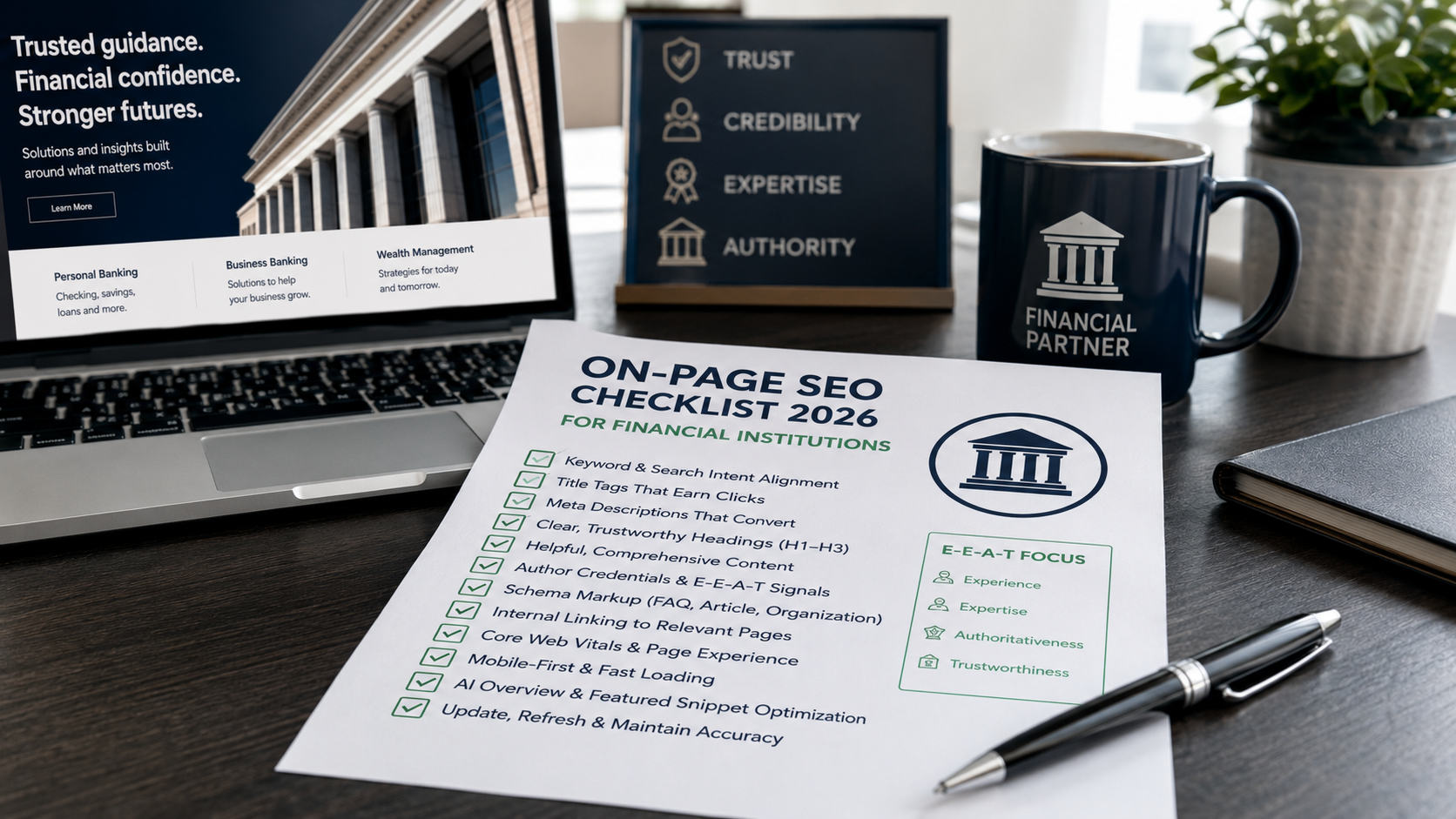
If you run marketing for a bank, credit union, lending platform, wealth advisory, or any other financial brand, you already know the search results page is your most valuable piece of real estate. The customer journey rarely begins at a branch anymore — it starts with a question typed into Google during a moment of financial need. 71% of all financial decisions now begin with online research, and if your institution doesn't show up with a clear, authoritative answer at that moment, you effectively don't exist to that prospect. Digispot AI
The challenge is that financial content plays by stricter rules than almost any other industry. Google classifies it as "Your Money or Your Life" (YMYL) content, which means every page is held to a far higher standard for accuracy, expertise, and trust. On-page SEO is where most of that battle is won or lost. This checklist walks through what actually moves the needle in 2026 — organized so your team can work through it page by page.
Why On-Page SEO Is Different for Finance
Before the checklist, it's worth understanding why the bar is higher. Because financial content can impact people's financial stability, it's categorized as YMYL, which raises the bar for Experience, Expertise, Authoritativeness, and Trustworthiness (E-E-A-T). A missing author bio or thin sourcing doesn't just weaken one section — it can drag down a whole page. SeoProfy
This scrutiny has intensified sharply. The March 2026 Core Update became the most volatile update in Google's history, with 79.5% movement in Top-3 results. And the standard now applies more broadly than ever: anonymous authorship carries ranking risk across all content types in 2026, including entertainment and lifestyle, not just YMYL topics. For finance, where the scrutiny was already highest, that means the fundamentals below are no longer optional — they're the cost of admission. SEO-KreativLaunchcodex
One useful way to frame the work: there are two types of SEO — technical (site speed, meta tags, XML sitemaps, Google Business Profile) and content (creating high-quality content that ranks for specific keywords). On-page SEO sits at the intersection of both, and that's exactly where this checklist lives. Mint Studios
The On-Page SEO Checklist
1. Match Each Page to a Single, Specific Search Intent
Every page should target one primary keyword and the intent behind it — not a scattershot of loosely related terms. The intent of the URL should be specific to the keyword you target on that page. A page targeting "tax consultants for small business" should live at a clean, descriptive URL like /tax-consultant-for-small-business rather than a string of parameters or numbers. Digital SEO Land
The most common mistake here is chasing volume over intent. The most common mistake SEOs make while researching keywords is targeting high-search-volume keywords without giving much thought to their intent. High-volume terms are the long-term goal, but for newer financial service providers, it makes sense to prioritize less competitive keywords and spend your SEO budget wisely on things that matter most. Keywords with medium difficulty and volume give you a realistic way to compete without a massive budget. Digital SEO LandDigital SEO Land
Before writing anything, study the SERP. A detailed analysis of the search engine results pages shows what ranks well, what keywords competitors have covered, gaps in the content, and a unique angle that can differentiate you. Digital SEO Land
2. Get Title Tags, Meta Descriptions, and Headers Right
These are the workhorses of on-page SEO. Your title tag should lead with the primary keyword and read naturally to a human, not just a crawler. Your H1 should match the page's core promise, and your H2s and H3s should break the content into a logical hierarchy that both readers and search engines can follow.
For financial topics specifically, structure matters more than usual because the subject matter is dense. Financial services tends to be abstract, so you want to include diagrams and images that support your content — with proper alt text following SEO best practices. Alt text isn't a throwaway field; it's both an accessibility requirement and a ranking signal, and it's where a lot of finance sites leave value on the table. Mint Studios
3. Build Visible Author Credentials Into Every Page
This is the single biggest on-page lever for financial content, and it's where most institutions fall short. Three years ago, you could rank a well-optimized article without an author bio. Try that now on a YMYL topic and you will not even make page two. SEO-Kreativ
The data backs this up. E-E-A-T signals correlate with roughly 8% of ranking weight across all queries, but for YMYL queries that correlation roughly triples to approximately 24%. Every article needs a named, credentialed author with a bio page that links to verifiable professional profiles. SEO-Kreativ
Practical steps for your content team:
Centralize author identity. Use one consistent author name, one consistent headshot, and one consistent bio across every platform where you publish — inconsistency is the enemy of entity recognition. SEO-Kreativ
Create real bio pages. Create detailed author bio pages for every content creator and connect them to LinkedIn, Google Scholar, or other professional profiles. iMark InfoTech
Show the credentials that matter. For financial content, include CFA or CFP designations — these aren't just trust signals for users, they're machine-readable data points Google uses to validate expertise claims. Outpace
Never fake it. Fake authors with stock photo bios or AI-generated headshots risk demotion under Google's spam policies and look bad to readers who notice. RightBlogger
If you publish AI-assisted content, that's allowed — but accountability isn't optional. Google evaluates content quality regardless of whether it was written by a human or AI, as long as it's reviewed by a subject matter expert, enriched with original insights, and attributed to a named author who takes accountability for accuracy. iMark InfoTech
4. Implement Structured Data (Schema Markup)
Schema is one of the most underused on-page tools in finance. When implemented correctly, structured data gives Google's systems a direct, machine-readable signal about who created the content, what credentials they hold, and how the content relates to broader entities in Google's Knowledge Graph. Outpace
At minimum, every article should carry the following:
Article schema with a nested author property. Every article on a YMYL site should include Article schema with a nested author property that points to a Person schema. Outpace
Person schema with a sameAs chain. The sameAs chain lists the URLs of every external profile associated with the author — LinkedIn, professional directories, publication records — and is the technical mechanism connecting your author bio to the broader entity graph. Include name, jobTitle, worksFor, knowsAbout, and sameAs. Redot Global
Organization schema at the site level. Site-level trust is established through Organization schema, which should include name, logo, contact information, founding date, and links to official social profiles — and for regulated industries, licensing and accreditation information. Outpace
A "reviewed by" signal where relevant. For YMYL niches, you can add reviewedBy to your BlogPosting if a different person reviewed the content for accuracy — increasingly cited as a useful E-E-A-T signal in financial verticals. RightBlogger
One non-negotiable rule: schema should always accurately reflect the actual content on the page. If your person schema lists credentials that don't match what's on the page, Google may flag the discrepancy. Validate everything before publishing. Doctor Rank
5. Nail Trust Signals and Compliance on the Page
For financial sites, trust isn't a vibe — it's a set of concrete page elements Google is specifically designed to look for. A financial site without regulatory disclosures is a red flag that Google's systems are built to identify and penalize. Outpace
Make sure every relevant page includes:
HTTPS across the entire site, with no exceptions
Clear, accessible privacy policy, terms of service, and editorial guidelines
Real contact details and transparent business information
Accurate regulatory disclosures and disclaimers
A "last reviewed" or "last updated" date on time-sensitive content
That last point deserves emphasis. Outdated content is a trust signal problem — implement a content audit cycle, review key pages at least annually, and add "last reviewed" dates. For YMYL content, more frequent review cycles are mandatory. Compliance and SEO aren't in tension here; the same disclosures that keep your legal team happy also send the trust signals Google rewards. iMark InfoTech
6. Optimize Core Web Vitals and Mobile Experience
On-page SEO includes how the page actually performs. Financial websites that achieve "Good" Core Web Vitals scores across all metrics see a 27% reduction in abandonment rates for critical conversion paths like loan applications and account sign-ups compared to those with "Poor" scores. Digispot AI
Two metrics matter most for financial pages:
Cumulative Layout Shift (CLS) should stay under 0.1. A shifting "Apply Now" button can cause misclicks and frustration. Digispot AI
Interaction to Next Paint (INP) should stay under 200ms. This is critical for complex banking dashboards and multi-step forms. Digispot AI
Mobile isn't a secondary consideration either. 80% of the websites that appear at the top of search results ensure their sites are effectively optimized for mobile users, and financial searches increasingly happen on phones during moments of immediate need. Promodo
7. Structure Content to Earn AI and Featured-Snippet Visibility
The way people search has changed, and on-page formatting now determines whether you get pulled into AI answers. People ask ChatGPT, Perplexity, and Google's AI Overviews for recommendations, and to get cited your pages need structured answers, FAQ sections, and one-sentence definitions that language models can extract cleanly. Vague prose doesn't get pulled into AI answers. SeoProfy
This is high-stakes because of how much AI Overviews now reshape click behavior. Getting cited inside an AI Overview now earns 35% more clicks than holding a traditional ranking alone. Concretely, that means: open sections with a direct one-sentence answer, use FAQ blocks with genuine questions, and write in clear, extractable statements rather than meandering paragraphs. Launchcodex
8. Build Topical Authority Through Internal Structure
A single optimized page rarely wins on its own anymore. Topical authority continues to be one of the strongest signals Google uses to evaluate how deeply a website covers a subject. The on-page implementation of this is your internal linking and content architecture. Promodo
Start by focusing on a few core topics — for example, personal loans, investments, or insurance — and create in-depth pillar pages for each. Then support these with a cluster of related articles that answer specific user questions. Over time, this interconnected structure shows Google your site is a reliable, comprehensive source. Every supporting article should link up to its pillar and across to its siblings, reinforcing the topical relationships on the page itself. Promodo
9. Don't Forget Local Pages (If You Have Branches)
For institutions with physical locations, local on-page optimization connects digital research to in-person relationships. Create individual location pages with unique content for each branch and avoid generic "copy-paste" descriptions — mention local landmarks, specific branch manager names, and community events the branch sponsors. Duplicate location pages are a wasted opportunity and can even dilute your authority. Digispot AI
Putting It All Together
On-page SEO for financial institutions comes down to a simple but demanding principle: prove, on every page, that real expertise stands behind the content. While most industries focus mainly on keywords and links, finance marketers must prioritize trust, transparency, and compliance — clear authorship, verified facts, and regulatory-friendly content aren't just best practices, they're essential for ranking. Promodo
The institutions that win in search aren't necessarily the ones with the biggest budgets. They're the ones that treat each page as an opportunity to demonstrate credibility — through specific intent targeting, named expert authors, clean schema, visible compliance signals, fast mobile performance, and a content structure that builds authority over time. None of these items is exotic. The advantage comes from doing all of them, consistently, across your whole site.
A final word of realism: SEO isn't a quick fix — it's a long-term investment that compounds over time. Work through this checklist methodically, prioritize your highest-traffic and highest-intent pages first, and revisit it each quarter as Google's standards continue to evolve. OMNICOMMANDER
Ready to Turn This Checklist Into Results?
Auditing every page against YMYL standards, wiring up schema correctly, and building author authority across your site is detailed, ongoing work — and the cost of getting it wrong in a regulated industry is steep. Ritner Digital specializes in helping financial institutions translate checklists like this one into measurable organic growth.
Get in touch with Ritner Digital → to schedule a conversation about your on-page SEO and start showing up where your customers are already searching.
Frequently Asked Questions
What is YMYL content, and why does it matter for financial institutions?
YMYL stands for "Your Money or Your Life" and refers to content that can significantly impact a person's health, financial stability, safety, or civic wellbeing. Because financial content directly affects people's money, Google holds it to a far higher standard for accuracy, expertise, and trust. For YMYL queries, E-E-A-T signals correlate with roughly 24% of ranking weight — about three times the influence they have on ordinary queries. In practice, this means a missing author bio or weak sourcing can keep an otherwise well-optimized financial page off the first results page entirely. Redot GlobalSEO-Kreativ
What's the difference between technical SEO and on-page SEO?
Technical SEO covers things like site speed, meta tags, XML sitemaps, and Google Business Profile, while content SEO is the practice of creating high-quality content that ranks for specific keywords. On-page SEO sits at the intersection of the two — it covers everything you control on an individual page, from title tags and headers to author credentials, schema markup, and page performance. For most financial brands, the site stays relatively small, so technical SEO doesn't need to play as large a role, and one audit every six months is often enough. Mint StudiosMint Studios
How important are author bios and credentials for financial content?
They're arguably the single biggest on-page factor for finance. Three years ago you could rank a well-optimized article without an author bio, but try that now on a YMYL topic and you will not even make page two. Every article needs a named author with a real bio page that links to verifiable professional profiles. For financial content specifically, include CFA or CFP designations — these aren't just trust signals for users, they're machine-readable data points Google uses to validate expertise claims. SEO-KreativOutpace
Can I use AI to write financial content and still rank?
Yes, but accountability is non-negotiable. Google evaluates content quality regardless of whether it was written by a human or AI, as long as it's thoroughly reviewed by a subject matter expert, enriched with original insights and real data, and attributed to a named author who takes accountability for accuracy. What you cannot do is publish anonymous or unreviewed AI output — and listing "AI" or "ChatGPT" as the author bypasses E-E-A-T entirely and is a bad signal even when it's technically true. iMark InfoTechRightBlogger
What schema markup should financial pages use?
At a minimum, every article should carry Article schema, Person schema, and site-level Organization schema. Every article on a YMYL site should include Article schema with a nested author property that points to a Person schema, and that Person schema should include a sameAs chain listing the URLs of every external profile associated with the author — LinkedIn, professional directories, and publication records — which is the technical mechanism connecting your author bio to the broader entity graph. One rule applies throughout: schema should always accurately reflect the actual content on the page, because if your credentials don't match what's visible, Google may flag the discrepancy. Outpace + 2
Which Core Web Vitals matter most for financial websites?
Cumulative Layout Shift (CLS) and Interaction to Next Paint (INP) are the two to watch. CLS should stay under 0.1 — a shifting "Apply Now" button can cause misclicks — and INP should stay under 200ms, which is critical for complex banking dashboards and multi-step forms. The payoff is concrete: financial websites with "Good" Core Web Vitals scores see a 27% reduction in abandonment rates for critical conversion paths like loan applications and account sign-ups compared to those with "Poor" scores. Digispot AIDigispot AI
How do I get my financial content cited in AI Overviews and ChatGPT?
Structure is everything. To get cited, your pages need structured answers, FAQ sections, and one-sentence definitions that language models can extract cleanly — vague prose doesn't get pulled into AI answers. The stakes are high because getting cited inside an AI Overview now earns 35% more clicks than holding a traditional ranking alone. Open each section with a direct answer, use genuine FAQ blocks, and write in clear, extractable statements. SeoProfyLaunchcodex
How long does SEO take to show results for a financial institution?
There's no shortcut. SEO isn't a quick fix — it's a long-term investment that compounds over time. The most reliable approach is to work through the fundamentals methodically, prioritize your highest-traffic and highest-intent pages first, and revisit your on-page standards each quarter as Google's requirements continue to evolve. Brands that combine quality content, verified author expertise, and AI-ready structure are the ones positioned to gain ground. OMNICOMMANDER
Sources
SEOProfy — SEO for Financial Services: The Complete Guide for 2026
Digispot AI — SEO for Banks & Financial Institutions: The Complete 2026 Guide
Mint Studios — SEO for Financial Services: What You Need to Know in 2026
Digital SEO Land — SEO for Financial Services: Best Practices & Challenges in 2026
Promodo — Top SEO Trends in Finance for 2026
SEO Kreativ — E-E-A-T Guide 2026: Trust Signals, AI Overviews & Rankings
Redot — Build E-E-A-T Authority: 2026 Strategy for Google & AI
RightBlogger — Author Schema Markup: Step-by-Step Guide With Code
Doctor Rank — What Is Schema Markup for Medical Blogs? The 4 Types
Launchcodex — Google March 2026 Core Update: What You Need to Know
Outpace SEO — E-E-A-T & YMYL SEO: The Complete 2026 Trust & Quality Guide
Imark Infotech — E-E-A-T Explained: Google's Quality Standards Guide
OmniCommander — How SEO Drives Loan & Deposit Growth for Financial Institutions in 2026