How to Generate Backlinks and Improve Your Ranking — 13 Tips That Actually Work
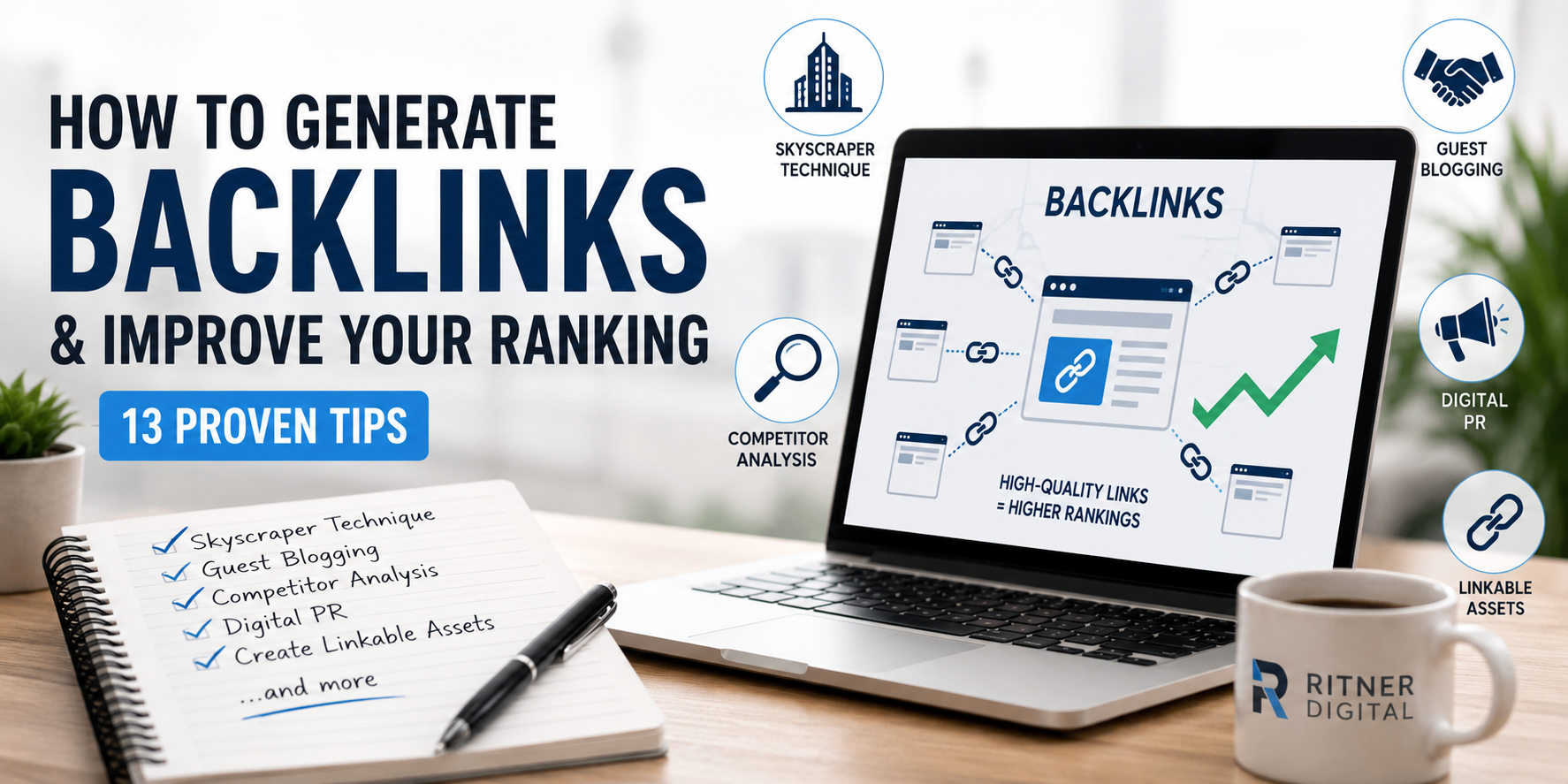
Backlinks are the backbone of SEO — and in 2025 and beyond, they're still one of the clearest signals Google uses to decide who ranks and who gets buried.
Think of backlinks as votes of confidence from other websites. When a high-quality, reputable site links to your page, it tells Google that your content is trustworthy and relevant, which can boost your rankings. The more authoritative those votes are, the more Google listens. Zero Gravity Marketing
And here's the thing — this isn't speculation. In 2024, an internal Google document leak confirmed the enduring importance of backlinks in SEO. The leaked information unequivocally stated that "links matter," revealing that links continue to play a central role in Google's ranking algorithm. Notably, it revealed that PageRank for a website's homepage is still evaluated for every document on that site, underscoring the influence of high-quality links on a site's overall authority. Smartmonkeymarketing
The numbers back it up too. According to a study by Backlinko, the first page of Google search results typically has 3.8x more backlinks than lower-ranked pages. And a significant 93.8% of link builders prioritize link quality over quantity. JustwordsSEO.AI
But here's the challenge: earning high-quality backlinks is hard. It takes strategy, patience, consistency, and creativity. The good news? We've broken it down into 13 actionable tips you can start using today.
What Makes a Backlink "High-Quality"?
Before diving into the tactics, it's worth understanding what separates a great backlink from a useless one. In 2025, the backlinks that will contribute most effectively to your SEO have specific characteristics: relevance to your industry or topic (links from sites within your industry carry more weight, as they signal topical relevance), and high-authority domains (links from established, reputable websites with high domain authority are seen as votes of confidence). Smartmonkeymarketing
Today, search engines care more about quality over quantity — meaning a handful of high-quality backlinks from credible sources can be far more valuable than a long list of low-quality links. Zero Gravity Marketing
With that foundation in place, here are the 13 tips.
Tip 1: Create Long-Form, Link-Worthy Content
The single most reliable way to earn backlinks is to publish content so good that people can't help but reference it.
Content over 3,000 words gets 3.5 times more backlinks than shorter articles. Long-form guides, original research, industry roundups, and comprehensive tutorials give other writers and publishers something worth citing. SEO.AI
Develop high-value content assets specifically designed to attract links — comprehensive guides and tutorials that serve as go-to resources, and original research and data that creates unique insights from surveys or industry analysis. GreenBananaSEO
The formula is simple: be the best resource on a topic in your niche, and the links will follow.
Tip 2: Use the Skyscraper Technique
Coined by SEO expert Brian Dean, the Skyscraper Technique is one of the most proven approaches to earning aggressive Tier 1 backlinks.
The idea is simple: look for content in your space that already performs well — it has lots of backlinks, shares, and engagement. Then create something that's at least 10x better. Make it more insightful, clearer, updated, and visually appealing. Once your content is live, reach out to the same websites that linked to the original and show them your improved version. Justwords
The key is to not just match the original — genuinely surpass it. Add newer data, better visuals, deeper analysis, and more actionable takeaways. Then, make your outreach pitch compelling: show the site owner exactly what you improved and why their readers deserve the upgrade.
Tip 3: Guest Blog on Reputable Sites in Your Niche
Guest blogging has been declared dead many times — and every time, it bounces back stronger.
Guest blogging continues to be one of the most effective ways to earn quality backlinks. Identify reputable websites in your industry that accept guest posts, pitch relevant topics that provide value to their audience, and include natural links back to your content. GreenBananaSEO
The key word here is reputable. A guest post on a high-authority industry publication is worth infinitely more than publishing on a low-quality blog farm. Do your research, read the publication's existing content, and pitch a topic that genuinely adds something new to their audience's conversation.
Guest blogging remains a viable strategy for earning backlinks when done correctly. Done wrong — keyword stuffed, generic, or self-promotional — it can actually hurt your brand. Zero Gravity Marketing
Tip 4: Reclaim Unlinked Brand Mentions
This is one of the easiest and most overlooked link-building wins available to any brand with an online presence.
Just like unlinked mentions, you want to turn brand mentions into quality backlinks. The good news is that it's a quick and easy process. Use a social listening or mention-tracking tool like BrandMentions, Mention.com, Brand24, or Google Alerts to get notified whenever someone mentions your brand. Justwords
When you find an unlinked mention, reach out to the writer or editor with a friendly note. Let them know you noticed the mention, thank them for it, and politely ask if they'd be willing to add a link. Since they've already written about you favorably, the conversion rate on these requests tends to be high.
These links are easy wins. The writer already trusts you enough to mention your brand — now you're just helping readers (and your SEO) with a clickable source. Neil Patel
Tip 5: Analyze Your Competitors' Backlink Profiles
If you don't know where your competitors are getting their links, you're fighting with one hand tied behind your back.
Your competitors' backlinks are a roadmap for your strategy. If it's working for them, it could work for you. Use Ubersuggest, Ahrefs, or Semrush to pull competitor backlink reports. Examine their homepage links, most-linked blogs, and referral domains. Identify patterns: Are they earning links from industry directories? Guest posts? Data-driven reports? Neil Patel
Once you have that map, ask the right question: can I create something better? If your competitor earned a link for a "2024 Social Media Trends" piece, why not publish a deeper "2025 Social Media Playbook?" Provide more value. Pitch it to the same sites. Neil Patel
Competitor backlink analysis isn't just a research exercise — it's a living content and outreach strategy.
Tip 6: Get Listed in Reputable Directories
Business directories aren't glamorous, but they work — especially for local SEO.
List your business on reputable local or niche directories. While directory links may not have the highest authority, they can drive targeted traffic and improve your local SEO. Childsey
Focus on quality over quantity here as well. Listings in Google Business Profile, industry-specific directories, the Better Business Bureau, Yelp, and niche platforms relevant to your field all carry real value. Avoid mass-submission services that blast your information across hundreds of low-quality directories — those can do more harm than good.
Tip 7: Leverage Social Media to Amplify Your Content
Social media links are almost always NoFollow, meaning they don't pass direct link equity. But that doesn't mean they don't matter.
Post your content on platforms like Twitter, LinkedIn, and Facebook to encourage others to share and link to it. Hashtags and tagging relevant users can amplify your reach. Childsey
The indirect benefit is significant. The more people who see your content, the more opportunities arise for someone to organically link to it from their blog, publication, or resource page. Link builders leveraging social media for outreach gain an average of 22% more links monthly, with 61.7% incorporating social media channels into their outreach efforts. SEO.AI
Think of social media as the distribution engine that gets your content in front of the right eyes — the people who have the authority and the inclination to link back to you.
Tip 8: Build Relationships and Collaborate Locally
Link building isn't just a digital exercise — real-world relationships can translate directly into backlinks.
Collaborate with local businesses or organizations for events or campaigns, and request links from their websites. This can also strengthen community ties. Childsey
Sponsor a local event. Partner with a nonprofit. Co-host a webinar with a complementary business. These collaborations naturally generate mentions and links on partner websites, local news outlets, and community platforms — and they build goodwill in your market at the same time.
Tip 9: Participate in Industry Forums and Communities
Being an active, helpful voice in your industry's online communities is a slow but steady backlink builder.
Engage with forums or communities related to your industry. Answer questions and share your expertise, including links to your content where relevant. Avoid spamming, as this can damage your reputation. Childsey
Platforms like Reddit, Quora, LinkedIn Groups, and industry-specific Slack or Discord communities are all viable. The rule is: lead with genuine value. Answer questions thoroughly, build credibility, and only drop a link to your content when it's genuinely the most helpful resource for the conversation.
Tip 10: Invest in Digital PR and Original Research
If you want links from major publications — think Forbes, industry trade journals, or high-authority news outlets — you need to give them something worth writing about.
Original research is one of the highest-value link magnets available. Conduct a survey, compile proprietary data, or produce an annual industry report. Creating innovative and original content — sharable, unique, informative, and likeable — means more and more websites will leverage your content, ensuring better visibility of the content and the brand, which further results in increased traffic to the website. MadHawks
Investing in PR efforts that increase brand visibility, even if they don't always result in a backlink, can still play a valuable role in enhancing authority and boosting rankings. Brand mentions in major publications — even without a link — signal trust to Google and increase the likelihood of your content being surfaced in AI-generated search overviews. Smartmonkeymarketing
Tip 11: Fix Broken Links on Other Sites (Broken Link Building)
This technique requires a bit of detective work but delivers a strong return.
The process: find resource pages or blog posts in your niche that contain broken outbound links (links pointing to pages that no longer exist). Then reach out to the site owner, let them know the link is broken, and suggest your content as a replacement.
It's a win-win — you're helping them improve their page's user experience while earning yourself a relevant, contextual backlink. Tools like Ahrefs' broken link checker, Check My Links (a Chrome extension), or Screaming Frog can help you find these opportunities at scale.
Most website owners will appreciate this as it helps improve their user experience and SEO. Justwords
Tip 12: Monitor and Maintain Your Backlink Profile
Building backlinks is only half the job. The other half is protecting what you've earned.
Use tools like Google Search Console, Ahrefs, or SEMrush to track your backlink profile. These tools provide insights into the number, quality, and sources of your backlinks. Regularly review your backlinks to ensure they are from reputable sources. Disavow any low-quality or spammy links using Google's Disavow Tool if necessary. Track metrics like organic traffic, referral traffic, and keyword rankings to assess the effectiveness of your backlink strategy. Childsey
Monitoring your profile also gives you a baseline to measure progress and helps you identify patterns in what's working — so you can double down on the strategies that are earning you the best links.
Tip 13: Diversify Your Anchor Text
Anchor text — the clickable words in a hyperlink — might seem like a minor detail, but getting it wrong can flag your site as manipulative.
Using the same anchor text repeatedly can look unnatural. Vary your anchor text to include branded terms, keywords, and generic phrases. Childsey
A natural backlink profile will contain a mix of: your brand name, your target keywords, partial-match keywords, related phrases, and generic terms like "click here" or "learn more." If the vast majority of your inbound links use the exact same keyword phrase, that's a red flag to Google's algorithm. Keep it diverse, keep it natural.
Interestingly, research has confirmed that exact match anchor text backlinks are no more effective at increasing content rankings than non-exact match anchor text. So there's really no reason to force it. SEO.AI
What to Avoid: Common Backlink Mistakes
Knowing what not to do is just as important as knowing what to do.
Don't buy links. Buying links violates search engine guidelines and can lead to penalties. Focus on earning links through quality content and genuine relationships. Childsey
Don't chase quantity over quality. A handful of high-quality backlinks from credible sources can be far more valuable than a long list of low-quality links. Zero Gravity Marketing
Don't link to or from irrelevant sites. Having irrelevant links from low-quality sites can impact your website's credibility and make it look spammy to search engines, directly impacting the authoritativeness of your website. MadHawks
Don't expect overnight results. It typically takes 10–15 weeks to see the full impact of new backlinks, though you may notice initial movements within a few weeks. Link building is a long game — commit to the process. GreenBananaSEO
The Bottom Line
Backlinks will likely remain a key factor in SEO, but search engines are increasingly prioritizing user experience and content quality. By focusing on creating valuable content and building authentic relationships, you'll be well-prepared for changes in the SEO landscape. Childsey
The brands winning in search right now aren't the ones with the most links — they're the ones with the most relevant, most trusted, and most naturally earned links. Quality, consistency, and patience are what separate the sites that dominate page one from those stuck on page three.
Start with two or three of these strategies, build systems around them, and scale up from there. Your rankings will follow.
Ready to Build a Backlink Strategy That Actually Moves the Needle?
At Ritner Digital, we specialize in SEO strategies built for long-term authority — not shortcuts that get your site penalized. Whether you're starting from scratch or looking to accelerate an existing effort, we'll help you earn the links that matter.
→ Get in touch with our team at ritnerdigital.com/#contact
Sources
Neil Patel — How to Build High Quality Backlinks (2025) — neilpatel.com/blog/how-to-build-backlinks/
Childsey — How to Build Backlinks in 2025 — childsey.com/blog/how-to-build-backlinks-in-2025
Justwords — 13 Key Strategies For Getting High Quality Backlinks In 2025 — justwords.in/blog/high-quality-backlinks-strategies/
MadHawks — Backlink Strategies in 2025 — madhawks.com/blog/backlink-strategies-in-2025
Zero Gravity Marketing — Do Backlinks Still Matter for SEO in 2025? — zerogravitymarketing.com/blog/do-backlinks-still-matter-for-seo
SEO.ai — Top 31 Link Building Statistics & Facts on Backlinks for SEO (2025) — seo.ai/blog/link-building-statistics
GreenBananaSEO — 2025 SEO Backlinking Strategies — greenbananaseo.com/ways-one-can-get-backlinks-for-seo/
Smart Monkey Marketing — A 2025 Guide to Building Quality Backlinks — smartmonkeymarketing.co.uk/insights/a-2025-guide-to-building-quality-backlinks/
Frequently Asked Questions
How long does it take for backlinks to improve my rankings?
It typically takes 10–15 weeks to see the full impact of new backlinks, though you may notice initial movements within a few weeks. Link building is a long-term investment — don't expect overnight results, and don't abandon a strategy just because you don't see immediate movement. Stay consistent and track your metrics over time. GreenBananaSEO
How many backlinks do I need to rank on page one of Google?
There's no magic number. It's not about racking up hundreds of random links — today, search engines care more about quality over quantity, meaning a handful of high-quality backlinks from credible sources can be far more valuable than a long list of low-quality links. Focus on earning relevant, authoritative links rather than chasing a specific count. Zero Gravity Marketing
Are NoFollow links worth pursuing?
Yes — don't dismiss them. While NoFollow links don't pass link equity, they can still drive traffic and increase brand visibility. A NoFollow link from a high-traffic publication can put your brand in front of thousands of potential customers and indirectly lead to DoFollow links from people who discover your content through it. Childsey
Is it okay to buy backlinks?
No. Buying links violates search engine guidelines and can lead to penalties. Focus on earning links through quality content and genuine relationships. Beyond the penalty risk, the real risk lies in paying for or acquiring links that won't ultimately pass any ranking value — brands can invest thousands in link-building only to wonder why their authority or rankings aren't improving. ChildseySmartmonkeymarketing
What tools should I use to track my backlinks?
Tools like Google Search Console, Ahrefs, or SEMrush provide insights into the number, quality, and sources of your backlinks. For finding unlinked brand mentions, tools like BrandMentions, Mention.com, Brand24, or Google Alerts are excellent options. For broken link building, Ahrefs' broken link checker or Screaming Frog will help you find opportunities at scale. Childsey
Does social media help with backlink building?
Directly, not much — social media links are almost always NoFollow. But indirectly, the impact is real. Link builders leveraging social media for outreach gain an average of 22% more links monthly, with 61.7% incorporating social media channels into their outreach efforts. Social platforms get your content in front of the right people — the writers, editors, and publishers who can give you the links that truly count. SEO.AI
Do backlinks still matter with AI search becoming more prominent?
Absolutely. Quality backlinks are still one of the strongest signals of trust and relevance even as search evolves. They play a key role in how Google evaluates which brands earn visibility and can increase the chances of a source being cited or surfaced in AI-generated answers. While AI Overviews don't directly rely on backlinks, the searches are still powered by traditional search systems, which do — meaning if your site has a strong backlink profile, it's likely to rank high in search results, which increases the chances of AI picking and using your content in its result overviews. Neil PatelJustwords
What's the difference between a good and a bad backlink?
Good backlinks are links from authoritative, relevant, and trustworthy websites — sources like respected industry blogs, news outlets, or educational institutions — that signal to search engines that your site is credible. Bad backlinks can harm your SEO efforts by triggering penalties from search engines like Google. If your site has a high volume of links from spammy or manipulative sources, it may be flagged for violating search engine guidelines, leading to reduced visibility or even removal from search results. Americaneagle