How Long Does It Take for Backlinks to Improve My Rankings?
You've done the work. You've earned the links. Now you're refreshing your rankings dashboard every morning wondering — where are the results?
It's one of the most common frustrations in SEO, and it's completely valid. Backlinks are one of Google's most powerful ranking signals, but they don't work like a light switch. There's no single moment where you flip them on and watch your rankings climb. The process is more gradual, more nuanced, and — if you understand what's actually happening — far less mysterious than it seems.
This guide breaks down exactly how long backlinks take to move the needle, what factors speed things up or slow them down, and what you should realistically expect at each stage of the process.
The Short Answer
On average, it takes about 10 weeks for a backlink to impact Google rankings. However, the actual timespan depends on a number of factors, and results will vary from one website to another. Some backlinks impact rankings in as little as one month, while others may require six months or more. Sure Oak
That's the average — but averages can be misleading. The real picture is more of a range:
For clients, on average, it takes 2–4 weeks after a backlink is placed to notice a change in Google rankings. In more competitive industries where competing sites have more backlinks, it can take up to 3 months to see ranking improvements. To reach a business outcome — meaning ranking in the top 3 for a target keyword — depends on how competitive a keyword is, how old your website is, and other backlink-related factors. When link building agencies say it can take 6 months to see a result, they're usually talking about business outcomes: rankings that result in meaningful new traffic to your website. Ranko Media
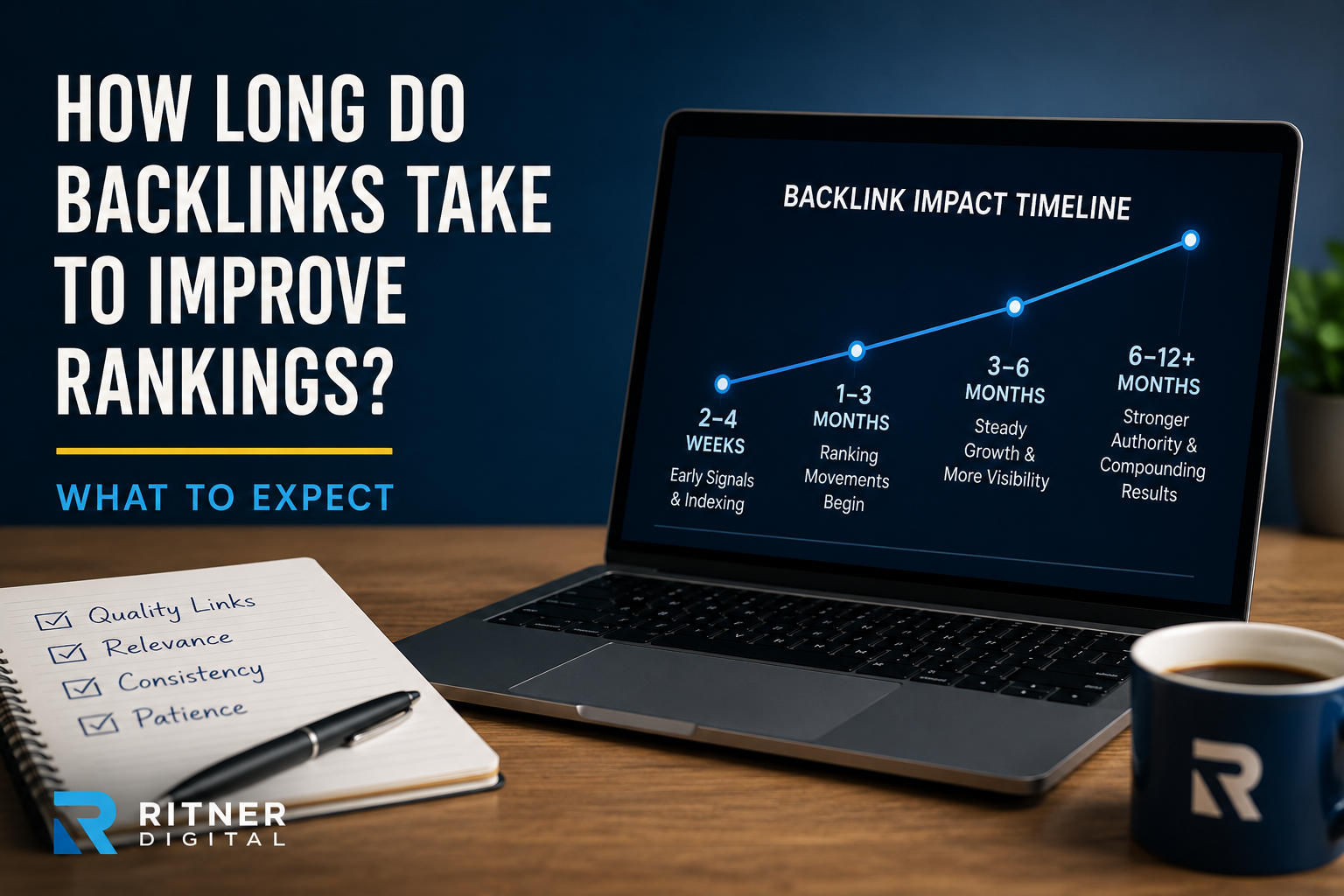
The bottom line? Early signals can appear within weeks. Meaningful, traffic-driving results typically take 3–6 months. True domain authority that compounds over time? That's a 6–12 month commitment minimum.
The Three Phases Every Backlink Goes Through
Understanding the timeline starts with understanding what actually happens after a backlink goes live. Backlinks and the pages they're pointing to usually undergo three phases: Indexing, the "Big Jump," and the "Uphill Climb."
Indexing happens when Google picks up the page containing the backlink and includes it in its directory. You can verify this by typing "site: [URL]" into Google — if the page appears in results, it's been indexed. SEOptimer
After indexing comes the Big Jump — a noticeable early ranking movement as Google processes the new link signal. Then the Uphill Climb kicks in, which is the slower, steadier accumulation of authority over time as more links build up, your content ages, and Google's trust in your domain deepens.
Internal studies from SEO agencies show noticeable ranking movement roughly 8–12 weeks after Google indexes a link. However, many factors will determine how long backlinks take to work. Stellar SEO
6 Factors That Determine How Fast Backlinks Work
1. Your Website's Age and Existing Authority
This is the biggest variable of all. A new website without domain authority, history of search traffic, or SEO foundation is the worst scenario — if your website is brand new with 10 pages or so, you can add 100 links a week and still see no traffic for months to come. An existing website with good domain authority and some traffic — one that has been live for 12–24 months and has gained a few backlinks — can see results more quickly, especially for less competitive keywords, within 4–6 weeks. Luca Tagliaferro
Established sites with strong existing profiles benefit from every new backlink much faster than newer sites still building credibility from scratch.
2. The Quality and Relevance of the Backlink
Not all links are created equal — and the gap between a strong link and a weak one is enormous when it comes to timeline.
Link relevance is a key factor in Google's spam policies, which emphasize using relevant backlinks to ensure a high-quality user experience. A survey of SEO experts showed that 84.6% of respondents consider link relevance one of the top indicators of link quality — clearly outweighing domain scores and even site traffic. A relevant link from a site that ranks well for topics like yours tells Google that an independent publisher thinks your page is valuable for their readers. Editorial
A high-authority, highly relevant link can move rankings in weeks. A low-quality link from an unrelated site may never move them at all.
3. How Competitive Your Target Keywords Are
The competitiveness of the keywords you're targeting directly impacts how long results take to show. In every aspect of marketing, businesses need to know when and how they will see a return on their investments. It doesn't matter how hard you work or how many links you earn — if you can't outperform your competitors, your backlinks won't show results. Sure Oak
For low-competition, long-tail keywords, a handful of quality backlinks can produce results in a matter of weeks. For high-competition terms where established sites have hundreds or thousands of referring domains, you're looking at a much longer road — sometimes 6–12 months of consistent link building before you crack the first page.
4. The Pace and Scale of Your Link Building
Earning links at a consistent, growing pace matters more than most people realize. As long as your links are of high quality, each new backlink will yield quicker returns than the last. As an added benefit, earning links at a rigorous pace also helps your page rank higher. Just a warning though: make sure that your link building activity isn't too consistent. If you're earning the exact same number of links every week, Google's algorithm could interpret your efforts as an unnatural link scheme. Sure Oak
Vary your pace, mix your sources, and let your link profile grow organically. Natural-looking growth is what Google rewards.
5. Technical SEO and Content Quality on Your Site
Backlinks don't operate in isolation. Backlinks won't help much if your content doesn't match search intent, loads slowly, or lacks basic SEO best practices such as titles, H1s, and internal linking. A backlink acts as a vote of confidence, but Google still evaluates whether your content deserves to rank. Ranko Media
If your technical SEO is a mess — slow page speed, crawl errors, poor mobile experience — backlinks will struggle to move the needle regardless of their quality. Fix the foundation first, then build links on top of it.
6. Google's Crawl Rate and Algorithm Updates
Even after a backlink goes live and the page is indexed, there's still a processing delay. With 9 years in SEO experience, the top three delays observed include: crawling speed (Google needs time to discover and process new backlinks, especially from lesser-known sites), content quality (backlinks are most effective when they link to relevant, high-quality content, and poor content can delay benefits), and competition and algorithm changes (in competitive niches or during Google updates, the impact of backlinks might be less noticeable). Editorial
Major algorithm updates can temporarily suppress or amplify ranking changes — which is why you should never panic after a single volatility event.
What a Realistic Timeline Looks Like
Here's a plain-English breakdown of what to expect at each stage, based on a consistent link building effort on an established website targeting moderately competitive keywords:
Weeks 1–4: Google crawls and indexes the pages containing your new backlinks. You may see very minor ranking fluctuations — this is normal. Don't read too much into it.
Weeks 5–10: The first meaningful ranking movements tend to appear here. Noticeable movement typically occurs roughly 8–12 weeks after Google indexes a link. Pages may jump several positions for target keywords. Stellar SEO
Months 3–5: Generally, you can start to see the effects of backlinks in about 3 months. However, the timeline can vary based on several factors, including the quality of the backlinks and the frequency of search engine crawls on your site. This is typically when organic traffic starts to reflect ranking gains. webapex blog
Months 6–12: The compounding effect begins. You'll often only see very marginal gains for the first 6–12 months of a link building campaign — but then things can skyrocket. One example showed only marginal increases throughout an entire year of SEO work, even with some dips — but then at the end of the year, traffic almost quadrupled by the following April. Elevate Digital
Beyond 12 months: This is where domain authority truly takes hold, competitive keywords become reachable, and your content starts attracting backlinks passively rather than requiring constant outreach.
What to Do If Your Backlinks Aren't Working
Waited two months and seen nothing? Before assuming the links are the problem, work through this checklist.
If you've waited more than 2 months and seen no movement in your rankings from backlink placements, ask yourself: Would Google consider this backlink a meaningful vote for my website? Is the content high-quality and written by an expert, or is it spammy and low-value? Are there technical issues on the linking website such as crawl blocks or noindex tags? Are you targeting a highly competitive keyword with insufficient supporting content? Fixing these issues can help unlock the potential of your backlink efforts. Ranko Media
Also consider whether the linking pages themselves have actually been indexed by Google. A backlink on a page that Google hasn't crawled doesn't pass any value — period.
The One Thing Most People Get Wrong
The single biggest mistake in link building isn't building the wrong types of links or targeting the wrong sites. It's giving up too soon.
Giving up too soon can often be a fatal mistake when it comes to SEO or link-building efforts. The reason a lot of businesses don't see success with their SEO campaigns is because the goal is often wrong. Elevate Digital
SEO is not a paid ad campaign where you flip a switch and see immediate returns. It's a compounding asset — one that builds slowly at first, then accelerates dramatically once critical thresholds of authority and trust are crossed. The businesses that win in organic search are the ones that commit to the long game and don't flinch when the first three months don't show dramatic results.
Significant results on average take 4 to 12 months, though it depends on a mix of factors. Plan accordingly, track consistently, and trust the process. Editorial
Key Takeaways
Most backlinks begin influencing rankings within 8–12 weeks of being indexed
Early ranking signals can appear in 2–4 weeks for established sites
Meaningful traffic-driving results typically take 3–6 months
New websites face longer timelines — often 6–12 months before seeing significant movement
Quality, relevance, and your site's technical health all directly affect how fast links work
Consistency and patience are the two most underrated factors in link building success
Ready to Build a Backlink Strategy That Compounds Over Time?
At Ritner Digital, we build SEO strategies designed for long-term authority — not short-term tricks that fade the moment Google updates its algorithm. If you're ready to invest in link building that actually works, we'd love to talk.
→ Get in touch at ritnerdigital.com/#contact
Sources
Editorial.link — How Long for Backlinks to Take Effect? — editorial.link/how-long-for-backlinks-to-take-effect/
Sure Oak — How Long Do Backlinks Take to Work? — sureoak.com/insights/how-long-do-backlinks-take-to-work
Luca Tagliaferro — How Long for Backlinks to Work? — lucatagliaferro.com/how-long-take-backlinks-work/
Stellar SEO — How Long Does It Take for Backlinks to Work? — stellarseo.com/how-long-does-it-take-for-backlinks-to-work/
SEOptimer — How Long It Takes for Backlinks to Take Effect — seoptimer.com/blog/how-long-for-backlinks-to-take-effect/
Ranko Media — How Long Do Backlinks Take to Work? — rankomedia.com/blog/how-long-do-backlinks-take-to-work/
Elevate Digital — How Long Do Backlinks Take to Help Your SEO — elevate-digital-solutions.com/how-long-do-backlinks-take-to-help-your-seo/
WebApex — How Long Does SEO Take to Work? — webapex.com.au/blog/seo-ranking-timeline/
Frequently Asked Questions
How long does it take to see my first ranking movement from a new backlink?
On average, it takes 2–4 weeks after a backlink is placed to notice a change in Google rankings. That said, this early movement is often subtle — a few positions up or down as Google processes the new signal. Don't mistake minor fluctuations in the first few weeks for failure. The more meaningful, traffic-driving ranking improvements typically come later in the 3–5 month window. Ranko Media
Does it take longer for a brand new website to see results from backlinks?
Yes — significantly longer. A new website without domain authority, history of search traffic, or SEO foundation is the worst scenario — you can add 100 links a week and still see no traffic for months to come. If your site is under 12 months old, set your expectations accordingly and focus first on building a solid content foundation alongside your link building efforts. Luca Tagliaferro
Do high-authority backlinks work faster than low-authority ones?
Yes. Securing backlinks from authoritative domains within your industry can accelerate SEO improvements significantly. Conversely, backlinks from dubious sources or unrelated domains — such as generic link farms or off-topic blogs — can impede SEO progress or damage your site's rankings. One strong, relevant link from a trusted publication will move rankings faster than a dozen links from low-quality sources. Stellar SEO
What happens if I build a lot of backlinks very quickly?
Proceed with caution. As you attempt to earn links at a consistent pace and scale, make sure that your link building activity isn't too consistent. If you're earning the same number of links every week, Google's algorithm could interpret your efforts as an unnatural link scheme. Vary your pace, diversify your sources, and let your link profile grow in a pattern that looks natural and organic. Sure Oak
Can a Google algorithm update affect how quickly my backlinks work?
Absolutely. In competitive niches or during Google updates, the impact of backlinks might be less noticeable. Major algorithm updates can temporarily suppress or amplify ranking changes, which is why you should never make major strategic decisions based on short-term volatility. Track trends over weeks and months, not days. Editorial
I've had backlinks for two months and seen no improvement — what should I do?
Start by troubleshooting before assuming the links aren't working. Ask yourself: Would Google consider this backlink a meaningful vote for my website? Is the content high-quality and written by an expert, or is it spammy and low-value? Are there technical issues on the linking website such as crawl blocks or noindex tags? Are you targeting a highly competitive keyword with insufficient supporting content? Fixing these issues can help unlock the potential of your backlink efforts. Also verify that the linking pages have actually been indexed by Google — a backlink on an unindexed page passes zero value. Ranko Media
Is there anything I can do to speed up how fast backlinks impact my rankings?
Yes. Go after higher authority and more relevant websites with your outreach. Rather than just getting links from outreach campaigns, also consider building content that attracts backlinks on a passive basis — when those pages rank, journalists and bloggers find and link to them naturally. Beyond that, make sure your technical SEO is clean, your content matches search intent, and you're building links at a varied, consistent pace rather than in erratic bursts. Ranko Media
How long until backlinks start driving real traffic, not just ranking changes?
Expect some results in 3–5 months after you've had time to run outreach campaigns, earn links, and given Google time to crawl, analyze, and index them. For genuinely competitive keywords and meaningful traffic volume, most sites see the real compounding payoff between months 6 and 12 — and the growth that follows tends to be exponential rather than linear, especially when link building is paired with strong on-page content. Ranko Media