Google Didn't Kill FAQs. It Killed the Abuse of Them. Here's What's Actually Going On.
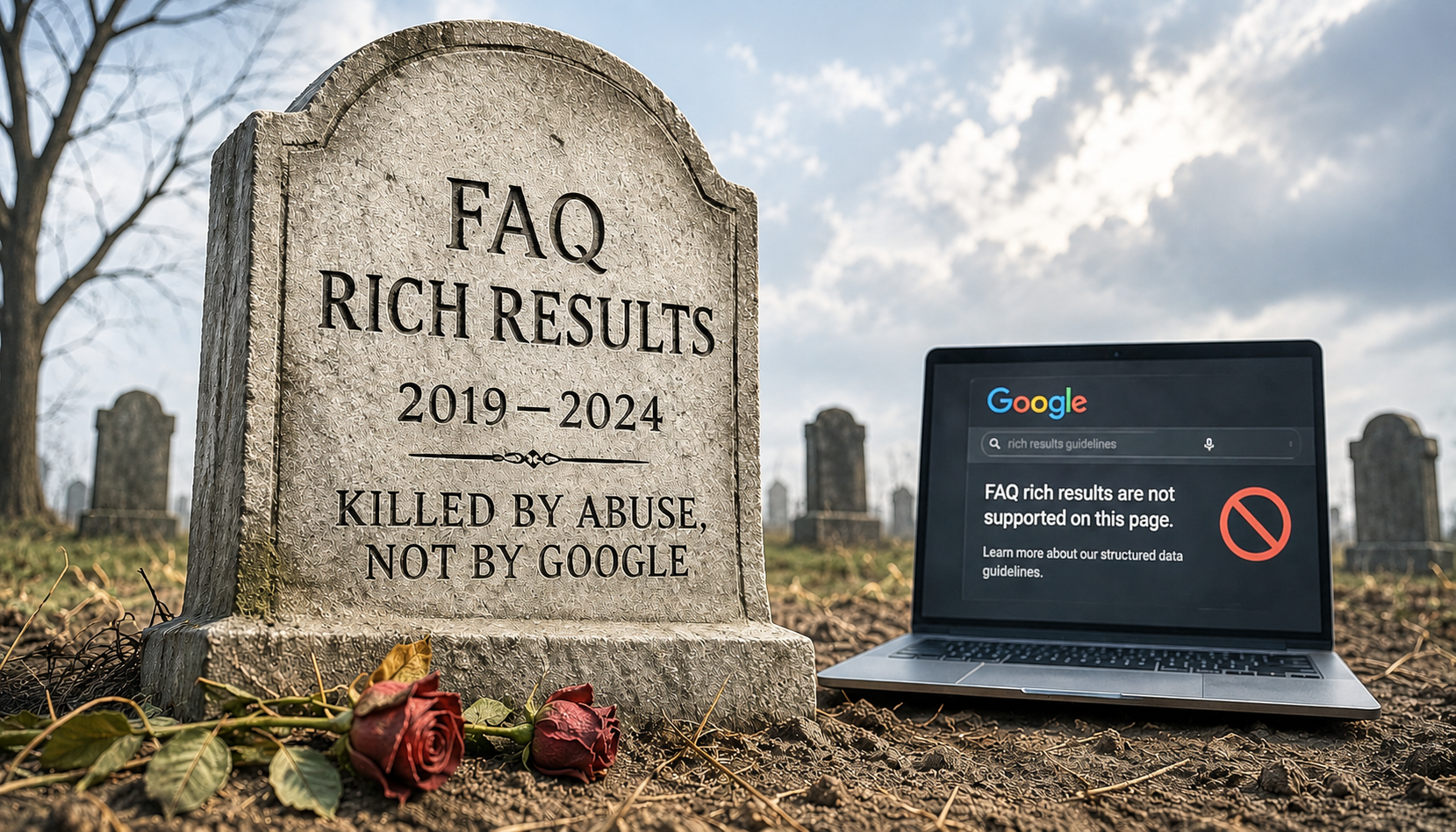
There's a post making the rounds in SEO circles right now with a headline that reads like an obituary: "BREAKING: GOOGLE just KILLED FAQ rich results."
Cue the panic. Cue the hot takes. Cue the comment section brawl between people who think SEO is dead and people who think nothing ever changes.
Here's the thing — both camps are wrong. And if you're a business owner or marketer trying to make sense of what Google actually did, you deserve a straight answer instead of engagement-bait. So let's get into it.
What Actually Happened (The Real Timeline)
Let's start with the facts, because the "BREAKING" framing is doing a lot of heavy lifting here.
Google will no longer support FAQ rich results as of May 7, 2026. Going forward, you will no longer see FAQ rich results in Google Search results, and Google Search Console will stop reporting on FAQ structured data. Search Engine Land
That part is true. But here's what the viral post conveniently left out: this is not a sudden decision. This has been coming for nearly three years.
The deprecation completes a process that started in August 2023, when Google first restricted FAQ rich results to well-known, authoritative government and health websites. For most of the web, FAQ rich results have already been gone for nearly three years. The May 2026 announcement removes them for everyone, including the sites that retained them after the 2023 restriction. Nobs Marketplace
So when someone in your LinkedIn feed acts like Google just dropped a bomb this week — they either weren't paying attention in 2023, or they're manufacturing urgency for clicks. Probably both.
The full deprecation rolls out in phases:
May 7, 2026 — FAQ rich results stop appearing in Google Search entirely
June 2026 — Google removes the FAQ search appearance filter, the rich result report, and Rich Results Test support
August 2026 — Search Console API support for FAQ rich results is removed
Google didn't publish a blog post or explain the reasons behind the removal. They just quietly updated their developer documentation. Which, honestly, tracks — this isn't breaking news to Google. It's the last step in a cleanup they started years ago. Search Engine Journal
Why Did Google Do This? (The Part Nobody's Explaining Well)
The social post we're referencing gestures at this but doesn't fully commit to an answer. Let's actually go there.
The widespread adoption of FAQ schema led to significant abuse, with many websites creating artificial or low-quality FAQ sections solely to gain rich result visibility. Some sites were stuffing irrelevant questions or providing misleading answers just to occupy more SERP space. Wildnet Technologies
Think about how many websites you've visited in the last year that had an FAQ section at the bottom of a service page. Now ask yourself: how many of those questions were ones you actually had? How many answers were genuinely useful versus clearly written for a search engine?
That's exactly what Google is responding to. The feature worked well in its early days — real questions, real answers, real users getting value. Then SEOs (understandably, this is their job) figured out that FAQ schema was a fast lane to more SERP real estate. Templates spread. Agencies added FAQ sections to every page by default. The questions became formulaic. The answers became keyword-stuffed filler. Google noticed.
The pattern is not unique to FAQ markup. HowTo rich results followed the same path. Google restricted them in late 2023, then deprecated them entirely. Both changes share a common cause: widespread schema abuse. When teams add FAQ sections to pages specifically to capture the SERP dropdown, rather than to genuinely answer reader questions, the format produces more noise than signal. Google's response has been to remove the display feature rather than police individual implementations. Launchcodex
That last sentence is important. Google isn't going through millions of sites and grading each FAQ on quality. That's not scalable. Instead, they just shut down the incentive entirely. If there's no rich result to chase, there's no reason to manufacture low-quality FAQs. It's a blunt instrument, but it works.
So Are FAQs Dead? No. And Here's Why That Framing Is Misleading.
This is where we need to push back hard on the "FAQ schema is now useless" take, because it's flat-out wrong.
Google stated it will continue to use FAQ structured data to better understand pages, even though it will no longer display the rich result. The line confirms what some SEO professionals have argued since the 2023 restriction: structured data and rich results are two different things. Schema markup tells Google what a page is about in machine-readable form. Rich results are a display feature that uses some structured data to render visual SERP elements. Nobs Marketplace
Read that again. Structured data and rich results are two different things. Google killed the visual display. It did not kill the comprehension signal.
And in 2026, that distinction matters more than ever — because Google isn't the only system parsing your content anymore.
AI systems rely on machine-readable signals to decide which pages to cite. FAQPage markup provides exactly the format those systems prefer: explicit question, direct answer, identified source. Research from AirOps found that pages with clean structure paired with schema earn 2.8 times higher AI citation rates than poorly structured pages. Launchcodex
Let that number sink in. 2.8 times higher AI citation rates. As AI Overviews, Perplexity, ChatGPT, and Gemini become increasingly common entry points for search behavior, being the source that gets cited matters enormously. And FAQ schema, structured correctly around real questions, is practically a direct feed into how those systems build their answers.
Only 38% of pages cited in Google AI Overviews rank in the top 10 of traditional search results, according to an Ahrefs study of 863,000 keyword SERPs from February 2026. That figure is down from 76% in mid-2025. Launchcodex
AI citation eligibility is increasingly disconnected from traditional rankings. You don't just need to rank — you need to be understood and trusted by AI retrieval systems. Well-structured content with real answers is exactly how you get there.
What This Actually Means for Your SEO Strategy
Let's be practical. Here's how to think about this:
1. You do not need to panic-delete your FAQ schema.
Google has confirmed that unused structured data does not cause problems for your site's performance in Search. FAQPage remains a valid Schema.org type, and leaving the markup in place will not hurt your rankings or trigger any penalties. SEO News
Don't let anyone upsell you on an emergency "FAQ cleanup audit" this week. That's fear-mongering, not strategy.
2. This is a ranking change — full stop.
Google's deprecation of FAQ rich results is a display change, not a ranking change. Your page positions stay where they were. CTR may shift, but the direction and magnitude depend on how much of your visibility came from the rich result format specifically. Launchcodex
Your organic positions didn't move. Your page didn't get penalized. The accordion dropdown in the search results is gone. That's it.
3. The real lesson is about why you're adding FAQ content in the first place.
If you've been adding FAQ sections because an agency told you to slap them on every service page for schema purposes — that's the behavior Google was targeting. Stop doing that.
If you're adding FAQ content because your customers genuinely have questions and you want to answer them clearly — keep doing that. Write better answers. Go deeper. Be the resource.
Google did not say FAQ content is unhelpful. It did not say question-and-answer sections should disappear from websites. For site owners, the new job is not to mourn the loss of a SERP enhancement. It is to rebuild the role of FAQs inside a modern search strategy — separating user experience from markup habits, prioritizing clear answers over templated bloat, and designing pages that can still perform in traditional results, AI-generated summaries, and direct-answer environments. ALM Corp
That's a more sophisticated framing than "FAQs are dead" — and it's the right one.
4. Watch what comes next.
The viral post got this part right. The same logic Google applied to FAQ schema applies to other content patterns that exist purely for SEO optics:
Programmatic pages with thin, templated content
"SEO sections" bolted onto the bottom of pages that serve no user
Over-optimized content that reads like it was written for a robot
Google is actively managing what kinds of content it surfaces in search results, and features that once gave publishers extra visibility are being phased out as AI-driven responses take up more of the search results page. SEO News
The direction of travel is clear. Tricks that inflate SERP presence without delivering user value will get their incentives removed, one by one. This isn't new philosophy from Google — it's the same principle they've been articulating for years, and they're finally enforcing it at the feature level.
The Bottom Line
Here's the honest summary for anyone who made it this far:
Google deprecated FAQ rich results — the visual dropdown that appeared in search results — effective May 7, 2026. This is the final step of a phaseout that began in August 2023. It is not sudden, it is not a crisis, and it is not the death of FAQ content or schema markup.
What it is: a signal that Google (and increasingly, AI search systems) are rewarding content built for real users and penalizing patterns that exist purely to game search features. FAQ schema still helps Google and AI systems understand your pages. Real answers to real questions still belong on your website.
The businesses that will win in this environment aren't the ones scrambling to remove FAQ markup this week. They're the ones who were writing genuinely useful content all along — and the ones willing to make that shift now.
Ritner Digital helps businesses cut through the noise and build search strategies that actually work — not just strategies that chase the last SERP trick Google kills.
Ready to build a content strategy built for 2026 and beyond? Let's talk. →
Sources: Search Engine Land · Search Engine Journal · Google Search Central Documentation · NO-BS Marketplace · Launchcodex · ALM Corp
Frequently Asked Questions
Did Google completely remove FAQ schema support?
No. Google removed the rich result display — the visual accordion dropdown that appeared in search results. The FAQPage schema type itself is still valid and still used by Google to better understand your page content. Other search engines and AI systems like ChatGPT, Perplexity, and Gemini may also continue to use it. You don't need to remove it from your code.
Do I need to delete FAQ schema from my website right now?
No. Google has confirmed that unused structured data does not cause penalties or harm your rankings. If you have FAQ markup in place, leaving it there won't hurt you. That said, if your FAQ sections were added purely for the rich result display and contain low-quality, templated content, this is a good time to audit them for actual user value — not because Google will penalize you, but because that content isn't helping anyone.
Will removing FAQ schema improve my rankings?
No. This deprecation is a display change, not a ranking change. Your organic positions are not affected by whether you have FAQ schema on your pages or not. Removing it will not boost your rankings, and leaving it will not hurt them.
Does FAQ schema still help with AI search like ChatGPT or Google AI Overviews?
Yes — and this may actually be the most important reason to keep using it correctly. AI systems prefer machine-readable, structured content when deciding what pages to cite in generated answers. FAQ schema provides exactly that format: a clear question, a direct answer, and an identified source. Research has found that well-structured pages with schema earn significantly higher AI citation rates than unstructured pages.
What kind of FAQ content should I actually be creating?
The kind your customers actually have. If someone calls your business and asks the same question repeatedly, that belongs in your FAQ. If a question exists only because an SEO template told you to put it there, it probably shouldn't. The shift Google is pushing — and that AI search is rewarding — is away from keyword-stuffed Q&A filler and toward genuine, specific answers that demonstrate real expertise.
Is this part of a bigger trend in how Google is changing search?
Yes. FAQ rich results and HowTo rich results have both been deprecated after widespread abuse. Google is systematically removing display incentives that were being gamed rather than used as intended. At the same time, AI Overviews and AI Mode are taking up more of the search results page. The pattern is consistent: content that exists purely for SERP tricks loses its advantage, while content built for real users continues to perform.
Should I be worried about my SEO after this change?
Only if your strategy was built around chasing SERP features rather than serving your audience. If your content genuinely answers questions, demonstrates expertise, and is structured clearly — you're in good shape. If you've been relying on FAQ schema to prop up thin pages, this is a good wake-up call to invest in content that would hold up even if Google removed every rich result tomorrow.