Google Still Ranks Pages. AI Doesn't. Here's Why That Distinction Is Rewriting Every Marketing Strategy.
There's a sentence making the rounds in marketing circles right now, and it deserves more than a quick nod of agreement:
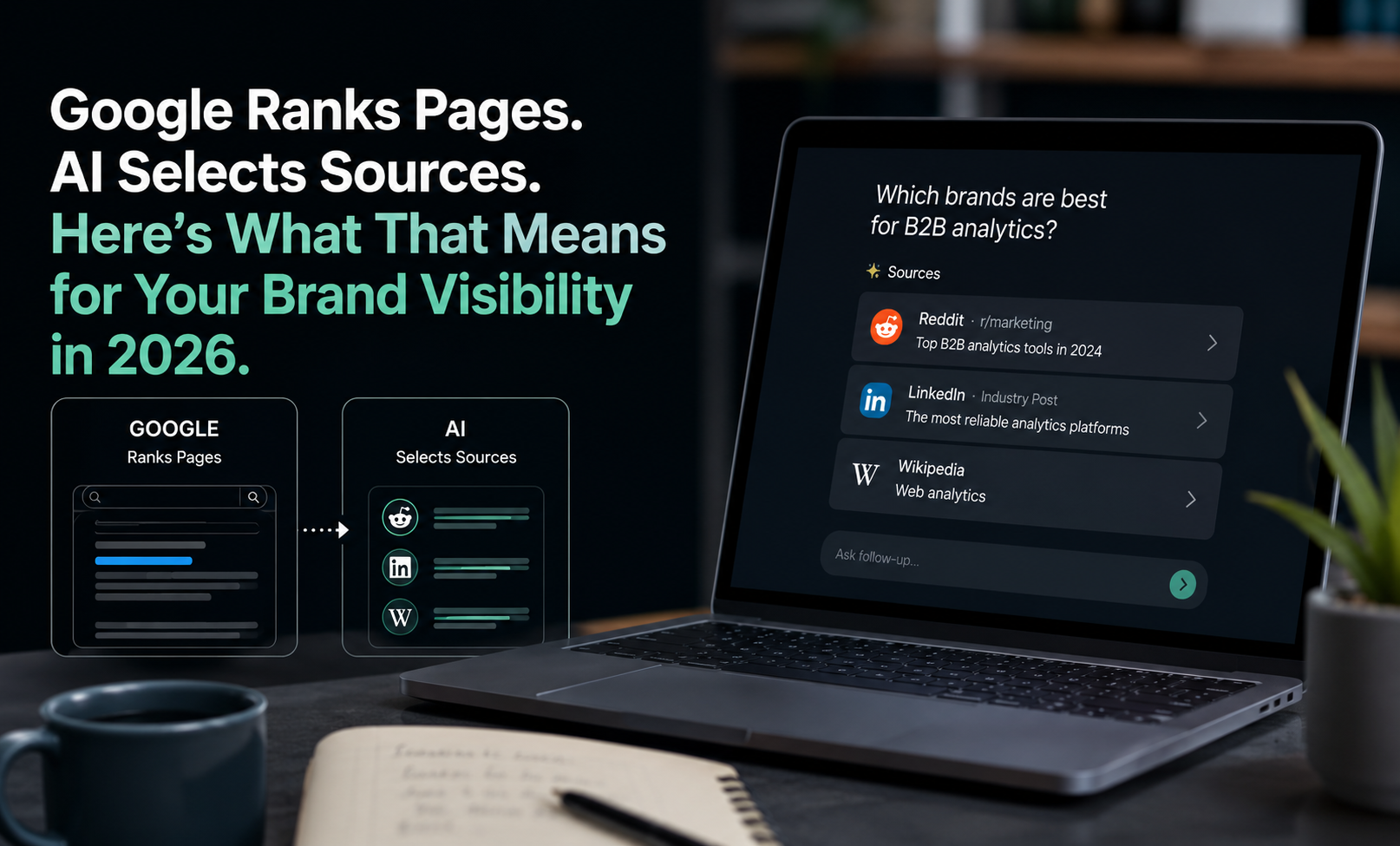
Google still ranks pages. AI doesn't rank — it selects sources.
That's not a subtle difference in wording. It's a fundamental shift in how visibility is earned, measured, and defended. And most brands — even sophisticated ones with mature SEO programs — haven't fully internalized what it means for their business.
This post unpacks that shift completely: why the ranking-vs.-selection distinction matters, where community presence fits in, what the data actually shows, and what you need to do about it right now.
The Two-Layer Visibility Problem Nobody Is Talking About Clearly Enough
For the past two decades, the dominant model of search visibility was vertical and linear. You created content, acquired links, improved technical health, and watched your pages climb a ranked list. Position one was the goal. Everything else was noise.
That model isn't dead — but it's no longer sufficient on its own.
What's emerged is a two-layer visibility problem. Layer one is the familiar game: organic rankings in traditional search results. Layer two is something newer and structurally different — whether AI systems select your brand as a trusted source when generating answers.
These two layers operate on overlapping but distinct signals. Getting layer one right doesn't automatically win layer two. And increasingly, layer two is where buyer decisions are being shaped before a single click ever happens.
Brands are no longer competing for rankings. They are competing to be selected as trusted sources within AI-generated responses. That reframe has massive implications for where you spend your time, budget, and content effort. BirdEye
How AI Search Actually Works (And Why It's Nothing Like a Ranking System)
When someone searches Google, they get a list. Ten blue links. A featured snippet. Maybe a few ads. The fundamental mechanic is ranking — content is sorted by relevance and authority into a predictable, browsable order.
When someone asks ChatGPT, Perplexity, or Gemini a question, something entirely different happens. These systems generate a synthesized answer by selecting, validating, and combining information from a limited set of trusted sources. Customers no longer browse multiple options — they rely on a single response. BirdEye
Read that again. A single response. Not ten options. Not a list to scroll through. One answer, with a handful of cited sources embedded inside it.
AI search does not behave like a traditional results page. There is no fixed ranking, no predictable position drops, and no stable "page one." Visibility moves according to signals that update in real time. Brands drift in and out of answers based on freshness, authority, community validation, and how clearly their content can be interpreted as relevant and trustworthy. AirOps
This is the core reason why your existing SEO dashboard — however well-built — is only telling you half the story.
The Semrush Chart That Explains Everything
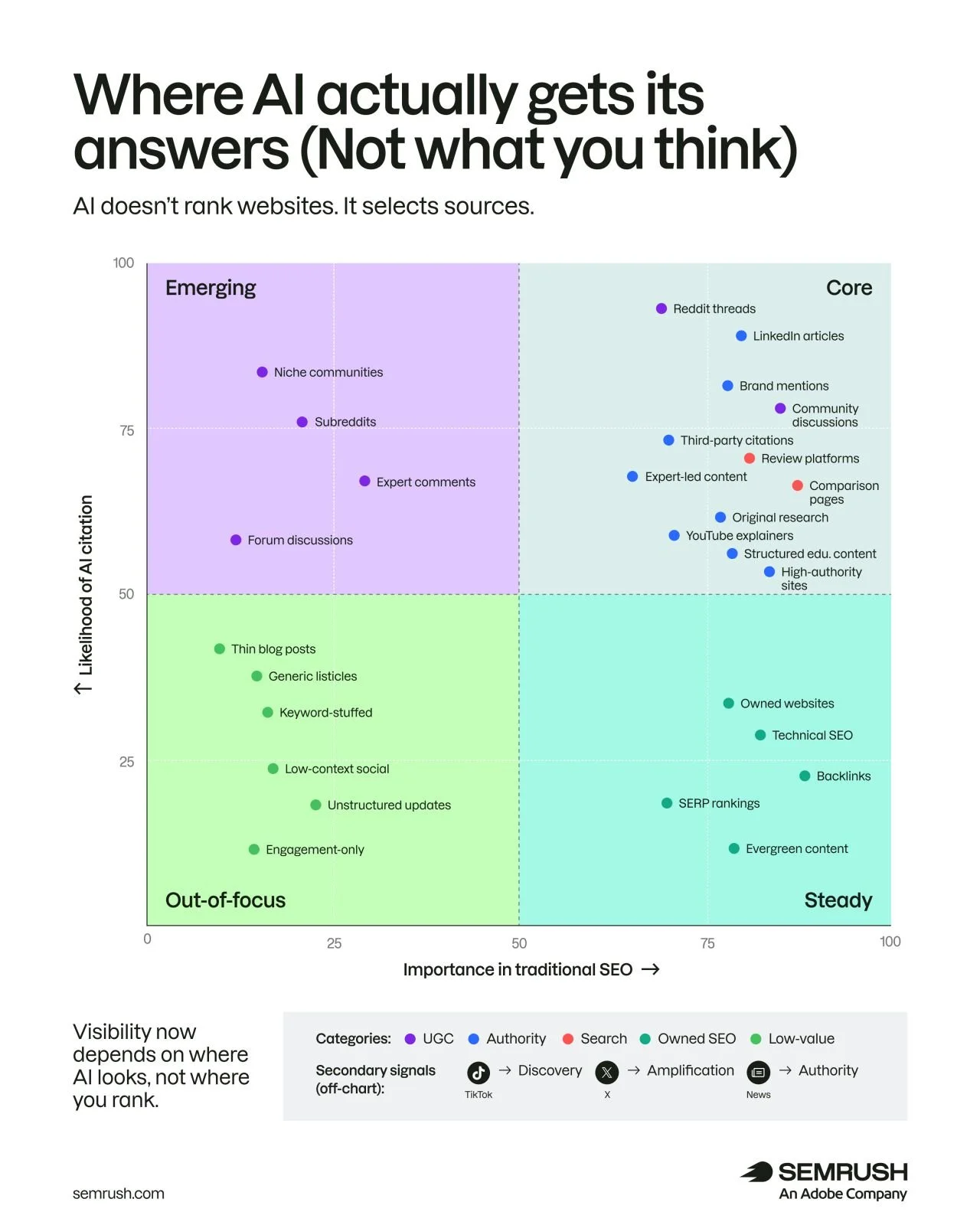
A Semrush graphic circulating recently maps content types across two axes: likelihood of AI citation (vertical) and importance in traditional SEO (horizontal). The result is a four-quadrant view of the new visibility landscape, and it's one of the clearest visualizations of this shift we've seen.
Here's what the quadrants tell you:
Core (high AI citation likelihood + high traditional SEO importance): Reddit threads, LinkedIn articles, brand mentions, community discussions, third-party citations, review platforms, comparison pages, original research, expert-led content, YouTube explainers, structured educational content, and high-authority sites. These are the sources AI systems trust most — and they span both traditional SEO signals and community-driven authority.
Emerging (high AI citation likelihood + lower traditional SEO importance): Niche communities, subreddits, expert comments, forum discussions. These are undervalued by traditional SEO playbooks but increasingly powerful for AI citation. The gap between their SEO value and their AI value is exactly where smart brands are finding leverage right now.
Steady (low AI citation likelihood + high traditional SEO importance): Owned websites, technical SEO, backlinks, SERP rankings, evergreen content. This is the traditional SEO stack. It still matters — but it's not doing the heavy lifting for AI visibility on its own.
Out-of-focus (low on both axes): Thin blog posts, generic listicles, keyword-stuffed content, low-context social posts, unstructured updates, engagement-only content. The stuff that may have worked five years ago and is now essentially invisible in both systems.
The bottom line from this chart: your owned website and technical SEO alone will not get you cited by AI systems.The sources AI trusts most are community-validated, third-party, and distributed across platforms you probably aren't treating as strategic channels.
The Reddit Number That Should Stop You in Your Tracks
Reddit alone drives approximately 9.3 million monthly visits from AI tools.
Let that sit for a second. A platform that many B2B marketers still dismiss as irrelevant to their industry is one of the single most-cited sources across every major AI system.
Reddit was the single most-cited domain by large language models in 2025–2026, surpassing Wikipedia. And the top cited domains in ChatGPT in the US are Reddit, Wikipedia, Amazon, Forbes, and Business Insider. IssuewirePosition Digital
This isn't a coincidence. AI systems are trained on human conversation and trust signals at scale. Reddit represents exactly what AI models are looking for: real people asking real questions and getting real answers from peers with demonstrated experience. It's community-validated information — and community validation is one of the core signals AI uses to decide what to surface.
Domains with millions of brand mentions on Quora and Reddit have roughly 4x higher chances of being cited than those with minimal activity. Position Digital
Four times. If your brand has zero presence in Reddit threads, subreddits, or community discussions relevant to your category, you are starting that race significantly behind.
Why "Ecosystem Trust" Is the New Page Rank
The original PageRank algorithm worked by counting links. More links from authoritative sources meant more authority, which meant higher rankings. It was a proxy for trust — if lots of credible sites link to you, you're probably credible too.
AI visibility operates on a similar proxy system, but the inputs are much broader. It's not just links. It's the entire ecosystem of signals surrounding your brand: mentions in community discussions, citations in third-party articles, reviews on external platforms, expert commentary that references you, LinkedIn content that establishes thought leadership, YouTube content that explains your category.
Community and user-generated channels now act as a core trust layer in AI search. Models look to user-generated domains like Reddit, LinkedIn, YouTube, Wikipedia, and other community spaces to understand what people experience, recommend, and question about brands. Instead of relying primarily on brand-owned pages, AI systems often cite UGC domains where people compare options, share outcomes, and validate claims in public. Community platforms drive nearly half of citations — about 48% of AI search citations come from user-generated and community sources. AirOps
Nearly half. From sources you don't own and can't directly control.
This is what we mean by ecosystem trust. It's not enough to have a great website. AI systems are cross-referencing your brand across the entire web — and if the only place you exist with authority is your own domain, you're a weak signal in a system that rewards breadth and third-party validation.
Nearly 30% of AI users check a brand's social profiles after receiving an AI recommendation. Getting cited in an AI answer is step one, not the finish line. What users find when they verify matters just as much as whether you showed up at all. Yext
The Data on AI Traffic: Still Small, But Remarkably High-Intent
Before we go further, let's address the volume question honestly. AI referral traffic is not replacing Google traffic yet. It's still a fraction of overall web traffic. Any strategy that ignores this is selling you something.
AI platforms are only driving an average of 1% of overall web traffic across 10 major industries. That's the honest number. Digiday
But here's what makes that 1% worth fighting for aggressively: the quality of that traffic is disproportionate to its volume.
LLM traffic has higher conversion rates than organic traffic: ChatGPT converts at 15.9%, Perplexity at 10.5%, Claude at 5%, and Gemini at 3%. Google's organic conversion rate is 1.76%. Position Digital
ChatGPT traffic converts at nearly nine times the rate of standard organic search. Nine times.
With AI platforms, people can now search in ways that weren't possible before with traditional search engines. This has expanded the diversity of search intent, and much of the resulting traffic arrives already pre-qualified. Someone who asked an AI system "what's the best B2B email marketing agency for a 50-person SaaS company" and then clicked through to your site already went through a filtering process before they arrived. They're not browsing. They're evaluating. SeaRanks
And the growth trajectory is not subtle. AI-referred sessions saw a 527% year-over-year increase. The volume is small now. The direction is unambiguous. Position Digital
What AI Systems Actually Use to Decide Who Gets Cited
If you're going to build a strategy around AI visibility, you need to understand the actual selection signals — not just the vague notion of "be authoritative." Here's what the research shows:
Domain authority and backlink profile still matter. Sites with over 32,000 referring domains are 3.5x more likely to be cited by ChatGPT than those with up to 200 referring domains. Traditional SEO work isn't wasted — it feeds into AI selection, just not as the only signal. Position Digital
Review and rating platform presence is a multiplier. Domains with profiles on platforms like Trustpilot, G2, Capterra, Sitejabber, and Yelp have 3x higher chances of being chosen by ChatGPT as a source, compared to sites without such presence. Position Digital
Content structure matters more than you think. Comparison pages with three tables earn 25.7% more citations. Validation pages with eight list sections earn up to 26.9% more citations. Shortlist pages averaging ten words or fewer per sentence earn 18.8% more citations. AI systems can extract answers more easily from structured, scannable content. If your pages are dense essay-style walls of text, you're making it harder to be selected. Position Digital
Freshness is a trust signal. AI models treat recency as a key signal of trust, especially when users compare options or make decisions. Maintaining fresh, up-to-date content is now non-negotiable for earning visibility in AI search. Pages that stay current remain inside the window models rely on when evaluating trust and relevance, while stale content quickly loses ground to fresher competitors. AirOps
Original data and proprietary research outperform generic content. Early-discovery content with five to seven statistics earns a 20% higher citation likelihood. AI systems are looking for information grounded in data. If you're just rephrasing what everyone else has already said, you're giving AI nothing distinctive to cite. Position Digital
Being ranked on Google helps — but it's not required. This is one of the most counterintuitive findings in the research. Only about 17% of AI Overview citations come from content ranking in the traditional top ten organic results. The majority of citations pull from pages ranking in positions 21 through 100, and in many industries, the bulk of citations come from sources that don't rank in the top 100 at all. Jarred Smith
That's a striking disconnect from the assumption that AI just reflects Google's top results. It doesn't. AI selection and organic ranking are related but meaningfully independent systems.
The Concentration Problem: Most Brands Aren't In the Answer at All
Here's a sobering reality check from the data. While 80% of brands are cited at least once, only 15% secure the top citation position with their own domain, and a meaningful share of brands are not cited at all. BirdEye
The math here is brutal. In a system that delivers one answer with a handful of sources, being the third or fourth cited source is often good enough. Being absent entirely means you don't exist for that buyer at that moment — regardless of how well your site ranks.
In classic search, 56% of users built their own shortlist from multiple sources. In AI Mode, 88% of users took the AI's shortlist without external checking. The AI's top pick becomes the user's top pick 74% of the time. Position Digital
Think about the strategic implications of that. More than eight in ten people using AI search are accepting the AI's shortlist as their shortlist. Three-quarters are choosing what the AI chose first. The brands included in that answer are the only brands being seriously considered.
Decision compression describes the shrinking window between awareness and action. Historically, a consumer researching a financial product might spend days comparing rates, reading reviews, and evaluating brand credibility. Today, an AI system can summarize top options, highlight trade-offs, and present a ranked list within seconds. Mattbritton
Your brand either makes it into that compressed moment of decision — or it doesn't.
LinkedIn, Reddit, and Communities Aren't "Nice to Have" Anymore
Let's return to the original insight that sparked this post: if your brand isn't consistently showing up across Reddit, LinkedIn, and communities, it's much less likely to be included in AI answers.
This framing — that visibility is becoming "ecosystem trust on top of rankings" — is the clearest way we've seen it articulated. And the data backs it up completely.
Reddit and community forums give AI systems something your owned website can't: independent, third-party evidence that real people find your brand credible, useful, or worth recommending. When AI is trying to decide whether to surface your brand, it's looking for corroboration from sources it already trusts.
LinkedIn articles and professional community discussions serve a similar function, particularly for B2B brands. They establish individual expertise and topical authority in a context that AI systems recognize as credible professional discourse.
Social media isn't just a content distribution channel — it's an active search destination. And it shows up twice in the customer journey: at discovery and at verification. Brand familiarity from social ranks as a top purchase influencer alongside review sentiment and review count. Yext
The playbook here isn't complicated, but it requires a real shift in where you invest content effort:
Participate genuinely in subreddits where your buyers ask questions. Not to spam links. Not to promote. To be helpful in ways that build a real presence and create mentions that AI can find and trust.
Publish on LinkedIn with depth and specificity. Generic "here are five tips" posts don't build the kind of authority that AI systems recognize. Detailed analysis, original data, and expert perspectives do.
Earn third-party citations. Whether through digital PR, guest content, original research that others reference, or getting your brand mentioned in comparison content, every independent citation is a trust signal that feeds the ecosystem.
Maintain review platform presence. Make sure you exist on the platforms buyers use to validate — G2, Trustpilot, Capterra, whatever is relevant to your category. Domains with profiles on platforms like Trustpilot, G2, Capterra, Sitejabber, and Yelp have 3x higher chances to be chosen by ChatGPT as a source. Position Digital
The Traditional SEO Layer Still Matters — But Its Role Has Shifted
None of this means you should abandon traditional SEO. The Semrush quadrant makes this clear — owned websites, technical SEO, and backlinks are in the "Steady" category for a reason. They still contribute meaningfully to visibility in both traditional search and, to a degree, AI selection.
Websites with more organic traffic tend to get more mentions in AI Overviews and Perplexity. There's correlation between organic authority and AI visibility. The difference is that correlation isn't causation, and it's not sufficient. Strong organic rankings get you in the conversation for AI selection — they don't guarantee inclusion. Position Digital
What traditional SEO does exceptionally well is build the foundation: domain authority, crawlability, topical depth, content architecture. These signals tell AI systems that your site is a legitimate, established source worth considering. But the selection decision increasingly depends on signals outside your owned domain — the ecosystem layer.
Think of it this way: traditional SEO gets your brand nominated. Ecosystem trust determines whether it gets selected.
What Measurement Looks Like Now
If you're still measuring search performance exclusively through rankings and organic click-through rates, you're flying partially blind. The rise of AI search has created a measurement gap that most analytics setups aren't equipped to close.
Traditional performance dashboards must evolve. Instead of focusing solely on sessions and conversions, leaders should monitor citation frequency, recommendation rank within AI outputs, and sentiment context. These metrics reflect real influence in an answer-driven ecosystem. Mattbritton
Practically, this means regularly testing your brand's target queries across ChatGPT, Perplexity, Google AI Overviews, and Gemini. Are you being cited? What context is being used to describe you? Which competitors are appearing alongside you — or instead of you? Are the sources being cited about your brand accurate and favorable?
Consumers who highly trust AI still verify. After getting a recommendation, 62% immediately search Google, 58% visit the business's website directly, and 52% click through to sources cited in the AI response. Getting cited in an AI answer is step one, not the finish line. If what customers find during that verification loop contradicts the AI answer — wrong hours, outdated location, stale reviews — you've lost a customer you technically showed up for. Yext
Measurement now spans the full loop: AI answer inclusion, what sources are cited about you, what users find when they verify, and whether that verification experience supports or undermines the AI recommendation.
A Practical Framework: What to Actually Do
Here's how we recommend thinking about this in priority order:
1. Audit your AI visibility first. Before optimizing anything, know where you stand. Run your 15–20 most important buyer queries through ChatGPT, Perplexity, and Google AI Overviews. Document who's showing up, what sources are being cited, and whether your brand appears at all. This baseline is your starting point.
2. Strengthen your owned content for extractability. Review your most important pages and ask: can an AI system pull a clean, direct answer from this content? Add question-based headings, concise answer paragraphs, FAQ schema, comparison tables, and structured lists. Make it easy to be cited.
3. Build genuine community presence. Identify the subreddits, LinkedIn communities, and industry forums where your buyers are active. Contribute substantively — answer questions, share real expertise, engage with existing conversations. This isn't a short-term play, but it's one of the highest-leverage things you can do for long-term AI visibility.
4. Invest in original research and data. Proprietary data and original research are among the most citation-worthy content types for AI systems. If you have access to internal data, customer insights, or category knowledge nobody else is publishing, put it into the world in a structured, shareable format.
5. Audit your third-party presence. Review platforms, comparison sites, industry directories, news citations — make sure your brand exists on the platforms AI systems trust. Inconsistent or missing information on these surfaces directly reduces your selection probability.
6. Make content freshness a system, not an event. Stale content loses AI visibility to fresher competitors. Build a regular refresh cadence into your content operations — particularly for commercial, comparison, and high-intent pages.
7. Track AI visibility alongside traditional metrics. Start monitoring your brand's presence in AI-generated answers on a regular basis. The tools for this are maturing quickly. At minimum, build a manual testing protocol that your team runs monthly.
The Bottom Line
The insight that started this conversation is simple, and it's right: Google ranks pages, AI selects sources. These are two different systems with two different sets of criteria, and winning at one doesn't guarantee winning at the other.
What AI systems are looking for is ecosystem trust — the distributed, cross-platform signal that real people and credible sources recognize your brand as authoritative in your category. Reddit threads, LinkedIn articles, community discussions, review platforms, third-party citations, original research: these aren't peripheral content activities anymore. They are core visibility infrastructure for the search environment that's forming around us right now.
This isn't a race to rank. It's a race to become the default reference — the brand AI selects when a buyer asks a question that matters. UnboundB2B
The brands building that ecosystem trust today will have a compounding advantage that gets harder to overcome with every passing month. The ones waiting for AI search to "mature" before investing are ceding ground they'll eventually need to buy back at a much higher cost.
Ready to Understand Where Your Brand Actually Stands?
Ritner Digital helps businesses build visibility that works across both layers — organic search authority and AI citation presence. We run AI search audits, build the content and entity infrastructure that gets brands selected as sources, and track the metrics that actually reflect how buyers are discovering you in 2026.
If you want to know where your brand appears when your buyers ask AI systems about your category — and what it would take to show up consistently — let's talk.
Work With Us → ritnerdigital.com/#contact
Sources: Semrush, Birdeye State of AI Search 2026, AirOps 2026 State of AI Search, Yext Consumer Search Behaviors Report 2026, SE Ranking research, Ahrefs citation analysis, Seer Interactive LLM conversion data, BrightEdge Generative Parser, Digiday AI referral traffic analysis, position.digital AI SEO statistics.
Frequently Asked Questions
Does Google ranking still matter for AI visibility?
Yes — but it's one signal among many, not the determining factor. Research from BrightEdge found that only about 17% of AI Overview citations come from content ranking in the traditional top ten organic results. Strong rankings contribute to domain authority and crawlability, which AI systems do factor in, but they don't guarantee selection. Think of organic ranking as getting your brand nominated — ecosystem trust across Reddit, LinkedIn, third-party citations, and review platforms is what actually determines whether you get selected.
What is the difference between SEO, GEO, and AEO?
Traditional SEO focuses on ranking pages for keyword queries in Google and other search engines. GEO — Generative Engine Optimization — is the broader strategy of building your brand's authority and credibility across AI-powered search ecosystems so it consistently earns citations over time. AEO — Answer Engine Optimization — is more tactical and on-site: structuring individual pieces of content with question-based headings, concise answer paragraphs, and schema markup so AI systems can easily extract and cite a clean answer. Enterprise brands need both. Neither works as well without the other.
Why does Reddit matter so much for AI search?
Reddit was the single most-cited domain by large language models in 2025–2026, surpassing even Wikipedia. AI systems trust Reddit because it represents real people asking real questions and getting peer-validated answers — exactly the kind of community signal AI uses to assess credibility. Brands with active, genuine mentions across relevant subreddits have roughly 4x higher chances of being cited than brands with minimal community presence. This doesn't mean spamming links — it means building authentic participation in the conversations your buyers are already having.
How do I know if my brand is appearing in AI search answers?
The most accessible starting point is manual testing. Run your 15–20 most important buyer queries through ChatGPT, Perplexity, Google AI Overviews, and Gemini. Document who appears, what sources are cited, and whether your brand is included or absent. For ongoing monitoring, a growing category of AI visibility tools — including options from Semrush, SE Ranking, Profound, and others — can track brand mentions and citation frequency across AI platforms at scale. At minimum, build a monthly manual testing protocol until your team has a more automated system in place.
Does AI-referred traffic actually convert?
Disproportionately well relative to its volume. ChatGPT traffic converts at approximately 15.9%, Perplexity at 10.5% — compared to Google organic's average conversion rate of around 1.76%. AI-referred visitors arrive pre-qualified because they've already gone through a filtering process before clicking. They asked a specific question, received a synthesized recommendation, and then chose to visit your site. That intent level is meaningfully different from someone clicking a search result while still in early exploration mode. The volume is still small, but the quality makes it worth competing for aggressively.
How long does it take to build AI search visibility?
It depends on where you're starting from. Brands with existing domain authority, a strong content foundation, and some third-party presence can see meaningful AI citation improvement in 60–90 days with the right structural changes to content and a focused ecosystem-building effort. Brands starting with thin content, minimal community presence, and no review platform footprint are looking at a longer runway — 6 to 12 months to build the trust signals AI systems rely on. The important thing is that every piece of the ecosystem you build compounds over time. There's no shortcut, but there's also no ceiling on how authoritative you can become.
What content types are most likely to be cited by AI systems?
Based on current research, the highest-citation content types are: original research and proprietary data, structured comparison pages with tables, expert-led content with clear credentials, educational content with direct and extractable answers, and community-validated discussions on platforms like Reddit and LinkedIn. Thin blog posts, generic listicles, keyword-stuffed content, and unstructured social updates consistently rank lowest for AI citation likelihood — regardless of how much traffic they may have historically driven through traditional search.
Should I be creating content specifically for AI, or just improving my existing content?
Both, in that order. Start by auditing your most important existing pages and making them more extractable — add structured headings, concise answer paragraphs, FAQ schema, comparison tables, and current data. This lifts your existing authority into a more AI-readable format without starting from scratch. Then layer in new content strategically: original research, structured comparison content, and expert-led pieces designed from the ground up to earn third-party citations. The brands winning in AI search aren't abandoning their existing content library — they're restructuring it while building the ecosystem signals around it.