Expanding Into the UK and Germany? Here's Everything You Need to Know About International SEO Before You Launch.
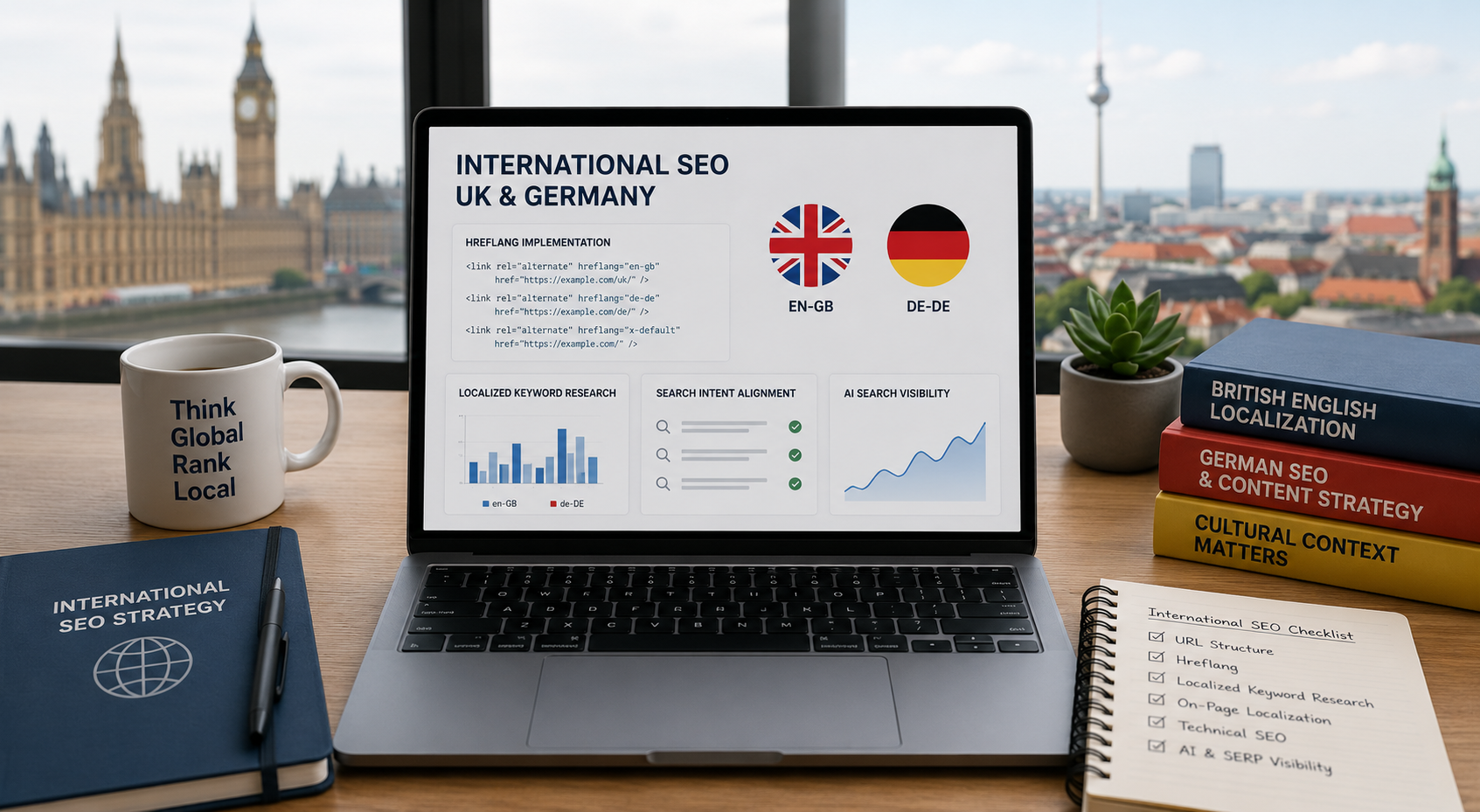
If you're expanding into the UK and Germany and you need a strategy that actually works — not a translated version of your existing US playbook — you're asking the right question. International SEO is one of the most technically demanding and strategically nuanced disciplines in the entire search landscape. It's also one of the most rewarding when done correctly.
This post is written for teams exactly where you are: you have a functioning US presence, you know your new markets matter, and you need to understand what it actually takes to build organic visibility in two distinct countries with two very different search environments. We'll cover URL structure, hreflang implementation, localized keyword research, content localization, and the AI-era layer that most international SEO guides are still ignoring entirely.
Let's get into it.
The Mistake Most Brands Make When Going International
The most common and most expensive mistake brands make when entering new international markets is treating international SEO as a translation project. It isn't. It's a market entry strategy with deep technical, linguistic, cultural, and competitive dimensions — and confusing the two will cost you months and significant budget before you figure out why things aren't working.
International keyword research is not the same as translating your home-market keyword list. Search volume, query phrasing, and user intent vary across languages and countries, often dramatically. Approaching each market with fresh research produces significantly better results than assuming existing keywords will transfer. Seohandbook
The UK and Germany aren't just different languages. They're different search ecosystems — different competitive landscapes, different content expectations, different trust signals, and different relationships with the types of sources that rank. A strategy that wins in the US needs to be rebuilt from the ground up for each market, not adapted on top of what you already have.
Step One: Choose Your URL Structure — This Decision Has Permanent Consequences
Before you write a single word of localized content or implement a single hreflang tag, you need to decide how your international site will be structured. This is one of the most consequential early decisions in international SEO, and it's very difficult to reverse cleanly once you've committed.
You have three main options:
Country-code top-level domains (ccTLDs): example.co.uk and example.de. These send the strongest possible geo-targeting signal to Google. Users and search engines in each country immediately recognize the domain as local. The downside is that each ccTLD is treated as a separate domain — which means your existing domain authority doesn't transfer. You're essentially building link equity from scratch in each market.
Subdirectories: example.com/uk/ and example.com/de/. This is the most commonly recommended structure for most businesses entering new markets. You keep all link equity consolidated under one domain, your technical infrastructure is simpler to manage, and hreflang implementation is more straightforward. The geo-targeting signal is slightly weaker than a ccTLD, but Google's handling of subdirectories for international targeting has improved significantly.
Subdomains: uk.example.com and de.example.com. Generally the least recommended option — they share some of the drawbacks of both ccTLDs and subdirectories without the full benefits of either.
ccTLDs provide the strongest geo-targeting signal but require separate link authority. Subdirectories consolidate link equity under one domain and are the default recommendation for most businesses entering new markets. Digital Applied Team
For most brands expanding into the UK and Germany simultaneously, subdirectories are the practical starting point — particularly if you're not starting with established domain authority in either market. The decision should factor in your current domain strength, your long-term commitment to each market, and your team's technical capacity to manage the implementation.
Step Two: Hreflang — The Technical Foundation You Cannot Get Wrong
Hreflang is the HTML attribute that tells search engines which language and regional version of a page to serve to which audience. It's the backbone of technical international SEO, and it is notoriously unforgiving. A single error doesn't just affect one page — it can cause Google to ignore your entire hreflang implementation.
Seventy-five percent of international sites have hreflang errors that fragment search rankings. The wrong page version surfaces in the wrong country, users land on content in the wrong language, and conversion rates crater — all because a handful of HTML attributes are missing, malformed, or asymmetric. Digital Applied Team
Here's what correct hreflang implementation for a US, UK, and Germany setup looks like in practice:
Every page must reference itself and all alternate versions. For a US English, UK English, and German three-market setup, each page needs four tags: a self-referencing tag, a tag for the US version (en-us), a tag for the UK version (en-gb), and a tag for the German version (de). Every version must link to every other version — this bidirectional requirement is one of the most common failure points.
Every page must link to all its alternate versions, including a self-referencing tag. This is called bidirectional linking and is essential for hreflang to work correctly. Missing or incorrect bidirectional links will cause Google to ignore your hreflang implementation. Lnsel
The three most common hreflang errors that break implementations are: missing self-referencing tags, asymmetric annotations where page A references page B but page B doesn't reference page A, and incorrect ISO language or country codes. For the UK and Germany specifically, the correct codes are en-gb for British English and de or de-de for German.
You also need an x-default tag — this is a fallback that tells Google which page to serve when no regional version matches the user's location or language preference. For most US-headquartered brands, this defaults to the main English US page.
A single error in a hreflang cluster causes Google to ignore the entire cluster, wasting implementation effort. Digital Applied Team
For implementation method, you have three options: in the HTML head, via HTTP headers, or through your XML sitemap. For large-scale international websites, implementing hreflang through your XML sitemap is often the most manageable solution. For most growing brands, the XML sitemap approach scales better as your content library grows across markets. Digital Applied Team
After implementation, validate everything through Google Search Console's International Targeting report, and run your pages through dedicated hreflang testing tools before and after any major site updates. Hreflang is not a set-and-forget implementation — it requires ongoing auditing, particularly after CMS updates, site migrations, or content restructuring.
Step Three: Localized Keyword Research — Start From Scratch in Each Market
This is where brands consistently underinvest, and it's where the gap between a mediocre international SEO program and a high-performing one is most visible.
Localized keyword research for the UK and Germany means starting fresh in each market — not importing your US keyword list and running it through a translator.
The UK market speaks English, but it doesn't search like an American audience. Searchers in the US look for "sneakers," while in the UK they type "trainers." A campaign optimized only for "sneakers" will miss a large percentage of qualified users in other English-speaking markets. This principle extends across every category. Legal terminology differs. Product names differ. Even the way buyers phrase commercial intent queries differs meaningfully between US and UK English. Your keyword research needs to reflect actual UK search behavior — pulled from UK-filtered data in tools like Ahrefs, Semrush, or Google Keyword Planner with proper country-level settings applied. Search Engine Land
The German market adds a layer of complexity that goes well beyond language. German users often phrase search queries differently than English-speaking users, which means keyword optimisation requires localisation rather than simple translation. Trust and credibility — Germans value trust, reliability, and authority in online content. Search engines and users alike often favour websites with a .de domain and local hosting. ExtraDigital
In Germany, users tend to favor long-tail, information-dense queries, often reflecting a cultural preference for thorough research. German is also a compound noun language — words that would be separate phrases in English become single compound words in German, dramatically changing keyword structure and search volume distribution. "Project management software" in English might fragment into multiple German compound variations that each carry different search intent and volume. Search Engine Land
The same keyword can have radically different search volumes in different countries. Do not assume that because a keyword has high search volume in English, its direct translation has proportional volume in French or German. Check actual volume for each language in each country. Seohandbook
The practical process for localized keyword research looks like this: start with your core product and service categories, research how those categories are actually searched in each target market using local-language tools and filtered data, analyze the SERPs in each market to understand what content types and formats are ranking, map intent to each keyword cluster, and build your content architecture around local search behavior — not around a translated version of your existing structure.
Step Four: Content Localization — Translation Is the Floor, Not the Ceiling
Machine translation has improved dramatically, but machine-translated content rarely ranks. Google's quality systems detect machine-translated content with high accuracy. For any content you're serious about ranking in Germany, you need human-native German copywriting — not DeepL output lightly edited, and not a German speaker reviewing AI translation and calling it done. Digital Applied Team
Localization means adapting content for how each market thinks, researches, and makes decisions — not just swapping words. The concept of localization in international SEO goes beyond mere translation. Local idioms, cultural references, and even holiday-related searches are factors that need to be considered. Your content must be tailored to each market's unique preferences and behaviors. Yocreativ
For the German market specifically, this means more formal tone in B2B contexts, greater emphasis on authority and credentials, more detailed and comprehensive content that supports the research-oriented search behavior German users demonstrate, and trust signals that German buyers recognize — including local business registration references, German-language customer testimonials, and pricing displayed in euros with German-market-appropriate formatting.
For the UK market, the tone is typically closer to US English but with British spelling conventions throughout (optimisation, not optimization; colour, not color), culturally appropriate references, and UK-specific regulatory or compliance context where relevant to your category.
Neither market will respond well to content that feels like it was written for an American audience and then adjusted. The goal is content that reads as if it was written by someone who lives and works in that market — because for professional international SEO, it should be.
Step Five: Local Authority Building — Links and Community Presence in Each Market
Your US backlink profile does not transfer to your UK or German subdirectories in any meaningful way. Each market requires its own authority-building strategy — earning citations, links, and brand mentions from sources that are locally relevant and recognized.
For the UK, this means earning coverage in UK-based industry publications, directories, and news outlets. UK-specific trade associations, review platforms used by British buyers, and links from .co.uk domains all contribute meaningfully to geo-targeted authority signals.
For Germany, the authority-building picture is even more distinct. German buyers rely heavily on established German-language sources — industry portals, comparison sites like Check24, review platforms like Trusted Shops, and German trade publications. A German-language press release picked up by a regional German publication is worth more for your de-market visibility than equivalent US coverage.
Link equity flows between hreflang variants — backlinks to any hreflang variant benefit all variants in the cluster through consolidated signals. You do not need to build links to each language version separately — links to your main domain support all regional versions. That said, locally-sourced links from in-market domains contribute the most to geo-targeted ranking signals, so building a market-specific link acquisition strategy for each country is still worth the investment. Digital Applied Team
The AI Search Layer Nobody Is Talking About in International SEO
Here's something most international SEO guides are not covering yet, and it matters enormously for brands expanding into new markets in 2026: AI search selection dynamics apply internationally too — and the trust signals AI systems look for vary by market.
The principles we've written about extensively — that AI doesn't rank pages, it selects sources, and that ecosystem trust across Reddit, LinkedIn, and community platforms is increasingly what determines AI citation — apply equally in UK and German search environments. But the specific platforms and community sources that AI systems trust in each market are different.
In Germany, this means building presence in German-language forums, Xing (Germany's dominant professional network alongside LinkedIn), German Reddit equivalents and communities, and German-language review ecosystems. An AI system surfacing answers for German queries is pulling from German-language trusted sources — not your English-language Reddit presence.
AI systems employing retrieval-augmented generation select source content before considering which regional variant should be served. A page can have strong domain authority, excellent on-page optimization, and proper technical implementation while scoring poorly on retrieval-specific factors like extractability and entity clarity. ALM Corp
This means that for each new market, you need to think about two layers of visibility simultaneously: traditional search rankings through technical SEO, hreflang, and localized content — and AI search selection through localized ecosystem trust signals, community presence, and extractable content in the local language.
The brands building both layers in each market from the start will have a compounding advantage that brands only building the traditional layer will struggle to close later.
What a Full International SEO Engagement Actually Looks Like
If you're serious about the UK and Germany, here's the scope of work that a proper international SEO engagement covers:
Technical audit and architecture: Evaluating your current site structure, recommending the optimal URL structure for your situation, auditing and implementing hreflang correctly across all markets, and ensuring your XML sitemap, robots.txt, and canonical tags are properly configured for multi-market operation.
Localized keyword research: Building market-specific keyword maps for both UK English and German, researching intent and SERP landscape in each market, and developing a content architecture that reflects actual local search behavior rather than translated US intent.
Content localization strategy: Establishing localization standards, sourcing native-language copywriting, adapting existing high-performing content for each market, and building a content production pipeline that keeps both markets fed with fresh, locally-relevant material.
Local authority building: Identifying link acquisition opportunities in each market, building a market-specific digital PR and citation strategy, and establishing presence on the review platforms and directories that carry trust weight with local buyers and local AI systems.
Technical ongoing maintenance: International sites are more technically complex than single-market sites. Hreflang implementations break when CMS updates happen, when pages are added or removed, or when site migrations occur. Ongoing technical auditing is part of any serious international SEO program.
Performance measurement: Tracking rankings, traffic, and visibility separately for each market using Search Console filtered by country, local-language rank tracking, and increasingly, AI visibility monitoring in each market's language.
Why International SEO Requires a Partner, Not Just a Vendor
The scope described above isn't something you hand off to a generalist agency that has "international SEO" checked on their services page. The UK and Germany each require genuine local market expertise — someone who understands not just the technical mechanics, but the cultural and competitive landscape of each market.
The brands that win internationally are the ones that master the execution layer. Most international SEO strategies fail not because of poor planning but because of poor execution. Search Engine Land
At Ritner Digital, we build international SEO programs that treat each market as its own strategic environment — with proper technical architecture, genuine localization, market-specific authority building, and visibility tracking across both traditional search and AI-generated answers. If you're heading into the UK and Germany, we'd like to hear about where you are and what you're building.
Frequently Asked Questions
Do I need separate websites for the UK and Germany?
Not necessarily. Whether you use separate domains (ccTLDs like .co.uk and .de), subdirectories (/uk/ and /de/), or subdomains depends on your specific situation — your current domain authority, your long-term commitment to each market, and your technical infrastructure. For most brands entering both markets simultaneously, subdirectories are the most practical starting structure because they consolidate link equity under one domain and simplify technical management. ccTLDs send a stronger geo-targeting signal but require building link authority essentially from scratch in each market.
How long does international SEO take to show results?
Realistically, three to six months to see meaningful organic traction in a new international market — assuming proper technical implementation, localized content, and active authority building from day one. Germany tends to be a longer runway than the UK because of the language gap and the additional technical complexity. Markets where you have strong brand recognition already tend to move faster than cold-entry markets. International SEO compounds over time — the investment you make in months one through three pays dividends in months nine through eighteen.
Can I just translate my existing content?
No — and machine-translated content in particular carries real risk. Google's systems detect machine-translated content with high accuracy, and it rarely ranks competitively. More importantly, translation alone doesn't capture how local users actually search. German users phrase queries differently, use different terminology, and have different content expectations than US or UK users. The UK uses different vocabulary, spelling conventions, and cultural references. Localization means rebuilding content strategy around local search behavior — not converting your existing US content into another language.
What is hreflang and why does it matter?
Hreflang is an HTML attribute that tells search engines which language and regional version of a page to serve to which audience. Without it, Google may serve your US English page to German users, your German page to UK users, or treat your localized content as duplicate content that competes with your main site. Hreflang is what ensures the right version reaches the right audience. It's also technically demanding — research consistently shows that 65–75% of international sites have hreflang errors that undermine their international SEO performance.
Does the UK count as a separate international market if we already publish in English?
Yes — and this surprises many US-based brands. The UK is a distinct search market with different vocabulary, spelling conventions, cultural context, competitive landscape, and buyer expectations. "Sneakers" vs "trainers," "pants" vs "trousers," "elevator" vs "lift" — these aren't trivial differences when you're building keyword strategies. Beyond terminology, UK SERPs often have different dominant players than US SERPs in the same category. You need UK-filtered keyword research, British English content, and UK-specific authority building to compete effectively in google.co.uk results.
Ready to Build International Visibility That Actually Works?
Expanding into the UK and Germany is a significant opportunity — and a significant technical undertaking. Ritner Digital builds international SEO programs from the ground up: proper hreflang architecture, genuine localized keyword research, native-language content strategy, market-specific authority building, and visibility tracking across both traditional search and AI-generated answers.
If you're ready to do this right, let's start with a conversation about where you are and what the expansion looks like.
Work With Us → ritnerdigital.com/#contact
Sources: Digital Applied International SEO Guide 2026, Search Engine Land International SEO Execution Guide, ExtraDigital German vs. English SEO Analysis, SEO Handbook International Keyword Research, ALM Corp AI-Driven International SEO Guide 2026, Yocreativ International SEO 2026, Lnsel International SEO Hreflang Guide.