You Need to Rank for Difficult, High-Value B2B Keywords. Here's Exactly How Enterprise SEO Gets That Done.
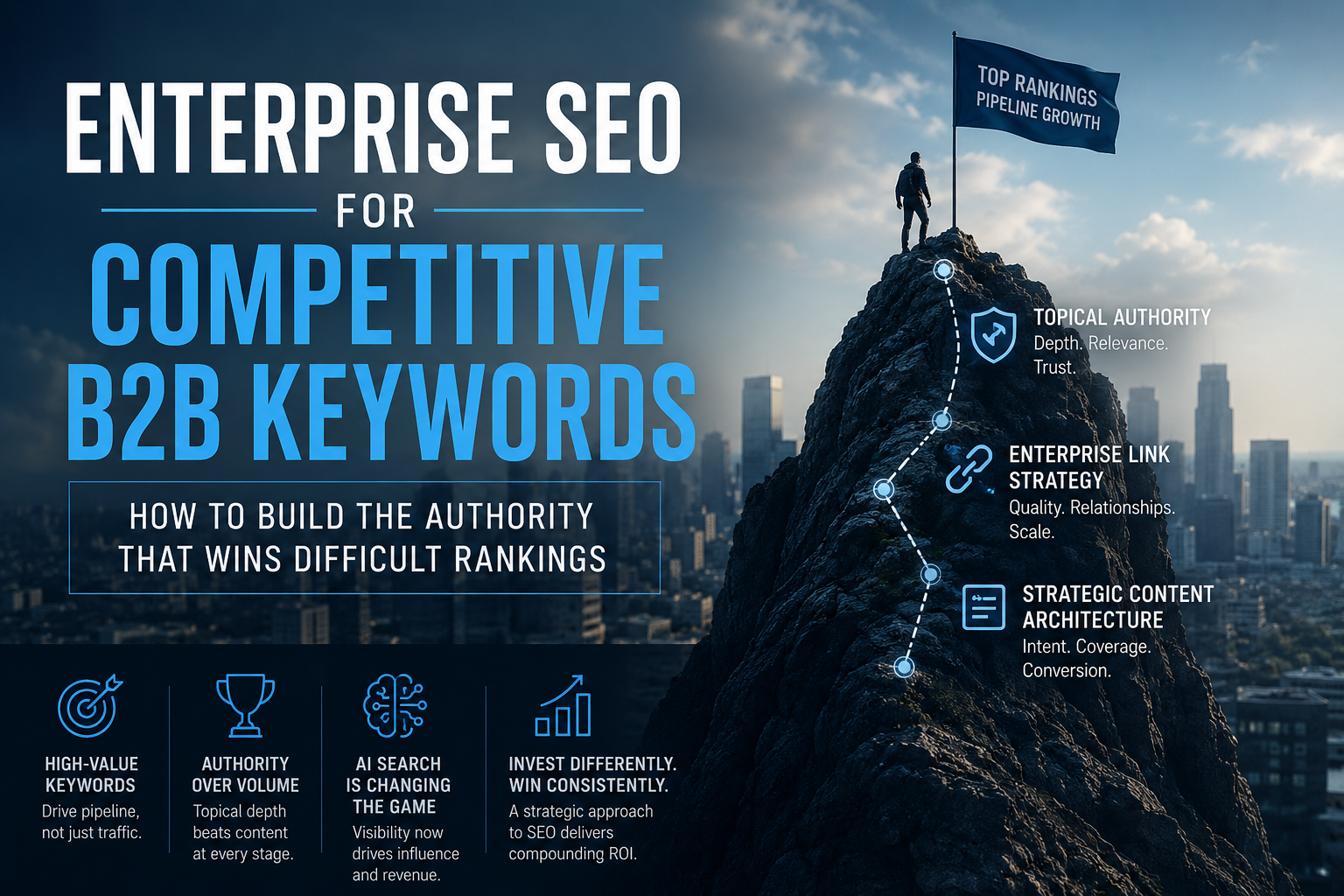
If you're reading this, you already know what you're up against. The keywords that actually move your pipeline — the ones your buyers type when they're close to a decision — are being fought over by well-funded competitors with years of domain authority, content teams, and link profiles you can't close overnight. You need an enterprise SEO program that understands competitive B2B landscapes and knows how to build the kind of authority that wins difficult keywords without cutting corners that create problems two years from now.
This post explains exactly how that's done. Not in vague strategic language, but in concrete terms: how competitive keyword strategy actually works in B2B, what authority building looks like at the enterprise level, how topical depth beats content volume every time, and why the brands winning difficult keywords in 2026 are doing something most enterprise SEO programs still aren't.
What Makes a Keyword "Difficult" — and Why That's Actually Good News
High keyword difficulty in B2B isn't a barrier — it's a signal. Difficult keywords are difficult because they're valuable. The brands fighting over "enterprise data integration platform" or "B2B revenue operations software" are fighting there because that's where buyers with real budgets and real purchase intent are searching.
In B2B SEO, search intent matters more than how often a keyword is searched. A low-volume query like "enterprise data security compliance checklist" can be far more valuable than a high-volume generic term. Nomadz Blog
This is the first thing a serious enterprise SEO program gets right: it stops chasing volume and starts chasing intent. The keyword that gets 200 searches a month from VP-level buyers evaluating solutions is worth more than the keyword getting 20,000 searches from people who will never become customers.
Organic search generates 44.6% of all revenue attributed to digital channels and remains more effective than paid search for long-term growth. The ROI case for competing aggressively on difficult B2B keywords is overwhelming — but only if the strategy is built around buyer intent and conversion quality, not raw traffic numbers. SeoProfy
The Three Pillars of Competitive Enterprise SEO
Ranking for difficult, high-value keywords in a competitive B2B landscape requires three things working together simultaneously. Most enterprise SEO programs either underinvest in one pillar or treat them as sequential rather than parallel investments. That's why they stall.
Pillar One: Technical Foundation
You cannot rank for competitive keywords on a technically broken site. This is the part of enterprise SEO that's least visible from the outside and most damaging when neglected.
A single misconfigured robots.txt directive on a large site can deindex thousands of pages overnight. A poorly planned site migration can wipe out years of link equity. These aren't hypothetical risks — they're things that happen to well-resourced teams at recognizable companies, often because someone applied small-site thinking to a large-site problem. Vizup
At the enterprise level, technical SEO means ensuring that search engines can efficiently crawl, interpret, and index your content at scale. Core Web Vitals, site architecture, internal linking structure, schema markup, canonical tags, log file analysis, and crawl budget management — these are the infrastructure decisions that determine whether your content investments can actually reach their ranking potential.
Internal linking, often neglected at scale, is one of the highest-ROI fixes available. Enterprise brands often have significant domain authority already — the asset is that new content tends to rank faster. The trap is that teams assume authority does all the work and stop building links and internal equity strategically. Vizup
Internal linking is particularly high-leverage for competitive keyword strategies because it allows you to distribute the authority you've already earned across the specific pages you most need to rank. A well-built topic cluster architecture — hub pages linking to supporting content, and vice versa — can dramatically improve rankings for mid-tail and long-tail variations of competitive head terms simultaneously.
Pillar Two: Topical Authority
This is where competitive B2B keyword strategies are won or lost more than anywhere else, and it's the pillar that most brands underestimate.
Topical closure beats keyword stuffing. If you publish five deep, authoritative articles on a topic, you'll outrank competitors who publish ten shallow posts. Google and AI models reward depth, not volume. When you own the topic, you own the rankings. Percepture
Topical authority means building content depth around your target categories that is genuinely more comprehensive, more expert, and more useful than anything else ranking in your space. Not more content — better content, organized intelligently around the way buyers actually research and make decisions.
Most B2B SEO programs go wrong by optimizing for traffic volume, then wondering why the pipeline doesn't move. Top-of-funnel keywords drive awareness traffic. Middle-of-funnel keywords attract evaluators. Bottom-of-funnel keywords attract buyers comparing solutions. Each stage needs different content formats: explainers, how-to guides, comparison pages, and case studies. Ariad Partners
A common mistake we see repeatedly in competitive B2B landscapes: brands produce fifty top-of-funnel awareness articles and zero comparison pages, zero competitor alternative content, and zero decision-stage content targeting buyers who are ready to act. The bottom of the funnel is where revenue comes from. It needs to be built intentionally.
Long-form, topically comprehensive pages covering a topic end-to-end tend to rank for significantly more keyword variations than short posts targeting single terms. This is particularly true for competitive categories where Google rewards demonstrated expertise. Authority Specialist
Pillar Three: Authority Building
Backlinks remain one of the most powerful ranking signals in competitive landscapes — but the strategy for earning them at enterprise level is entirely different from generic link building.
Position one pages have 3.8x more backlinks than positions two through ten, making link building essential for competitive rankings. In high-difficulty B2B categories, the gap in link authority between the pages currently ranking and those trying to crack the first page is usually the single largest obstacle to overcome. Olivermunro
The right approach to enterprise link acquisition in B2B focuses on a handful of proven formats:
Original data and research reports attract journalist and blogger citations consistently — this is the highest-use link acquisition format in the software and enterprise technology vertical. Free tools and calculators generate passive links over extended time periods. Integration and partner pages — being listed on partner ecosystems like Salesforce AppExchange or HubSpot App Marketplace — generate authoritative links and referral traffic simultaneously. Authority Specialist
The focus in 2026 is on quality over quantity. Enterprises should prioritize earning links from authoritative and relevant sources rather than chasing sheer numbers. One mention in an authoritative industry publication is worth more than fifty links from generic directories. SeoProfy
Digital PR tied to original research is consistently the highest-leverage approach for competitive B2B keywords. When you publish proprietary data that journalists, analysts, and industry bloggers actually want to cite, you earn links from exactly the high-authority domains that move the needle on competitive keywords — and you earn them at scale without outreach campaigns that beg for links from people who don't care about your content.
E-E-A-T: The Framework Google Uses to Filter Competitive Results
Understanding Google's E-E-A-T framework — Experience, Expertise, Authoritativeness, and Trustworthiness — is not optional for competitive B2B keyword strategy. It's the filter through which all of your content is evaluated before it can rank at the top of competitive results.
Google's E-E-A-T framework now works as a ranking filter. Content that lacks clear E-E-A-T signals fails to rank, whatever the technical optimization or keyword targeting. Trust stands out as the most vital element — Google clearly states that untrustworthy pages have low E-E-A-T no matter how experienced, expert, or authoritative they may seem. Mayurkishnani
In practical terms, E-E-A-T for competitive B2B SEO means: credentialed authors with demonstrable expertise in the topics they're writing about, transparent sourcing and citation practices, consistent brand authority signals across your owned and earned presence, and content that demonstrably reflects firsthand experience rather than summarized information from other sources.
Brand authority is the lifeblood of successful enterprise SEO strategy in 2026. Search engines now prioritize trust signals more than ever, making it crucial for organizations to create content that shows genuine expertise and experience. Mayurkishnani
This is also where the AI search layer intersects with traditional competitive keyword strategy. The same E-E-A-T signals that help you rank for difficult keywords in organic search are the signals that get your brand selected as a source in AI-generated answers. Building genuine authority doesn't just win rankings — it wins citations.
The Intent Mapping That Most Enterprise SEO Programs Skip
Ranking for difficult keywords requires a precise understanding of what buyers actually want when they type those queries — not what you wish they wanted, and not what the keyword research tool reports as "intent."
In 2026, the most valuable B2B keywords are those your decision-makers are searching for at the bottom of the funnel, indicating readiness to purchase. Top-of-funnel topics still matter — they drive traffic, establish authority, and nurture leads over time — but bottom-of-funnel keywords convert. RTEE Tech
A proper intent mapping exercise for competitive B2B keyword strategy involves analyzing the actual SERPs for each target keyword to understand what Google currently believes the searcher wants: informational content, comparison content, product pages, or something else entirely. If you're producing an informational blog post for a keyword where Google is surfacing comparison pages and vendor alternatives, you're going to lose that ranking battle regardless of how good your content is — because you're producing the wrong content type for that intent signal.
Focus on keywords where competitors rank positions four through twenty — these are often achievable targets with the right content investment and authority building strategy. The sweet spot for competitive keyword campaigns is the cluster of terms where you have realistic authority to compete, strong buyer intent, and content gaps that you can close with better execution than what's currently ranking. Whitehat SEO
Why Content Volume Is the Wrong North Star
One of the most common enterprise SEO mistakes we see is treating content volume as the primary output metric. More pages, more posts, more articles — and wondering why competitive rankings aren't moving.
Publishing at scale without a content governance system is how you end up with 200 pages targeting the same keyword, none of them ranking. Enterprise content SEO isn't about producing more. It's about coordinating what gets created, who owns it, how it gets updated, and when it gets retired. Most large organizations have the first part figured out and completely ignore the last three. Vizup
Content governance — the system that determines which content exists, how it's organized, when it's refreshed, and what gets consolidated or retired — is one of the highest-leverage investments available to enterprise SEO programs. Keyword cannibalization alone (multiple pages competing for the same terms with diluted authority) is responsible for ranking stagnation on more competitive B2B keywords than almost any other single issue.
High-authority content comprises detailed blogs, industry insights, professional perspectives, and original studies. Not only does this kind of content rank well, but it also creates trust among decision-makers. The enterprise SEO programs winning competitive B2B keywords are publishing less than their competitors and ranking higher — because what they publish is genuinely better, better structured, and better maintained. Nomadz Blog
The Competitive Intelligence Layer
Winning difficult keywords requires knowing exactly what you're competing against — not at the surface level of "who ranks for this term," but at the depth of why they rank, what signals they've built that you haven't, and where the specific gaps in their coverage create an opening for you.
Competitive intelligence for enterprise B2B SEO means: analyzing the full backlink profiles of ranking pages to understand what link sources are driving competitive authority, auditing competitor content depth and structure to identify where your content can demonstrably outperform what's there, identifying topic clusters where competitors have thin coverage relative to their ranking position, and finding the keyword adjacencies where you can build ranking equity faster because competition hasn't fully developed those territories yet.
Competitors with sharper topical focus can outrank a Fortune 500 on specific queries even with a fraction of the domain authority. This is simultaneously a threat and an opportunity. If you've been assuming your domain authority protects you from smaller, more focused competitors in your niche — it doesn't. And if you're the challenger brand, sharper topical focus is exactly the lever that lets you punch above your weight class on competitive terms. Vizup
The AI Search Dimension of Competitive B2B Keywords
Here's the layer that changes the ROI math on competitive keyword investment in 2026: winning difficult B2B keywords and earning AI citations are increasingly the same program, built on the same signals.
The same content that ranks well typically gets cited by AI systems. Google's Danny Sullivan confirmed: "Good SEO is good GEO." Whitehat SEO
The topical authority, E-E-A-T signals, original research, structured content, and high-authority backlink profile that you build to rank for competitive B2B keywords in organic search are the exact same signals that determine whether AI systems select your brand as a trusted source when your buyers ask AI-powered questions about your category.
This means that the ROI calculation for competitive enterprise SEO in 2026 isn't just "what traffic and pipeline do I get from ranking position one." It's "what does it mean for my brand when buyers using ChatGPT, Perplexity, and Google AI Overviews to research my category are consistently seeing my brand cited as a trusted authority."
A thought leadership SEO campaign — involving deep keyword research, audience intent analysis, authoritative content creation, and generative optimization — delivers some of the strongest ROI in digital marketing, with approximately 748% ROI and an average nine-month break-even period. SeoProfy
The brands investing in enterprise SEO as an authority-building program rather than a traffic-generation tactic are building something that compounds in both dimensions simultaneously — organic rankings and AI citations — and creates compounding returns that paid channels can never replicate.
What an Enterprise SEO Timeline Actually Looks Like
This is where honest agencies differentiate themselves from agencies telling you what you want to hear. Competitive B2B keywords take time. Anyone promising first-page rankings for high-difficulty terms in sixty days is either lying or planning to use tactics that will eventually hurt you.
A well-executed technical SEO campaign yields reliable early returns, with typical ROI around 117% within about six months. Technical fixes — crawlability, site speed, internal linking, structured data — move the fastest and often unlock ranking improvements on terms where you're close to competitive already. SeoProfy
B2B SEO in competitive industries takes time. Companies that commit to twelve to eighteen months see compounding results. The content and authority building required to rank for genuinely difficult keywords accumulates over time. The first six months build the foundation. Months six through twelve are where ranking movement becomes visible on competitive terms. Months twelve through twenty-four are where the compounding effect becomes undeniable. Home
85% of businesses achieve a positive ROI within twelve months, with higher gains in competitive industries. 90% of businesses report that ongoing SEO efforts continue to yield positive ROI even beyond twenty-four months. SEO Agency
The honest framing is this: competitive enterprise SEO is a twelve-to-eighteen month commitment before you're seeing the full picture of what the program can do. It's also one of the few marketing investments that appreciates rather than depreciates over time — the rankings and authority you build in month twelve are still working for you in month thirty-six, unlike paid media that stops the moment the budget pauses.
What to Look for in an Enterprise SEO Agency
If you're evaluating agencies for competitive B2B keyword work, here's how to cut through the noise:
They show you real data, not curated wins. Any agency can find a case study that looks good in a slide deck. Ask for a transparent look at actual Search Console data, ranking movement over time, and the full picture of a client engagement — including what didn't go as planned and why. Agencies willing to show you the uncomfortable numbers are the ones doing honest work.
They talk about revenue, not just rankings. Ranking for difficult keywords is the mechanism, not the goal. The goal is pipeline, qualified leads, and revenue influence. Enterprise SEO agencies worth working with connect their work directly to business outcomes — which means they need to understand your sales cycle, your buyer personas, and what a qualified lead actually looks like.
They understand the full search landscape. Competitive B2B keyword strategy in 2026 isn't just Google organic rankings. It's AI Overviews, ChatGPT citations, Perplexity answers, and the ecosystem trust signals that determine whether your brand is selected as a source across every surface where your buyers are searching. An enterprise SEO program that ignores AI search visibility is leaving an increasingly large share of buyer discovery unaddressed.
They build, don't rent. The highest-value enterprise SEO work — original research, content systems, authority building, topical depth — creates assets you own. Avoid programs that are primarily built around rented tactics that evaporate when the relationship ends.
Frequently Asked Questions
How competitive is too competitive for SEO to be viable?
There's no keyword that's too competitive for SEO to be viable — but there are timelines that don't match a business's needs. If you need to rank for an extremely high-difficulty keyword in ninety days, SEO is the wrong tool for that specific goal. If you're building a twelve-to-eighteen month program to own the most valuable keywords in your category, even the most competitive B2B terms become achievable with the right authority-building strategy, content depth, and technical foundation. The question isn't whether you can rank — it's whether your timeline and investment align with the difficulty level you're targeting.
How do you prioritize which difficult keywords to target first?
Priority is determined by the intersection of four factors: commercial intent and proximity to purchase decision, realistic ranking feasibility based on your current domain authority relative to what's ranking, business value per conversion, and the content gap — where your competitive analysis shows you can produce something meaningfully better than what's currently ranking. High-difficulty keywords where you're close in authority to what's ranking and where the current top results have clear content weaknesses are your highest-ROI starting point. Terms where the difficulty is driven purely by link authority gaps are a longer play that requires parallel link acquisition investment.
What's the difference between enterprise SEO and standard B2B SEO?
The core principles are the same — relevance, authority, technical health. What makes enterprise SEO distinct is complexity and scale. Enterprise SEO applies when a site has more than 10,000 pages, multiple stakeholders involved in content and technical decisions, and organic traffic that represents significant revenue. The defining characteristic isn't company size alone — it's the complexity of managing SEO across a large, dynamic site with organizational constraints that small teams don't face. Enterprise SEO adds layers of coordination, content governance, internal advocacy, and cross-functional project management that don't exist at smaller scales. A title tag change that takes ten minutes on a small site might require a multi-week process at an enterprise — and an enterprise SEO agency needs to be built to operate within that reality. Vizup
Does paid search performance predict how hard a keyword will be to rank for organically?
CPC is one of the most useful signals for identifying commercially valuable keywords — high CPC indicates that competitors are willing to pay to appear for that term, which correlates strongly with conversion value. But CPC doesn't predict organic difficulty directly. A keyword can have high CPC and moderate organic difficulty, or low CPC and extremely high organic difficulty. For prioritization, use keyword difficulty scores combined with SERP analysis of what's actually ranking, your domain's authority relative to ranking pages, and CPC as a proxy for commercial value — not as a difficulty predictor on its own.
How do you measure success on competitive B2B keywords beyond rankings?
Rankings are the leading indicator, not the outcome metric. The metrics that matter are organic leads generated — form fills, demo requests, and inquiries that originated from organic search — pipeline attributed to organic using CRM data, keyword rankings for decision-stage terms, and share of voice — what percentage of available organic clicks in your niche does your site capture versus competitors. For AI search visibility, we layer in regular monitoring of brand citation frequency across ChatGPT, Perplexity, and Google AI Overviews for target queries. The full measurement picture connects visibility to pipeline influence, not just traffic. Home
How does AI search change the ROI calculation for competitive keyword investment?
It increases it significantly. The authority signals required to rank for difficult B2B keywords — topical depth, E-E-A-T, original research, high-authority backlinks — are the same signals that determine whether AI systems select your brand as a trusted source. This means every dollar invested in competitive organic keyword strategy now works in two channels simultaneously: traditional search rankings and AI citation visibility. Brands winning difficult B2B keywords in organic search are increasingly also the brands being cited by AI systems when buyers ask category-level questions — which creates a compounding visibility advantage that makes the ROI case for enterprise SEO investment stronger than it's ever been.
Ready to Build Authority in Your Most Competitive Keywords?
Ritner Digital builds enterprise SEO programs designed for competitive B2B landscapes — combining technical infrastructure, topical authority, strategic link acquisition, and AI search visibility into an integrated system that compounds over time.
If you're ready to have an honest conversation about what it takes to rank where your buyers are actually searching — including the difficult keywords your competitors are already fighting over — let's start there.
Work With Us → ritnerdigital.com/#contact
Sources: Backlinko B2B SEO Strategy 2026, FirstPageSage SEO ROI Benchmarks, Oliver Munro B2B SEO Statistics 2026, Authority Specialist Enterprise Software SEO Statistics, Vizup Enterprise SEO Guide 2026, Ariad Partners B2B SEO 2026, Impulse Digital B2B SEO Strategy Guide, Mayur Kishnani Enterprise SEO Trends 2026, Digital World Institute SEO ROI Statistics.