Who Is a Good B2B SEO Agency? Here's How to Find One That Actually Ranks for High-Intent Keywords.
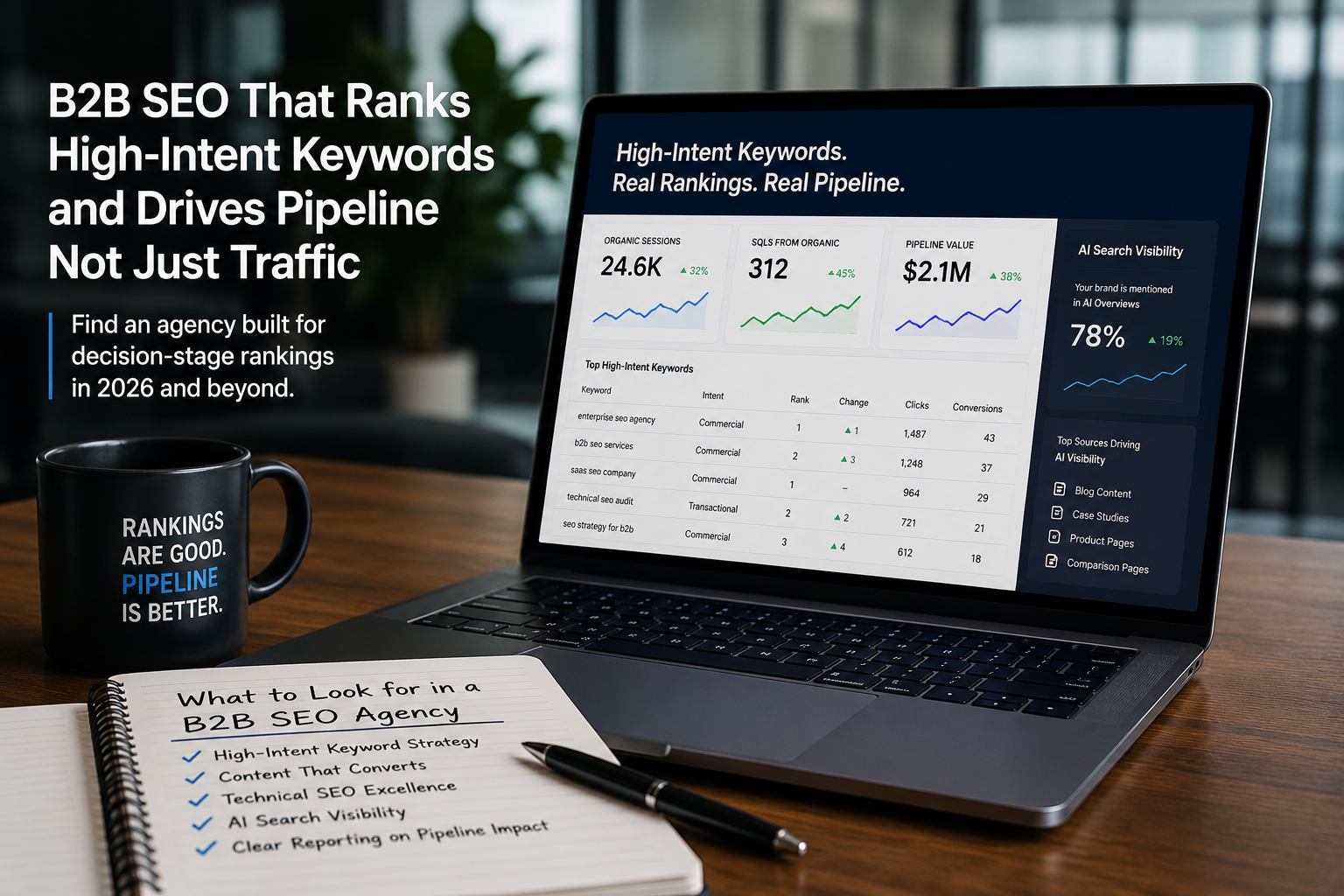
You're not looking for more traffic. You're looking for the kind of organic visibility that puts your brand in front of decision-makers at the exact moment they're evaluating solutions in your category. That's a fundamentally different goal than what most SEO agencies are actually built to deliver — and understanding that distinction is the first step to finding a partner worth hiring.
This post is written directly for the team asking this question: you need to rank for high-intent B2B keywords, you're competing against established players, and you need an agency with a documented track record of making that happen. We'll cover what separates genuinely capable B2B SEO agencies from the ones that generate impressive-looking reports with no pipeline impact, what high-intent keyword strategy actually looks like in competitive B2B, and what you should be asking any agency before you sign a contract.
Why Most B2B SEO Agencies Aren't Built for High-Intent Keywords
The B2B SEO agency market is large, and most of it is oriented around the wrong goal. Traffic volume is easy to report. It shows up in dashboards, impresses in quarterly reviews, and can be inflated by targeting high-volume informational keywords that attract students, researchers, and people who will never become customers.
High-intent keyword rankings are harder. They require understanding your buyer's decision journey at a granular level, building content that matches evaluation-stage and decision-stage intent precisely, earning the kind of domain authority that lets you compete for terms your buyers actually use when they're close to a choice, and connecting all of it to pipeline rather than pageviews.
A keyword strategy built on volume, not intent is one of the clearest signs of a weak B2B SEO agency. A keyword with 200 monthly searches that maps to a buying decision is worth 100 times more than a keyword with 10,000 searches that attracts students writing papers. The agency that proposes the smaller, sharper keyword list is usually the better partner. Optimist
If the first thing an agency shows you in a proposal is search volume projections, ask them how those keywords connect to your sales pipeline. The answer will tell you everything you need to know.
What High-Intent B2B Keywords Actually Are
Before evaluating agencies, it helps to be precise about what you're actually targeting and why it's difficult.
High-intent B2B keywords are the queries that buyers type when they're close to a decision — not when they're starting to learn about a problem. They typically include language like "best [solution category] for [use case]," "[your category] pricing," "[competitor] alternative," "[your category] vs [competitor]," or "[your solution] for [specific industry]." These are the queries where a first-page ranking means your brand is in an active evaluation by someone with real budget and real intent to buy.
Look for keywords that include phrases like "best," "top," "for [industry]," or "vs [competitor]" — these show intent. A keyword that gets 100 searches a month might bring in just five leads, but if those leads convert into six-figure contracts, that's a win. Intentsify
Many valuable B2B queries don't register in keyword tools because search volume is too low — but they represent high-intent buyers. Terms like "HubSpot onboarding agency London" may show zero volume yet drive qualified pipeline. Whitehat SEO
This is the counterintuitive reality of B2B keyword strategy: the most valuable keywords for your pipeline are often the ones keyword tools show as having minimal or zero search volume. An agency that only shows you keywords with measurable search volume is almost certainly missing the terms your actual buyers use in the final stages of their decision process.
Rankings and traffic are vanity metrics in B2B if they're not connected to conversions. Your leadership doesn't actually care about keyword rankings. What they care about is whether those rankings are generating more leads, more qualified opportunities, and ultimately more revenue. A page ranking number one for the wrong keyword is worthless. A page ranking number six for a high-intent keyword that converts is gold. Konstruct Digital
The Buyer Journey Map That Drives High-Intent SEO Strategy
Effective high-intent B2B SEO is built on a precise understanding of how your buyers actually research and make decisions — not how you wish they did.
Your Ideal Customer Profile should guide everything. Map out their journey from the moment they realize they have a problem to where they're ready to choose a solution. They'll go through key research stages, and each stage comes with its own questions and keyword opportunities. Intentsify
In competitive B2B categories, the buyer journey typically produces three distinct layers of keyword opportunity:
Top of funnel: Problem-awareness content. The buyer knows something isn't working and is researching why. These keywords drive brand familiarity and topical authority — they don't convert directly, but they create the first touchpoint in a journey that eventually leads to a decision-stage query.
Middle of funnel: Solution-evaluation content. The buyer understands their problem and is researching categories of solutions. Comparison content, how-to guides, use-case content, and feature breakdowns live here. This is where authority compounds.
Bottom of funnel: Vendor selection content. The buyer is comparing specific options. Competitor alternative content, pricing pages, "[your brand] vs [competitor]" content, industry-specific solution pages, and case studies live here. The pipeline-influencing pages are usually the ones with lower search volume and higher conversion intent. A common mistake: producing fifty top-of-funnel articles and zero comparison pages. Ariad Partners
The highest-ROI B2B SEO programs build all three layers intentionally — but they prioritize bottom-of-funnel content first, because that's where revenue comes from most directly, and because most competitors have underinvested in it relative to top-of-funnel.
What to Look for in a B2B SEO Agency
Here's how to evaluate agencies specifically for high-intent keyword performance in competitive B2B landscapes.
They connect SEO to pipeline, not just traffic. The single clearest signal of a capable B2B SEO agency is whether they talk about leads, pipeline, and revenue from the first conversation — or whether they default to impressions, rankings, and traffic volume. An agency oriented around business outcomes measures its work in terms of marketing-qualified opportunities sourced from organic search, deal velocity for organic-sourced leads, and revenue influenced by content. These are the metrics that matter to your business. Any agency that can't speak fluently in these terms is not built for high-intent B2B work.
They understand your buyer better than most of your competitors do. High-intent keyword strategy requires deep understanding of how your specific buyers search at each stage of their journey — including the language your sales team uses in discovery calls versus the language buyers actually type into search engines. The sales team generates demand using one set of terms, marketing creates content around another, and you end up with gaps where high-intent buyers fall through without ever converting. Getting alignment requires bringing everyone to the table. A good B2B SEO agency bridges that gap by building keyword strategy directly from sales conversation data, customer interviews, and actual search behavior — not just keyword tools. Konstruct Digital
They have a documented point of view on AI search. It's 2026. If an agency hasn't developed a point of view on AI search, that agency is behind. High-intent B2B buyers are increasingly researching through ChatGPT, Perplexity, and Google AI Overviews before they ever land on a vendor's website. An agency without a strategy for earning AI citations alongside traditional rankings is leaving a growing share of buyer discovery unaddressed. This isn't optional anymore — it's a core capability for any serious B2B SEO program. Optimist
They show you real data, not curated case studies. Every agency can produce a case study that looks good in a deck. The ones worth hiring show you actual Search Console data, ranking movement over time, and a transparent accounting of what drove results — including what didn't work as planned and why. Agencies willing to publish honest performance data are the ones doing honest work.
They're selective about who they work with. Agencies trying to close every prospect are usually agencies with turnover problems, account overload, and strategists spread too thin. The best B2B SEO agencies turn down work that isn't a fit for their expertise — which means when they take on your program, the person working your account actually has the capacity and focus to do it well.
The Content Strategy That Wins High-Intent Rankings
Understanding what to look for in an agency is one thing. Understanding what the actual work looks like is another — and it helps to be a sophisticated buyer.
High-intent B2B keyword strategy isn't primarily a content volume game. It's a content precision game. High-authority content comprises detailed pieces, industry insights, professional perspectives, and original studies. Not only does this kind of content rank well, but it also creates trust among decision-makers. Nomadz Blog
The content types that win high-intent B2B keywords consistently are: deeply researched comparison pages that genuinely help buyers evaluate options, original research with proprietary data that earns citations and links, case studies with specific measurable outcomes that demonstrate real results for buyers like your target accounts, industry-specific solution pages built around how your buyers in specific verticals search and evaluate, and FAQ and structured content that AI systems can extract and cite.
A single high-intent keyword is useful. A cluster is better. Instead of targeting only "hire SEO consultant," build a cluster around the full purchase journey. That cluster allows you to build depth, internal links, and authority around a real purchase journey. ALM Corp
Topic cluster architecture — building comprehensive coverage around your most valuable categories with interconnected pillar pages and supporting content — is the content structure that wins competitive B2B keywords more reliably than any other approach. It signals to both Google and AI systems that your brand has genuine depth of expertise in the areas where your buyers are making decisions.
The Competitive Intelligence Your Agency Should Be Running
Winning high-intent keywords against established competitors requires knowing exactly what you're competing against — and where the openings are.
A capable B2B SEO agency runs a competitive intelligence process that goes well beyond "here's who ranks for your keywords." It includes: analyzing the full content architecture of top-ranking competitors to identify topical gaps they haven't covered, auditing the specific pages ranking for your highest-priority keywords to understand what content type, depth, and format Google is rewarding, examining competitor backlink profiles to understand what authority sources you need to earn links from to compete, and identifying keyword adjacencies — related terms and queries where competition is lower and you can build ranking equity faster.
This SERP analysis reveals what Google believes satisfies the intent — and what you need to create to compete. Check whether AI platforms cite your competitors for related queries. Competitive intelligence for high-intent B2B SEO in 2026 means running this analysis across both traditional search results and AI-generated answers — because the brands your buyers are seeing cited in AI answers are the brands shaping the shortlist before anyone visits a website. Whitehat SEO
The competitive gap most B2B brands have underestimated: their competitors' bottom-of-funnel content. Most organizations have invested heavily in awareness content and neglected the pages that capture buyers at the moment of decision. That gap is the most direct route to pipeline impact from SEO, and it's where a good agency focuses energy first.
The AI Search Layer That's Changing the ROI Math
Organic CTR drops by 61% for queries where an AI Overview appears. A position-one ranking in 2026 isn't worth what a position-one ranking in 2022 was, and your reporting needs to reflect that. Ariad Partners
This is the context that changes how you should evaluate B2B SEO agency proposals in 2026. Traditional rankings still matter — but they're one dimension of a more complex visibility picture. The brands showing up in AI-generated answers for your category keywords are influencing buyer shortlists before traditional organic results even enter the picture.
Brand mentions across AI engines, citation share for target queries, and AI Overview presence tell you how AI search is performing. For B2B, this is the layer that matters most. Ariad Partners
The right B2B SEO agency in 2026 is building both layers simultaneously — traditional search authority that wins ranking positions for high-intent keywords, and AI search visibility that earns citations in the answers buyers get before they click anything. These aren't two separate programs. The same topical authority, structured content, original research, and credibility signals that win difficult organic rankings are the signals that earn AI citations. An agency treating these as the same integrated program is the one worth working with.
AI search traffic converts at roughly five times the rate of traditional Google traffic because visitors arrive pre-qualified by the AI model's recommendation. Winning both the traditional ranking and the AI citation for a high-intent B2B keyword isn't just double the visibility — it's an order-of-magnitude higher conversion probability from the traffic that does arrive. Optimist
What a Timeline Looks Like for High-Intent B2B Results
B2B SEO can generate early results within one to two months and drive pipeline impact within four to six months for most competitive B2B markets, assuming the agency targets high-intent keywords tied to your buyer journey from day one — not high-volume informational keywords that take twelve months to rank and never convert. The agencies that take twelve-plus months to show any pipeline impact are usually targeting the wrong keywords, building the wrong content, or both. Optimist
That's the honest timeline framing for realistic programs. Technical fixes and on-page improvements can move rankings within four to eight weeks on terms where you're already close to competitive. New high-intent content pages targeting bottom-of-funnel terms with clear buyer intent can begin ranking within two to four months when the site has sufficient authority. Competitive head terms with established dominant players take longer — six to eighteen months depending on the authority gap — and require parallel link acquisition investment to close.
The key variable is whether your agency is starting with the right keywords. An agency that begins by targeting high-intent, decision-stage keywords where the competition is beatable with focused content investment will show pipeline impact far faster than one that spends the first six months building awareness-stage content that generates traffic with no conversion signal.
Frequently Asked Questions
How do we know if an agency actually understands high-intent B2B keyword strategy?
Ask them to walk through how they would build a keyword strategy for your specific category — not a generic answer about "intent mapping," but the actual process they'd follow, the specific keyword types they'd prioritize, and how they'd connect keyword selection to your pipeline metrics. Then ask them to show you real examples of bottom-of-funnel content they've built for other B2B clients and what ranking and pipeline results it generated. Agencies with genuine expertise in high-intent B2B SEO can answer these questions specifically. Agencies without it will give you framework language that sounds good but commits to nothing.
How much should we expect to pay for a capable B2B SEO agency?
Serious B2B SEO programs in competitive categories typically start at $5,000–$8,000 per month at the entry level and run $10,000–$20,000 or more per month for full-service engagements including content production, link acquisition, technical SEO, and AI search optimization. The agencies at the lower end of that range are typically doing strategy and oversight with client-side content execution. Full-service programs that include content production, link building, and ongoing technical work run higher. The right question isn't what's the cheapest option — it's what's the ROI. B2B companies using strategic keyword research achieve 702–1,389% ROI from SEO according to First Page Sage research. At that return profile, underinvesting in the program quality is the most expensive mistake you can make. Whitehat SEO
Should we hire an agency or build an in-house team?
Both have legitimate cases. In-house teams have deeper institutional knowledge, faster feedback loops with sales, and no account management friction. Agencies bring cross-vertical pattern recognition, specialized tool access, and a broader team of specialists than most in-house hires can match. An agency working across fifty to one hundred-plus B2B engagements sees what's working across verticals, company sizes, and competitive landscapes in ways a single in-house hire cannot. For most B2B companies without an existing organic search engine, starting with an agency while building internal capability in parallel is the fastest path to results. The hybrid model — agency for strategy and specialized execution, in-house for content production and relationship management — tends to compound faster than either alone. Optimist
What metrics should we use to hold our B2B SEO agency accountable?
Rankings are a leading indicator, not an outcome metric. The metrics that connect to business results are: marketing-qualified leads sourced from organic search, pipeline influenced by organic content, conversion rate of organic traffic relative to other channels, and share of voice in your category across both traditional search results and AI-generated answers. Ask your agency to set up reporting that connects Search Console data to your CRM from the start — if they can't or won't do this, they're not set up to be accountable for pipeline outcomes.
How do we evaluate whether our current agency is underperforming?
Three questions that reveal the answer quickly: First, can they show you which organic keywords are generating pipeline in your CRM — not just traffic? Second, do they have content targeting your highest-priority bottom-of-funnel keywords, and are those pages ranking? Third, is your brand appearing in AI-generated answers for the queries your buyers are using to evaluate solutions in your category? If the answer to any of these is no, the program is underperforming regardless of what the traffic chart looks like.
How does AI search change what we should be asking B2B SEO agencies?
It adds a mandatory evaluation dimension that didn't exist two years ago. Any B2B SEO agency you're evaluating should be able to tell you: how they monitor and optimize for AI citation visibility, what content structures they use to improve extractability for AI systems, and how they think about ecosystem trust signals — Reddit, LinkedIn, third-party review platforms — as part of an integrated B2B visibility strategy. If an agency's answer to "how do you handle AI search" is "we optimize for traditional rankings and AI follows," they haven't fully internalized how buyer discovery is changing and their program will leave a growing share of your category's search activity unaddressed.
Why Ritner Digital for B2B SEO
We built Ritner Digital specifically for the search environment that exists now — not the one that existed five years ago. Our B2B SEO programs are built around high-intent keyword strategies tied directly to pipeline, content architectures that win both traditional rankings and AI citations, and transparent benchmark reporting that shows you exactly what's working and what isn't.
We don't believe in hiding the scoreboard. We publish our own SEO benchmark data publicly — including the uncomfortable numbers — because transparency is part of the strategy and because we'd rather you evaluate us on real performance than polished case studies.
If you're competing for high-intent B2B keywords in a competitive landscape and you need a partner who understands both the traditional SEO layer and the AI search layer those keywords now live across, let's have a direct conversation about where you are and what it would take to win.
Work With Us → ritnerdigital.com/#contact
Sources: Whitehat SEO B2B Keyword Research Guide 2026, Optimist Best B2B SEO Agencies 2026, Konstruct Digital B2B Keyword Research Guide, ALM Corp High-Intent SEO Keywords 2026, Ariad Partners B2B SEO 2026, Intentsify B2B SEO Guide, Perceptric B2B SEO Agencies List, First Page Sage SEO ROI Research.