My Website Isn't Showing Up on Google. How Do I Fix It — and How Do I Hire the Right SEO Agency to Help?
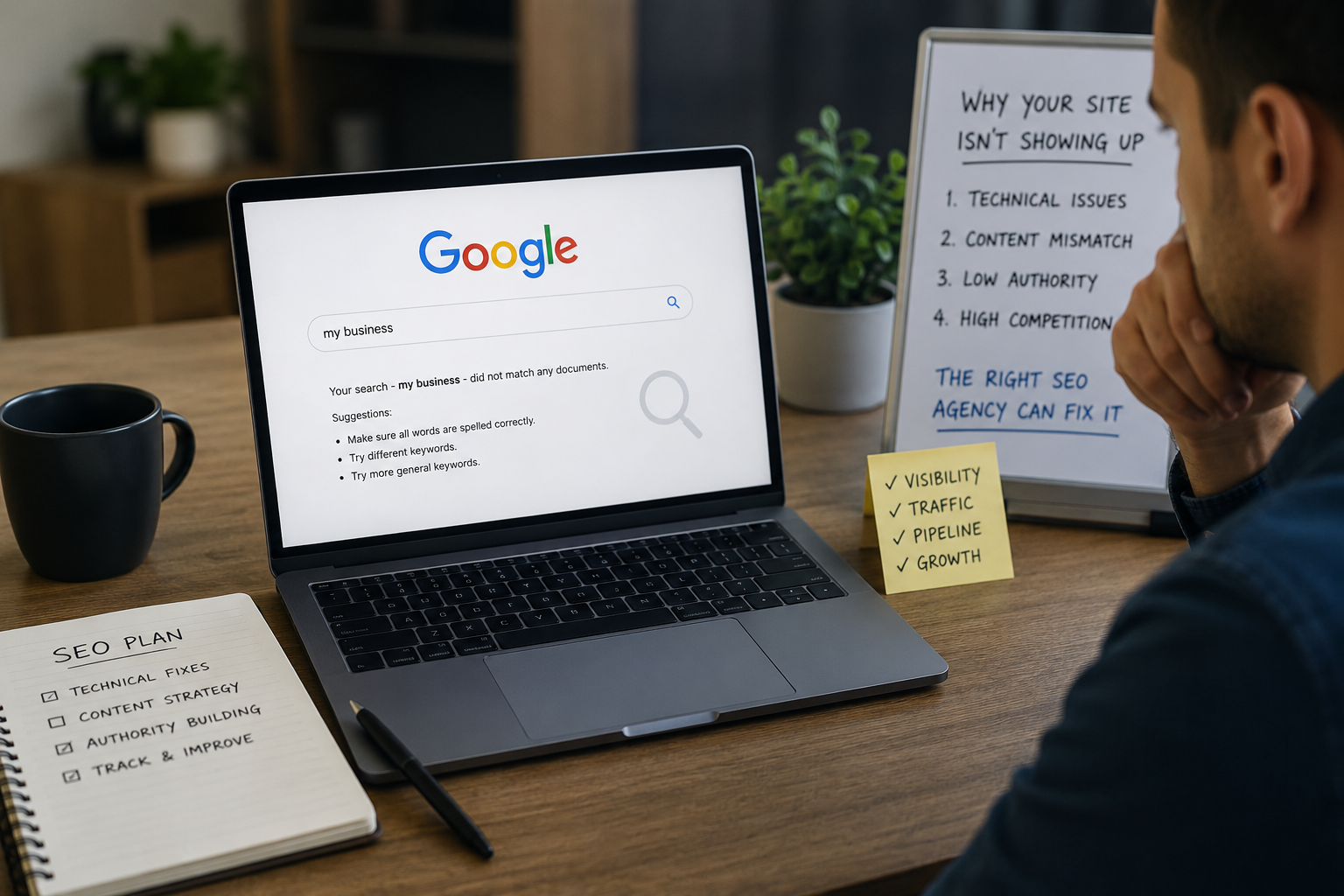
If you've searched for your own business on Google and come up empty — or found yourself buried somewhere on page four where no real buyer will ever look — you're not alone, and you're not out of options. The vast majority of ranking problems are fixable once you understand what's actually causing them. And once they're fixed, the right SEO agency builds the foundation that keeps you visible and growing over time.
This post does two things. First, it walks you through the most common reasons businesses aren't showing up on Google and what to do about each one. Second, it gives you a practical framework for hiring an SEO agency that will actually deliver results — not traffic reports that look impressive and leave your pipeline empty.
Let's start with the diagnosis.
Why Your Website Isn't Showing Up on Google
Before you hire anyone or spend a dollar on SEO, it helps to understand what's actually preventing your site from ranking. The causes fall into four categories, and most businesses struggling with visibility have problems in more than one of them simultaneously.
The Technical Layer: Google Can't Find or Read Your Site
A site with technical issues is like a shop with the door locked — no one can get in. If Google can't crawl or index your site properly, your content won't rank even if it's excellent. New Era Digital
The most common technical culprits include:
Indexation problems. One of the most common reasons Google does not index your site or a specific page is that it has been noindexed inadvertently. Adding noindex meta robot tags to a page tells Googlebot that it can crawl the page but that the results can't be added to the index. This happens more often than you'd think — during website migrations, CMS updates, or when developers accidentally leave staging settings on a live site. Yoast
Robots.txt blocking. Your robots.txt file tells Google which parts of your site it's allowed to crawl. A misconfigured robots.txt can silently block Google from your most important pages without any obvious error on the frontend.
Page speed failures. Google filters by performance first — your content only gets evaluated if your site loads fast enough. Pages ranking in position one now have a 10% higher Core Web Vitals pass rate than pages at position nine. If your site loads slowly on mobile, your content may never get seriously evaluated regardless of its quality. Bykreator
Broken internal links and orphaned pages. A site where every page is an island — with no links to or from other pages — is harder to crawl and understand. Every blog post should link to at least two related articles or service pages, and your service pages should link to relevant supporting content. AGS Web Solutions
The fastest way to diagnose technical issues is Google Search Console, which is free and flags crawl errors, indexation problems, Core Web Vitals failures, and manual penalties directly. Run a site: search in Google (type "site:yourdomain.com") to see how many of your pages are actually indexed — if the number is dramatically lower than the number of pages on your site, you have an indexation problem that needs fixing before anything else.
The Content Layer: Google Can't Tell What You're About
Even a technically healthy site won't rank if its content doesn't clearly tell Google — and real human buyers — what problems you solve, who you serve, and why you're the right answer.
Many websites are not showing up on Google because they were built quickly without a strong SEO foundation, clear search intent strategy, or ongoing technical maintenance. A website is not a marketing strategy, design is not discoverability, and launch day is not the finish line. Monterey Premier
The most common content problems that kill rankings are:
Thin pages with too little substance. A homepage with just your business name and a phone number won't rank. Aim for at least 300–500 words on important pages that explain what you do, who you help, and why you're different. Service pages, product pages, and location pages all need enough content for Google to understand what they're about and match them to the right searches. iMark InfoTech
Wrong keywords for the wrong intent. If you're targeting keywords your buyers don't actually use, or optimizing for informational searches when you need commercial intent traffic, you'll get the wrong visitors — or no visitors at all. Keyword strategy needs to match how your actual buyers search at each stage of their decision process.
Content that matches nothing people search for. Every page on your site should be built around a specific search query your target customer actually types. If pages exist for organizational reasons rather than search reasons, Google has no reason to surface them.
Duplicate content. If multiple pages on your site cover the same topic without clear differentiation, they compete against each other and dilute the authority that should be concentrated on a single strong page.
The Authority Layer: Google Doesn't Trust You Yet
Off-page SEO is mainly about authority and trust. Google uses backlinks as a signal of credibility. If reputable websites link to you, Google is more likely to trust your content. New Era Digital
New sites and sites in competitive categories often struggle to rank simply because they haven't earned enough third-party trust signals yet. Backlinks from relevant, authoritative websites are the primary signal Google uses to assess how credible and established your site is relative to competitors.
This is the layer that takes the longest to build — and the one that's hardest to shortcut without risking penalties. Legitimate link acquisition comes from creating content other sites want to reference, earning coverage in industry publications, getting listed in relevant directories, and building the kind of brand presence that naturally attracts citations over time.
The Competition Layer: Your Competitors Have More History
Sometimes your site is doing everything reasonably well and still isn't ranking — because the sites above you have been building authority for years in a competitive market. A new company is not going to outrank national networks for a broad, high-competition keyword in the first year. Not because SEO does not work, but because those competitors have years of domain authority, thousands of pages, and enormous backlink profiles. The right approach is to start with specific, longer-tail keywords where competition is manageable. Search Scale AI
Competing in a crowded space requires a realistic starting point — targeting achievable keywords first, building authority systematically, and expanding into more competitive terms as your domain strength grows.
The Timeline: When Will Your Site Start Ranking?
This is the question every business owner asks, and the honest answer requires nuance.
Technical fixes — indexation problems, site speed, noindex tags — can produce visible improvements within days to weeks once Google recrawls. Content improvements take longer: expect 60–90 days for a well-written page to begin climbing in rankings. Backlink-dependent improvements take the longest — Google needs to discover the links, evaluate their quality, and factor them into rankings, which typically takes 60–120 days per link campaign. Search Scale AI
Most sites see initial movement within three to six months of consistent work. Strong rankings for competitive terms take six to twelve months. The sequence matters: months one through two are technical fixes and content creation, months three through four are early ranking movement on long-tail terms, months five through eight are growing organic traffic, and months nine through twelve are when competitive terms start moving. AGS Web Solutions
Anyone promising meaningful ranking improvement in thirty days is either targeting keywords so uncompetitive they're worth nothing, or using tactics that will create bigger problems down the road.
How to Hire the Right SEO Agency
Once you understand what's holding your site back, the next step is finding the right partner to fix it and build on it. The SEO agency market is large, and the quality gap between good agencies and bad ones is enormous. Here's how to evaluate your options clearly.
Start With What You Actually Need
Before you talk to a single agency, get clear on your specific situation. Are you invisible on Google entirely — which points to technical or fundamental content problems? Or are you ranking but not highly enough — which is a competitive authority and content quality problem? Or are you ranking and getting traffic but not converting — which is less an SEO problem and more a conversion and content relevance problem?
The answer shapes which type of agency and which type of engagement makes sense. An agency that's excellent at fixing technical foundations might not be the right fit for a brand that needs a full content authority program. Be specific about your starting point.
The Questions That Reveal Everything
Ask any agency you're evaluating how they would prioritize your site. This question exposes whether they think strategically or just follow a checklist. A thoughtful answer mentions traffic potential, conversion value, competitive difficulty, and quick wins versus long-term plays. Watch out for red flags: "We optimize everything equally" or "We start with the homepage." These suggest cookie-cutter work. A strong agency will ask about your business model and which customers matter most. Viralchilly Blog
Beyond that opening question, the conversations that reveal the most are:
"Walk me through a real client engagement — including what didn't go as planned." Good agencies can do this. They have honest stories about timeline setbacks, algorithm updates that affected campaigns, and adjustments they made. Agencies that only have smooth success stories either haven't done much real work or aren't being transparent with you.
"Show me how you connected SEO to revenue for a client." Strong agencies respond with specific attribution frameworks showing how content influenced the pipeline. Weak agencies pivot to traffic graphs without demonstrating business impact. If an agency can't connect their work to business outcomes — leads, demos, revenue — they're not measuring the right things. Getpassionfruit
"Who will actually be working on my account?" The bait-and-switch that frustrates more clients than any other agency behaviour: you meet an impressive senior strategist during the pitch, they understand your industry and ask sharp questions — then three weeks after signing, a junior account manager you've never spoken to is running your campaigns. Ask directly: what is the experience level of the person who will own my account day-to-day? Stridec
"What is your approach to AI search visibility?" The agency you hire needs two distinct capabilities: traditional SEO execution and AI search visibility. If an agency hasn't developed a point of view on AI search, that agency is behind. AI Overviews now appear in a significant portion of searches, and your buyers are increasingly using ChatGPT and Perplexity to research solutions before they ever visit a website. An agency without a strategy for both layers is leaving a growing share of your visibility unaddressed. Stridec
"What will you NOT do for my business?" A genuine specialist will immediately name things that are irrelevant to your situation. If they refuse to exclude anything and frame every capability as potentially useful, they are a generalist with a specialist label. DerivateX
The Red Flags That Should End the Conversation
No legitimate SEO agency guarantees specific rankings. Any SEO agency that guarantees specific rankings is either lying or using tactics that will get your site penalised — Google itself warns against these guarantees in its official documentation. Stridec
Beyond guaranteed rankings, watch for:
Secretive processes. Transparency in link building separates reputable agencies from risky ones. If they won't disclose their methods, assume they're doing something they know you wouldn't approve of. A legitimate agency should be able to explain exactly what they're going to do and why, without claiming their approach is proprietary. Earlyseo
Vanity metric reporting. If an agency's sample reports lead with impressions, keyword rankings, and traffic volume without any connection to leads or revenue, that's the reporting you'll get as a client. Rankings and traffic are inputs. Revenue, leads, and pipeline impact are outcomes. An agency that leads with keyword rankings without connecting that to business results is optimising for activity, not outcomes. Stridec
Data hostage tactics. You should have your own logins to Google Analytics, Search Console, and any tracking tools — not screenshots or a proprietary dashboard that locks you out if you leave. Any agency that will not provide direct data access is a red flag. You should own everything: content on your site, analytics data, Search Console access, and any accounts created on your behalf. Stridec
Rushing you into long-term contracts. Be careful with SEO companies that rush you into long-term contracts without answering your questions first. When they ignore your concerns or seem to disappear after the first call, that's already telling you how they'll handle the rest of the engagement. SeoProfy
Generic proposals. A red flag proposal opens with the agency's history, awards, and client logos. It lists twelve blog posts and four links per month as deliverables. It uses the same traffic growth projections from their website. It does not reference your business model or your specific competitive situation. A proposal built for your business names your competitors, references your specific gaps, and shows what they would prioritize in the first ninety days. DerivateX
What Good Reporting Actually Looks Like
Before you sign anything, ask for a sample reporting template. Good SEO reporting connects search performance to business outcomes — not just rankings. At minimum you should see: organic traffic trends segmented by page and intent, keyword ranking movement for target terms, conversion data from organic traffic, and an honest narrative of what changed and why.
For businesses in 2026, good reporting also includes a layer of AI search visibility monitoring — how often your brand is appearing in AI-generated answers for your target queries, what sources are being cited about you, and whether your content is being extracted and attributed correctly across ChatGPT, Perplexity, and Google AI Overviews.
What the Right SEO Investment Actually Looks Like
SEO agency pricing varies widely and the variation doesn't always correlate with quality. That said, there are tiers worth understanding.
Entry-level engagements at $1,000–$3,000 per month typically cover technical auditing, on-page optimization, and basic content guidance with limited content production. These can be appropriate for small businesses with limited competition that primarily need foundational fixes.
Mid-range programs at $3,000–$8,000 per month typically include full technical SEO, keyword strategy, content production, and some link acquisition — appropriate for growing businesses in moderately competitive markets.
Full-service enterprise programs at $8,000–$20,000 or more per month include comprehensive strategy, content production at scale, active link acquisition programs, AI search optimization, and ongoing competitive intelligence. These are built for businesses competing in aggressive categories where the cost of not ranking is significant.
The more important question is whether the agency's pricing reflects a differentiated methodology or commodity keyword work — the cheapest option and the best option rarely overlap. Stridec
The honest framing is this: SEO is a compounding investment. The results you build in month six are still working for you in month eighteen. The authority you earn this year makes next year's ranking effort easier. SEO is a marathon, not a sprint — and businesses that treat SEO as ongoing infrastructure outperform those who treat it as a launch checklist. Seekmarketingpartners
Frequently Asked Questions
How do I know if my site has a technical SEO problem versus a content problem?
Start with a site search: type "site:yourdomain.com" into Google and see how many pages appear. If very few pages are indexed relative to how many pages your site has, you have an indexation problem — likely technical. If pages are indexed but ranking very low or not showing up for the searches you care about, the problem is more likely content relevance, authority, or keyword targeting. Google Search Console, which is free, will show you crawl errors, indexation issues, and which queries are already driving impressions even if they aren't driving clicks yet. That data tells you a lot about where to start.
Is it possible to fix my rankings without hiring an agency?
Yes — particularly on the technical side. Checking for noindex tags, submitting a sitemap in Google Search Console, fixing broken links, and improving page speed are all things a business owner or internal team can tackle with guidance. Where it gets harder without professional help is content strategy, competitive keyword research, and link acquisition — these require experience and tools that most businesses don't have internally. If your site is brand new and has no fundamental problems, you might make real progress on your own. If you're in a competitive category and have been invisible for a while, the gap between what self-managed SEO achieves and what a capable agency builds is typically significant enough to justify the investment.
How much of a head start do my competitors have, and can I catch up?
It depends on the market and what "ahead" means in terms of their actual signals. Some businesses appear to have strong rankings but have relatively thin content depth or weak backlink profiles — those are catchable faster than their ranking suggests. Others have spent years building genuine topical authority and link equity — those take longer to close the gap on. A good SEO agency will run a competitive gap analysis in the first few weeks of an engagement that tells you exactly where the distance is, which terms are most achievable in the near term, and what a realistic twelve to eighteen month trajectory looks like.
What should I do first — fix my website myself or hire an agency?
Fix the most obvious technical problems first, then hire. Specifically: verify your pages are indexed, make sure your robots.txt isn't blocking Google, submit your XML sitemap in Search Console, and check your page speed in PageSpeed Insights. These are free to diagnose and often free to fix. Coming to an agency with the basic foundation already verified means they can move faster on strategy and content — and you'll have a better baseline for evaluating what they do.
How do I avoid getting locked into a bad agency?
Ask about contract terms before you discuss anything else. Understand the minimum commitment period, what the exit terms look like, and whether you own all the content, data, and accounts if you leave. Ask specifically: "If we part ways six months in, what do I take with me?" Good agencies answer this cleanly. Agencies that retain ownership of your content or data are structuring the relationship to make leaving painful. Performance clauses — benchmarks the agency commits to hitting within a defined timeframe — are worth asking for and worth walking away from agencies that refuse to include them. Stridec
Does SEO still matter if AI is changing how search works?
More than ever, but the definition of "ranking" has expanded. In 2026, your customers don't only search on Google. Many now ask ChatGPT, Perplexity, or use Google's AI Overviews to get answers directly. These tools don't send people to your site — they read your site and summarize it. If your page isn't structured for AI, you get skipped. The good news is that most of what makes a page rank well in traditional search also makes it more likely to be cited by AI systems — technical health, content quality, authority signals. The additional layer is making sure your content is structured for extractability: clear direct answers, structured headings, schema markup, and the kind of third-party ecosystem presence that AI systems use as a trust signal. Bykreator
Ready to Find Out What's Holding Your Site Back?
The fastest path to understanding your specific ranking problem is a proper audit — not a generic checklist, but an honest look at your technical foundation, content gaps, keyword positioning, and competitive landscape.
Ritner Digital works with businesses at every stage: from companies that have never had real organic visibility and need to build from the ground up, to established brands whose rankings have slipped and need to understand why. We publish our own performance data publicly because we believe transparency is part of the strategy — and we'd rather you evaluate us on real results than polished sales materials.
If you're ready to understand where you stand and what it would actually take to show up where your buyers are searching, let's start with a conversation.
Work With Us → ritnerdigital.com/#contact
Sources: Search Scale AI Why Website Not Ranking 2026, SEO.com Site Not Showing Up on Google, Yoast Not Ranking Guide, AGS Web Solutions 12 Fixes 2026, Monterey Premier Why Website Not Showing Up, Stridec Questions to Ask an SEO Agency, Stridec Red Flags Hiring an SEO Agency, ViralChilly Questions Before Hiring SEO Agency, EarlySEO 15 Critical Questions 2026, Derivatex How to Hire SaaS SEO Agency.