How to Grow Your Local Business's Online Presence — and Hire the Right SEO Agency to Make It Happen
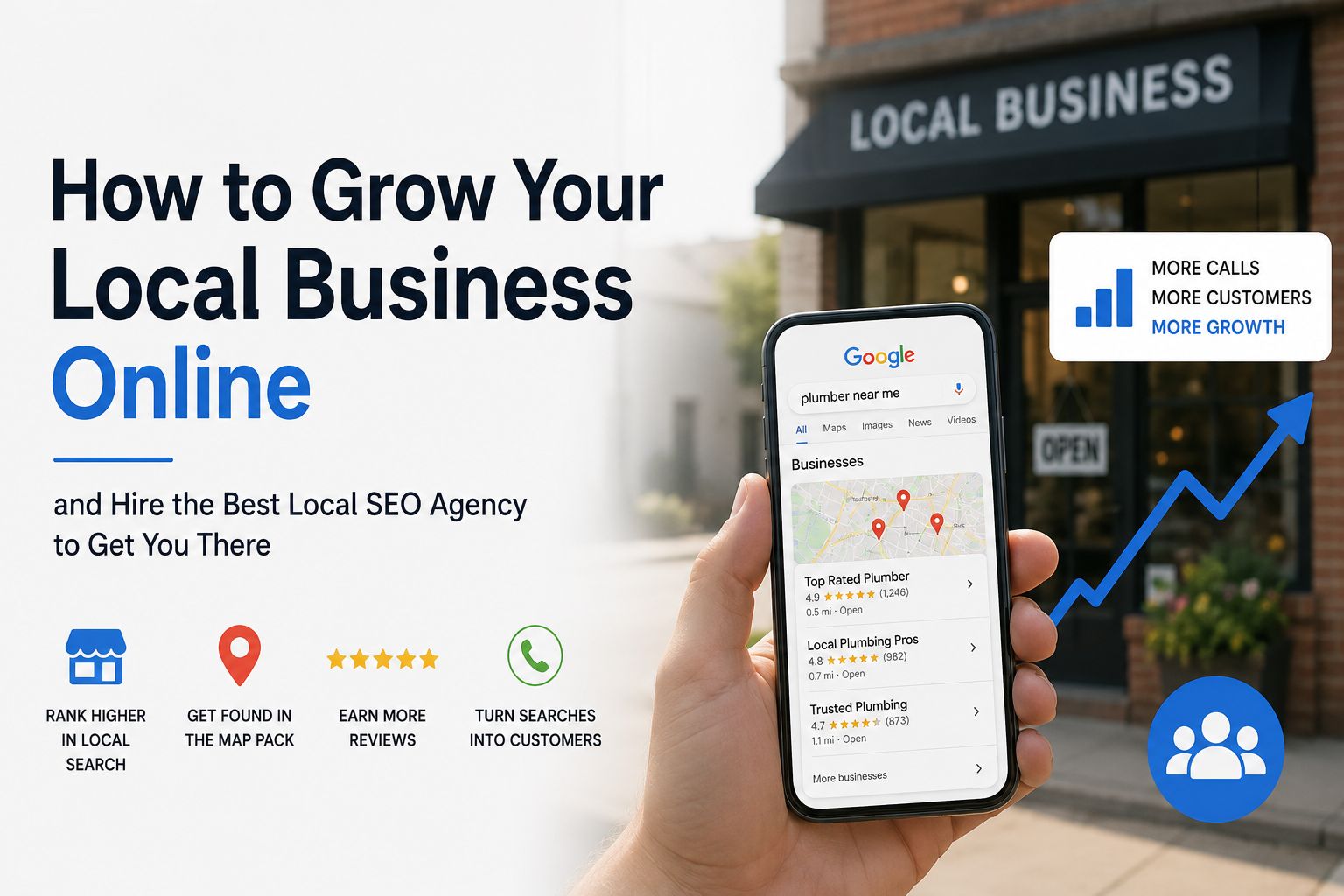
If your local business isn't showing up when nearby customers search for what you offer, you're losing real revenue to competitors who figured this out before you. Local search isn't complicated in principle — but it does require getting a specific set of things right consistently, and knowing which of those things actually move the needle versus which ones are noise.
This post answers both sides of your question. First, we'll walk through exactly how local search visibility works in 2026 — what Google is actually evaluating, what's changed, and what the highest-leverage moves are for a local business trying to grow. Second, we'll give you a clear framework for hiring an SEO agency that genuinely understands local search and will treat your marketing budget as an investment rather than an expense.
How Local Search Actually Works
Before hiring anyone, it helps to understand the game you're playing. Local SEO is a distinct discipline from general SEO — it has its own ranking system, its own signals, and its own opportunities that most business owners haven't fully mapped.
When someone searches "electrician near me" or "best Italian restaurant in [your city]," they see two sets of results: the Google Maps 3-pack — the three businesses that appear with a map at the top of the results page — and local organic results below it. Appearing in the 3-pack is one of the most valuable pieces of real estate in digital marketing for a local business. 46% of all Google searches have local intent. When people search "coffee shop near me" or "best plumber in [City]," Google often shows local business listings first. Yadavbikash
Google decides which businesses appear in that map pack using three primary factors: relevance, distance, and prominence. Understanding each one is the foundation of every effective local SEO decision.
Relevance is how closely your business matches what the person searched for. Your Google Business Profile category, the services you list, the keywords in your website content, and the completeness of your profile all contribute to how relevant Google considers you for any given search.
Distance is how close your business is to the searcher's location. You can't change your physical address — but you can build strong enough relevance and prominence signals to partially offset distance disadvantage. A business with strong reviews and a fully optimized profile can sometimes outrank a physically closer competitor because relevance and prominence outweigh proximity when the gap is large enough. Search Scale AI
Prominence is how well-established and trusted Google considers your business to be — measured through your reviews, your citations across the web, links to your website, your profile completeness, and real user engagement with your listing. Prominence is the factor that takes the longest to build but has the highest ceiling. Businesses that invest in prominence over 12–24 months establish map pack positions that are very difficult for newer competitors to displace. Search Scale AI
Your Google Business Profile: The Highest-Leverage Asset in Local SEO
According to the Whitespark 2026 Local Search Ranking Factors report, eight of the top ten ranking signals in the Local Pack and Maps category come directly from the Google Business Profile itself. No other single channel concentrates this much ranking potential. ALM Corp
If you haven't fully optimized your Google Business Profile — or if you set it up once and haven't touched it since — this is the single highest-priority item in local SEO. Here's what optimization actually means in practice:
Choose the right primary category. Your primary GBP category is the single most impactful ranking factor in local search. It tells Google what type of business you are and determines which searches you're eligible to appear for. Choose the most specific, accurate category available. Secondary categories provide supporting relevance signals — use up to ten, but only for services you genuinely offer. DIWYM
Complete every field. Business description, services list, attributes, business hours, photos, and Q&A — a complete profile performs meaningfully better than a partial one. Top performers have all core fields completed, 100+ photos, special features enabled, regular post activity, and accurate hours. New photos matter as much as total count — target two to four new photos per month minimum. DIWYM
Keep your hours accurate — including holidays. This sounds obvious, but it has a direct ranking impact. Being open when a user is searching is the fifth most important factor for local pack rankings. If your hours are wrong, outdated, or missing special holiday closures, you could be losing visibility during exactly the moments when potential customers are searching with the highest intent. SEO News
Post regularly. GBP posts — updates, offers, events, new services — contribute to engagement signals and keep your profile appearing active and relevant. Regular Google Business Profile posts help improve engagement, relevance, and freshness signals. While posts are not a direct ranking factor alone, they contribute to better user interaction, which indirectly improves local rankings. Yadavbikash
Stay actively managed. The businesses still running on a "set it and forget it" approach are quietly losing map pack rankings to competitors who figured out this shift earlier. What separates businesses showing up at position one from those sitting at position four or five are the behavioral and engagement signals — post activity, photo freshness, review velocity, and accurate hours. Google is now rewarding businesses that look alive, not just businesses that exist. SEO News
Reviews: The Ranking Signal That Doubles as a Conversion Driver
Reviews have grown in importance for local pack rankings, from 16% in 2023 to 20% today. They're now one of the most influential signals you can actively build — and unlike proximity, they're entirely within your control. BrightLocal
What Google evaluates isn't just your star rating or your total review count. It's the full picture: review quantity, recency, average rating, the presence of substantive text in reviews, keyword relevance within review content, and whether you respond to reviews consistently.
Consistency beats spikes. A business getting 10–20 reviews per month consistently will often outperform a business that gets 200 reviews in a short burst. Google trusts patterns, not spikes. BURIED
The practical implication: build a systematic approach to review generation. Ask every satisfied customer, at the moment they're most happy with your service, to leave a Google review. Make it easy — a direct link to your review page sent via text or email removes the friction that stops most people from following through.
Respond to every review — positive and negative. Review responses signal to Google that your business is actively engaged, and they signal to prospective customers that you care. Respond professionally to both positive and negative comments, and use the language customers naturally use when describing your business. Over time, review trends support local search ranking factors because they reinforce relevance, trust, and activity. Q-Tech Inc.
Citations: NAP Consistency Across the Web
A citation is any online mention of your business name, address, and phone number — in directories, on review platforms, in local publications, or anywhere else on the web. Citations help Google verify that your business is a legitimate, established entity at a real location.
The most frequent errors include inconsistent NAP information across the Google Business Profile, website, and citations — confusing Google's verification algorithms. Even inconsistencies in abbreviations can dilute citation value: "Smith and Associates Plumbing" versus "Smith Plumbing" versus "Smith & Assoc." on different directories creates data quality flags in Google's verification systems. ALM Corp
The fix is ensuring your business name, address, and phone number are formatted identically everywhere they appear online. Quality over quantity: 15 accurate, high-authority citations outperform 200 low-quality ones. The priority citation sources are the high-authority directories — Google Business Profile, Yelp, Apple Maps, Bing Places, Facebook, and your industry-specific directories — where accuracy matters most. DIWYM
Your Website: The Foundation Local Search Builds On
Your Google Business Profile is the primary driver of map pack rankings — but your website still matters significantly for local organic rankings and for reinforcing the relevance and authority signals that support your overall local presence.
A well-built location page for a secondary market the business previously ignored can become a top traffic source within 60–90 days of publication. If your business serves multiple neighborhoods, suburbs, or service areas, dedicated pages for each location — with genuinely unique content, not copy-pasted service descriptions — let you compete for searches in areas beyond your physical address. Search Scale AI
Your website also needs to be technically healthy: fast-loading on mobile, properly structured with local schema markup, and clearly organized so Google can understand what you do and where you serve. Local Business schema can reinforce your company's location, service type, business hours, contact details, and other essential data. It does not guarantee rankings, but it improves clarity — and clarity matters more than ever in AI-driven search environments. Q-Tech Inc.
The AI Search Layer: Why Local Visibility Is Expanding Beyond Google Maps
Here's the dimension that most local SEO guides aren't fully accounting for yet — and it's one that's moving fast.
AI search tools like ChatGPT, Perplexity, and Google AI Overviews are increasingly answering local intent queries directly. When someone asks "what's the best plumber in [city]" or "find me a good dentist near downtown," AI systems are generating answers that pull from the same trust signals as traditional local search — reviews, citations, website quality, and the consistency of your business data across the web.
The Whitespark 2026 report introduced an entirely new AI Search Visibility category for the first time, with citation-based and entity-based signals making up three of the top five AI visibility factors. Businesses with consistently updated, actively managed GBP profiles are the ones being recommended in AI-driven local answers. Businesses with stale profiles aren't just slipping down the map pack — they're becoming invisible to AI-powered discovery entirely. SEO News
AI search visibility for local businesses correlates with the same factors that drive traditional local prominence: review volume and sentiment, citation authority, website quality and relevance, and branded mentions on authoritative web sources. ALM Corp
The practical upshot: most of what you do to improve your traditional local SEO also improves your AI search visibility. The two systems are increasingly fed by the same signals. But businesses that are actively managing their online presence — fresh reviews, updated profiles, consistent citations, quality website content — are pulling ahead in both channels simultaneously.
How to Hire the Right Local SEO Agency
With a clear picture of what local SEO involves, you're in a much stronger position to evaluate agencies. Here's what to look for and what to avoid.
They Specialize in Local, Not Just General SEO
Local SEO and general SEO share foundational principles but diverge significantly in execution. Google Business Profile optimization, map pack strategy, local citation building, review acquisition systems, and hyperlocal content are specializations that agencies without local focus often handle superficially.
Ask potential agencies specific questions about their methodology. Ask for case studies. Check their own rankings. If they can't rank themselves, they probably can't rank you. An agency that claims local SEO expertise but doesn't rank locally for their own relevant keywords should give you pause. Boulderseomarketing
They Can Explain Exactly What They'll Do and Why
A capable local SEO agency should walk you through a clear plan within the first conversation: what they'd audit first, which signals they'd prioritize based on your current situation, what the content strategy looks like, and how they approach review generation and citation management. A good SEO service provider doesn't just track position — they track impact. Because rankings without results don't mean much. Eco York
Watch for agencies that lead with vague language about "optimizing your presence" without getting specific. The more specific they can be about your situation — and the more questions they ask about your business before proposing a strategy — the better.
They Measure What Matters to Your Business
Local SEO success isn't measured in impressions. It's measured in calls, direction requests, website clicks from local search, booked appointments, and foot traffic. Traditional agencies often report on rankings and impressions. The best partners track what actually matters: calls, direction requests, website visits from local searches, and ultimately revenue generated. This accountability changes the relationship between a business and its marketing partner. TrafficTail
Ask any agency to show you a sample report and verify that it connects search performance to actual business outcomes — not just a ranking tracker.
They Have a Point of View on AI Search
AI-driven search experiences are changing the way users discover and interact with local results. Many of the same signals that influence traditional local rankings — including on-page optimization, reviews, and authority — also impact AI visibility. Any agency without a perspective on how AI search affects local visibility in 2026 is working from an incomplete playbook. BrightLocal
Ask directly: how do you optimize for AI search visibility for local businesses? The answer should involve structured data, review strategy, citation authority, and content quality — not a blank stare or a vague reference to "staying updated on algorithm changes."
They're Transparent About Timeline and Pricing
Most local businesses invest between $1,500 and $4,000 per month for professional SEO services. Below $1,500 per month, be very careful. It's hard to find a reputable agency that won't just burn through your money at that level. Boulderseomarketing
On timeline: a basic timeline looks like this — zero to thirty days covers profile optimization, category setup, and initial citation cleanup where impressions begin to increase. Thirty to ninety days, with consistent review generation and ongoing activity, most businesses begin to notice some local pack movement. Three to six months of successful local SEO generally results in real ranking gains and tangible increases in calls, clicks, and direction requests. Exaalgia
Anyone promising significant results faster than that is either targeting terms with no competition or using tactics that will eventually backfire.
Red Flags That Should End the Conversation
Guaranteed rankings. No legitimate agency can guarantee specific rankings — Google's algorithm isn't within anyone's control, and any agency making this promise is either misrepresenting how SEO works or planning to use shortcuts that will eventually hurt you.
Fake reviews. This is a shortcut that can get your Google Business Profile suspended entirely. Any agency that mentions generating reviews without a clear and ethical acquisition strategy should be disqualified immediately.
No access to your own data. You should have your own Google Search Console and Google Analytics logins. Any agency that controls your accounts without giving you independent access is structuring the relationship to make you dependent on them.
Cookie-cutter packages. Local SEO in a competitive urban market for a restaurant looks completely different from local SEO for a niche service business in a mid-sized market. Agencies selling fixed packages without understanding your specific situation are applying a generic approach to a problem that requires a specific one.
What You Can Do Right Now Before Hiring Anyone
Before you sign a contract with any agency, take these steps yourself — they cost nothing and will give you a clear baseline:
Claim and verify your Google Business Profile if you haven't already. Unverified profiles receive significantly less visibility in local search.
Search your business name in Google and check what appears. Is your information consistent across your website, your GBP, and any directories that appear? NAP inconsistencies are easy to spot and worth documenting before an agency starts work.
Search for your top two or three services in your city and see who's appearing in the map pack and why. Look at their review counts, how recently they've been reviewed, and how complete their profiles appear. This gives you a competitive baseline to share with any agency you evaluate.
Run a site: search for your own domain (type "site:yourdomain.com" in Google) and see how many pages are indexed. If the number seems low relative to your actual page count, you may have a technical indexation issue that needs addressing.
Frequently Asked Questions
How long does local SEO take to show results?
For most local businesses starting from a basic or incomplete foundation, initial movement in local pack visibility typically appears within thirty to ninety days of consistent optimization — particularly for GBP improvements and citation cleanup. Meaningful and sustained improvements in calls, clicks, and direction requests generally emerge at the three-to-six month mark. Competitive markets and businesses starting from zero take longer. The compounding nature of local SEO means results accelerate over time as reviews accumulate, citations strengthen, and content builds authority.
Do I need a website to rank in local search?
You can appear in the Google Maps 3-pack with only a Google Business Profile, but your website significantly strengthens your overall local presence — particularly for local organic rankings below the map pack. Website signals, including page speed, content relevance, mobile optimization, and schema markup, are established ranking factors for local organic results. More importantly, your website is where local search traffic converts into actual leads and customers. A well-optimized GBP drives visibility; your website drives revenue from that visibility.
What's the difference between local SEO and general SEO?
General SEO focuses on ranking for keywords in national or global search results, building domain authority, and competing for terms regardless of geography. Local SEO focuses specifically on ranking for geographically-targeted searches — typically "[service] near me" or "[service] in [city]" queries — and is primarily driven by Google Business Profile optimization, local citation consistency, review management, and local content. The map pack that appears for local searches is a completely separate ranking system from general organic results, with its own signals and its own optimization requirements.
Should I focus on Google Business Profile or my website first?
For most local businesses, your Google Business Profile will generate faster and more direct results than website work alone — particularly if your GBP is incomplete or hasn't been actively managed. Start with GBP optimization, then layer in website improvements for local keywords, location pages, and technical health. The two systems reinforce each other: a strong website improves your local organic rankings, which contributes to the prominence signals that also support your map pack position.
How do reviews affect my local rankings?
Significantly — and in multiple dimensions. Google evaluates review quantity, recency, average star rating, the text content of reviews, and whether you respond to them consistently. Reviews have grown from 16% to 20% of local pack ranking factor weight according to the 2026 Local Search Ranking Factors survey, making them one of the most important signals you can actively build. Consistent monthly review generation outperforms periodic bursts. A business earning ten to twenty genuine reviews monthly will consistently outperform a competitor with more total reviews but no recent activity.
Can a small local business compete with bigger brands in local search?
Yes — and local SEO is specifically where smaller local businesses have an advantage over large national brands. A national chain with thousands of locations can't optimize each individual Google Business Profile with the same care, responsiveness, and local specificity that an owner-operated local business can. Local businesses with fully optimized GBPs, consistent review generation, accurate citations, and genuine community presence regularly outrank larger competitors in their specific markets. Local search rewards relevance and community trust more than brand size or marketing budget.
What should I expect to pay for local SEO services?
Professional local SEO services typically start at $1,500 per month for foundational work — GBP optimization, citation cleanup, review strategy, and basic content support. More comprehensive programs including active content creation, location page development, link acquisition, and AI search visibility optimization run $2,500–$4,000 per month or more depending on market competition. Be skeptical of services priced below $1,000 per month — at that level, you're likely getting automated tools with minimal strategic input, which rarely moves the needle in competitive local markets. The right question isn't the monthly cost — it's the ROI relative to what a new customer is worth to your business.
Ready to Build a Local Presence That Actually Brings In Business?
Ritner Digital builds search visibility strategies for businesses that need to be found where buyers are actually looking — from Google Maps and local organic results to AI search tools that are increasingly shaping local discovery.
If you want to understand exactly where your local presence stands right now and what it would take to show up consistently for the searches that matter most to your business, let's start with a conversation.
Work With Us → ritnerdigital.com/#contact
Sources: Whitespark 2026 Local Search Ranking Factors Report, BrightLocal Local Algorithm and Ranking Factors 2026, ALM Corp Google Maps SEO Guide, ALM Corp Google 3-Pack Rankings Guide, Search Scale AI Local SEO Guide 2026, Opositive Google Business Profile Ranking Factor Analysis, Boulder SEO Marketing Local SEO Guide 2026, Ecoyork Local SEO 2026 Ranking Factors.