Which SEO Marketing Services Should You Use? A Straight Answer for Every Business Situation.
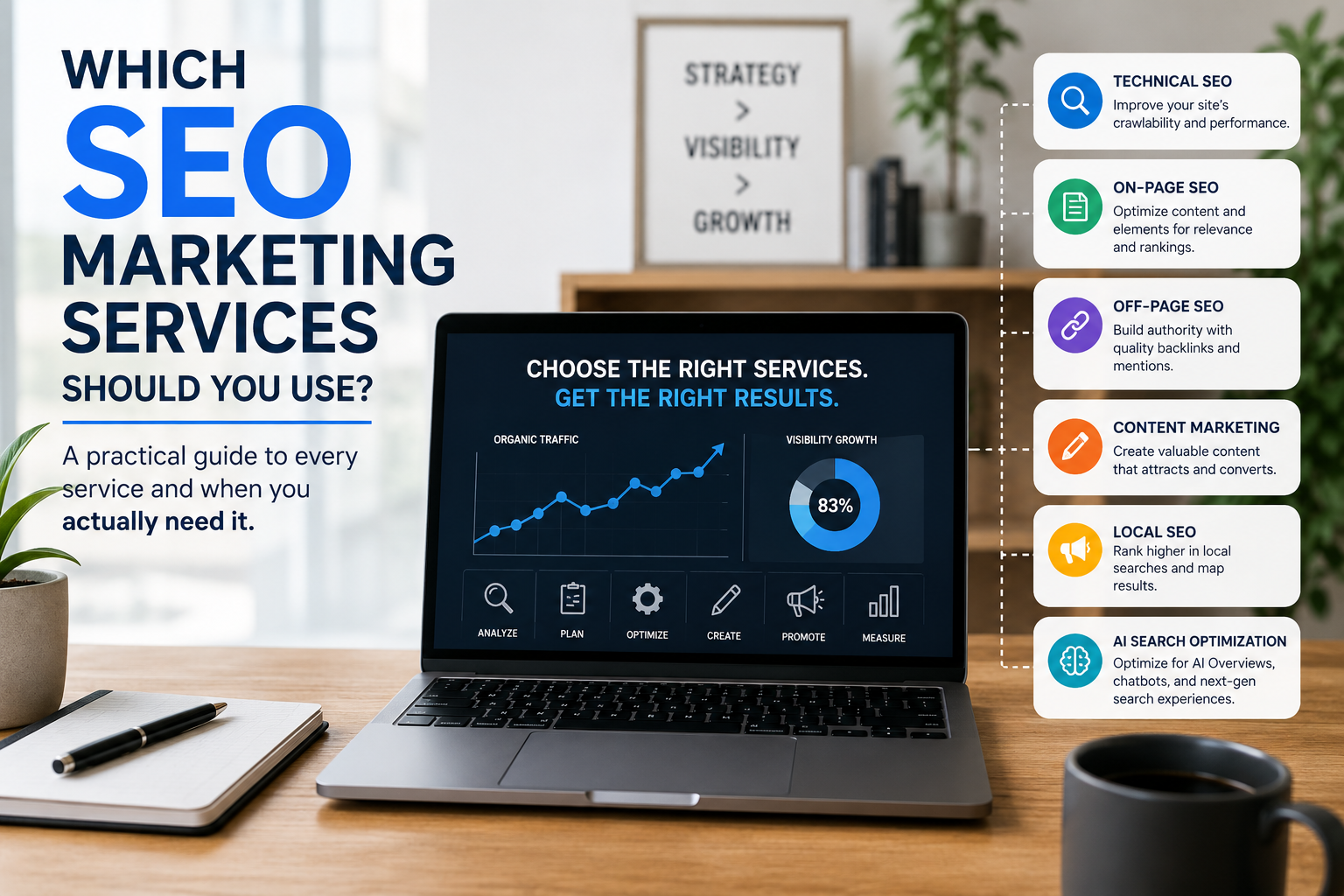
"Which SEO services should I use?" sounds like a simple question. It isn't — because the right answer depends entirely on what your business actually needs, what's holding your visibility back right now, and what kind of growth you're trying to drive. The worst thing you can do is buy a package of services someone else decided you need before anyone looked at your specific situation.
That said, the SEO services landscape does have a clear structure. There are six core disciplines that make up professional search engine optimization, plus a newer and increasingly important layer most agencies still aren't handling well. This post walks through all of them, explains what each one does and when it matters, and gives you a practical framework for deciding which combination makes sense for your business.
Why "Which SEO Services" Is the Wrong Starting Question
The right starting question is: what's currently preventing your business from getting the organic visibility and leads it should have?
The answer to that question determines which services you need — not the other way around. A brand-new website with no indexed pages needs something completely different from an established business whose rankings have plateaued. A local service business competing for map pack visibility has different priorities than a SaaS company trying to rank for competitive B2B keywords.
Professional SEO services are built around six interconnected disciplines. Removing any one of them weakens the others. But that doesn't mean you need to activate all six simultaneously at equal investment. The sequence and emphasis depend on your situation. Rankfast
Start with the diagnosis. What's actually broken or missing? Then use this guide to understand which services address those specific gaps.
The Six Core SEO Services — What Each One Does and When You Need It
1. Technical SEO
Technical SEO is the infrastructure layer — the behind-the-scenes work that determines whether Google can actually find, crawl, understand, and index your pages. No amount of great content or backlinks will overcome serious technical problems. If Google can't access your pages, nothing else in your SEO program will work.
Technical SEO addresses the infrastructure that determines whether Google can find, crawl, and rank your pages. It is the foundation that all other SEO work builds on. Rankfast
What it includes: site speed and Core Web Vitals optimization, crawlability and indexation auditing, fixing broken links and redirect chains, XML sitemap setup and maintenance, robots.txt configuration, schema markup implementation, mobile usability, site architecture, and canonical tag management.
When you need it most: Always — but especially at the start of any SEO program, after a website migration, after a significant CMS update, or if your traffic has dropped suddenly and unexpectedly. Technical issues often cause problems that are invisible to the naked eye but catastrophic for rankings. Technical fixes — indexation problems, site speed, noindex tags — can produce visible improvements within days to weeks once Google recrawls. It's the fastest-returning category of SEO work, which is why it should almost always come first. Search Scale AI
2. On-Page SEO
On-page SEO is everything you control on individual pages to help Google understand what that page is about and match it to the right searches. It's the layer that sits on top of your technical foundation and makes your content legible and relevant to search engines.
What it includes: keyword research and mapping, title tag and meta description optimization, heading structure (H1, H2, H3), internal linking, image alt text, content length and depth relative to what's ranking, URL structure, and ensuring each page targets a clear and specific search intent.
Service and landing pages should be dedicated to each service, location, and audience type, each targeting specific high-intent keywords. Websites with active blogs earn 97% more inbound links on average than those without fresh content. Rankfast
When you need it most: Any time you have pages that exist but aren't ranking for the searches they should be capturing. On-page work is also the starting point for new content strategy — you need keyword research before you write anything, and you need intent mapping before you decide what pages to create.
A common on-page mistake: putting multiple services or topics on a single page. If you offer three services on one page, Google doesn't know which one to rank you for. You're competing against yourself. Google matches one page to one search query — when you put three services on one page, it sees it as unfocused and ranks you lower for all three. Bykreator
3. Content Marketing and Content SEO
Content is the mechanism through which your website actually ranks for the keywords your buyers are using. On-page SEO tells you how to structure and optimize content — content marketing is the program that produces it systematically over time.
Around 70% of marketers rely on content marketing as their main acquisition and branding channel. Topic cluster architecture — building interconnected hubs of content around your core services, with pillar pages supported by detailed subtopic articles — is the structure that builds topical authority at scale. Rankfast
What it includes: content strategy and editorial planning, pillar page and topic cluster development, blog content production, service and location pages, comparison and alternative pages targeting decision-stage buyers, FAQ content optimized for featured snippets and AI Overviews, and content refresh programs for existing pages that are losing rankings.
When you need it most: When your site has the technical foundation in place but isn't generating organic traffic because it lacks the depth of content coverage required to rank for your most valuable keywords. Content is a long-term compounding investment — pages you publish today will continue generating traffic and leads for years. High-authority content comprising detailed analysis, industry insights, professional perspectives, and original studies not only ranks well but also creates trust among decision-makers. Nomadz Blog
Content marketing is also the layer most closely tied to AI search visibility. Well-structured, authoritative content that directly answers buyer questions is both the content that ranks in traditional search and the content AI systems cite in generated answers.
4. Link Building and Authority Development
Links from other websites to yours are one of Google's strongest ranking signals — and in competitive categories, your link profile is often the single largest gap between where you rank and where you want to rank.
Nearly 80% of SEO professionals name link building as a key part of their strategy. Links from other websites to yours are one of Google's strongest ranking signals. Rankfast
What it includes: digital PR and editorial link acquisition, original research and data publishing that earns natural citations, guest content on relevant industry publications, competitor backlink analysis and gap identification, broken link building, partner and ecosystem page opportunities, and link profile auditing to identify and disavow toxic links.
When you need it most: When your technical foundation and content are solid but you're not ranking competitively because your domain authority is lower than the sites above you for your target keywords. Link building is the most time-intensive and hardest-to-shortcut element of SEO — it also has the most lasting impact on competitive rankings. Quality matters far more than quantity. Enterprises should prioritize earning links from authoritative and relevant sources rather than chasing sheer numbers. One mention in an authoritative industry publication is worth more than fifty links from generic directories. SeoProfy
One critical warning: link building is also where the most damage is done by bad agencies. Purchased links from private blog networks, link farms, and low-quality directories can trigger Google penalties that are painful and time-consuming to recover from. Legitimate link acquisition is earned through content worth citing — not bought from link brokers.
5. Local SEO
Local SEO is a distinct discipline for businesses that serve customers in specific geographic areas and need to appear in location-based searches — "near me" queries, city-specific searches, and Google Maps results. It has its own ranking system, its own signals, and its own optimization requirements separate from general organic SEO.
What it includes: Google Business Profile optimization and management, local citation building and NAP consistency, review generation and management strategy, location page development, local schema markup, Google Maps optimization, and local link acquisition from community and industry sources.
46% of all Google searches have local intent. Eight of the top ten ranking signals in the Local Pack come directly from the Google Business Profile itself — no other single channel concentrates this much ranking potential for local businesses. Yadavbikash
When you need it most: If your business relies on local customers — any service area business, retail location, restaurant, medical practice, law firm, contractor, or professional service with a geographic footprint. Local SEO is not optional for these businesses — it's the primary mechanism through which nearby customers find you. If you're not appearing in the Google Maps 3-pack for your core service searches in your area, local SEO is your highest-priority investment.
6. AI Search Optimization (GEO and AEO)
This is the newest and most rapidly evolving category in the SEO services landscape — and it's the one most agencies are still catching up to. AI search optimization covers two related disciplines: Generative Engine Optimization (GEO), which is the broader strategy of building your brand's authority so AI systems consistently select you as a trusted source, and Answer Engine Optimization (AEO), which is the tactical layer of structuring individual content pieces so AI systems can easily extract and cite clean answers from them.
What it includes: content structuring for AI extractability (direct answer paragraphs, FAQ schema, structured headings), entity optimization and brand entity building, ecosystem trust signal development across Reddit, LinkedIn, review platforms, and third-party publications, AI citation monitoring across ChatGPT, Perplexity, and Google AI Overviews, and original research publishing that earns AI citations.
The median SEO ROI in 2026 reaches 748%, with organizations realizing $22 in returns for every $1 invested. AI-generated answers now shape how buyers discover providers and make faster decisions, which means your brand must send clear, consistent signals that prove relevance, authority, and trust. Rankfast
When you need it most: Now — regardless of your business type or size. AI search traffic converts at roughly five times the rate of traditional Google traffic because visitors arrive pre-qualified by the AI model's recommendation. This category isn't a future consideration — it's an active channel where buyers in every industry are already researching and shortlisting vendors. The brands investing in AI search visibility today are building a compounding advantage that will be increasingly difficult for competitors to close. Optimist
How to Decide Which Services Your Business Actually Needs
The right combination of SEO services depends on your starting point, your goals, and your competitive landscape. Here's a practical framework for thinking through your situation.
If your site is new or has never had real SEO investment: Start with technical SEO and on-page optimization. Get the foundation right before anything else. Parallel that with local SEO if you serve a geographic market. Then layer in content marketing as the technical foundation stabilizes.
If your site has been around but traffic is flat or declining: Start with a full technical and content audit to identify what's actually holding performance back. The culprit is usually one of: technical indexation issues, content that doesn't match current search intent, keyword cannibalization, or a backlink profile that's stagnated while competitors built authority. Fix what's broken before adding more content or links on top of a broken foundation.
If you rank for some terms but can't break through on competitive keywords: This is almost always an authority and content depth problem. You need both link acquisition from credible sources and deeper topical coverage through content clusters — simultaneously, not sequentially. Competitive keywords require both signals working together.
If you have decent organic rankings but AI search visibility is low: This is the gap most established businesses have right now. Your traditional SEO may be working reasonably well, but your brand isn't being selected by AI systems. The fix involves content restructuring for extractability, ecosystem presence building, and entity optimization — the GEO and AEO layer that feeds AI citation signals.
If you're a local business with minimal online presence: Google Business Profile optimization and local SEO are your entry point — these generate results faster than any other category for local businesses. Layer in on-page content improvements and review acquisition systematically from the start.
The Services That Are Almost Always Worth Having Together
Some SEO services are significantly more effective in combination than individually. Here's what tends to compound together:
Technical SEO + On-Page SEO: Technical fixes without on-page optimization leave you with crawlable pages that still don't rank for anything specific. On-page optimization without a solid technical foundation means your content may never be fully indexed. These two should always move together.
Content Marketing + Link Building: Content without links builds topical depth without the authority signals required to rank for competitive terms. Links without content substance point to pages that don't deserve to rank. The combination — content that earns links naturally because it's genuinely worth citing — is the most sustainable and highest-ROI approach to competitive keyword rankings. Topical closure beats keyword stuffing. If you publish five deep, authoritative articles on a topic, you'll outrank competitors who publish ten shallow posts. Percepture
Local SEO + On-Page Content: Google Business Profile optimization drives map pack visibility, but your website reinforces the authority and relevance signals that determine how high in the pack you appear. Location pages, service pages, and local content all feed the prominence signals that compound over time.
Traditional SEO + AI Search Optimization: The same content that ranks well typically gets cited by AI systems. Good SEO is good GEO. These aren't separate programs — the authority, structure, and trust signals you build for traditional search rankings are the same signals that determine AI citation visibility. Treating them as a single integrated program is more efficient and produces compounding results in both channels simultaneously. Whitehat SEO
What Professional SEO Services Actually Cost
Understanding pricing ranges helps you evaluate whether what you're being offered is realistic.
For most businesses, quality SEO services range from $2,500 to $10,000 per month. Local and small businesses can expect to pay on the lower end of that range, while competitive industries like legal, healthcare, and financial services typically require $5,000 to $15,000 or more per month to see meaningful results. Enterprise-level campaigns with national scope can exceed $100,000 per month. Be cautious of agencies offering SEO for $300 to $500 per month — at that price point, the work is either automated, outsourced at low quality, or simply insufficient to compete in any meaningful market. Rankings
The pricing model matters too. Most reputable agencies work on monthly retainers — which makes sense for SEO because it's an ongoing program, not a one-time project. Be skeptical of agencies that offer significant SEO results as one-time project pricing. Sustainable visibility requires ongoing work: content production, link acquisition, technical maintenance, and performance monitoring don't stop after an initial setup.
The Question Behind the Question: How Do You Choose the Right Agency?
Knowing which services you need is half the answer. The other half is finding an agency that can actually deliver them competently and honestly.
A few things that separate the agencies worth working with from the rest:
They diagnose before they prescribe. Any agency that proposes a specific service package before auditing your site and understanding your business situation is selling you a generic solution to a specific problem. The right agency asks questions first.
They connect services to outcomes. Technical SEO, content, link building, local SEO — none of these are the goal. Organic leads, qualified traffic, AI citations, and revenue are the goal. Every service should be tied to a measurable business outcome, and your reporting should reflect that connection.
They build what you own. The content on your site, the links earned to your domain, the authority built in your category — these are assets that compound over time and belong to your business. Good agencies build things you keep. Avoid agencies that lock your data, your accounts, or your content behind proprietary systems that disappear when you leave.
They have a current point of view on AI search. Any agency that hasn't updated its service offering to address AI search visibility in 2026 is working from an outdated playbook. The way buyers discover businesses, products, and services is changing — your agency should be ahead of that change, not catching up to it.
Frequently Asked Questions
Do I need all six SEO services at once?
Not necessarily — but you do need all six eventually if you want comprehensive, competitive visibility. The practical approach for most businesses is to prioritize based on what's currently the most significant bottleneck. If your technical foundation is broken, fix that first. If your content is thin, build that next. If your authority is the limiting factor, invest in link acquisition. Many businesses run all six services simultaneously once they're past the foundational stage because the services compound each other — but sequencing makes sense if budget is a constraint.
What's the difference between SEO and content marketing?
They're closely related but distinct. SEO is the broader discipline of improving search visibility — it includes technical infrastructure, on-page optimization, link building, and content strategy. Content marketing is specifically about producing valuable content that earns traffic, builds authority, and serves buyers at every stage of their research journey. Good content marketing is informed by SEO strategy — keyword research, intent mapping, and competitive analysis — and executed in a way that serves both search engines and human readers. In practice, a professional SEO program almost always includes content marketing as one of its core components.
How quickly do different SEO services show results?
The timeline varies significantly by service type. Technical fixes — crawlability, indexation, site speed — can produce measurable improvement within days to weeks once Google recrawls. On-page optimization shows movement within sixty to ninety days for most pages. Content published on a healthy, authoritative site typically begins ranking meaningfully within sixty to ninety days. Link acquisition takes the longest — new links generally take sixty to one hundred twenty days to fully factor into rankings. Local SEO improvements, particularly Google Business Profile optimization and review generation, often show map pack movement within thirty to ninety days. AI search citation improvements can appear faster — sometimes within weeks of making significant content and entity optimization changes.
Is link building still worth it in 2026?
Yes — and in competitive categories, it's often the difference between ranking on page one and ranking on page three. Position one pages have 3.8x more backlinks than positions two through ten. The methodology has evolved — low-quality link schemes are more likely to trigger penalties than ever — but the underlying signal hasn't changed. High-authority links from relevant, credible sources remain one of the most powerful ranking signals Google uses. The investment is in earning those links through content worth citing, not buying them from link brokers. Olivermunro
Can I do SEO myself or do I need an agency?
Some elements of SEO are accessible to non-specialists — particularly basic on-page optimization, Google Business Profile management, and content publishing. The more technical and strategic layers — technical auditing, competitive keyword strategy, link acquisition, and AI search optimization — require specialized expertise and tools that most businesses don't have internally. The honest answer: you can self-manage a basic local SEO program and see real results. You're unlikely to self-manage your way to competitive rankings for high-difficulty keywords without professional help. The ROI calculation depends on the value of ranking for those terms relative to the cost of professional services.
What should I ask an SEO agency before hiring them?
Three questions that reveal the most: First — "What would you audit in the first thirty days and what would you prioritize based on what you find?" Good agencies can answer this specifically. Second — "Show me how SEO work you did for a client connected to their revenue or leads." Strong agencies have attribution data, not just ranking charts. Third — "What is your approach to AI search visibility?" Any agency without a clear answer to this is working from a 2022 playbook in a 2026 search environment.
Ready to Figure Out Which SEO Services Your Business Actually Needs?
At Ritner Digital, we don't sell packages. We start with an honest look at where your business stands — technically, competitively, and in terms of AI search visibility — and build a program around what will actually move the needle for your specific situation.
If you want a clear-eyed answer to which SEO services make sense for your business right now, let's start with a conversation.
Work With Us → ritnerdigital.com/#contact
Sources: Rankfast What Do SEO Services Include 2026, Brafton Types of SEO 2026, Rankings.io Best SEO Companies 2026, ALM Corp Google Maps SEO Guide, FirstPageSage SEO ROI Benchmarks 2026, Whitespark Local Search Ranking Factors 2026, Ariad Partners B2B SEO 2026, Optimist Best B2B SEO Agencies 2026.