The Fashion Brand's Guide to SEO: Why You Need a Specialist and What to Look For
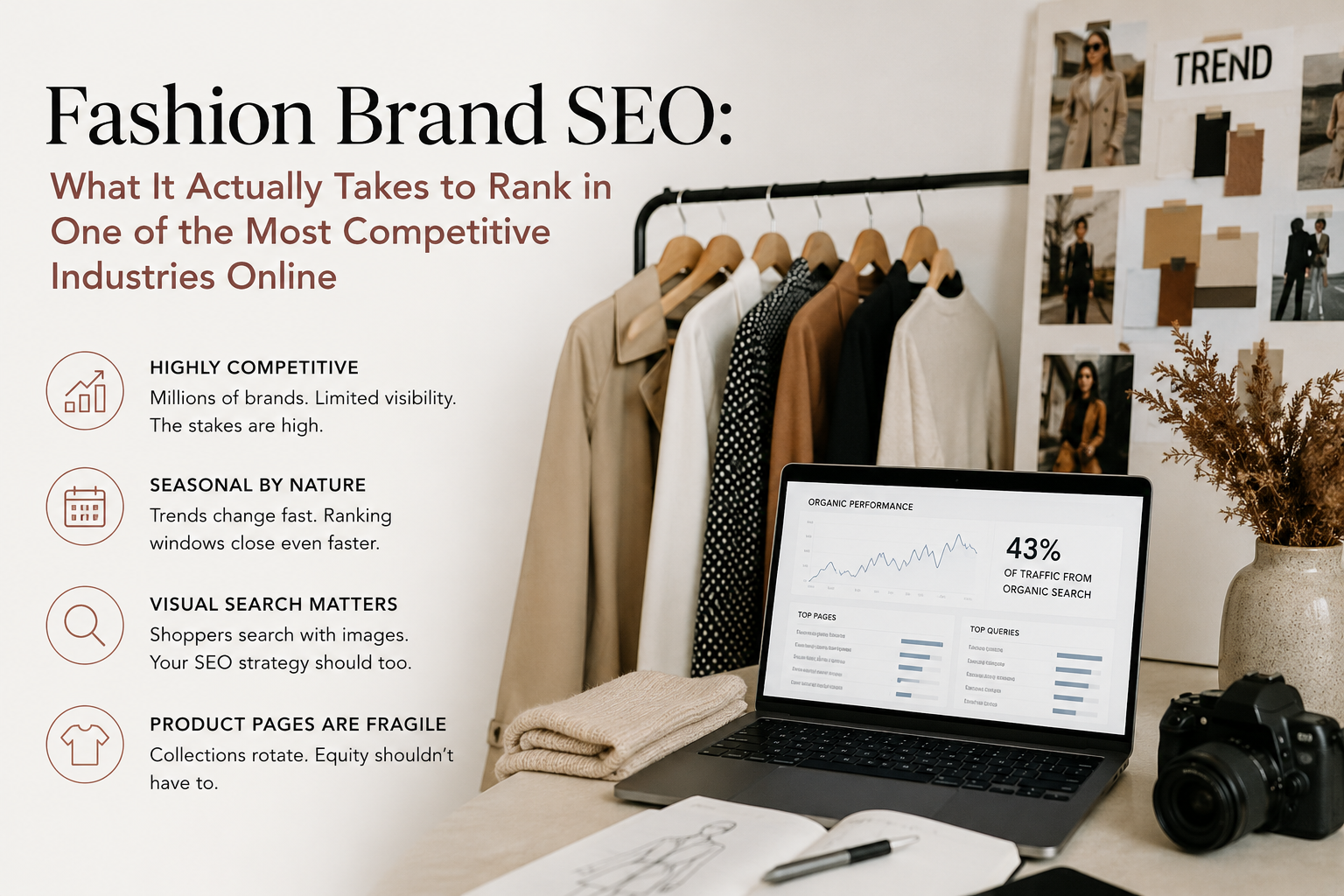
Fashion is one of the most competitive verticals in all of ecommerce. You're not just competing with other brands in your niche — you're competing with Zara, ASOS, H&M, and thousands of independent labels, all targeting the same search terms, the same buyers, and the same Google real estate. Generic SEO advice written for insurance companies or B2B software isn't going to cut it here.
Organic search accounts for 43% of all traffic to fashion websites — making SEO the single most scalable customer acquisition channel available to apparel and lifestyle brands. That's a massive percentage of your potential customer base arriving through search — and a massive opportunity being left on the table by fashion brands whose SEO programs are underbuilt, misaligned with how fashion buyers actually search, or managed by agencies that don't understand the industry. Marketing LTB
This post breaks down what SEO for fashion brands actually requires, why fashion has challenges that don't exist in other categories, what a capable fashion SEO program looks like, and how to find and evaluate the right agency partner to run it.
Why Fashion SEO Is Different From Every Other Industry
Fashion has a set of SEO challenges that are genuinely unique to the category. Understanding them is the starting point for understanding why generalist agencies often underdeliver for fashion clients.
Seasonality Is a Ranking Deadline, Not a Calendar Note
Seasonality hits fashion harder than almost any other category. Your summer collection pages need to rank by April. Your winter pages need momentum by September. If your SEO strategy does not account for these cycles, you are always showing up late. Fashion brands lose 40% of potential organic revenue simply because their seasonal content was not indexed in time. Ecomseo
This is the most consequential fashion-specific SEO problem and the one that generalist agencies most consistently miss. SEO takes time — content published in January doesn't rank instantly. A fashion brand that starts optimizing for "spring dresses 2026" in March is already behind. The calendar has to run backward from search demand peaks, with content and category pages built, indexed, and authority-building months before the buying season starts.
Product Lifecycles Create a Constant SEO Destruction Problem
A consumer electronics store might sell the same laptop for 18 months. A fashion store might retire a product after one season. That means your SEO value is constantly being created and destroyed as collections rotate. Ecomseo
Every time a product is discontinued and its page is deleted, any ranking authority that page had built disappears. Done wrong, seasonal collection rotation destroys months of SEO investment every year. Done right — with proper redirect strategies, evergreen URL structures, and category page architecture that persists across seasons — that authority compounds instead of evaporating.
Visual Products Create Unique Optimization Requirements
Fashion is a visual category by nature. Buyers search with visual intent. They discover products through Google Images, Pinterest, and increasingly Google Lens. We have clients where 15% to 25% of their organic traffic comes from image search results. That's a significant traffic channel that most general SEO programs never fully develop — and it requires specific optimization: descriptive filenames, precise alt text with color and material information, high-quality photography that reduces bounce rates, and schema markup that makes product images eligible for rich results. Ecomseo
Duplicate Content at Scale Is the Technical Nightmare of Fashion Ecommerce
Fashion stores typically have thousands of SKUs with variations in size, color, and fit. Without deliberate technical architecture, this creates massive duplicate content problems — Google sees nearly identical pages for "black midi dress" in small, medium, large, and XL and doesn't know which to rank. Handling size and color variants correctly, through canonical tags, proper faceted navigation, and parameter handling, is a technical requirement that fashion ecommerce demands and that many agencies get wrong.
The Keyword Landscape Requires Both Trend Fluency and Search Data
Fashion buyers search differently from buyers in most other categories. They search for occasions, fits, body types, aesthetics, and trends alongside product types. Size and fit keywords are underserved in fashion SEO. Searches like "best jeans for pear body shape" or "oversized blazer size guide" have decent volume and very high purchase intent. These are perfect targets for blog content and buying guides that link directly to relevant products. Ecomseo
A fashion SEO strategy that only targets obvious product keywords misses the entire exploratory and editorial layer of how fashion buyers search — and that layer often converts better than direct product searches because the buyer arrives with a specific need already in mind.
What a Fashion SEO Program Actually Looks Like
With those challenges understood, here's what the services inside a proper fashion SEO engagement cover.
Technical SEO for Fashion Ecommerce
Technical SEO for fashion brands has the same foundations as technical SEO for any ecommerce site — crawlability, indexation, site speed, Core Web Vitals, mobile performance — but adds fashion-specific complexity in a few critical areas.
Category page architecture is the highest-leverage technical investment for most fashion ecommerce sites. Category pages are among the most powerful revenue drivers in fashion ecommerce. Shoppers frequently search for product types, styles, and seasonal collections rather than individual items. Effective category SEO involves keyword mapping based on style variations, occasion-based searches, and trend-led demand signals. Clear filtering options, indexable subcategories, and enriched content blocks improve both rankings and user experience. When implemented correctly, category architecture becomes a scalable traffic acquisition system that continuously captures demand across multiple product categories. Searchflex
Product schema markup is another fashion-specific priority. Implementing structured data that makes product pages eligible for rich results — showing price, availability, rating, and imagery directly in search results — significantly improves click-through rates for product searches.
Handling out-of-stock and discontinued products correctly is the technical challenge that most fashion sites handle poorly. Deleting product pages that have accumulated backlinks and ranking authority is one of the most damaging things a fashion brand can do to its own SEO. The right approach — redirecting discontinued products to relevant category pages, keeping evergreen collection URLs permanent, and updating seasonal content rather than rebuilding it — preserves the equity you've earned season after season.
Keyword Research for Fashion: Beyond the Obvious
Fashion keyword research requires layers that don't exist in simpler categories. Keyword strategy for fashion should focus on both high-intent purchase terms and trend-driven keywords such as "fall 2026 fashion trends," "plus-size dresses," or "sustainable outerwear." XsOne Consultants
The full keyword landscape for a fashion brand includes: direct product searches (highest intent, most competitive), style and occasion-based searches (buyers looking for outfit solutions, often with high purchase intent), trend searches (seasonal and cultural trend terms that drive discovery), body type and fit searches (underserved by most competitors and high-converting), sustainability and material searches (growing rapidly in volume and purchase intent), and brand comparison and alternative searches (buyers in decision-making mode).
A keyword strategy that only addresses the first category is leaving the majority of fashion search demand untouched. The brands ranking broadly across all six layers are the ones compounding organic traffic and revenue year over year.
Content Strategy for Fashion: Editorial Authority That Converts
Fashion search behaviour is heavily influenced by emerging trends and seasonal styling needs. Informational content targeting queries around outfit ideas, trend forecasts, and occasion-based styling can drive qualified traffic earlier in the funnel. Performance-driven brands align editorial calendars with merchandising plans and paid media campaigns. This ensures that content investment supports revenue outcomes rather than vanity traffic metrics. Searchflex
Fashion content strategy operates on two tracks simultaneously. The editorial track builds topical authority and captures discovery-phase buyers — trend coverage, style guides, occasion-based outfit recommendations, fit and fabric guides, and buying guides that answer the questions fashion buyers actually have. The commercial track captures buyers closer to purchase — category pages, product pages with rich descriptions, comparison content, and size guides that reduce purchase friction.
Style guides and FAQs are two of the most underutilized tools in fashion ecommerce SEO. They don't just help users — they add high-value keyword content and structure to your site. A brand that publishes a comprehensive guide to choosing the right fit for different body types, linking internally to relevant products and categories, builds both search authority and purchase confidence simultaneously. Outreach Monks
Link Building for Fashion: Where Editorial Meets PR
Fashion is one of the categories where link building and PR overlap most naturally. The most effective link acquisition for fashion brands isn't cold outreach to random websites — it's building content and brand narratives that fashion publications, editors, bloggers, and stylists genuinely want to reference.
Trend-based articles like "Top Sustainable Fashion Trends in 2026" or content around celebrity-inspired looks often get picked up by editorial-style websites. Brand story features and "Behind the Scenes" posts help build trust and human connection. Data or opinion pieces around fashion behavior, sustainability, or shopping trends can earn backlinks from press or industry publications. Outreach Monks
Reclaiming unlinked brand mentions is a high-ROI link building tactic for fashion brands. Identifying instances where fashion brands are cited without proper backlinks allows targeted outreach to publishers, editors, or bloggers who can insert contextual links. Tracking mentions across industry blogs, fashion forums, and media articles ensures no opportunity is overlooked. LinkGraph
Influencer collaboration is also a fashion-specific link building opportunity that doesn't exist in most other categories. Partnerships with fashion creators who publish editorial content — not just social posts — can generate high-authority links from fashion-relevant domains that carry strong topical authority signals.
Image SEO: The Traffic Channel Fashion Brands Underinvest In
Images drive fashion purchases more than in almost any other ecommerce vertical. Google Images is a genuine traffic channel for fashion brands. Every product image needs a descriptive filename and an alt attribute that describes the product accurately. Include the color, material, and product type in the alt text. This helps with both accessibility and image search rankings. Image quality matters for SEO indirectly — Google measures user engagement signals, and blurry or poorly lit product photos increase bounce rates. Fashion shoppers expect to see how clothes look on real bodies, not just flat-lay images on white backgrounds. Ecomseo
Visual search through Google Lens is an emerging and fast-growing discovery channel for fashion specifically. Buyers who see an outfit they like — on social media, on a friend, on the street — can photograph it and search for similar items. Fashion brands whose product imagery is properly structured and indexed are capturing this demand. Most aren't.
AI Search Visibility for Fashion
AI search tools are increasingly influential in how fashion buyers discover brands and products. When someone asks ChatGPT "what are the best sustainable denim brands" or asks Perplexity for outfit recommendations for a specific occasion, the brands appearing in those answers are shaping buyer consideration before any traditional search happens.
The same principles that drive traditional fashion SEO authority — topical depth, structured content, third-party citations from fashion publications, and genuine expertise demonstrated through editorial content — are the signals that determine AI citation visibility. Fashion brands investing in editorial authority aren't just winning traditional search rankings. They're building the ecosystem trust signals that determine whether AI systems recommend them when buyers ask fashion questions conversationally.
In 2026, strong fashion SEO means combining technical performance with "search everywhere" reach. While many firms chase traffic, the best approach prioritizes conversion-led growth. Embarque
What to Look for in a Fashion SEO Agency
Understanding what fashion SEO requires is one thing. Finding the right agency to run it is another. Here's what separates capable fashion SEO partners from generalist agencies that will apply a standard ecommerce template to a category that doesn't fit one.
They understand fashion seasonality at a strategic level. Ask any agency you evaluate: how do you handle seasonal keyword strategy and collection page management? The answer should involve publishing schedules built months before buying season peaks, evergreen URL structures for recurring categories, and a clear strategy for handling discontinued products that doesn't destroy accumulated authority. If the answer is vague or generic, walk away.
They can speak specifically about fashion category and product page architecture. Category pages are the highest-revenue SEO asset for most fashion brands. An agency that can't discuss keyword mapping for style and occasion subcategories, faceted navigation handling, and internal linking from editorial to commercial pages isn't ready for fashion ecommerce complexity.
They treat image SEO as a real traffic channel. If image optimization is an afterthought in their proposal — a line item that mentions alt text and nothing else — they're missing a channel that can drive 15–25% of organic traffic for fashion brands. A capable agency has a documented approach to image SEO, visual search, and Google Lens optimization.
They connect content to revenue, not vanity metrics. Fashion brands can generate enormous amounts of organic traffic from broad editorial content that never converts to purchases. The right agency builds content strategy that serves both discovery and conversion — aligning editorial calendars with merchandising plans and ensuring that traffic-driving content links to revenue-generating pages.
They have a point of view on AI search visibility for fashion. As AI search tools become more embedded in how buyers discover brands and products, fashion brands need to be building the kind of editorial authority and ecosystem trust that gets them cited in AI-generated answers. Any agency without a perspective on this is optimizing for a search landscape that's already partially in the past.
They show you results in your category, not just general ecommerce. Generalist agencies often miss the seasonality of fashion. A specialized fashion SEO agency knows a "summer dress" strategy must be indexed by March and optimizes for visual search like Google Lens and Pinterest. Ask specifically for fashion or apparel case studies — not just ecommerce results from unrelated categories. The challenges are genuinely different, and pattern recognition from fashion-specific work is valuable in ways that general ecommerce experience isn't. Embarque
Frequently Asked Questions
How long does fashion SEO take to show results?
Fashion brands typically begin seeing SEO improvements within three to six months, with stronger organic growth occurring around six to twelve months, depending on competition and execution. For seasonal campaigns specifically, the timeline pressure is more acute — content and category pages targeting seasonal demand need to be built and indexed two to three months before peak buying season to have any ranking momentum when it matters most. Technical fixes and on-page improvements on existing pages with some authority can show movement faster, often within sixty to ninety days. XsOne Consultants
Should I hire a fashion-specific SEO agency or a general ecommerce SEO agency?
Fashion-specific is strongly preferable if you can find an agency with genuine track record in the category. The seasonal complexity, visual search requirements, product lifecycle management, and the specific way fashion buyers search are material differences from general ecommerce that require category-specific expertise. That said, a strong general ecommerce agency that has done significant fashion work is better than a fashion-specific agency without the technical depth to execute properly. Evaluate on demonstrated fashion results, not just stated specialization.
How do I handle SEO when my products go out of stock or collections end?
This is one of the most important technical decisions in fashion SEO and one of the most commonly gotten wrong. The biggest SEO mistake fashion brands make is deleting or hiding pages when a collection ends. A page for "summer dresses 2024" that earned backlinks and rankings has real value. Deleting it throws that value away. For evergreen categories, keep the URL permanent and update the content and products each season. The URL /collections/summer-dresses should always exist. For truly discontinued products with no equivalent replacement, redirect to the most relevant category page to preserve link equity rather than returning a 404 error. Ecomseo
What keywords should a fashion brand prioritize?
The most valuable keywords aren't always the most obvious ones. High-volume product category terms are extremely competitive and dominated by large retailers with massive domain authority. The highest-ROI keyword targets for most fashion brands are: occasion and style-based searches with clear purchase intent, fit and body type keywords that are underserved by competitors, sustainability and material-specific searches growing in volume and intent, and long-tail product searches with specific descriptors that attract buyers close to a decision. These terms often have lower search volume but significantly higher conversion rates and more realistic competitive difficulty for independent and mid-market brands.
How important is social media for fashion SEO?
Social media doesn't directly improve search rankings through algorithmic signals — but the relationship is more significant than that framing suggests. Fashion spreads faster on visual platforms than almost any other category. When buyers discover a brand on Instagram, TikTok, or Pinterest, many subsequently search for that brand on Google — and branded search volume is a positive authority signal. Influencer coverage on social platforms also often generates editorial content with links. The brands with the strongest fashion SEO programs typically have strong social presences not because they believe social media boosts rankings directly, but because the two channels feed each other in ways that compound over time.
What does fashion SEO cost?
Fashion SEO retainers for professional agencies typically start at $2,000–$3,000 per month for foundational programs covering technical SEO and on-page optimization. Full-service programs including content production, link building, image SEO, and AI search visibility run $4,000–$10,000 per month depending on the size of the site, the number of SKUs, and the competitive landscape. Enterprise fashion brands with large product catalogs and national or international competitive ambitions often invest $10,000–$25,000 per month or more. Be skeptical of fashion SEO packages priced below $1,000 per month — at that level the work is insufficient for any competitive fashion market.
Ready to Build Search Visibility That Compounds for Your Fashion Brand?
Fashion SEO done right compounds over time — category authority built this season feeds rankings next season. Editorial content published this quarter earns links and AI citations for years. The brands investing in proper fashion SEO now are building compounding advantages that will be increasingly expensive for competitors to close.
Ritner Digital builds search visibility programs for brands that need to be found where buyers are actually looking — including the AI search tools that are increasingly shaping how buyers discover fashion brands before they ever type a query into Google.
If you want to understand where your fashion brand's search presence stands and what a program built for your specific situation looks like, let's start with a conversation.
Work With Us → ritnerdigital.com/#contact
Sources: Marketing LTB Best Fashion SEO Agencies 2026, Searchflex Fashion Ecommerce SEO Strategies, EcomSEO Fashion Ecommerce SEO Guide, Outreach Monks SEO for Fashion Ecommerce, Embarque Top Fashion SEO Agencies 2026, LinkGraph SEO for Fashion Brands, Power Digital SEO for Fashion Ecommerce.