Which Countries Are Farthest Behind on SEO and AI Search — and What That Gap Actually Means
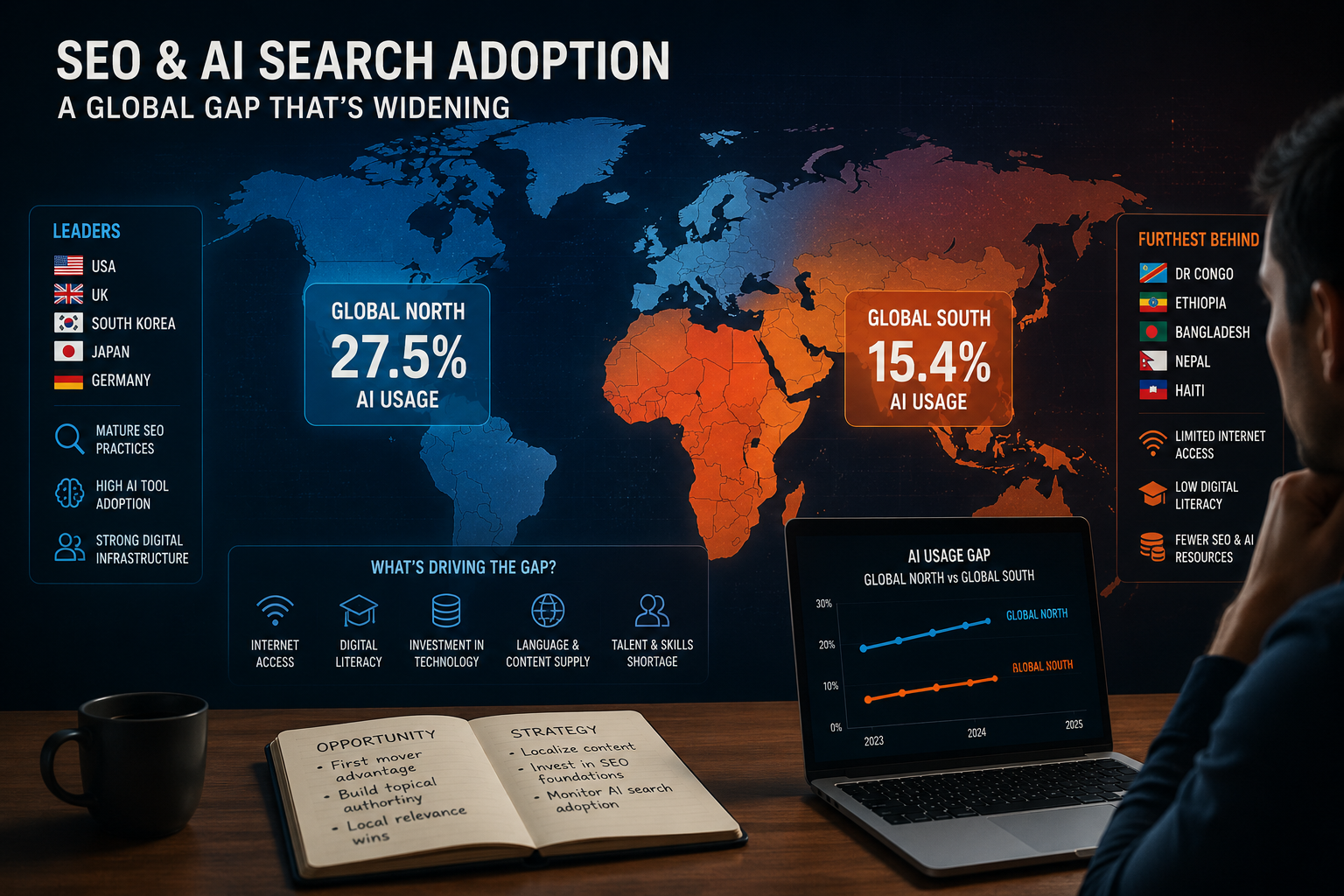
The global conversation about SEO and AI search visibility is dominated by voices from the United States, the United Kingdom, Western Europe, and a handful of advanced Asian markets. That's not an accident — these are the markets where search engine optimization is most mature, AI search tools are most embedded in daily behavior, and the competitive stakes for online visibility are highest.
But zoom out to a global view and the picture changes dramatically. The gap between where search and AI search are in leading markets and where they are in the rest of the world is one of the most consequential and least-discussed stories in digital marketing right now. For global brands, international marketers, and businesses expanding into new geographies, understanding this gap — and what drives it — is increasingly essential strategic context.
This post looks at which countries and regions are furthest behind on both traditional SEO adoption and AI search visibility, what's causing those gaps, and what it means for businesses operating across borders.
The Global SEO Landscape: Who's Ahead, Who's Behind
The global SEO services market crossed $100 billion in 2026 for the first time — but that investment is distributed with extraordinary unevenness. North America is the largest regional market, with the United States dominating the landscape. By 2025, the U.S. holds a significant 26.77% of the global SEO market. Canada follows at 5.41%, while Mexico, a rapidly growing market, represents 1.61%. Cognitive Market Research
The math is stark: the United States alone represents more than a quarter of the entire global SEO market. That means the remaining three-quarters of global SEO spend is distributed across every other country on earth — with enormous concentration in Western Europe, Australia, and a handful of advanced Asian economies.
North America held 33.90% of global SEO services revenue in 2025, with the United States as the dominant market. India is the standout in growth — its SEO software market is forecast to reach $8.1 billion by 2030 at an 18.2% CAGR, the highest growth rate of any single country. Companies History
The regions with the lowest SEO market development — sub-Saharan Africa, Central Asia, much of Southeast Asia outside Singapore and Vietnam, most of Latin America outside Brazil and Mexico, and large parts of the Middle East — share common characteristics: lower internet penetration rates, smaller pools of digital marketing professionals with formal SEO training, less competitive domestic digital ecosystems, and markets where paid advertising has historically been the dominant online channel when any digital marketing is invested at all.
The AI Search Gap: Wider Than the SEO Gap
If the global SEO adoption gap is significant, the AI search gap is wider still — and it's growing faster.
AI usage now stands at 27.5% in the Global North and 15.4% in the Global South, with the gap between regions continuing to widen. That 12-point gap in general AI tool usage translates directly into a visibility gap for businesses trying to reach consumers through AI-powered search — because AI search tools are far more embedded in daily behavior in high-adoption countries than in low-adoption ones. Microsoft Blogs
Microsoft's January 2026 AI Diffusion Report, which tracked generative AI usage across 147 countries, found that 16.3% of the global working-age population now uses AI tools. The Global North added adoption nearly twice as fast as the Global South in that period. The wealthiest countries are not just ahead — they are pulling further ahead. All About AI
The countries leading AI adoption — Singapore at 66%, Chile at 60%, the UAE at 56%, and the Baltic nations of Latvia, Lithuania, and Estonia all in the top ten globally — are also the markets where AI search tools are most embedded in how consumers research and make decisions. Cybernews
At the other end: AI adoption varies widely, from 66% in Singapore to just 7% in Venezuela, Poland, and Nigeria. In markets at the bottom of that range, AI search is effectively not yet a meaningful consumer behavior — which means the entire AI search optimization discipline is almost irrelevant to businesses operating exclusively in those markets today. The keyword is today. Cybernews
Which Regions Are Furthest Behind — and Why
Sub-Saharan Africa
Sub-Saharan Africa represents one of the largest SEO and AI search gaps of any major global region. The barriers are structural: lower internet penetration rates, significant mobile-first internet adoption that creates different search behavior than desktop-centric markets, and a professional digital marketing ecosystem that is developing rapidly but from a lower starting base.
That said, the picture is more nuanced than simple underdevelopment. In Africa, DeepSeek usage is estimated to be two to four times higher than in other regions, aided by strategic promotion and partnerships with firms such as Huawei. DeepSeek's free, open-source model eliminated cost barriers associated with Western AI platforms, making it accessible in markets often excluded from the first wave of AI adoption. Microsoft
Africa's AI search gap isn't primarily about awareness or interest — it's about access and infrastructure. Where affordable AI tools have reached African markets, adoption has been rapid. The SEO gap is more persistent because it requires professional expertise, technical infrastructure, and competitive commercial ecosystems that are still building in many African markets. South Africa is the continent's most advanced market on both dimensions, but even there the gap with leading global markets is substantial.
Latin America
Latin America's SEO and AI search landscape is more developed than sub-Saharan Africa but significantly behind North America and Western Europe — with wide variation between countries.
Brazil and Mexico have mature digital marketing ecosystems with competitive SEO practices, agencies with genuine international-level capability, and growing AI search adoption. Outside these two anchors, the picture changes considerably. Argentina, Colombia, and Chile are developing markets with growing digital sophistication. Venezuela sits at the bottom of global AI adoption rankings at 7%. Most of Central America and the smaller South American economies have limited formal SEO investment and minimal AI search penetration.
Chile is the standout exception, ranking second globally in AI adoption at 60% — the only Latin American country in the top tier — and first in Latin America for AI readiness according to the Latin American Artificial Intelligence Index. Chile stands out for its balanced performance across infrastructure, data, human talent, research, and governance. Cybernews
The broader Latin American SEO gap is driven by language dynamics as well as development levels. Spanish-language SEO has historically received less sophisticated tooling, data, and research than English-language SEO — though this gap has narrowed meaningfully in recent years as major SEO platforms have invested in Spanish-language capabilities.
Southeast Asia (Outside Singapore and Vietnam)
Southeast Asia is a region of dramatic contrasts on this dimension. Singapore leads the world in AI adoption at 66% and has one of the most sophisticated digital marketing ecosystems on the planet. Vietnam has developed a strong SEO professional community with internationally competitive agency capability. Thailand is showing accelerating AI adoption.
But much of the rest of the region — Cambodia, Myanmar, Laos, and parts of Indonesia and the Philippines outside major urban centers — has limited formal SEO infrastructure and minimal AI search penetration. Indonesia's State of SEO 2026 report shows the lowest GEO adoption of any market studied, though government and NGO websites are frequently cited by AI systems due to their authoritative source status — creating natural AI presence without deliberate optimization. Arfadia
The Indonesia finding is an interesting paradox: a market behind on deliberate AI search optimization but where certain institutional players show up in AI answers anyway — simply by virtue of being authoritative sources in a market with fewer competing citations. This pattern is likely repeated across other developing markets and represents a genuine early-mover opportunity for businesses willing to invest in AI search visibility before their competitors in those markets do.
Central and South Asia (Outside India)
India deserves its own category: it is simultaneously a market with significant SEO sophistication — with a massive professional digital marketing community and the fastest-growing SEO software market in the world — and a market where the gap between leading practitioners and the broader SME ecosystem is enormous. Most Indian small businesses have minimal SEO investment. Enterprise and tech companies are often internationally competitive.
Outside India, Central and South Asian markets — Pakistan, Bangladesh, Nepal, Sri Lanka, and the Central Asian republics — have limited formal SEO infrastructure and are early-stage on AI search adoption. Pakistan has a growing community of SEO professionals serving international clients, but domestic market investment in SEO remains limited. Bangladesh and Nepal are even earlier in development.
Eastern Europe
Eastern Europe presents an interesting case that often gets overlooked in these discussions. Poland sits at just 7% AI adoption — alongside Venezuela and Nigeria at the very bottom of the global rankings — a surprising figure for an EU member state with strong technology education traditions. This suggests that AI adoption in Eastern Europe is lagging behind SEO adoption, creating a different kind of gap: markets where traditional SEO is reasonably developed but where the transition to AI search optimization is slower than the regional economic development level might suggest. Cybernews
The Baltic states are the notable exception — Latvia, Lithuania, and Estonia are all in the global top ten for AI adoption, driven by deliberate national AI strategy and strong digital infrastructure investment.
The MENA Region Outside the Gulf States
The Middle East and North Africa region is defined by stark contrasts. The Gulf states — UAE, Saudi Arabia, Qatar — are among the world's leaders in AI adoption and increasingly sophisticated in digital marketing. The UAE's AI adoption rate has risen from 10% in 2023 to 56% in 2025, driven by one of the world's most deliberate national AI investment programs. In October 2017, the UAE appointed the world's first Minister of State for Artificial Intelligence, establishing governance frameworks while many governments were still debating whether AI warranted dedicated policy attention at all. Microsoft
North Africa and the Levant tell a different story. Egypt, Morocco, Tunisia, Jordan, and Lebanon have developing digital marketing ecosystems with limited AI search penetration outside major urban centers and technology-forward businesses. Iraq, Libya, and Yemen have minimal formal digital marketing infrastructure at all.
The Language Problem: Why AI Search Gaps Are Structural, Not Just Economic
One of the most underappreciated drivers of the AI search gap between countries isn't economic development — it's language. The Microsoft data points to something less discussed: language. The models driving global adoption worked best in English. For speakers of lower-resourced languages, the tools were available but limited in practice. All About AI
AI search tools — ChatGPT, Perplexity, Google AI Overviews, Gemini — were built and trained primarily on English-language content. Their ability to understand queries, retrieve relevant sources, and generate accurate answers in other languages improves every year, but remains meaningfully weaker for lower-resourced languages than for English.
This creates a compounding disadvantage for markets where those languages dominate. Not only are users in those markets less likely to be using AI search tools — the tools themselves are less useful when they do, which suppresses adoption further. This is a structural gap that will narrow over time as AI multilingual capability improves, but it won't close quickly. Notable developments in Q1 2026 included accelerating AI adoption in Asia driven in part by improving AI capabilities in Asian languages — South Korea, Thailand, and Japan saw the greatest movement as a result. Microsoft Blogs
The implication for global brands: visibility in AI search in non-English markets requires not just translation of content strategy but genuine investment in the local-language content ecosystems that AI systems in those markets draw from. A brand that ranks well in English-language AI answers has done essentially nothing to build AI search visibility in Arabic, Swahili, Vietnamese, or Bengali.
What the Gap Means for Global Brands
For businesses operating across borders, the global SEO and AI search gap creates both risks and opportunities worth understanding clearly.
The opportunity in underdeveloped markets is genuine — but time-limited. In markets where AI search adoption is low today, the competitive landscape for AI citation visibility is nearly empty. A brand that invests in building authoritative, well-structured content and ecosystem trust signals in those markets now will be establishing visibility before competitors recognize the opportunity. Businesses with formal GEO strategies receive 3.4 times more AI citations than those relying on traditional SEO alone — and the gap is compounding with every month. That multiplier applies in developing markets too — with the added advantage of lower competition. Arfadia
Assuming your English-language SEO transfers globally is a costly mistake. Brands that rank well for English queries in AI search have not thereby built AI search visibility in other language markets. The content ecosystems, citation sources, and trust signals that AI systems use in each language market are distinct. Building visibility in Spanish, French, Arabic, or Indonesian AI search requires dedicated local-language investment — not translation of English-language assets.
Mobile-first markets require different technical approaches. Many of the markets furthest behind on traditional SEO are mobile-first by necessity — consumers access the internet primarily through smartphones on relatively slow connections. Technical SEO for these markets requires optimization priorities that differ from desktop-first markets: page speed on slower connections, lightweight content formats, and mobile UX that works on lower-specification devices.
The AI search rollout itself is uneven across markets. Google AI Overviews haven't launched uniformly globally. Google began rolling out AI Overviews in European countries in March 2025, including Germany, Switzerland, Austria, Italy, and Spain — making it essential for companies in those regions to adapt their content strategy to generative search systems. In markets where AI Overviews haven't launched, the AI search optimization imperative is genuinely less urgent today — though preparation now is still valuable. Evergreen
The Surprising Countries That Defy Expectations
The global SEO and AI search map has some counterintuitive data points worth noting.
Japan — a country synonymous with technological advancement — ranks just 57th globally in AI adoption at 17%, a surprisingly low figure for one of the world's most technology-sophisticated nations. Japan's low AI adoption is partly cultural (preference for human interaction over automated tools) and partly structural (strong existing digital infrastructure that meets needs without AI augmentation), not a sign of underdevelopment. Cybernews
The United States ranks only 28th globally in AI adoption at 41% population penetration, despite housing most major AI companies and having the most advanced AI infrastructure in the world. This reflects the paradox of a market that produces AI at the frontier but where broader population adoption lags markets that have more deliberately invested in national adoption programs. Cybernews
Poland sits at 7% AI adoption despite being an EU member with strong technology education — suggesting that EU membership and economic development don't automatically translate to AI search behavior, and that cultural and institutional factors shape adoption independently of economic development level.
Frequently Asked Questions
Does lower AI adoption in a country mean I should ignore AI search for that market?
Not necessarily — and increasingly, no. Even in markets with lower AI search adoption today, the trajectory is upward everywhere. Businesses that build AI search visibility now in developing markets are establishing positions before competition emerges. The cost and effort of building that visibility early is significantly lower than doing so once competition develops. Think of it as the equivalent of SEO in 2010 — the brands that invested early in markets where organic search was still developing captured dominant positions that proved very difficult for later entrants to displace.
Why is Japan so far behind in AI adoption despite being technologically advanced?
Japan's case illustrates an important point: technological sophistication and AI tool adoption are not the same thing. Japan has world-class digital infrastructure and technology expertise. Its AI adoption lag is partly cultural — Japanese consumers and businesses have historically shown preference for human service interaction — and partly structural, in that existing tools and systems meet needs without requiring AI augmentation. This is changing as AI capabilities improve and as Japanese-language AI quality improves specifically, which drove meaningful adoption movement in early 2026.
Which developing markets represent the biggest SEO and AI search opportunity?
India stands out as the most significant opportunity by scale — the world's fastest-growing SEO market by CAGR, with a massive and growing internet user base, improving AI tool capabilities in Indian languages, and competitive digital marketing ecosystems in major cities. Indonesia is a large, mobile-first market with rapidly improving digital infrastructure and currently very low AI search competition. Brazil is already a sophisticated SEO market but has significant headroom in AI search optimization specifically. The Gulf states — particularly UAE and Saudi Arabia — are high-development markets with rapidly growing AI adoption and strong commercial digital ecosystems.
How should a global brand approach markets at different stages of SEO development?
The approach should be explicitly tiered. In highly developed markets like the US, UK, and Singapore, the full competitive SEO and AI search optimization program is necessary just to maintain visibility. In mid-development markets like Brazil, India, and South Korea, traditional SEO foundations are essential and AI search investment is increasingly important. In early-development markets, the priority is establishing a strong technical foundation, building local-language content, and earning the kind of third-party citations that will matter both for traditional SEO and for AI search as adoption grows. Trying to apply the same program across all market tiers is both inefficient and ineffective.
Is the AI search gap in developing markets permanent or will it close?
It will close — but more slowly than optimists typically project and unevenly across markets. The main closing mechanism is improving multilingual AI capability, which is accelerating. As AI tools work meaningfully better in Arabic, Swahili, Hindi, Bahasa Indonesia, and other lower-resourced languages, both consumer adoption and commercial investment in AI search optimization will follow. The gap will likely narrow substantially over the next three to five years, but the leading markets will continue to advance simultaneously, meaning absolute gaps may narrow while relative gaps persist for longer.
Building Visibility in Every Market Your Buyers Search In
At Ritner Digital, we build search visibility infrastructure for brands that need to be found across multiple markets and search environments — from the mature US and UK markets where AI search competition is already intense, to developing markets where the opportunity to establish AI citation visibility is still wide open.
If you're expanding internationally or trying to understand where your brand stands in AI search across different markets, let's start with a conversation.
Work With Us → ritnerdigital.com/#contact
Sources: Microsoft Global AI Diffusion Report 2025 H2, Microsoft State of Global AI Diffusion 2026, Cybernews AI Adoption Index 2025, Arfadia State of SEO Indonesia 2026, Cognitive Market Research Global SEO Market Report, The Business Research Company SEO Services Market Report 2026, Companies History SEO Market Statistics 2026, AICPA/CIMA Global AI Adoption Survey 2026, Evergreen Media SEO Trends 2026.