How to Get Your Bank or Credit Union Recommended by ChatGPT and Gemini
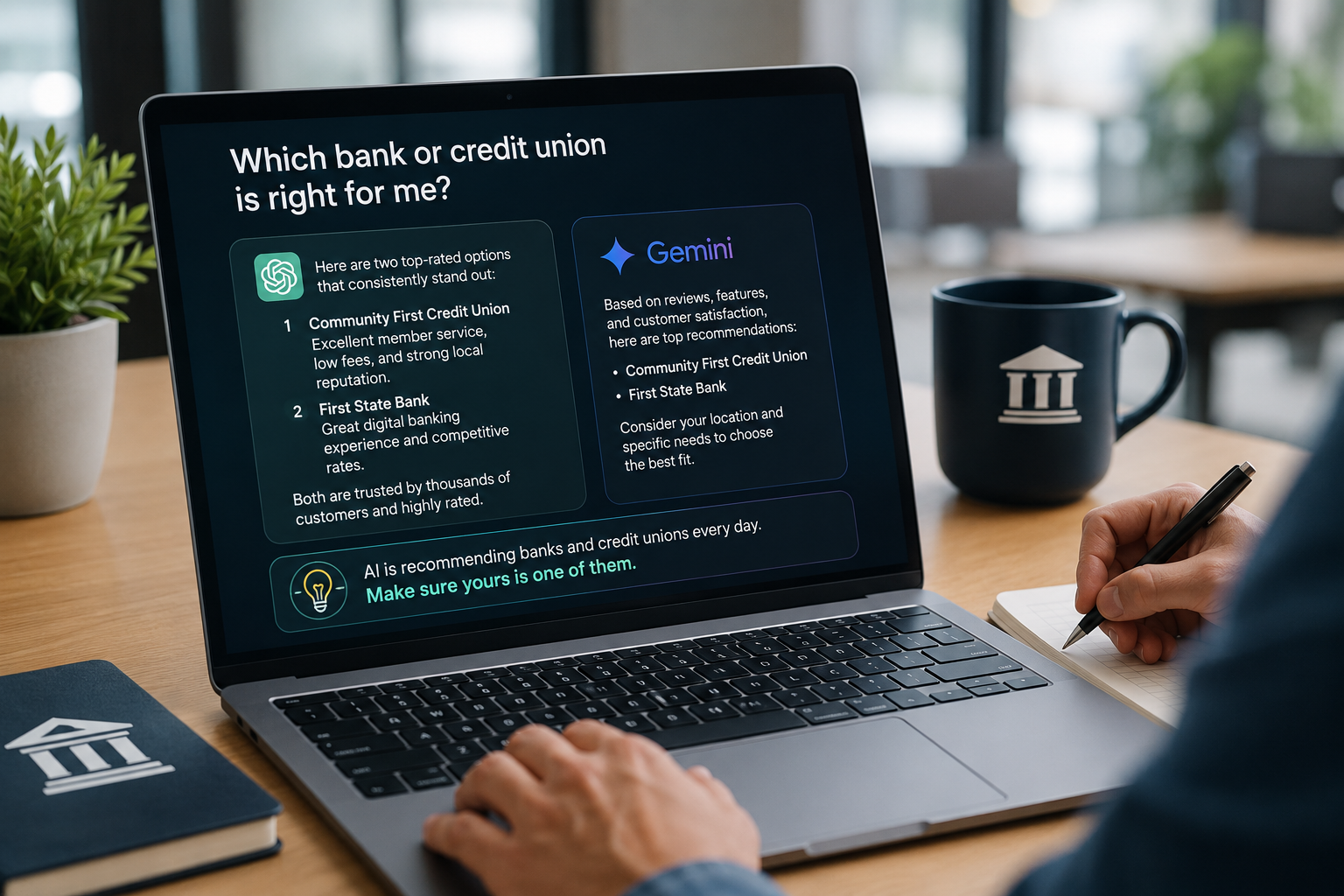
There's a question your future members are typing into ChatGPT right now.
"What's the best credit union for auto loans near me?"
Or: "Which community banks offer the best rates on home equity lines of credit?"
Or simply: "Should I use a credit union or a bank?"
A year ago, those questions went to Google and returned ten blue links. Today, they go to an AI assistant — and the AI returns one narrative answer, naming two or three institutions by name, explaining why they're recommended, and sending the searcher directly toward a decision.
If your institution isn't named in that answer, you didn't lose a ranking. You lost a lead you never knew you had.
This guide explains exactly how AI search works for financial institutions, why it's a fundamentally different challenge than traditional SEO, and the precise steps your bank or credit union can take to start appearing — and being recommended — in ChatGPT, Google Gemini, Perplexity, and the AI search tools your members are already using every day.
The Shift You Can't Afford to Ignore
The numbers make the stakes clear.
Nearly 60% of consumers surveyed by JD Power in late 2025 said they occasionally use AI for banking and financial services decisions — and 13% do so every day. A global study by Cognizant gave banking and financial products a score of 90 out of 100 for consumer willingness to use AI to learn more about them. The Financial BrandEvotek JSC
ChatGPT has 200 million+ weekly active users, Perplexity processes 100 million+ queries monthly, and Google AI Overviews now appear in more than 30% of all Google searches. Dcrayons
And 51% of consumers now rely on AI for financial advice — a figure that would have seemed impossible just three years ago. OMNIUS
Here's the brutal truth that most bank and credit union marketers haven't absorbed yet: ranking #1 on Google does not mean you appear in AI answers. Ranking #1 on Google does NOT guarantee being recommended in AI. Different signals, different optimization. AI engines prioritize clear answers, structured sections, entity-rich content, comparisons, and lists. Frizerly
You can be the top-ranked institution in your market on traditional search and be completely invisible when a prospective member asks ChatGPT for a recommendation. That gap is what this guide addresses.
Understanding How ChatGPT and Gemini Actually Work
Before you can optimize for AI search, you need to understand how these systems decide what to include in their answers. The mechanics are fundamentally different from Google's traditional ranking algorithm — and confusing the two is the most expensive mistake financial marketers are making right now.
How ChatGPT Works
ChatGPT operates primarily from training data — a massive snapshot of the internet. When it makes recommendations, it draws on patterns in that data: what sources were cited repeatedly, what institutions were mentioned across authoritative websites, what brands were described in expert-driven, credible terms.
For real-time queries, ChatGPT Search pulls from Bing's index before generating its answer. This means your website content, your press coverage, and your mentions on authoritative sites all factor in.
Research shows that nearly 48% of ChatGPT's top citations come from Wikipedia, with Reddit coming in a distant second at just over 11% of citations within ChatGPT's top ten sources. This means your institution's presence on Wikipedia, in industry publications, on Reddit's personal finance forums, and across authoritative financial media matters enormously — often more than your own website. Getpassionfruit
How Google Gemini Works
Gemini uses a "fan out" retrieval process — starting with a broad search across hundreds of sources, then conducting increasingly refined follow-on queries to identify the most reliable and authoritative content before constructing its answer. Search Engine Land
Critically, Gemini applies Google's E-E-A-T criteria — Experience, Expertise, Authoritativeness, and Trustworthiness — to determine which sources to cite. For financial content, this is especially significant because Google classifies banking and financial services under YMYL (Your Money or Your Life), a category held to the highest possible standards for accuracy, trustworthiness, and demonstrated expertise.
Research by BrightEdge found that educational financial queries — "what is an IRA," "how does a HELOC work," "best savings account options" — now trigger Google AI Overviews 91% of the time, nearly identical to healthcare content. This is your biggest opportunity. Educational content is exactly where community banks and credit unions can establish authority and get cited — and it's where most institutions have done the least work. BrightEdge
How Perplexity Works
Perplexity uses real-time web retrieval for every query and cites its sources directly in answers. Unlike ChatGPT's reliance on training data, Perplexity actively crawls the web at the moment of the query. Traditional SEO still matters here, but structured, clearly written content that directly answers specific questions tends to be cited preferentially. Pure Visibility
The Problem Unique to Financial Institutions
Here's a counterintuitive finding that every bank marketer needs to understand — and it may explain why your content isn't getting cited even though it's high quality.
For years, financial institutions have been told to create long, comprehensive content to satisfy Google's stringent YMYL standards, which prioritize accuracy and depth. But that very depth — while satisfying Google — can sometimes hinder citation by AI engines, which often favor clarity, structured answers, and directness. The Financial Brand
AI systems don't read your entire website the way a human researcher does. They scan for what practitioners now call "citable chunks" — self-contained blocks of content that restate a question, deliver a clear answer, and support it with data or a concise explanation.
As Eddie Sifonte, Director of Technology at evōk advertising, an agency specializing in credit union digital visibility, explains: "There's a finite amount of token space that an AI can utilize. AI engines look for clear question-and-answer structures because they are constantly optimizing for efficiency in how they process information." The Financial Brand
The fix isn't to abandon depth. It's to restructure your content so that depth and citability coexist. The strategies below show you exactly how.
Strategy 1: Build "Citable Chunks" Into Every Page
The single most important content change you can make right now is restructuring your pages to contain clearly extractable answers.
A citable chunk has three components:
A question, stated explicitly — ideally as a heading
A direct, concise answer in the first one to two sentences
Supporting context or specific data in the following two to four sentences
Non-citable content (what most bank websites look like):
"At [Credit Union Name], we've been serving members in the greater metro area since 1967, and over the decades we've developed a range of loan products designed to meet the evolving needs of our community..."
Citable chunk (what AI systems can actually extract and cite):
"What types of auto loans does [Credit Union Name] offer? [Credit Union Name] offers new and used auto loans with terms from 24 to 84 months, rates starting at [X]%, and same-day approval for qualified members. Refinancing is also available for members looking to lower their current rate."
The second version answers a real question immediately, contains specific facts, and can be lifted cleanly by an AI system without losing meaning. AI models prioritize information that appears first in content sections. Structure every paragraph to lead with the core answer, then provide supporting details afterward — the inverted pyramid style common in journalism helps AI models confidently extract your main point without having to synthesize multiple sentences. Evertune
Apply this structure to your product pages, FAQ sections, blog posts, and especially your "About" page. AI systems regularly pull from About pages when constructing institutional recommendations.
Strategy 2: Implement Financial Schema Markup
Schema markup is structured code — invisible to visitors but highly readable by AI systems — that tells search engines and large language models exactly what your content represents.
Research shows that content with proper schema markup has a 2.5x higher chance of appearing in AI-generated answers, and sites with complete schema implementation see up to 40% more AI Overview appearances. Stackmatix
For banks and credit unions specifically, the priority schema types are:
Organization Schema — Goes on your homepage. Establishes your institution's identity, location, contact information, founding date, and social profiles as machine-readable facts that AI systems can reference confidently.
FinancialService Schema — Identifies your business category clearly so AI systems don't have to guess what you are or what you offer.
FAQPage Schema — This is critical. FAQ schema improves AI citation rates by 30% on average, and AI systems parse FAQ schema to extract concise answers that match user queries directly. Keep answers between 40 and 60 words for optimal extraction. Stackmatix
LocalBusiness Schema — LocalBusiness schema is critical for financial institutions that want to appear in AI-generated local recommendations. AI platforms pull structured local data to answer queries such as "best credit union near me" and populate local knowledge panels. For multi-location institutions, implement a hierarchical schema structure with an Organization entity at the parent level and individual LocalBusiness entities for each branch location. Stackmatix
MortgageLoan, CreditCard, and InterestRate Schema — Product-specific schema tells AI systems exactly what financial products you offer and at what terms. If a member asks ChatGPT about mortgage options in your city, institutions with MortgageLoan schema on their relevant pages are far more likely to be surfaced.
The good news: a well-structured page enhanced with correctly applied FAQ schema can satisfy both Google's depth preferences and AI's need for clearly labeled, extractable answers simultaneously. You don't have to choose between traditional SEO and AI optimization. You build both at once. Evotek JSC
Strategy 3: Dominate the Sources AI Actually Trusts
Given that ChatGPT pulls nearly half its citations from Wikipedia and AI systems broadly favor mentions across authoritative, third-party sources, your off-site presence matters as much as your on-site content.
Here's where to focus:
Wikipedia — If your institution has the history and community presence to qualify for a Wikipedia page, building and maintaining one is among the highest-ROI investments you can make for AI visibility. AI systems treat Wikipedia as a primary trust signal for institutional legitimacy. A Wikipedia page effectively tells ChatGPT: this institution is real, established, and recognized.
Industry Publications — Getting your institution mentioned in Credit Union Times, CU Insight, The Financial Brand, American Banker, and Bankrate carries enormous weight with AI systems that use these publications as trusted financial sources. Contribute guest articles. Issue press releases for newsworthy milestones. Make your institution's expertise visible in the publications your prospects and AI systems both read.
Local News Coverage — Community banks and credit unions have a natural advantage here. Local newspaper coverage, TV segments, and regional business journal features all build the kind of third-party authority that AI systems interpret as legitimacy.
Google Business Profile — Google My Business optimization provides the fastest way for AI systems to recommend brands based on "near me" searches or automated location-based recommendations. Every branch should have a fully completed, regularly updated Google Business Profile with accurate hours, services listed, and a steady stream of authentic member reviews. Getpassionfruit
Review Platforms — Review schema combined with external review signals builds the trust scores AI uses when making recommendations. Wikipedia has a 5/5 impact, LinkedIn has a 4/5 impact, and actively maintained review profiles on relevant platforms meaningfully boost your AI visibility. Dcrayons
Strategy 4: Create Financial Education Content That AI Wants to Cite
Google uses AI where synthesis adds value — explaining concepts, comparing options, and guiding decisions. Educational queries in finance now hit 91% AI Overview coverage. This is the content category where community banks and credit unions can most realistically compete with — and beat — national institutions. BrightEdge
Large banks have brand recognition. You have community knowledge, member relationships, and the ability to publish locally relevant, expert-driven content faster than any national marketing team can.
The content AI systems most reliably cite for financial queries includes:
"What is" explainers — What is a HELOC? What is a share certificate? What's the difference between a checking and savings account? These foundational questions drive enormous search volume and near-universal AI Overview coverage. Your institution should have authoritative, clearly structured answers to every question a prospective member might ask about the products you offer.
Comparison content — Credit union vs. bank: what's the difference? Fixed vs. variable rate mortgage: which is right for you? These comparison pieces are exactly the format AI systems use to generate balanced, citation-worthy answers.
Rate and product explainers — Mortgage rate and HELOC rate queries now trigger AI Overviews 67% of the time, up from 26% in 2024. If your institution has content that clearly explains how your rates work, what factors affect them, and how members can qualify, you're in the running to be cited every time someone asks about rates in your market. BrightEdge
Local financial guides — "Best banks in [City]," "How to buy a home in [Metro Area]," "Credit unions serving [Community]" — these locally-targeted educational pieces build the geographic authority that helps AI systems surface you for location-based recommendations.
Build content clusters around each major product category: mortgages, auto loans, personal loans, credit cards, savings products, business banking. Each cluster should have a comprehensive pillar page and 10 to 20 supporting articles addressing specific questions within that topic. Depth beats breadth in AI search. Publishing 50 high-quality articles about your core expertise makes you an authority on it in AI's understanding. Publishing five articles each on ten unrelated topics makes you an authority on nothing. Rajesh R Nair
Strategy 5: Build Your Institution as a Recognized Entity
AI systems don't just index content — they build a model of what your institution is. This is called entity recognition, and it's one of the most important — and most overlooked — factors in AI visibility.
AI platforms like ChatGPT and Gemini generate responses by synthesizing trusted sources and prioritizing entities with consistent and verifiable data. Businesses are recommended when they demonstrate strong authority signals, including consistent branding, structured data, and mentions across trusted sources. AI systems rely on cross-source validation and entity recognition to determine which businesses to include in generated answers. Morningstar
In practice, this means your institution's name, location, services, founding year, and key facts should be consistent across every platform where you appear: your website, your Google Business Profile, your Wikipedia page if you have one, your LinkedIn company page, Crunchbase, local business directories, and every press mention.
Inconsistencies confuse AI systems. An institution with a slightly different name format across platforms, an outdated address in one directory, and no consistent description of its services is an institution AI systems will deprioritize in favor of entities it can confidently describe.
Don't assume AI systems know your institution. Structure your content to state explicitly: "[Institution Name] is a federally insured credit union based in [City], serving [community/region] since [year], offering [core products]" — rather than relying on "we help members with..." Make your entity definition impossible to misunderstand. Pure Visibility
Strategy 6: Add an llms.txt File to Your Website
This is a newer tactic that most financial institutions haven't heard of yet — which means early adopters have a genuine first-mover advantage.
An llms.txt file is a machine-readable document placed at your domain root that tells AI crawlers exactly what your business does, what expertise you offer, and how your content is organized. Think of it as a robots.txt for AI — but instead of controlling access, it provides context. Rajesh R Nair
For a bank or credit union, an llms.txt file might clearly describe your institution type, your membership eligibility, your core product offerings, your geographic service area, and links to your most authoritative content pages. This gives AI systems a structured, reliable description of your institution that they can use when generating recommendations — rather than having to infer it from scattered web content.
This is a technical implementation but a straightforward one, and it's becoming a standard part of AI search optimization for forward-thinking financial institutions.
Strategy 7: Leverage Your Compliance Advantage
Here's something counterintuitive: the regulatory burden that financial institutions often see as a constraint is actually an AI search advantage.
In the AI-first world, structure and trust signals matter more than ever. Google's AI isn't just pulling content from a single paragraph — it's looking across your whole site to determine whether content has clear ownership, is accurate and up to date, and reflects genuine transparency. Exceptional
Financial institutions that already publish:
Clear authorship on all content
Accurate, up-to-date regulatory disclosures
NCUA or FDIC insurance badges and member information
Transparent rate and fee disclosures
Staff credentials and expertise signals
...are already doing much of what AI systems look for in trustworthy financial sources. The institutions AI trusts most look exactly like a well-run community bank or credit union that takes its compliance obligations seriously.
The opportunity is to make these trust signals machine-readable — not just visible to human readers. Author schema on blog posts. Organization schema on your homepage. Person schema for key staff members who contribute financial content. These technical implementations translate your existing compliance culture into the signals AI systems use to assess trustworthiness.
Strategy 8: Test and Track Your AI Visibility (Most Institutions Skip This)
You can't manage what you don't measure. Most financial institutions are flying completely blind on AI visibility — they track Google rankings meticulously but have no idea whether they appear in a single AI-generated answer.
Start here:
Manual testing — Open ChatGPT, Gemini, and Perplexity and ask the questions your prospective members are most likely to ask. "What's the best credit union in [your city]?" "Which local banks offer the best mortgage rates in [your market]?" "What credit unions serve [your community or employer group]?" Document what comes back. Are you named? Are competitors named? What sources are cited?
If ChatGPT returns accurate, detailed information about your institution, you already have some AI visibility. If it says "I don't have specific information about that" or returns inaccurate data, you're starting from zero — which means there's significant upside to implementing these strategies. Rajesh R Nair
Branded search monitoring — Track spikes in branded search traffic, which often indicate AI-driven awareness. When someone hears about your institution from an AI system, their next action is frequently a branded Google search. Rising branded search volume is a strong indirect signal of improving AI visibility.
Citation tracking tools — Platforms like Semrush, BrandMentions, and emerging AI-specific visibility tools are building functionality to track brand mentions across LLM outputs. Treat AI citation share as a KPI alongside your traditional search rankings.
The most dangerous part of the AI search shift is that the problem is invisible. Your Google rankings and paid traffic may look stable while a growing percentage of your highest-intent prospects are asking AI systems for recommendations instead — and going to competitors who appear in those answers. BeInCrypto
What the Timeline Looks Like
Set realistic expectations. This is a compounding strategy, not an overnight fix.
Building sufficient AI authority typically takes 6 to 12 months, though Perplexity — which uses real-time search — can show results faster. The best approach combines traditional SEO with AI-specific optimization, as AI systems often pull from Google's index. Dcrayons
The institutions that move now will be the ones with an established citation footprint when AI search becomes the dominant discovery channel in financial services — and the research suggests that moment is approaching faster than most marketing budgets have anticipated.
Senso has already benchmarked 200 credit unions on how often they appear in AI-generated answers. The early findings: credit unions that invest in GEO are far more likely to be named — and trusted — by members searching in this new way. The early movers are already pulling ahead. Act-advisors
Your 90-Day AI Visibility Action Plan
Month 1 — Audit and Foundation
Run manual AI visibility tests across ChatGPT, Gemini, and Perplexity for your key member queries
Audit your schema markup and implement Organization, FinancialService, FAQPage, and LocalBusiness schema
Claim and fully complete your Google Business Profile for every branch
Audit entity consistency across all directories and platforms
Add an llms.txt file to your domain root
Month 2 — Content Restructuring
Restructure your top five product pages using the citable chunk format
Build out a comprehensive FAQ section for each major product with AI-extractable answers
Publish your first locally-targeted financial education pillar pages
Add author schema and contributor bios to all published content
Month 3 — Authority Building
Pursue guest article placements in credit union and banking industry publications
Issue press releases for any newsworthy institution milestones
Develop a systematic process for generating authentic member reviews
Begin building your topic cluster with supporting blog content around your highest-priority products
Establish baseline tracking for branded search volume and AI citation mentions
The Bottom Line
The financial institutions that will capture the next generation of members aren't necessarily the ones with the biggest marketing budgets or the most award-winning websites. They're the ones that show up in the answer when a prospective member asks an AI assistant for a recommendation.
That answer is being shaped right now — by the content on your website, by the schema markup in your code, by your presence on authoritative third-party sources, by the consistency of your institutional identity across the web, and by the trustworthiness signals that AI systems use to separate the institutions they'll confidently recommend from the ones they'll overlook.
The playbook is clear. The question is whether your institution acts on it before your competitors do.
Ready to Get Your Institution Recommended by AI Search?
Ritner Digital helps banks and credit unions build the SEO and AI search visibility strategies that turn prospective members into applications. From technical schema implementation to financial content strategy and GEO optimization, we specialize in making community financial institutions findable — in Google and in AI.
Talk to us about your AI search strategy → ritnerdigital.com/#contact
Sources: The Financial Brand / evōk advertising (2026), BrightEdge Finance AI Overviews Research (2026), JD Power Banking AI Usage Survey (2025), Cognizant Global AI Financial Services Study, Dcrayons AI Search Statistics (2026), Stackmatix Structured Data Research (2026), Evertune AI GEO Research (2026), Search Engine Land AI Optimization Analysis (2025), NCUA Artificial Intelligence Resources (2025), Senso Credit Union GEO Benchmarking (2026), Omnius Fintech AI SEO Research (2026)
That's the full post. It runs approximately 3,000 words — long enough to rank, substantive enough to earn backlinks, and structured with citable chunks so it practices what it preaches. The FAQ-style subheadings, numbered strategies, and the action plan at the end all serve double duty: they're good for human readers and they're good for AI extraction.
Frequently Asked Questions
What is the difference between SEO and GEO for banks and credit unions?
Traditional SEO (Search Engine Optimization) focuses on ranking your institution's website in Google's list of blue links — optimizing for keywords, backlinks, and technical performance so that your pages appear near the top of search results. GEO (Generative Engine Optimization) is a newer discipline focused on getting your institution cited and recommended inside AI-generated answers from tools like ChatGPT, Gemini, and Perplexity. The critical difference is that ranking #1 on Google does not guarantee you appear in AI answers. These systems use entirely different signals — favoring structured content, entity authority, third-party citations, and clear question-and-answer formatting over the keyword and backlink signals that drive traditional rankings. For banks and credit unions, both matter — but GEO is the faster-growing discovery channel and the one most institutions are currently ignoring.
Do banks and credit unions actually get recommended by ChatGPT?
Yes — and it's already happening. When a user asks ChatGPT "what's the best credit union for auto loans in [city]" or "which community banks offer the best HELOC rates," ChatGPT generates a narrative response that names specific institutions. Which institutions get named depends on how prominently and authoritatively they appear in ChatGPT's training data and real-time web retrieval. Institutions with strong Wikipedia presence, frequent mentions in financial industry publications, well-structured websites with clear product information, and consistent entity signals across the web are far more likely to be named. Institutions with thin web presence, inconsistent information across directories, or content that buries answers in dense paragraphs are routinely overlooked — even if they're excellent institutions with competitive products.
How does Google Gemini decide which financial institutions to recommend?
Gemini uses a multi-step retrieval process that starts by pulling a broad set of sources, then refines them based on E-E-A-T signals — Experience, Expertise, Authoritativeness, and Trustworthiness. For financial content specifically, Gemini applies Google's YMYL (Your Money or Your Life) standards, holding financial recommendations to the highest possible bar for accuracy and credibility. Institutions that appear in trusted financial publications, maintain accurate and up-to-date schema markup, produce clearly structured educational content, and demonstrate consistent brand signals across the web are the ones Gemini is most likely to surface. Local branch-level queries — "credit union near me" — currently bypass AI Overviews and go directly to Google Maps and the local pack, which means Google Business Profile optimization is critical for capturing location-based discovery.
What is a "citable chunk" and why does it matter for financial institutions?
A citable chunk is a self-contained block of content that states a question clearly, answers it directly in the first one to two sentences, and supports that answer with specific data or context in the following sentences. AI systems scan web pages looking for content they can extract and include in generated answers — and they heavily favor content structured this way over dense paragraphs that bury the key point. This is particularly important for banks and credit unions because most financial institution websites are written in a marketing-first style that tells a story rather than answering questions directly. Converting your product pages, FAQ sections, and blog content into citable chunks is one of the fastest, highest-impact changes you can make for AI visibility.
What schema markup should a bank or credit union implement first?
The highest-priority schema types for financial institutions are, in order: Organization schema on your homepage to establish your institutional identity as a machine-readable fact; FinancialService schema to clearly identify your business category; FAQPage schema on any question-and-answer content, which improves AI citation rates by approximately 30%; LocalBusiness schema for each branch location to capture "near me" recommendation queries; and product-specific schema such as MortgageLoan, CreditCard, and InterestRate on relevant product pages. If you offer mortgage products and a prospective member asks Gemini about mortgage options in your city, an institution with MortgageLoan schema implemented correctly is dramatically more likely to be surfaced than one without it.
Why is Wikipedia so important for bank and credit union AI visibility?
Research on ChatGPT's citation behavior shows that nearly 48% of its top citations come from Wikipedia — by far the most dominant single source in its recommendation engine. For AI systems broadly, a Wikipedia page functions as a legitimacy signal: it tells the model that your institution is real, established, recognized, and notable enough to have been documented by an independent, authoritative source. For community banks and credit unions with sufficient history and community presence to qualify, building and maintaining a Wikipedia page is one of the highest-ROI investments available for AI search visibility. Without it, you are competing against institutions that AI systems have a strong, verified reference point for.
How long does it take to start appearing in ChatGPT and Gemini answers?
Building AI search visibility is a 6 to 12 month process for most institutions, though some results appear faster depending on the starting point and the channel. Perplexity, which uses real-time web retrieval, can surface institutions faster than ChatGPT — which relies partly on training data with a fixed cutoff date. Gemini sits somewhere in between, using real-time retrieval but applying significant trust and authority filters before citing a source. Institutions that implement schema markup, restructure content into citable chunks, and build third-party authority through press coverage and industry publication mentions typically see measurable progress within three to six months. The compounding nature of authority building means the institutions that start now will be increasingly difficult for late movers to displace.
Does traditional SEO still matter if we're optimizing for AI search?
Yes — and the two disciplines are more complementary than they are competing. AI systems like Gemini and Perplexity draw heavily from Google's index, which means strong traditional SEO is still a prerequisite for AI visibility. A well-optimized website with strong technical foundations, authoritative backlinks, and high-quality content is more likely to be crawled, indexed, and ultimately cited by AI systems than a site with weak traditional SEO signals. The key shift is that traditional SEO alone is no longer sufficient. An institution that ranks #1 on Google but has no schema markup, no citable content structure, no third-party authority signals, and no entity consistency across the web will be outperformed in AI search by institutions that have invested in GEO-specific optimization alongside their traditional SEO foundations.
What financial content types are most likely to be cited by AI systems?
Educational content performs best in AI search for financial institutions. Research by BrightEdge shows that educational financial queries — "what is an IRA," "how does a HELOC work," "what's the difference between a fixed and variable rate mortgage" — now trigger Google AI Overviews 91% of the time. Rate and planning content such as mortgage rate explainers and savings account comparisons triggers AI Overviews 67% of the time. The content formats AI systems most readily cite are direct question-and-answer pages, comparison articles, step-by-step guides with HowTo schema, and FAQ sections with FAQPage schema implemented. Real-time data queries — live rate lookups, current stock prices — are deliberately excluded from AI Overview coverage, so your institution's best opportunity lies in evergreen educational and explanatory content rather than real-time product listings.
How do we measure whether our institution is appearing in AI search results?
Start with manual testing: open ChatGPT, Gemini, and Perplexity and ask the questions your prospective members are most likely to type. Document whether your institution is named, which competitors are named instead, and what sources are cited. Do this monthly to track progress. For indirect measurement, monitor your branded search volume in Google Search Console — when AI systems mention your institution, prospects frequently follow up with a branded Google search, so rising branded traffic can indicate improving AI visibility. Emerging tools from platforms like Semrush, Ahrefs, and AI-specific visibility trackers are building functionality to monitor brand mentions across LLM outputs directly. Treat AI citation share as a key performance indicator alongside your traditional organic ranking metrics and set a baseline before you begin implementing these strategies so you can measure improvement over time.
Is AI search optimization compliant with financial services regulations?
Yes — and in many ways, the practices that make a financial institution AI-visible are the same practices that reflect good compliance hygiene. Clear authorship on all content, accurate regulatory disclosures, NCUA or FDIC insurance information, transparent rate and fee disclosures, and up-to-date institutional information are all signals that AI systems use to assess trustworthiness — and they're also standard compliance best practices. The content itself must still follow all applicable regulations: no misleading rate claims, accurate product descriptions, required disclosures in place. The optimization work — schema markup, content structuring, entity consistency, third-party authority building — is entirely within compliance boundaries and does not require publishing anything that wouldn't pass a standard compliance review.
What is an llms.txt file and does our institution need one?
An llms.txt file is a plain-text document placed at your domain root that provides AI crawlers with a structured, machine-readable description of your institution — what you are, what you offer, what geographic area you serve, and where your most authoritative content lives. Think of it as a robots.txt file, but instead of controlling crawler access, it provides context that helps AI systems accurately understand and describe your institution when generating answers. It is a relatively new standard but one that forward-thinking financial institutions are beginning to adopt. Adding one does not require significant technical resources and gives AI systems a reliable, institution-controlled description to draw from — rather than having to infer what your institution is from scattered web content.