How to Get Your Business Cited by Claude
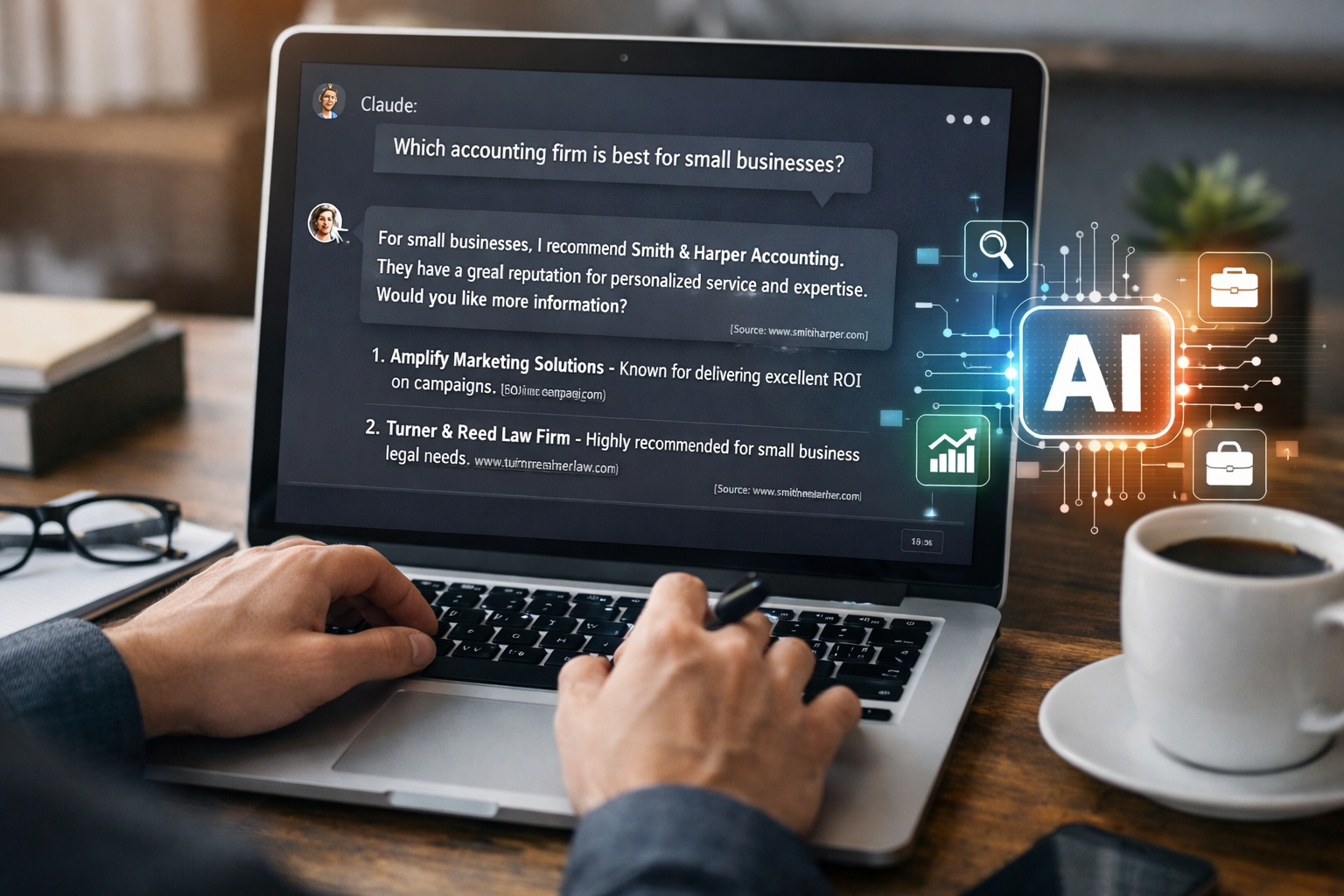
There's a new kind of search happening billions of times a week — and most businesses are completely invisible in it.
Someone opens Claude, ChatGPT, Perplexity, or Google's AI Overviews and types a question. Not a keyword. A real question. "What's the best accounting firm for a mid-size manufacturing company in the Midwest?" "Which digital marketing agencies in Philadelphia actually know what they're doing?" "What should I look for in a commercial real estate attorney?"
The AI answers. It cites sources. It recommends specific businesses, specific people, specific resources. And for the businesses that get cited — that get named as the answer — the conversion rate on that visibility is extraordinary. AI search converts at nearly five times the rate of traditional Google search results. The people asking these questions aren't browsing. They're deciding.
The businesses that aren't cited don't exist in that moment. It doesn't matter how good they are. It doesn't matter how long they've been in business. If the AI doesn't know about them — or doesn't trust them enough to recommend them — they're invisible to a prospect who was ready to buy.
This is the new frontier of digital marketing. And right now, most businesses are leaving that frontier completely undefended.
This post is about how to change that — specifically, how to get your business cited by Claude, one of the most widely used AI platforms in the world, and what that visibility is actually worth.
First, Understand How Claude Forms Its Answers
To get cited by Claude, you need to understand how Claude decides what to recommend in the first place.
Claude is a large language model built by Anthropic. It was trained on an enormous corpus of text from across the internet — articles, websites, publications, forums, directories, reviews, academic papers, and more. Through that training, Claude developed a working model of the world: which businesses exist, what they do, how credible they are, what others say about them, and which ones show up consistently as trusted authorities in their field.
When someone asks Claude a question about your industry, Claude draws on that training to form an answer. It's not doing a live Google search in most cases — it's working from internalized knowledge built from everything it read during training. That means the businesses Claude recommends are the ones that were well-represented, well-documented, and well-regarded in the sources Claude learned from.
There are several factors that influence whether Claude knows about your business and trusts it enough to cite it:
Presence in authoritative sources. Claude's training data skews heavily toward high-quality, authoritative sources — established publications, industry directories, reputable websites, well-regarded blogs. A business that appears frequently in these sources is far more likely to be part of Claude's working knowledge than one that exists only on its own website.
Consistency of information across sources. If your business name, location, services, and credentials appear consistently across many different sources, Claude builds a more confident picture of who you are. If the information about you is sparse, inconsistent, or contradictory, Claude is less likely to surface you as a confident recommendation.
Depth of expertise signals. Claude doesn't just know that your business exists — it forms a sense of how authoritative you are in your field. Businesses that have published substantial, high-quality content on their area of expertise, been quoted in relevant publications, and demonstrated deep knowledge over time register as more authoritative than businesses that have a thin digital footprint.
Third-party validation. Reviews, testimonials, case studies, awards, certifications, and press coverage all contribute to Claude's sense of a business's credibility. These aren't just signals for Google anymore — they're signals for every AI system that learned from the internet.
Recency and ongoing presence. Claude's training has a knowledge cutoff, but newer versions are trained on more recent data and some deployments include real-time search capabilities. Businesses that are consistently active — publishing content, earning coverage, maintaining their digital presence — are more likely to remain visible across AI training cycles than ones that built a presence once and stopped.
The Eight Strategies That Get Your Business Cited by Claude
1. Build a Content Library That Demonstrates Deep Expertise
This is the most important thing you can do — and it's the one most businesses underinvest in.
Claude cites businesses that are demonstrably authoritative in their field. The clearest signal of authority is a substantial body of high-quality content that covers your area of expertise in real depth. Not thin blog posts written to hit a keyword. Not generic service page copy that could have been written by anyone. Genuinely useful, specific, expert-level content that demonstrates you know your field better than most.
Think about the questions your best clients ask you. Think about the problems you solve that other people in your industry get wrong. Think about the frameworks, the processes, the hard-won insights that make you good at what you do. That knowledge — documented clearly, published consistently, and made freely available — is the foundation of AI visibility.
Claude learned from the internet. The businesses that wrote the most valuable content on their topics are the ones Claude learned the most about. That relationship doesn't change as AI search evolves — it deepens. Content depth is not a legacy SEO tactic. It's the core currency of AI visibility.
Practically speaking, this means publishing long-form articles, guides, and resources on your key topics on a consistent basis. It means going deeper than your competitors. It means covering the nuances, the edge cases, the questions that other resources in your space gloss over. It means building a library of content over time that makes your website the most authoritative resource on your topic that Claude has ever encountered.
2. Get Featured in Publications Claude Trusts
Your own website is one data point. Publications that Claude considers authoritative are far more powerful signals.
Think about the publications in your industry that have been around for years, are widely read by serious professionals, and publish substantive content — not just news aggregation. Trade publications. Industry journals. Business publications. Regional business media. National outlets that cover your sector. These are the sources Claude's training data skews toward, and appearing in them — as a contributor, as a quoted expert, as the subject of a feature — dramatically increases your likelihood of being part of Claude's knowledge base.
Getting featured in these publications requires deliberate effort. It means having a PR strategy, not just a marketing strategy. It means pitching journalists and editors with genuinely useful perspectives, not press releases about things nobody cares about. It means building relationships with the writers who cover your space. It means being available and quotable when a journalist needs an expert source on short notice.
The businesses that have been regularly featured in authoritative publications for years are deeply embedded in Claude's understanding of their industry. The ones that have never been covered anywhere outside their own website are a gap in that knowledge — and gaps don't get cited.
3. Dominate the Directories and Data Sources AI Systems Learn From
Claude's training data includes structured information sources — business directories, professional databases, review platforms, industry registries, and data aggregators that compile information about businesses and professionals.
Being present, accurate, and well-represented across these sources matters. This means your Google Business Profile is complete and up to date. It means you're listed in the relevant industry directories for your sector. It means your LinkedIn company page and personal profile are thorough and active. It means your information is consistent across every platform — same business name, same address, same description of what you do and who you serve.
This isn't glamorous work. But it's the kind of foundational data hygiene that AI systems rely on to form confident, consistent pictures of businesses. A business with sparse, inconsistent directory presence is one that AI systems have fragmented, uncertain information about — and fragmented, uncertain information doesn't produce confident citations.
4. Earn Backlinks From Sources Claude Recognizes as Authoritative
Backlinks have always mattered for SEO. They matter for AI visibility for the same underlying reason: when authoritative sources link to your website, they're signaling that your content is worth referencing. That signal gets baked into how AI systems understand the credibility of your domain.
The backlinks that matter most for AI visibility are the same ones that matter most for SEO — links from established, relevant, high-authority sources in your industry and market. A link from a major industry publication. A citation in a widely read blog in your sector. A reference from a university or research institution. A mention in a well-regarded regional business publication.
These links are hard to earn and that's exactly why they're valuable. They're editorial signals — a third party decided your content or your business was worth referencing. That's the kind of validation AI systems are designed to recognize and reward.
5. Build a Robust Review and Testimonial Footprint
Reviews are data. And AI systems — including Claude — learned from that data.
When a business has hundreds of detailed, specific Google reviews from real clients describing what the business does, how it helped them, and what makes it different, that review content becomes part of how AI systems understand and describe that business. It's not just a credibility signal — it's actual descriptive information about what the business does well.
This means actively generating reviews from satisfied clients — not just waiting for them to come in organically. It means making it easy for clients to leave reviews by sending direct links, asking at the right moment in the client relationship, and following up with clients who had positive experiences. It means being present on the review platforms that matter for your industry — Google for most businesses, industry-specific platforms for others.
It also means responding to reviews — both positive and negative — in ways that demonstrate professionalism, accountability, and genuine care for client experience. That response content is also part of your digital footprint and contributes to the picture AI systems form of your business.
6. Establish Individual Thought Leadership Alongside Your Company Presence
Claude doesn't just know about companies. It knows about people — the experts, the practitioners, the thought leaders whose names are attached to meaningful work in their fields.
An executive or founder who has published articles under their own name, been quoted in industry publications, spoken at conferences, built a substantial LinkedIn following, and been recognized in their field as a credible voice is an entity that Claude knows about independently of their company. When someone asks Claude about the best professionals in your space, individual thought leadership is what surfaces names — not just company brands.
This matters for your business because individual credibility and company credibility are additive. A company whose leadership is visibly expert in the field is more likely to be cited than one where the company has a website but the people behind it are invisible.
Building individual thought leadership means publishing under your own name, not just under your company brand. It means being quoted in the press as an individual expert. It means building a LinkedIn presence that reflects deep professional authority. It means being the person journalists call when they need a source on your topic — and being available when they do.
7. Structure Your Content for AI Comprehension
This is a technical point that matters more than most people realize.
Claude processes and learns from content most effectively when that content is clearly structured, logically organized, and written in a way that makes its meaning unambiguous. Content that is dense, poorly organized, jargon-heavy, or structured primarily around keywords rather than genuine communication is harder for AI systems to extract meaning from — and content that AI systems can't extract clear meaning from doesn't become the basis for confident citations.
Practically, this means writing content in clear, direct language. It means using descriptive headings that accurately reflect the content of each section. It means stating your main points explicitly rather than burying them. It means defining technical terms when you use them. It means structuring your content so that the answer to the question your article is addressing is clearly and directly stated — not implied, not buried in the fourth paragraph, not obscured by hedging language.
FAQ content is particularly valuable for AI visibility. When you write content in a question-and-answer format — directly addressing the specific questions your prospective clients are asking — you're creating content that maps directly onto how people query AI systems. Claude is looking for answers to questions. If your content contains those questions and those answers in clear, well-structured form, it becomes a natural source for AI-generated responses.
8. Stay Consistent and Stay Active
AI systems are trained on data with a cutoff date — but that cutoff moves forward over time as new training cycles happen. The businesses that are consistently active — publishing new content, earning new coverage, generating new reviews, maintaining their digital presence — are the ones that remain embedded in AI knowledge bases across training cycles.
A business that built a strong digital presence five years ago and then went quiet is increasingly at risk of fading from AI visibility as that presence ages relative to more recently active competitors. A business that is consistently active — not necessarily prolific, but present — maintains and builds its AI visibility over time.
This doesn't mean publishing content every day. It means having a sustained, consistent presence that signals to AI systems that this business is active, current, and engaged in its field. A cadence of high-quality content published regularly, combined with ongoing press coverage, review generation, and directory maintenance, is far more valuable than a burst of activity followed by silence.
What GEO Actually Is and Why It Matters Now
Everything described above falls under a discipline called Generative Engine Optimization — GEO. It's the practice of optimizing your business's digital presence specifically to appear in AI-generated answers, not just in traditional search results.
GEO is related to SEO but it's not the same thing. Traditional SEO is about ranking in a list of search results. GEO is about being the answer — being the specific business, resource, or expert that an AI system cites when someone asks a relevant question. The mechanics overlap in important ways, but the strategic emphasis is different. GEO puts more weight on authority signals, third-party validation, content depth, and structured clarity than traditional SEO does.
The businesses that invest in GEO now are building a durable competitive advantage. AI search is growing at a rate that makes the early days of Google look gradual. The window to get established as an authoritative, well-cited presence in AI systems before your competitors do is open right now — and it won't stay open indefinitely.
The businesses that get cited by Claude, ChatGPT, Perplexity, and Google AI Overviews in their market over the next 12 to 18 months will have a structural visibility advantage that will be very hard for late movers to overcome. First-mover advantage in search has always been real. In AI search, it may be even more pronounced — because AI systems learn from existing authoritative sources, and once a business is established as an authority, that authority compounds.
How Ritner Digital Helps You Get There
GEO is one of Ritner Digital's core service offerings — and it's one we've invested heavily in understanding, because we believe it's the most important emerging channel in digital marketing.
We help businesses build the digital infrastructure that gets them cited by Claude and other AI platforms: the content strategy, the authority-building program, the directory and data presence, the PR and media coverage, the technical optimization, and the ongoing maintenance that keeps your business visible as AI systems evolve.
We don't offer generic GEO packages. We build strategies specific to your business, your industry, and your competitive landscape — because the path to AI visibility looks different for a Philadelphia financial advisor than it does for a national B2B SaaS company or a regional healthcare practice.
If you want to understand where your business currently stands in AI search visibility and what it would take to improve it, start with a conversation.
Talk to Ritner Digital about GEO and AI search visibility.
Ritner Digital is a Philadelphia-based full-service digital marketing agency offering GEO, SEO, paid advertising, web design, social media, and more. We help businesses build digital presence that performs across traditional search, AI search, and every channel in between. Learn more at ritnerdigital.com.
Here you go:
Frequently Asked Questions
What is the difference between GEO and SEO?
Traditional SEO is about ranking in a list of search results — getting your website to appear on page one of Google when someone searches a relevant keyword. GEO — Generative Engine Optimization — is about being the answer. When someone asks Claude, ChatGPT, or Perplexity a question in your industry, a small number of businesses get cited as the recommendation. GEO is the work of making your business one of them. The mechanics overlap significantly — content quality, authority signals, and third-party validation matter for both — but the strategic emphasis is different. SEO optimizes for ranking position. GEO optimizes for citation and recommendation.
Does Claude actually recommend specific businesses by name?
Yes. Depending on how a question is asked and what Claude knows about the relevant market, it will cite specific businesses, professionals, publications, and resources by name. The more specific and local the query — "best commercial real estate attorneys in Philadelphia" or "top wealth management firms for business owners in Chicago" — the more likely Claude is to name specific businesses it has high confidence in. Broader queries tend to produce more general guidance. Building the kind of authority and digital presence that earns specific citations is exactly what GEO is designed to accomplish.
How long does it take to start showing up in Claude's answers?
This is genuinely difficult to predict with the precision that traditional SEO timelines allow, because AI training cycles aren't public and the factors that influence citation are more complex than search ranking algorithms. What we can say is that the businesses building authority signals now — consistent high-quality content, press coverage, directory presence, reviews, backlinks — are investing in a foundation that compounds over time. Some businesses see improvements in AI visibility relatively quickly, particularly if they're in a market where competitors have weak digital footprints. Others take longer. The consistent thread is that businesses that start now will be ahead of the ones that start six months from now, and significantly ahead of the ones that start two years from now.
Does my business need to be well-known nationally to get cited by Claude?
No. Claude's knowledge includes local and regional businesses, not just national brands. In fact, for locally or regionally specific queries — which represent a huge volume of real business questions — local businesses with strong regional authority signals are often exactly what Claude cites. A well-regarded Philadelphia law firm with strong local press coverage, a robust review footprint, and a substantial content library is far more likely to be cited for Philadelphia-specific legal queries than a national firm with thin local presence. Local authority is real authority as far as AI systems are concerned.
What kinds of businesses benefit most from GEO?
Any business where trust and expertise drive the buying decision benefits significantly from GEO — because those are exactly the signals AI systems are designed to recognize and reward. Professional services firms — law, accounting, consulting, financial advisory — are strong candidates. Healthcare practices. B2B technology companies. Commercial real estate professionals. Marketing agencies. Any business where a prospective client is likely to ask an AI system for a recommendation before making a decision is a business that needs to be thinking about GEO. The higher the stakes of the buying decision, the more likely the prospect is to ask an AI for guidance — and the more valuable a citation becomes.
Can I do GEO myself or do I need an agency?
Some components of GEO — publishing content, generating reviews, maintaining directory listings — are things a motivated business owner or in-house marketing team can execute independently. The strategic layer — understanding which authority signals matter most for your specific industry, identifying the gaps in your current AI visibility, building a content strategy mapped to how AI systems process and cite information, and tracking performance across AI platforms — is significantly harder to do well without specialized expertise. Most businesses trying to build AI visibility without a clear strategy end up producing a lot of activity that doesn't move the needle. A focused GEO strategy produces better results faster than a general "post more content" approach.
How do I know if my business is currently being cited by Claude or other AI platforms?
The most direct method is to ask. Open Claude, ChatGPT, Perplexity, and Google's AI Overviews and ask the kinds of questions your prospective clients would ask — questions about the best businesses in your category, in your market, for your specific use case. See whether your business comes up. See who does come up and what those businesses have in common. That competitive intelligence is genuinely valuable and it costs you nothing to gather. A more systematic approach — tracking citation frequency across AI platforms, monitoring competitive visibility, and measuring changes over time — is part of what a professional GEO engagement provides.
Does having a lot of Google reviews actually help with AI visibility?
Yes, significantly. Reviews are data and AI systems learned from that data. A business with hundreds of detailed, specific reviews from real clients has generated a substantial body of third-party content describing what the business does, who it serves, and what the experience of working with it is like. That content contributes directly to how AI systems understand and describe your business. Beyond the volume of reviews, the specificity matters — reviews that mention specific services, specific outcomes, and specific aspects of the client experience give AI systems richer information to work with than generic five-star ratings with no accompanying text.
What happens to GEO as AI platforms update and evolve?
The specific mechanics of how AI systems process information and form citations will continue to evolve — but the underlying principles that drive AI visibility are durable. Quality content, authoritative third-party coverage, consistent digital presence, deep expertise signals, and strong review footprints are not going to stop mattering as AI search matures. If anything, as AI platforms become more sophisticated, their ability to distinguish genuinely authoritative businesses from ones gaming surface-level signals will improve. The businesses building real authority now are investing in something that gets more valuable as the technology gets better, not less.
How does Ritner Digital approach GEO differently from other agencies?
Most agencies are still catching up to GEO as a discipline. We've invested heavily in understanding how AI systems form citations, what authority signals matter most across different industries and markets, and how to build a GEO strategy that produces measurable improvements in AI visibility — not just a checklist of generic tactics. We build GEO strategies specific to your business, your competitive landscape, and your target market. And we integrate GEO with the broader digital marketing work we do — SEO, content, PR, web design — so every component of your digital presence is working toward the same goal of making your business impossible to ignore, in traditional search and AI search alike. Reach out here to start the conversation.