How to Optimize for Google AI Overviews vs. Perplexity vs. ChatGPT
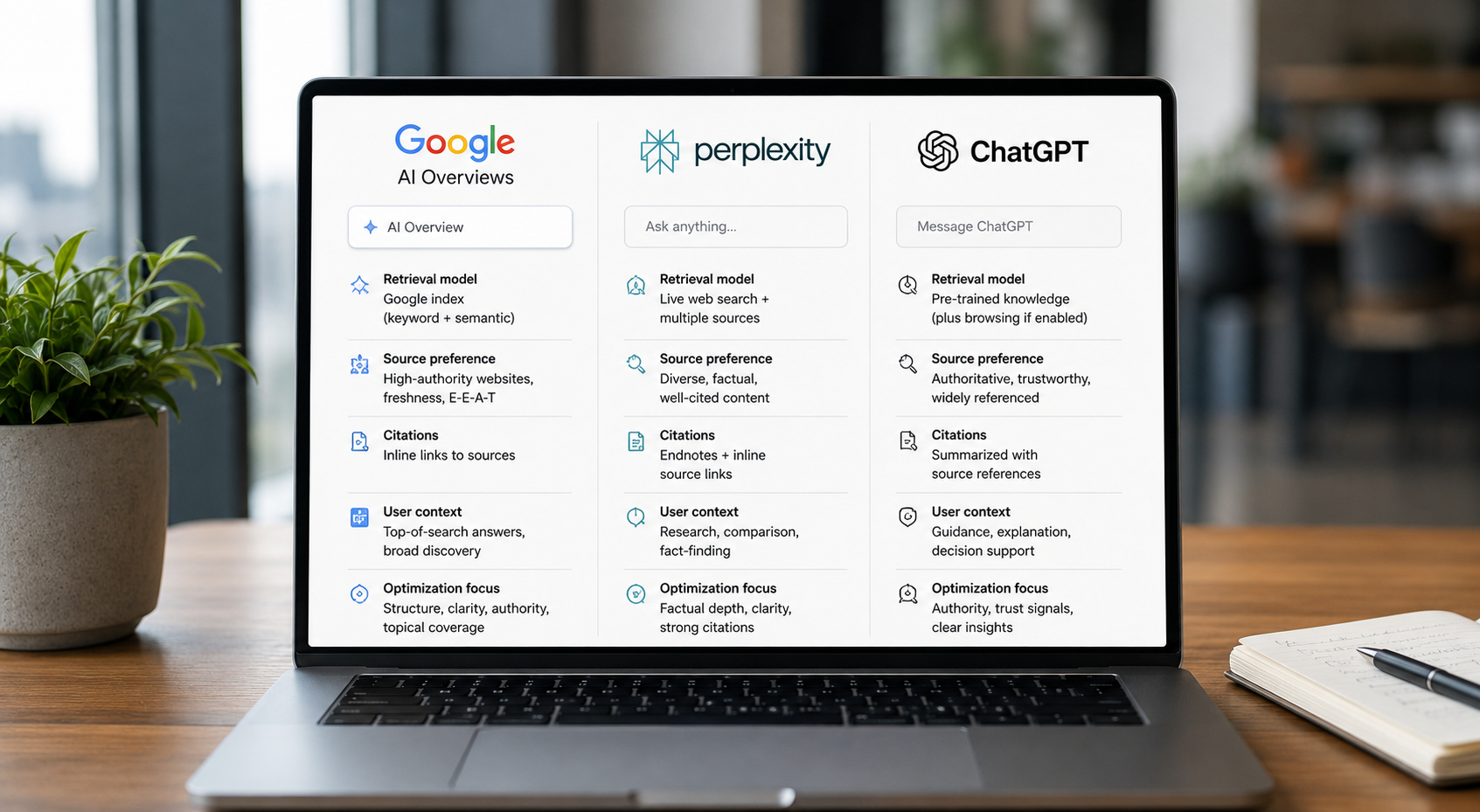
The instinct to treat AI search optimization as a single unified discipline is understandable but wrong. Google AI Overviews, Perplexity, and ChatGPT are not the same product with different interfaces. They have different retrieval infrastructure, different source preferences, different citation behaviors, and different user contexts that shape what kinds of content get surfaced and how.
Optimizing for all three with identical tactics is like optimizing for Google, Amazon, and LinkedIn with the same keyword strategy. The underlying principles overlap, but the specific execution is different enough that treating them as one thing produces results that are mediocre across all three rather than strong on any of them.
This piece breaks down how each platform actually works, what it favors, and what platform-specific optimization looks like in practice — followed by the foundational work that benefits all three simultaneously.
Google AI Overviews
How It Works
Google AI Overviews — formerly called Search Generative Experience during its testing phase — sits at the top of Google search results for queries where Google determines a synthesized answer adds value over a traditional ranked list. It's powered by Google's Gemini model and draws exclusively from Google's own web index — the same index that powers traditional organic search results.
This is the most important structural fact about Google AI Overviews: it retrieves from Google's index. There is no separate AI Overview index. No separate crawling infrastructure specifically for AI Overviews. If your content is in Google's index and ranking reasonably well for relevant queries, it is in the pool of content Google AI Overviews retrieves from. If it isn't indexed or isn't ranking, it isn't being considered.
The relationship between traditional organic rankings and AI Overview inclusion is closer for Google than for any other platform. Research suggests that content appearing in AI Overviews frequently comes from pages ranking in the top ten organic results for the same query — though not exclusively, and the correlation is imperfect. Pages that don't rank at all for a query are very rarely included in AI Overviews for that query.
What Google AI Overviews Favor
Structured, directly answering content. Google AI Overviews consistently favor content that answers the specific query being asked clearly and directly. Pages that bury their answer in context, that require significant reading before reaching the relevant information, or that address the topic broadly without directly answering the specific question perform worse than pages that lead with clear answers.
Authoritative domains in Google's ecosystem. Because Google AI Overviews pulls from Google's index, the domain authority signals that influence traditional rankings — quality backlinks, consistent indexation, demonstrated topical expertise — directly influence AI Overview inclusion. A strong traditional SEO presence in Google is the most direct prerequisite for Google AI Overview visibility.
Content that matches query intent precisely. Google's query intent classification is sophisticated enough to distinguish between informational, navigational, commercial, and transactional intent at a granular level. AI Overview content selection reflects that classification — informational queries surface different content types than commercial investigation queries. Aligning your content's intent signal with the intent of the queries you're targeting is more important for Google AI Overviews than for the other platforms.
Featured snippet eligible content. There is meaningful overlap between content that earns featured snippets in traditional Google Search and content that gets included in AI Overviews. The formatting signals that earn featured snippets — concise direct answers, well-structured lists, clear definitions, numbered processes — are the same signals that make content AI Overview eligible. If you've been optimizing for featured snippets, you've been doing relevant work for AI Overviews.
Platform-Specific Optimization Actions
Audit your highest-priority pages for Google ranking position. Any page targeting a query where you want AI Overview visibility needs to be ranking — ideally in the top ten, and at minimum in the top twenty. AI Overview inclusion is functionally unavailable to unranked content.
Implement FAQ schema on pages that address specific questions. Google's structured data processing for AI Overviews benefits from explicit schema markup that identifies question-and-answer pairs, helping Google extract and use that content for synthesis.
Optimize for featured snippets on your target queries. The correlation between featured snippet eligibility and AI Overview inclusion is strong enough that featured snippet optimization is simultaneously AI Overview optimization for Google specifically.
Monitor AI Overview appearances in Search Console. Google has added AI Overview impression and click data to Search Console for some users — checking whether your tracked queries are triggering AI Overviews and whether your domain appears in them gives you the most direct measurement available for this platform.
Perplexity
How It Works
Perplexity is the platform that most explicitly shows its work. Unlike ChatGPT, which cites sources inconsistently, and Google AI Overviews, which sometimes summarizes without clear attribution, Perplexity consistently shows the sources it draws from for every response. This makes it the most transparent AI search platform for understanding retrieval behavior — and the most useful for diagnosing why your content is or isn't being cited.
Perplexity operates its own web index through PerplexityBot, its proprietary crawler, but also supplements that with real-time web search. It positions itself as a research tool — the default use case is someone who wants a synthesized, cited answer to a research question, with the sources visible so they can verify and go deeper. This user context shapes what Perplexity surfaces: it favors content that reads as genuinely informative and well-sourced rather than content that reads as marketing.
What Perplexity Favors
Explicitly sourced and cited content. Perplexity has a strong preference for content that itself cites sources — statistics with attribution, claims backed by named research, data points linked to their origin. Content that makes assertions without supporting evidence is less likely to be retrieved and cited by a platform whose entire value proposition is verified, sourced answers.
Content from domains with editorial credibility. Perplexity's retrieval behavior shows a meaningful preference for content from domains that operate with editorial standards — publications with named authors, editorial oversight, and reputational accountability. This doesn't exclude brand content entirely, but it does mean that brand content competing against editorial content from credible publications faces a higher bar.
Depth over breadth. Perplexity users are in research mode. The platform surfaces content that goes deep on specific topics rather than content that provides surface-level overviews. Comprehensive, substantive content that treats topics with genuine depth consistently outperforms thin content that covers many points shallowly.
Current and recently updated content. Perplexity's real-time retrieval capability means it can surface recently published content faster than platforms with longer crawl and index cycles. Fresh content that addresses current questions — recent developments, updated statistics, new research — has a retrieval advantage on Perplexity that it may not have on platforms with slower update cycles.
Platform-Specific Optimization Actions
Check your robots.txt for PerplexityBot. Perplexity's crawler identifies itself as PerplexityBot and respects robots.txt. Confirming it isn't blocked is the most basic prerequisite for Perplexity visibility.
Build content that cites its sources explicitly. For every significant claim in content you want Perplexity to cite, include attribution — link to the primary source, name the study, reference the data. This both satisfies Perplexity's preference for sourced content and makes your content more trustworthy to human readers simultaneously.
Monitor Perplexity manually for your target queries. Because Perplexity shows its sources, running your target queries through Perplexity and examining the cited sources gives you the clearest available picture of which competitors' content is being retrieved and why. This competitive intelligence is more accessible on Perplexity than on any other AI platform.
Pursue coverage in the publications Perplexity favors. When you run target queries on Perplexity and see the same publications appearing consistently as cited sources, those publications are worth targeting for coverage, guest contributions, or expert quotes — because getting mentioned there gets you into Perplexity's preferred source pool.
ChatGPT
How It Works
ChatGPT is the most complex platform to optimize for because its behavior varies most significantly depending on the mode being used. In base conversational mode without search enabled, responses come entirely from the model's parametric memory — what it learned during training. In search-enabled mode, ChatGPT retrieves current web content, historically through a partnership with Bing's index supplemented by OpenAI's own crawling infrastructure through GPTBot and ChatGPT-User.
The user context on ChatGPT is also the most varied of the three platforms. People use ChatGPT for everything from casual questions to complex research to task completion. The queries that are most commercially relevant — vendor recommendations, category comparisons, pricing questions, how-to guidance — are the ones most likely to trigger web search retrieval rather than purely parametric responses.
What ChatGPT Favors
Multi-source brand presence for parametric responses. In base model mode, ChatGPT cites brands that are well-represented across multiple credible sources in its training data — not just brands with good websites. Companies that have been covered in publications, discussed in forums, reviewed on authoritative platforms, and referenced across a wide range of independent sources have higher parametric citation frequency than companies that exist primarily on their own domain.
Bing-indexed content for search-enabled responses. Because ChatGPT's search functionality has drawn from Bing's index, ensuring your content is properly indexed in Bing — through Bing Webmaster Tools, sitemap submission, and not inadvertently blocking Bingbot — is a meaningful platform-specific step that most SEO programs skip because they're Google-focused.
Conversational, natural language content. ChatGPT's language model is particularly well-suited to extracting information from content written in natural, conversational prose rather than content that reads as heavily keyword-optimized. Content that sounds like a knowledgeable person explaining something clearly — rather than content that sounds like it was written to satisfy a keyword brief — tends to integrate more naturally into ChatGPT's synthesized responses.
Content that answers the full question, not just the surface query. ChatGPT users often ask complex, multi-part questions. Content that addresses a topic comprehensively — anticipating follow-up questions and addressing them in the same piece — is more likely to provide the kind of complete information ChatGPT needs to generate a satisfying response than content that answers only the narrow surface question.
Platform-Specific Optimization Actions
Submit your site to Bing Webmaster Tools and verify clean Bingbot access. This is the highest-leverage platform-specific technical action for ChatGPT search visibility and the one most commonly overlooked.
Check robots.txt for GPTBot and ChatGPT-User. Ensuring both OpenAI crawlers have access is the crawl accessibility prerequisite specific to ChatGPT, as covered in more depth elsewhere.
Build the external brand presence that feeds parametric memory. Earned media coverage, review volume on authoritative platforms, presence in structured databases, and mentions across independent credible sources all contribute to the parametric citation frequency that determines whether ChatGPT mentions your brand in non-search responses.
Write for human clarity, not keyword optimization. ChatGPT's language model responds better to natural, clear prose than to keyword-dense content. If your content sounds like it was written for an algorithm, it integrates less naturally into ChatGPT's generation process than content written with genuine communicative intent.
The Foundational Work That Benefits All Three
Despite the platform-specific differences, there is a core body of work that improves citation frequency across Google AI Overviews, Perplexity, and ChatGPT simultaneously — and this foundational layer is where most brands should start before optimizing for any specific platform.
Content that directly answers buyer questions at depth. All three platforms are trying to provide the best available answer to a question. Content that does that job well — with clear structure, genuine depth, and direct answers — performs better than content that doesn't on every platform, regardless of specific retrieval differences.
Domain authority built through legitimate link acquisition. All three platforms weight source credibility, and all three use signals that correlate with domain authority as measured by quality backlinks and referring domain diversity. Building real authority through digital PR, earned media, and content that attracts genuine citations raises your floor across all platforms.
Technical accessibility and clean crawl infrastructure. All three platforms need to be able to access your content. Clean robots.txt configuration, proper indexation, fast page speed, server-side rendered content, and working pages without crawl errors are prerequisites that apply universally.
Consistent entity definition across the web. All three platforms benefit from a consistent, cross-referenced brand entity — the same name, description, services, and positioning appearing consistently across your own domain, your GBP, your LinkedIn company page, your Crunchbase profile, and your third-party mentions. Entity confusion limits citation confidence on every platform.
Review volume and external social proof. All three platforms incorporate review signals and external social proof into their implicit credibility modeling. Consistent review generation on relevant platforms improves citation frequency across the board.
How to Prioritize When You Can't Do Everything at Once
For most brands, the sequencing question matters more than the platform question. The right starting point is the foundational work — because it compounds across all three platforms simultaneously and doesn't require you to choose between them.
After the foundation is in place, prioritize platforms based on where your buyers actually spend time. For B2B brands with sophisticated buyers doing deep research, Perplexity deserves early attention because the research-mode user context is the most commercially relevant and the source transparency makes it the most actionable for competitive intelligence. For brands whose buyers start research in Google, AI Overview optimization is the natural extension of existing SEO work. For brands with broad consumer awareness goals, ChatGPT's massive user base makes parametric presence building a high-leverage long-term investment.
The honest answer is that platform-specific optimization is the refinement layer on top of foundational citation worthiness — and most brands aren't yet at the point where platform-specific nuance is the binding constraint. Get the foundation right first. Then optimize for platforms.
Ritner Digital builds AI search programs that address platform-specific optimization on top of a foundational citation worthiness strategy — because doing either without the other produces incomplete results. If you want to know where to start for your specific situation, begin here.
Frequently Asked Questions
Should we focus on one platform or all three simultaneously?
Start with the foundational work that benefits all three simultaneously — content depth, domain authority, technical accessibility, entity consistency — before optimizing for any platform specifically. That foundational layer is where most brands are weakest, and improving it raises your floor across all three platforms at once. After the foundation is solid, prioritize platforms based on where your buyers actually spend their research time. B2B brands with sophisticated buyers doing deep research should prioritize Perplexity first because the user context matches most closely. Brands whose buyers start in Google should treat AI Overview optimization as a natural extension of existing SEO. Brands building broad category awareness have the most to gain from ChatGPT parametric presence over the long term.
Does ranking well in Google automatically mean we'll appear in Google AI Overviews?
It significantly improves your eligibility but doesn't guarantee inclusion. Google AI Overviews draws from Google's own index, which means unranked content is functionally excluded from consideration. But ranking in the top ten for a query doesn't guarantee AI Overview inclusion — Google also evaluates content structure, answer clarity, and how directly the content addresses the specific query being asked. Pages that rank well but are structured poorly for synthesis — burying answers in narrative, using vague headers, failing to address the query directly — can rank organically without appearing in the AI Overview for the same query. Strong organic rankings are the prerequisite. Clear, directly answering content structure is what converts that ranking eligibility into actual AI Overview appearances.
Why does Perplexity show its sources but ChatGPT often doesn't?
It's a product design choice that reflects each platform's positioning. Perplexity explicitly positions itself as a research tool where verifiability and source transparency are core to the value proposition — showing sources is fundamental to the product, not an optional feature. ChatGPT is a more general-purpose conversational AI where the synthesis itself is often the primary value rather than the sources behind it. In practice, ChatGPT does cite sources more consistently in search-enabled mode than in base conversational mode, but it still does so less consistently and less prominently than Perplexity. This difference in citation transparency is why Perplexity is more useful for competitive intelligence — you can see exactly which sources are being retrieved — while ChatGPT requires more inference about what's driving the responses you're seeing.
Is Bing SEO actually necessary for ChatGPT optimization or is that overstated?
It's understated rather than overstated, particularly given how thoroughly most SEO programs ignore Bing. ChatGPT's search functionality has operated with significant reliance on Bing's index, which means content that isn't indexed in Bing or is blocked to Bingbot is at a meaningful disadvantage for ChatGPT search-enabled responses compared to content with clean Bing indexation. Most SEO programs are built entirely around Google and have never submitted a sitemap to Bing Webmaster Tools, checked Bingbot crawl access, or verified Bing indexation for priority pages. For ChatGPT search optimization specifically, correcting that oversight is one of the higher-leverage platform-specific actions available — and one of the least competitive, since most brands aren't doing it.
Does the same content work for all three platforms or do we need different content for each?
The same foundational content — well-structured, deeply authoritative, directly answering buyer questions — performs well across all three platforms without platform-specific versions. Where platform-specific content strategy becomes relevant is at the optimization layer rather than the content creation layer. For Perplexity, ensuring content cites its sources explicitly is a meaningful optimization that doesn't require writing different content — it's a quality addition to content that should exist anyway. For Google AI Overviews, FAQ schema implementation is a technical addition to existing content. For ChatGPT, the emphasis on natural conversational prose over keyword-optimized writing is a stylistic orientation that shapes how content is written rather than requiring separate content assets. Think of platform-specific optimization as formatting and distribution decisions applied to a shared content foundation rather than three separate content programs.
How do we track performance across all three platforms without spending all our time on measurement?
Build a lean measurement system that runs on a consistent cadence rather than trying to track everything comprehensively. A practical minimum is running your ten highest-priority queries across all three platforms once a week, documenting which brands appear, and tracking your citation frequency in a simple spreadsheet. That weekly process takes two to three hours and produces the trend data you need to know whether the foundational work is compounding in the right direction. Google AI Overviews is the exception — Search Console provides some AI Overview impression data that automates part of the Google-specific measurement without manual testing. For ChatGPT and Perplexity specifically, manual testing supplemented by a purpose-built AI citation tracking tool when budget allows is the most practical approach for most brands.
What happens when one of these platforms changes its retrieval behavior?
Brands built on foundational citation worthiness are more resilient to platform changes than brands optimized for specific platform mechanics. When Google updated AI Overview behavior in mid-2025, brands with strong organic rankings and authoritative content maintained or improved their inclusion rates while brands that had gamed specific formatting signals saw more volatility. The pattern is consistent with how traditional algorithm updates affect SEO — brands built on genuine authority and quality weather changes better than brands built on tactical exploitation of specific mechanics. The practical implication is that platform-specific optimization should always sit on top of foundational work rather than substituting for it, because the foundation is what survives when platform-specific mechanics shift.
Is there a query type that works best on each platform for getting cited?
Yes — and understanding this helps prioritize content production. Google AI Overviews are most likely to appear for informational queries with clear, factual answers — definitions, explanations, how-to guidance, and comparative questions where a synthesized answer genuinely serves the user better than a list of links. Perplexity citation is most achievable for research-oriented queries — deep dives into specific topics, questions that benefit from multi-source synthesis, and current-events or recently updated information where Perplexity's real-time retrieval is an advantage. ChatGPT citation is most commercially relevant for recommendation and comparison queries — "what's the best option for X," "which type of provider should I use for Y" — where the parametric knowledge base and conversational synthesis produce vendor recommendations that directly influence buyer consideration. Mapping your content production to the query types most favored by each platform lets you match platform-specific optimization to specific content assets rather than applying generic optimization across everything.
Ritner Digital builds platform-aware AI search programs — with strategy that accounts for how Google AI Overviews, Perplexity, and ChatGPT actually differ. If you want to know which platform deserves your attention first and why, start here.