How Turnersville Landscapers Can Dominate Local Search (And Beat the Big Guys)
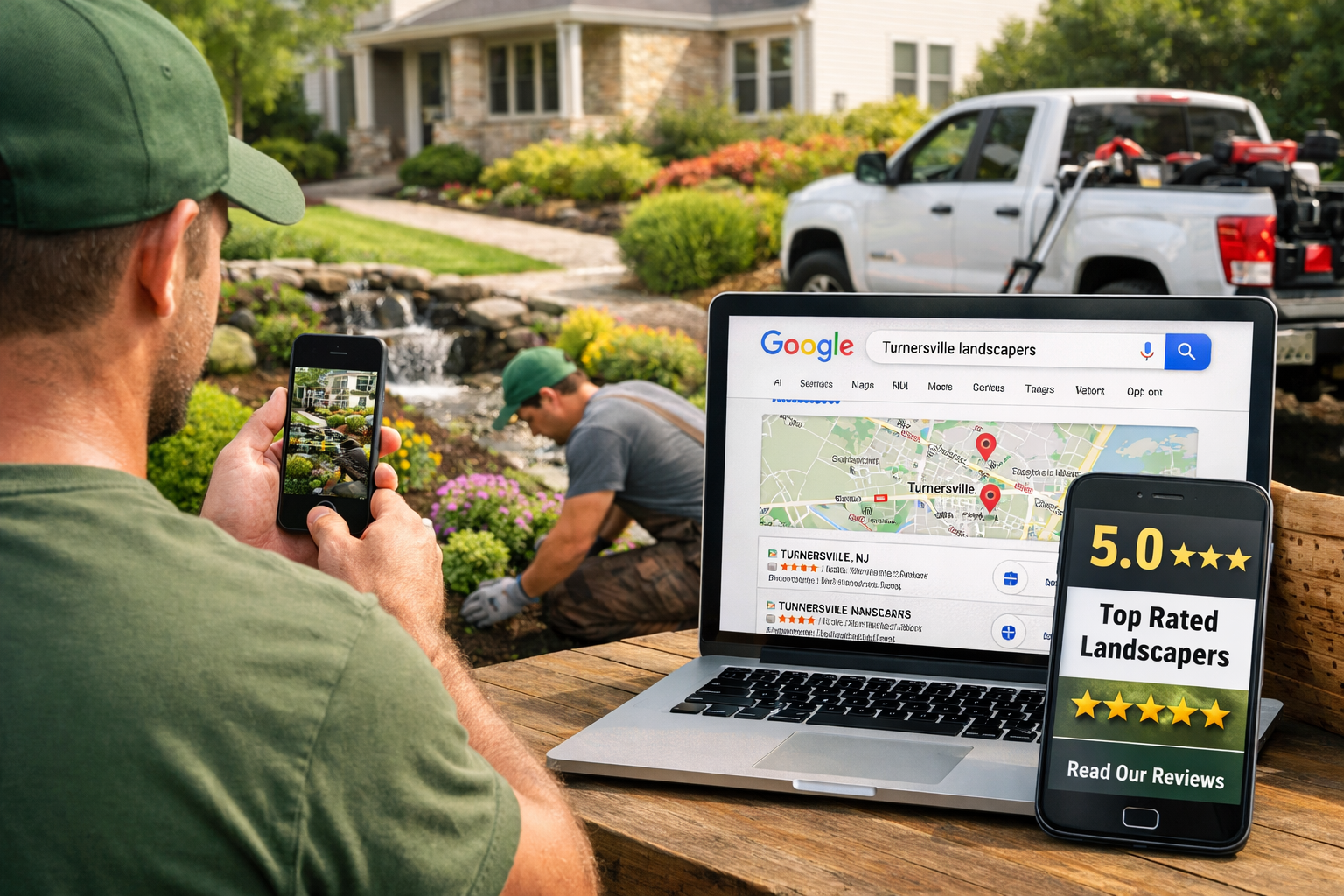
If you run a landscaping business in Turnersville, you already know the grind. Spring cleanups, mulch deliveries, weekly cuts, fall leaf removal — the work is there if you can find the customers. But so is the competition. Between the local crews working Washington Township and Blackwood, the companies blanketing Sewell with door hangers, and the big regional outfits dumping serious money into Google Ads across all of Gloucester County and beyond, getting found online can feel like a losing battle when you're a small or mid-sized operation.
Here's the truth most marketing agencies won't tell you: the big guys are actually at a disadvantage when it comes to truly local marketing. They're casting too wide a net, targeting "landscaping New Jersey" or "lawn care South Jersey" instead of owning their immediate backyard. Their ads are showing up in front of people in Vineland, Woodbury, and Pennsauken — nowhere near your service area. Their website copy reads like it was written for anyone and no one at the same time.
That's your opening.
Hyperlocal digital marketing is the strategy that lets small and mid-sized landscaping companies punch way above their weight class. It's how you show up before the national franchises in search results, how you build a reputation that travels from one neighborhood to the next, and how you turn a modest marketing budget into a full schedule. In a tight-knit, word-of-mouth community like Turnersville and greater Washington Township, hyperlocal strategy works better than almost anywhere else.
This guide breaks it all down — from Google rankings to social media to paid ads to the tools that keep your pipeline full year-round. Let's get into it.
Section 1: Your Google Business Profile Is Your Most Valuable Digital Asset
Before you spend a single dollar on ads, before you redesign your website, before you post anything on social media — you need to have a fully optimized Google Business Profile. This is not optional. It is the foundation of everything.
When a homeowner in Turnersville grabs their phone and searches "landscaper near me" or "lawn care Turnersville NJ," Google doesn't show them a list of websites first. It shows them a map with three businesses highlighted — what's called the Local Pack or Map Pack. These three listings get the lion's share of clicks. They get the phone calls. They get the jobs.
Getting into that map pack and staying there is one of the highest-leverage things you can do for your landscaping business. Here's how to do it right.
Claim and verify your profile. If you haven't done this yet, go to Google Business Profile and claim your listing. Google will send a postcard to your business address with a verification code. This step is non-negotiable — unverified profiles have severely limited visibility.
Fill out absolutely every field. Business name, address, phone number, website, hours of operation, holiday hours, service areas, business description, services offered — fill it all in completely and accurately. Google rewards completeness. Under service areas, list every town you actively work in: Turnersville, Sewell, Blackwood, Washington Township, Williamstown, Glassboro, Mullica Hill, Sicklerville. The more specific you are, the better.
Write a strong business description. This isn't just filler — Google reads it. Write two to three paragraphs that naturally include phrases like "landscaping in Turnersville NJ," "lawn care in Washington Township," and "Gloucester County landscaper." Mention what makes you different — years of experience, specific services, local knowledge, family owned. Keep it conversational, not robotic.
Upload photos constantly and strategically. Businesses with more photos get dramatically more profile views and direction requests. Upload before-and-after shots of every job. Photograph mulch installs, cleanups, new plantings, hardscaping work, anything visual. Geo-tag your photos to Turnersville and surrounding areas when possible — this sends geographic signals to Google. Aim for at least 25 photos to start, and add new ones every week.
Build your review count like your business depends on it — because it does. Reviews are the single most important ranking factor for Google's local algorithm. A landscaper with 80 reviews averaging 4.8 stars will outrank a competitor with a fancier website almost every time. After every completed job, send the customer a direct link to your Google review page via text message. Make it as easy as possible. Most satisfied customers will leave a review if you ask directly and make the process simple. Respond to every review — positive and negative. Responses show Google and potential customers that you're engaged and professional.
Post weekly to your profile. Google lets you publish posts — updates, offers, photos, events — directly to your Business Profile. Most landscapers never use this feature, which means it's easy to stand out. Post a seasonal tip every week, share a completed project photo, announce a spring cleanup special. Google's algorithm favors active profiles, and weekly posting signals that your business is current and relevant.
Section 2: Build a Website That Speaks to Turnersville Specifically
Your website is your 24/7 salesperson. But if it reads like it was built for any landscaper in any town in America, it's not working hard enough for you. The websites that rank well in local search and convert visitors into paying customers are the ones that talk like a local, look professional, and load fast on a phone.
Here's what separates a high-performing landscaping website from a generic one.
Hyperlocal copy throughout. From your homepage to your service pages to your about section, your website needs to reference Turnersville and your surrounding service area specifically and naturally. Not "we serve the greater New Jersey area" — that tells Google nothing and it tells potential customers nothing. Instead: "We've been providing lawn care and landscaping services to homeowners in Turnersville, Sewell, Washington Township, and Blackwood since [year]." Mention local roads, neighborhoods, and landmarks naturally within your copy. Reference the Gloucester County climate, the local soil conditions, the specific challenges South Jersey homeowners face with their lawns.
Dedicated location pages for every town you serve. This is one of the most powerful and underused SEO tactics for local service businesses. Create individual pages for every town in your service area — a Turnersville page, a Washington Township page, a Sewell page, a Blackwood page, a Mullica Hill page, and so on. Each page should be genuinely unique, not just the same content with the town name swapped out. Talk about specific neighborhoods in that town. Mention local landmarks. Reference any particularities about doing landscaping work in that area. These pages rank for searches like "landscaper Washington Township NJ" and "lawn care Sewell NJ" — terms that your competitors may not be targeting at all.
Individual service pages with local context. Don't lump all your services onto one page. Create separate pages for lawn mowing, spring and fall cleanup, mulching and bed maintenance, fertilization and weed control, aeration and overseeding, landscape design, irrigation, hardscaping — whatever you offer. Each page should be detailed, answer common customer questions, include pricing ranges if you're comfortable with that, and tie back to your Turnersville and South Jersey service area. These pages rank for specific service searches and help customers self-qualify before they call.
A blog that establishes local expertise. A regularly updated blog does two things: it gives Google fresh content to index, and it positions you as the local expert homeowners turn to for advice. Write posts like "Best Grass Seed for Gloucester County Lawns," "When to Schedule Your Aeration in South Jersey," "How to Prep Your Turnersville Lawn for a Hot, Humid Summer," or "Why Your Blackwood Lawn Has Bare Patches — And How to Fix It." These long-form posts rank for questions homeowners are actually typing into Google, and they drive warm, high-intent traffic to your website.
Mobile-first design and fast load speed. This cannot be overstated. The majority of people searching for a landscaper are doing it on their phone, often while standing in their yard staring at a problem they want solved. If your website takes more than three seconds to load on mobile, a significant percentage of those visitors will leave before it finishes loading. Google also uses mobile page speed as a ranking factor. Use a modern, responsive website platform, compress your images, and regularly test your site speed using Google's PageSpeed Insights tool. Aim for a score above 80 on mobile.
Clear calls to action everywhere. Every page of your website should make it painfully obvious what the visitor should do next. Phone number in the header, clickable on mobile. A simple contact form above the fold on your homepage. A "Get a Free Estimate" button on every service page. Don't make people hunt for how to reach you — they won't.
Trust signals. Logos of associations you belong to, years in business, number of customers served, before-and-after photo galleries organized by service type, and a dedicated testimonials page all build credibility. In a local market like Turnersville where reputation is everything, social proof on your website converts browsers into callers.
Section 3: Local SEO — The Long Game That Pays Off Forever
Search engine optimization for a local landscaping business comes down to one core goal: making Google believe, without question, that you are the most relevant and trustworthy landscaper for searches coming from Turnersville and surrounding areas. Everything you do on your website and your Business Profile either advances that goal or doesn't.
Here are the key pillars of local SEO for landscapers.
NAP consistency. NAP stands for Name, Address, Phone Number. Google cross-references your business information across dozens of online directories — Yelp, Angi, HomeAdvisor, Yellow Pages, the Better Business Bureau, local chamber of commerce listings, and more. If your business name is listed slightly differently in different places, or if your phone number is inconsistent, it creates confusion for Google and can suppress your rankings. Audit every directory listing and make sure your NAP information is identical everywhere. Use a tool like Moz Local or BrightLocal to find and fix inconsistencies at scale.
Build local citations. A citation is any mention of your business name, address, and phone number online — even if there's no link. Get listed on every relevant directory: Yelp, Angi, HomeAdvisor, Thumbtack, Houzz, the Gloucester County Chamber of Commerce, the Washington Township business directory, and any local South Jersey business listings you can find. Each citation reinforces your local presence in Google's eyes.
Earn backlinks from local sources. A backlink — a link from another website to yours — is one of the strongest ranking signals in Google's algorithm. Local backlinks are especially powerful. Sponsor a Washington Township little league team and get a link from their website. Partner with a local nursery or garden center and exchange links. Get featured in the Washington Township Observer or a South Jersey local news outlet. Join the Gloucester County Chamber of Commerce and get listed in their member directory. Each of these local links tells Google that you are genuinely embedded in the Turnersville community.
Schema markup. This is a technical SEO element that most small business websites don't have — which means it's a competitive advantage if you implement it. Schema markup is a piece of code you add to your website that explicitly tells Google what your business is, where it's located, what it offers, and what your reviews say. A developer or a good website platform can add LocalBusiness schema markup to your site in under an hour, and it can meaningfully improve how your site appears in search results.
Track your rankings and adjust. Local SEO is not a set-it-and-forget-it strategy. Use a tool like BrightLocal or SEMrush to track where you rank for your target keywords — "landscaper Turnersville NJ," "lawn care Washington Township," "mulching service Sewell NJ" — and monitor changes over time. When you see movement up or down, investigate why and adjust your strategy accordingly.
Section 4: Google Ads — How to Run Paid Search Without Burning Money
Organic SEO is the long game — it takes time to build but pays dividends for years. Google Ads is the short game — you can be at the top of search results tomorrow if you set it up right. For most landscaping businesses, the smart move is to run both simultaneously.
But here's where most landscapers and most agencies get it wrong with paid search: they target too broadly and waste a huge percentage of their budget on clicks that will never convert.
Geo-target aggressively and precisely. Set your campaigns to show only within a tight, deliberate radius around Turnersville. Depending on how far you're willing to travel for jobs, this might be a 10-mile radius, 15 miles, or drawn as a custom shape around your specific service towns. Do not run ads that show up in Cherry Hill, Atlantic City, or anywhere else you don't actually work. Every dollar spent outside your service area is a dollar wasted.
Use hyperlocal, high-intent keywords. Broad keywords like "landscaping" or "lawn care" are expensive and attract people who are nowhere near ready to hire. The keywords that convert are long-tail, location-specific, and service-specific:
landscaper Turnersville NJ
lawn mowing service Washington Township NJ
spring cleanup Sewell NJ
mulch installation Blackwood NJ
aeration overseeding Gloucester County
leaf removal Williamstown NJ
These terms cost less per click because fewer advertisers are bidding on them, and they convert at a dramatically higher rate because the person searching is actively looking for exactly what you offer in exactly your area.
Use negative keywords to filter out wasted spend. Add negative keywords to your campaigns to prevent your ads from showing for irrelevant searches. Common negatives for a landscaping business include: "jobs," "hiring," "how to," "DIY," "free," "certification," "school." Review your search term reports weekly and add new negatives as you find irrelevant queries eating your budget.
Run call-only ads during business hours. For a local service business like landscaping, a phone call is worth ten form submissions. People who call want to book — they're ready to talk to someone and make a decision. Call-only ads show your phone number instead of a website link and only appear when someone can actually call you. Schedule them to run during your business hours so you don't miss calls.
Use Local Services Ads if you qualify. Google's Local Services Ads — sometimes called Google Guaranteed ads — appear above even regular Google Ads in search results and feature a green checkmark badge indicating Google has verified your business. They work on a pay-per-lead rather than pay-per-click model, which means you only pay when a potential customer actually contacts you. Getting approved requires a background check and license verification, but for landscapers who qualify, they are often the highest-ROI paid advertising available.
Set up proper conversion tracking. Before you spend a dollar on ads, make sure you're tracking what those dollars produce. Set up conversion tracking for phone calls, form submissions, and any other valuable actions on your website. Without this data, you're flying blind and have no way to know which keywords and ads are generating real leads versus wasting money.
Section 5: Facebook and Instagram — Show the Work, Own the Neighborhood
Social media for a landscaping business is not about going viral or accumulating followers from around the country. It's about being consistently visible to the 20,000 or 30,000 homeowners who live within your service area. That's a completely achievable goal, and it pays off directly in booked jobs.
Organic content: document every project. Make it a habit to photograph every job — before, during, and after. A dramatic mulch refresh, a freshly edged lawn, a cluttered yard transformed into something clean and beautiful — these images perform incredibly well on both Facebook and Instagram because they are genuinely satisfying to look at and they demonstrate tangible value. Post consistently, at minimum three times per week. Tag your location in Turnersville, Washington Township, or whichever town the job was in. Use local hashtags: #TurnersvilleNJ, #WashingtonTownshipNJ, #SouthJerseyLandscaping, #GloucesterCountyNJ, #BlackwoodNJ. Over time, this builds a local following that turns into a referral engine.
Hyperlocal paid advertising on Facebook and Instagram. Facebook's ad targeting is the most precise local advertising tool available to small businesses. You can target homeowners specifically — not renters — within a tight geographic radius around Turnersville. You can target by age, income level, home ownership status, and dozens of other variables. A well-crafted before-and-after photo ad with a simple "Get a Free Estimate" call to action, targeted to homeowners within 10 miles of Turnersville, can generate a steady stream of leads for $10 to $20 per day. Test different images, different headlines, and different offers. Scale up what works and cut what doesn't.
Seasonal promotions and limited-time offers. Social media ads perform especially well when they create urgency. "Spring cleanup slots are filling up — book by March 15th for priority scheduling" is more compelling than a generic "we do landscaping" message. Run promotional ad campaigns at the beginning of each season targeting your service area zip codes. Offer an early-bird discount, a free add-on service, or a referral bonus for customers who bring in a neighbor.
Video content outperforms photos. Short videos — even just 30 to 60 seconds shot on an iPhone — consistently get more reach and engagement than static images on both Facebook and Instagram. Timelapse videos of a full-day landscaping transformation are particularly powerful. Walk-through videos where you explain what you're doing and why build trust and position you as an expert. Behind-the-scenes footage of your crew working humanizes your business in a way that polished stock photo content never can.
Section 6: Nextdoor — The Most Underrated Platform in Local Home Services
If you're not on Nextdoor, you're missing one of the best local marketing opportunities available to a Turnersville landscaper. Nextdoor is a neighborhood-specific social network where local homeowners share recommendations, ask for contractor referrals, warn each other about problems, and discuss community issues. The trust level on this platform is extraordinarily high because it's neighbor-to-neighbor communication.
Claim your free Nextdoor Business Page. This takes 15 minutes and costs nothing. Fill it out completely with photos, services, and a description that mentions Turnersville and surrounding areas specifically.
Ask satisfied customers to recommend you on Nextdoor. Recommendations on Nextdoor are neighborhood-specific — when someone recommends your business, their neighbors see it. A handful of genuine recommendations from homeowners in the same Turnersville neighborhood carries more weight than a hundred generic Google reviews for the residents of that area.
Engage authentically in neighborhood discussions. When someone posts in a Turnersville or Washington Township Nextdoor group asking for a landscaper recommendation, you want your name to come up — either from a satisfied customer posting on your behalf, or from a business page recommendation that surfaces in the thread. Don't spam groups with promotional content, but do participate helpfully. Answer a question about lawn care. Offer a tip about dealing with the local soil. Be genuinely useful and your reputation will grow.
Consider Nextdoor's paid local advertising. Nextdoor offers a paid advertising product for local businesses that puts your content in front of homeowners in specific zip codes. The cost is relatively low compared to Google and Facebook, the audience is intensely local, and because Nextdoor users are already in a mindset of seeking local service recommendations, the conversion intent is high.
Section 7: Email and Text Marketing — Your Existing Customers Are a Gold Mine
The single most overlooked marketing asset for most landscaping businesses is their existing customer list. You have phone numbers and email addresses for every person who has ever paid you for a job. That list is worth real money — and most landscapers never use it.
Existing customers are dramatically easier and cheaper to retain and upsell than new customers are to acquire. They already trust you, they already know your work, and if they were satisfied, they're genuinely open to hearing from you again. The only reason they hire someone else next season is because you disappeared from their radar.
Build and maintain your customer list from day one. Every customer contact — name, phone number, email, address, services performed, date of service — should live in a CRM (customer relationship management) system or at minimum a well-maintained spreadsheet. Tools like Jobber, Housecall Pro, and ServiceTitan are built specifically for home services businesses and make managing customer data easy.
Send seasonal reminder campaigns. At the beginning of each service season, send a text or email to your entire past customer list. Keep it personal and direct: "Hey [Name], it's [Your Name] from [Business Name] — spring is right around the corner and our schedule is already filling up. Want to get you on the books for your spring cleanup? Reply here or call us at [number]." This kind of message, sent to 200 to 500 past customers, will generate 20 to 50 bookings from people who were already inclined to hire you but just hadn't gotten around to it.
Upsell additional services to current lawn care customers. If someone is on your weekly mowing schedule, they are a warm prospect for aeration, overseeding, fertilization, and fall cleanup. Send a targeted message in late August or early September: "Fall aeration season is coming up — we're offering priority scheduling to our existing lawn care customers this year. Want to add it to your service?" This turns one-service customers into multi-service customers and dramatically increases the lifetime value of each relationship.
Ask for referrals systematically. Word of mouth is already happening for your business — the question is whether you're actively encouraging it or just hoping for it. After a successful job, send a short text: "Really glad we could help — if any of your neighbors or friends are looking for a landscaper, we'd love the referral. We offer [X] for every customer you send our way." A simple referral incentive, combined with a direct ask, can generate a meaningful stream of new leads at near-zero cost.
Section 8: Online Reviews — The Currency of Local Service Businesses
We touched on Google reviews earlier, but this topic deserves its own section because reviews have become so central to how homeowners choose local contractors. Before someone calls you, there is an extremely high probability they looked you up online first. What they found — or didn't find — determined whether they called at all.
A landscaping business with fewer than 20 Google reviews is essentially invisible in a competitive local market, regardless of how good the actual work is. A business with 100 reviews averaging 4.8 stars is the default choice for any homeowner who doesn't already have a referral. The math is simple.
Make review generation a systematic process, not an afterthought. After every completed job, the person who did the work — whether that's you or one of your crew leaders — should text the customer a direct link to leave a Google review while still on-site or immediately after leaving. The request should be personal and brief: "Really appreciate your business — if you have a minute, it would mean a lot if you could leave us a review. Here's the link: [link]." Conversion rates on review requests sent immediately after a job are dramatically higher than requests sent days later.
Respond to every review. Every positive review deserves a genuine, specific thank-you response that mentions the type of work done and the location. Every negative review deserves a calm, professional response that acknowledges the concern and offers to make it right. Potential customers read negative reviews and your responses just as carefully as they read positive ones. A well-handled negative review can actually increase trust — it shows you stand behind your work and treat customers with respect.
Diversify beyond Google. While Google reviews are the most important, reviews on Yelp, Angi, Houzz, and Facebook also contribute to your overall online reputation and help you rank in different search contexts. Maintain active profiles on the major platforms and encourage reviews across all of them over time.
Section 9: Putting It All Together — A Year-Round Marketing Calendar
Digital marketing only works if it's consistent. Here's a simplified seasonal framework for a Turnersville landscaping business.
January–February (Pre-Season): Update your website with new photos and fresh content from last season. Audit your Google Business Profile and fix anything outdated. Plan your spring ad campaigns. Send a "pre-season booking" email to your past customer list. Start posting on social media to warm up your audience before the spring rush.
March–April (Spring Rush): Launch Google Ads campaigns targeting spring cleanup, mulching, and lawn care keywords. Run Facebook and Instagram ads with spring promotion offers. Post daily on social media — project photos, spring lawn tips, behind-the-scenes content. Send a booking reminder to your entire customer list. Collect reviews aggressively from every spring cleanup customer.
May–June (Peak Season): Maintain ad campaigns and adjust bids based on performance data. Keep posting content consistently. Send a mid-season upsell email to mowing customers about fertilization and weed control. Respond to all reviews promptly. Engage in local Facebook and Nextdoor groups.
July–August (Mid-Season): Slightly reduce ad spend if you're fully booked — no point paying for leads you can't service. Begin planning fall campaign. Start promoting aeration and overseeding to existing customers. Continue content posting and review collection.
September–October (Fall Season): Launch fall cleanup and aeration campaign on Google Ads and social media. Send fall booking email and text to your entire customer list. Post fall project photos and leaf removal content heavily. This is often the second-biggest booking season of the year — treat it like spring.
November–December (Off-Season): Wind down ads but don't stop entirely — some customers are thinking ahead. Send a year-end thank-you message to your customer list. Plan next year's marketing strategy. Update your website with any new services. Build out new location pages and blog content during slower weeks.
The Bottom Line
The big regional landscaping companies have larger ad budgets, bigger crews, and more brand recognition across South Jersey. But they cannot out-local you. They don't know Turnersville the way you do. They're not tagging jobs on Fries Mill Road. They're not showing up in Washington Township Facebook groups. They don't have the personal relationship with a homeowner on Cross Keys Road who has been a customer for six years and refers two neighbors every season.
Your local knowledge, your community presence, and your personal reputation are genuine competitive advantages — and digital marketing is the tool that amplifies all three of them.
Hyperlocal strategy isn't just a buzzword. For a landscaping business in a community like Turnersville, it's the most direct path from where you are now to a full schedule, a growing customer base, and a business that runs on referrals and reputation rather than chasing the next lead.
At Ritner Digital, we specialize in helping local South Jersey businesses build the kind of digital presence that drives real, measurable revenue. If you're a landscaper in Turnersville, Washington Township, Sewell, Blackwood, or anywhere in Gloucester County and you're ready to grow — let's have a conversation.
Contact Ritner Digital Today →
Frequently Asked Questions
What exactly is SEO and why does it matter for my landscaping business?
SEO stands for Search Engine Optimization. In plain terms, it's the process of making your website and online presence show up higher in Google when someone nearby searches for a service you offer. When a homeowner in Turnersville types "lawn care near me" or "landscaper Washington Township NJ" into Google, SEO is what determines whether your business shows up on the first page or gets buried on page four where nobody looks. For a landscaping business, good local SEO means more phone calls, more estimate requests, and more booked jobs — without paying for every single click the way you do with ads.
How does Google decide which landscapers show up first in local search results?
Google uses hundreds of ranking signals, but for local businesses the most important ones are relevance, distance, and prominence. Relevance means your website and Google Business Profile clearly communicate what services you offer and where. Distance means Google is trying to show searchers businesses that are geographically close to them. Prominence is essentially your reputation online — how many reviews you have, how highly rated you are, how many other websites link to yours, and how active and complete your Google Business Profile is. The businesses that show up in the top three map results are almost always the ones that have the most reviews, the most complete profiles, and the most consistent presence across the web.
How much should a landscaping business in Turnersville budget for digital marketing?
This depends on your revenue goals and how aggressively you want to grow, but here are some realistic benchmarks. A landscaping business doing under $300,000 in annual revenue should be investing at minimum $500 to $1,000 per month in digital marketing — this covers basic SEO, Google Business Profile management, and a modest paid ad budget. A business in the $300,000 to $750,000 range should be thinking $1,500 to $3,000 per month to maintain competitive visibility and run effective ad campaigns. Businesses pushing toward $1 million and beyond typically invest $3,000 to $6,000 per month or more across SEO, paid search, social media advertising, and content creation. The key mindset shift is to stop thinking of marketing as an expense and start thinking of it as the cost of acquiring a customer — if a new lawn care customer is worth $1,200 a year to you and they stay for five years, spending $150 to acquire that customer through digital advertising is an exceptional return.
What kind of return on investment can I realistically expect from digital marketing?
Realistic ROI depends heavily on which channels you're investing in and how well they're executed. Google Ads for local landscaping services, when managed well with tight geographic targeting and strong keywords, typically generates leads at a cost of $20 to $60 per lead depending on the service and time of year. If your average job is worth $400 and you're converting one in four leads into a paying customer, you're spending $80 to $240 to acquire a $400 job — and that customer may come back every season. Local SEO has a slower ramp but a much lower long-term cost per lead because once you rank, organic traffic is essentially free. Most landscaping businesses that commit to a comprehensive hyperlocal strategy for 12 months see a meaningful increase in inbound leads and can directly attribute new revenue to specific marketing channels.
How long does it take to see results from digital marketing?
It depends on the channel. Google Ads can put you at the top of search results within 24 to 48 hours of launching a campaign — the results are immediate but stop the moment you stop paying. Local SEO is a longer play. Most landscaping businesses start seeing meaningful movement in their Google rankings within three to six months of consistent effort, and the full impact of a well-executed SEO strategy is typically felt at the 9 to 12 month mark. Social media advertising falls somewhere in between — you can start generating leads within days of launching a campaign, but building a strong organic following that produces referrals and brand recognition takes six months to a year of consistent posting. The bottom line is that digital marketing rewards patience and consistency. Businesses that commit to it for a full year almost always see compounding returns.
Can I do my own digital marketing or do I need to hire someone?
You can absolutely handle some of this yourself, and for a bootstrapped landscaping business, doing so in the early stages makes sense. Managing your Google Business Profile, posting on social media, sending seasonal emails to past customers, and asking for reviews after jobs are all things you or an office manager can do without specialized expertise. Where it gets more complicated — and where DIY often costs more than it saves — is in Google Ads management, technical SEO, website optimization, and building a cohesive strategy across multiple channels simultaneously. Poorly managed Google Ads campaigns routinely waste 40 to 60 percent of their budget on irrelevant clicks. SEO done incorrectly can actually hurt your rankings. If you're spending meaningful money on paid advertising, having someone who knows what they're doing manage it almost always pays for itself in reduced waste and better performance.
What's the difference between Google Ads and SEO — and do I need both?
Google Ads puts you at the top of search results immediately but costs money every time someone clicks. SEO builds your organic rankings over time and eventually generates traffic without a per-click cost. They work very differently and serve different purposes. Ads are ideal for capturing immediate demand, promoting seasonal services, and filling your schedule fast. SEO is the long-term foundation that makes your business less dependent on paid advertising over time. Most successful landscaping businesses use both — ads to drive leads in the short term while SEO builds in the background, eventually reducing their reliance on paid spend as organic rankings improve. If budget forces you to choose one to start with, SEO plus a fully optimized Google Business Profile is the higher-leverage long-term investment. If you need leads fast for an upcoming season, ads will get you there quicker.
Why isn't my landscaping business showing up on Google even though I've been operating for years?
There are several common reasons. Your Google Business Profile may be unclaimed, incomplete, or have very few reviews compared to competitors. Your website may not include the specific location-based keywords that Google needs to understand where you operate and what you offer. You may have inconsistent business information across online directories, which confuses Google's local algorithm. Your competitors may simply have more reviews, more backlinks, and more active profiles than you do. The good news is that all of these are fixable, and in a market like Turnersville and Washington Township, the bar for local SEO is often not as high as you might think — many local landscapers have weak or inconsistent online presences, which means there's real opportunity for businesses willing to invest in getting it right.
How important are online reviews really — do homeowners actually read them?
Critically important, and yes — homeowners read them closely. Study after study shows that the vast majority of consumers read online reviews before hiring a local service provider, and that star rating and review count are among the top factors in their decision. For a high-trust service like landscaping — where someone is giving you access to their property and spending real money — reviews function as social proof that you deliver on your promises. A landscaper with 15 reviews averaging 4.2 stars will lose business to a competitor with 80 reviews averaging 4.8 stars almost every single time, even if the first landscaper's actual work is just as good. Review generation needs to be a systematic, ongoing part of how you run your business — not something you think about occasionally.
Should I be advertising on Facebook and Instagram or just focus on Google?
For most landscaping businesses, Google should be the priority because it captures active, high-intent demand — people who are searching for a landscaper right now and ready to hire. Facebook and Instagram advertising is more interruptive — you're showing your ad to someone who wasn't necessarily thinking about landscaping at that moment. That said, Facebook and Instagram are extremely effective for building brand awareness in your local area, promoting seasonal offers, and staying visible to past customers and their neighbors. The best approach is to prioritize Google first, then layer in social media advertising once your Google presence is solid. The combination — being visible when someone searches AND staying top of mind in their social feeds — is significantly more powerful than either channel alone.
What's the one thing I should do first if I'm starting from scratch with digital marketing?
Claim and fully optimize your Google Business Profile. It is free, it takes a few hours to do properly, and it is the single highest-leverage action you can take to immediately improve your visibility in local search. Add complete business information, upload at least 20 photos, write a strong keyword-rich description, set your service areas to include every town you work in, and then immediately start asking every customer for a Google review. If you do nothing else this season, doing this well will generate more inbound leads than most other marketing activities you could spend time or money on. Once your profile is dialed in, the next priority is making sure your website is mobile-friendly, fast, and includes location-specific content for your service area.
How do I know if my digital marketing is actually working?
You need to track the right metrics and connect them to real business outcomes — not just vanity numbers like page views or follower counts. The metrics that matter for a landscaping business are: how many phone calls came from Google, how many form submissions your website generated, what your cost per lead is from paid advertising, how your Google rankings are moving over time for your target keywords, and ultimately how much revenue you can attribute to digital marketing channels. Google Business Profile provides a free dashboard showing how many people viewed your profile, clicked your website, and called your phone number. Google Ads provides detailed conversion tracking if set up correctly. A good marketing partner should be sending you a monthly report that ties all of this together and shows you clearly what's working, what isn't, and where the budget should shift.