How Turnersville Pizza Shops Can Build an Online Presence That Actually Drives Orders
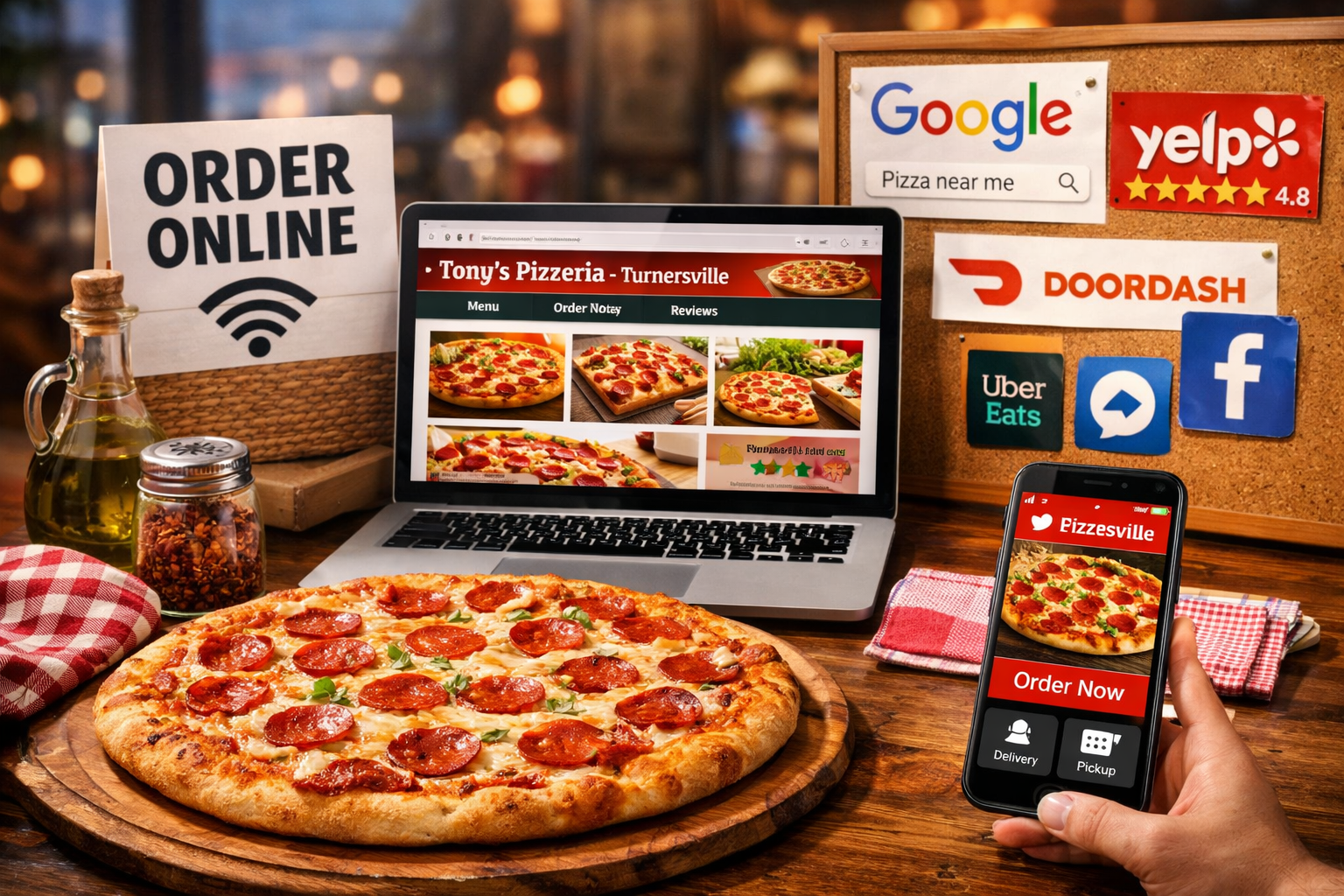
Running a pizza shop in Turnersville is not for the faint of heart. You're competing against the Domino's on Black Horse Pike, the Pizza Hut that's been there for decades, the growing number of regional chains pushing into Gloucester County, and every other independent pizzeria within a five-mile radius all fighting for the same Friday night order. The margins are tight, the hours are long, and the customer's loyalty lasts exactly as long as your last slice was good.
But here's what the chains have that most independent pizza shops in Turnersville don't — and it has nothing to do with the food. It's their online presence. Domino's and Pizza Hut spend millions on digital infrastructure, apps, SEO, and paid advertising. They show up everywhere, order from everywhere, and stay top of mind even when a customer hasn't thought about them in weeks.
The good news is that you don't need a million-dollar budget to compete digitally. You need a smart, hyperlocal strategy built specifically for a community like Turnersville — one that leverages your independence, your local roots, and your ability to connect with customers in ways that a national chain never can.
This guide covers everything: how to get found on Google, how to compete on delivery apps, how to build a social media following that turns into real orders, how to use email and text marketing to keep customers coming back, and how to build a review reputation that makes you the obvious choice when someone in Washington Township is hungry and reaching for their phone.
Let's get into it.
Section 1: Google — The First Place Hungry People Look
Before someone opens a delivery app, before they scroll Instagram, before they ask a neighbor for a recommendation — most people start with Google. "Pizza near me." "Best pizza Turnersville NJ." "Pizza delivery Washington Township." These searches happen hundreds of times every month within a few miles of your shop, and where you show up in those results directly determines how many of those searches turn into orders.
Google's local results — the map pack that shows three businesses at the top of the page — is prime real estate for any pizza shop. Getting there and staying there requires deliberate, consistent effort across several fronts.
Your Google Business Profile is everything. This is the free listing that shows your business name, address, phone number, hours, photos, menu, reviews, and ordering link directly in Google search results and on Google Maps. For a pizza shop, a fully optimized Google Business Profile is arguably more important than your website. When someone searches "pizza Turnersville NJ" on their phone, they are not necessarily going to click through to a website — they're looking at the map pack, reading your reviews, checking your hours, and either calling you or tapping your ordering link right then and there.
Claim your profile if you haven't already, and then fill out every single field completely. Business name, address, phone number, website, hours — including accurate holiday hours — and service options. Make sure you have "dine-in," "takeout," and "delivery" checked if you offer all three. Upload your full menu directly to your profile. Google allows you to add menu items with photos, descriptions, and prices — do this for every item you offer because it gives customers a reason to stay on your listing longer and helps Google understand what you sell.
Add a direct ordering link to your profile. If you have your own online ordering system, link directly to it. If you use a third-party platform like Slice, Toast, or Square, link to your ordering page there. Make it as frictionless as possible for someone to go from finding you on Google to placing an order.
Photos are critical for a food business in a way they aren't for most other industries. People eat with their eyes first, and a Google Business Profile for a pizza shop with no photos — or worse, blurry, poorly lit photos — is a missed opportunity every single day. Invest in even one afternoon of decent food photography. You don't need a professional photographer — a newer iPhone in good natural light can produce images that are genuinely compelling. Photograph your best pies, your specialty slices, your calzones, your wings, your shop front, your oven, your team. Upload at least 30 to 40 photos to start and add new ones regularly. Businesses with more photos consistently get more views, more direction requests, and more clicks than those with fewer.
Optimize for the searches people actually use. Your Google Business Profile description and your website copy need to include the specific phrases Turnersville-area customers are searching. Think beyond just "pizza" — people search for "best pizza near Turnersville," "pizza delivery 08012," "Sicilian pizza Washington Township," "gluten free pizza Blackwood NJ," "pizza specials near me tonight." Incorporate these naturally into your profile description, your website homepage, and your menu page descriptions. You're not stuffing keywords — you're speaking the same language your customers are using when they're hungry.
Local SEO on your website. Your website needs to make it crystal clear to Google that you are a pizza shop located in Turnersville, NJ serving the surrounding Gloucester County communities. Your homepage should reference Turnersville, Washington Township, Sewell, Blackwood, and any other delivery zones you cover. Create a dedicated delivery zone page that lists every neighborhood and zip code you deliver to. If you have a blog or news section, use it — even occasional posts like "New Menu Items for Spring at Our Turnersville Location" or "We Now Deliver to Sicklerville" give Google fresh, locally relevant content to index.
Make sure your name, address, and phone number are displayed consistently in the footer of every page on your website, and that they exactly match what's in your Google Business Profile and every other directory listing online. Consistency across the web is a foundational local SEO signal.
Section 2: Delivery Apps — Play the Game Without Losing Your Margin
Like it or not, delivery apps are a significant part of how people order pizza in 2024. DoorDash, Uber Eats, and Grubhub collectively drive a massive volume of orders for pizza shops across the country, and in a suburban market like Turnersville and Washington Township, a meaningful percentage of your potential customer base uses these platforms regularly.
The challenge is that the economics of third-party delivery apps are genuinely hostile to independent restaurants. Commission rates of 15 to 30 percent per order eat deeply into already thin margins. Many pizza shop owners find themselves working harder to fulfill more orders while taking home less money per order than they did before apps existed. The platforms also own the customer relationship — when someone orders from you on DoorDash, DoorDash has their contact information, not you.
None of this means you should avoid delivery apps entirely. It means you need to approach them strategically.
Be present on the major platforms but treat them as a customer acquisition channel, not a profit center. Your goal on DoorDash, Uber Eats, and Grubhub is not to maximize per-order margin — it's to get your pizza in front of people who don't know you yet and convert them into direct customers over time. Someone who orders from you on DoorDash and loves your pizza is a potential lifetime customer. If you can convert even a fraction of app customers to ordering directly from you in subsequent orders, the apps have served their purpose.
Optimize your listings on every platform. Your menu photos, item descriptions, pricing, and store hours need to be accurate and appealing on every platform you're on. The same principle that applies to Google photos applies here — people scroll through dozens of options on these apps and make decisions almost entirely based on photography and reviews. Blurry photos and sparse descriptions cost you orders. Strong photography and compelling item descriptions win them.
Build your own direct ordering system and actively migrate customers to it. Every pizza shop should have a first-party online ordering option — either through their own website or through a low-commission platform like Slice, which is built specifically for independent pizzerias and charges significantly less than DoorDash or Uber Eats. When a customer picks up an order or you fulfill a delivery, include a simple card or receipt insert that says something like: "Order directly at [website] or call [number] and save — no app fees." A small discount incentive for direct orders can accelerate this migration. Over time, shifting even 20 to 30 percent of your app orders to direct channels meaningfully improves your bottom line.
Manage your ratings on every platform. Your star rating on DoorDash and Uber Eats affects how prominently your restaurant is featured in search results within the app. A pizza shop with a 4.8 rating gets significantly more visibility than one with a 4.1. Respond to negative reviews professionally and promptly. If there's a recurring issue — cold deliveries, wrong orders, excessive wait times — address the operational root cause rather than just managing the symptom. App reviews compound over time, and a strong rating on multiple platforms is a genuine competitive asset.
Use the apps' promotional tools selectively. Both DoorDash and Uber Eats offer paid promotional options — featured placement, sponsored listings, first-order discounts. These can drive volume during slow periods or when you're trying to build awareness in a new area. Use them carefully and track the actual margin impact. A promotion that drives orders at a net loss is not a successful promotion, even if the order volume looks impressive.
Section 3: Social Media — Make Your Pizza Impossible to Ignore
If there is one industry where social media marketing is almost unfairly powerful, it's food. Pizza is inherently visual, inherently craveable, and inherently shareable. A well-shot photo or video of a perfect pepperoni pie coming out of the oven triggers an immediate, visceral response in anyone who sees it. That's your marketing advantage — and most independent pizza shops in Turnersville are not using it anywhere near effectively enough.
Instagram: Your most important visual platform. Instagram is where food content thrives, and a well-run pizza shop Instagram account is one of the most cost-effective marketing tools available to you. The content strategy is simple in concept even if it requires consistency to execute: post beautiful, appetizing content of your food several times per week, tag your location in every post, engage with followers who comment, and use local hashtags that put your content in front of Turnersville and Gloucester County residents.
Photography matters enormously here. You don't need elaborate setups — you need good lighting, a clean background, and a camera that can capture the detail of melted cheese, crispy crust, and fresh toppings. Natural light near a window is ideal. Shoot from above for flat lays, from the side to show crust height and layers, and close up to capture texture. Post your best-looking pies, your specialty items, your seasonal specials, your behind-the-scenes process. Variety keeps your feed interesting and your followers engaged.
Use Instagram Stories and Reels aggressively. Reels — short video content — get dramatically more reach than static posts because Instagram's algorithm actively pushes them to non-followers. A 15 to 30 second video of a pizza being pulled from the oven, cheese being stretched, or a time-lapse of a busy Friday night in your kitchen can reach thousands of people in Turnersville and surrounding areas who have never heard of your shop. Do this consistently and your following will grow steadily with genuinely local, food-interested people.
Facebook: Where your core local community lives. Facebook's average user skews older than Instagram, and in a suburban South Jersey community like Turnersville, Facebook remains the platform where local homeowners, families, and longtime residents spend significant time. Maintain an active Facebook Business Page, post your Instagram content there as well, and use Facebook's paid advertising capabilities to target local residents with highly specific promotions.
Facebook ads for a pizza shop can be extraordinarily targeted and cost-effective. You can show a "Friday night pizza special" ad exclusively to adults within a 5-mile radius of your shop between 4 PM and 8 PM on Fridays. You can retarget people who have visited your website. You can create a lookalike audience based on your existing customers. For $10 to $20 per day during peak ordering windows, a well-executed Facebook ad campaign can drive a meaningful and measurable increase in orders.
Join and participate in local Facebook groups — Washington Township community groups, Turnersville neighborhood pages, South Jersey food groups. Don't spam them with promotions. Be a genuine community participant. When someone asks for pizza recommendations, your satisfied customers will mention you. When you have a legitimate announcement — a new menu item, a fundraiser night for a local school, a special event — share it appropriately. Community presence on Facebook translates directly into customer loyalty in a tight-knit area like Turnersville.
TikTok: The underdog channel with massive upside. TikTok might seem like it's for teenagers, but its user base has expanded dramatically and its algorithm has a unique capability that no other platform matches: it can make a video from a completely unknown account go viral to a highly relevant local audience with zero paid promotion. Pizza content performs exceptionally well on TikTok — searches for pizza-related content on the platform generate billions of views.
You don't need to be a video production expert. Some of the best-performing food content on TikTok is raw, unpolished, and authentic — a cook showing how they stretch dough, a behind-the-scenes look at a busy Saturday night, a piping hot pizza being boxed up for delivery. The key is consistency and authenticity. Post three to five times per week, use trending audio where appropriate, and include location tags and local hashtags. One video going moderately viral in the South Jersey area can generate more new customers than months of other marketing activity.
Run a referral or user-generated content campaign. Encourage your customers to post photos of their orders and tag your shop. Repost their content. Run a monthly contest — best pizza photo tagged with your handle wins a free pie. User-generated content is free advertising from people your potential customers already trust, and it signals to the algorithm that real people are engaging with your brand.
Section 4: Email and Text Marketing — The Most Direct Line to Your Best Customers
Your regulars are your most valuable asset. The family that orders every Friday night, the office that places a catering order twice a month, the couple that comes in for date night every other week — these customers generate a disproportionate share of your revenue and are far more profitable than constantly chasing new ones. Email and text marketing is how you make sure those customers never forget about you and always feel like insiders.
Build your list from day one. Every customer interaction is an opportunity to capture contact information. Online orders automatically give you an email address and phone number — make sure your ordering system is storing this data in a way you can access and use. For in-store customers, offer a simple loyalty sign-up — either a paper form, a tablet at the counter, or a QR code that links to a quick form. Offer a small incentive: "Sign up for our text deals and get $3 off your next order." Even a modest list of 500 to 1,000 local customers is a powerful marketing asset.
Text marketing: The highest open rates in marketing. Text messages have open rates north of 90 percent — dramatically higher than email, social media, or any other channel. When you send a text to your customer list, almost everyone reads it. This makes it the most direct marketing channel available to you, which also means you need to use it respectfully. Don't text more than two to four times per month. Make every message genuinely valuable — a real deal, an exclusive offer, a time-sensitive promotion, a meaningful announcement. "It's Friday — get 20% off any large pie tonight only, use code FRIDAY20 at [ordering link]" sent to 800 customers at 4 PM on a Friday will generate orders. Platforms like Podium, Attentive, or even a simple tool like EZTexting make managing a text subscriber list straightforward and affordable.
Email marketing: Less urgent, more relationship-building. Email is better suited for longer-form communication — a monthly newsletter featuring new menu items, a story about your shop's history in Turnersville, a spotlight on a staff member, a preview of an upcoming seasonal menu, a catering promotion for the holidays. Email builds the sense that your customers are part of something — a community, a loyal following of people who are in on what's happening at your shop. It doesn't drive the same immediate spike in orders that a well-timed text does, but it builds the kind of relationship that keeps customers coming back for years.
Loyalty programs drive repeat business. A simple digital loyalty program — buy ten pizzas, get one free — gives customers a tangible reason to keep coming back to you instead of trying a competitor. Tools like Stamp Me, Fivestars, or loyalty features built into platforms like Toast or Square make running a program easy without requiring a physical punch card. The data a loyalty program generates is also incredibly valuable — you can see exactly who your most frequent customers are, what they order, and when they tend to order, which lets you market to them with precision.
Segment your list and personalize where possible. Not every customer is the same. Your Friday night delivery customers respond to different messages than your Sunday lunch dine-in regulars. Your catering customers need to hear about bulk deals and event packages, not individual pie specials. As your list grows, segment it by order type, frequency, and preferences so that the messages you send feel relevant rather than generic. Even basic personalization — using a customer's first name in a text or email — meaningfully increases engagement rates.
Section 5: Reviews and Online Reputation — Your Digital Word of Mouth
In Turnersville, word of mouth has always been the lifeblood of independent businesses. Your grandmother's friends tell your grandmother's friends, the guy at the barbershop recommends you to his clients, a happy customer mentions you at the school pickup line. That word-of-mouth ecosystem is alive and well — but today, it lives primarily online.
Online reviews are the digital version of a personal recommendation. When a new resident moves to Washington Township and searches for a local pizza shop, they have no existing relationships to draw on. They look at Google reviews, they check Yelp, they glance at your Facebook rating. The shop with 150 Google reviews averaging 4.7 stars is, in that moment, the equivalent of being recommended by 150 neighbors they haven't met yet. That's the power of a strong review profile, and building it should be a deliberate, ongoing priority.
Google reviews are the priority. More than any other platform, Google reviews directly impact your visibility in local search results and your conversion rate when someone finds your listing. A pizza shop with fewer than 30 Google reviews is leaving an enormous amount of business on the table. A shop with 100 or more reviews averaging above 4.5 is a formidable competitor regardless of its marketing budget in almost every other area.
The most effective way to build reviews is embarrassingly simple: ask. After every positive interaction — when a customer compliments the food, when a regular picks up their order and mentions they love the place, when a catering event goes well — ask them directly to leave a Google review. Send a follow-up text to online ordering customers with a direct link to your review page. Train your counter staff to mention reviews to happy customers. The vast majority of people who have a great experience at a local restaurant would happily leave a review if someone just asked them to.
Yelp, Facebook, and delivery app reviews all matter too. While Google is the priority, a strong presence across multiple review platforms reinforces your reputation and helps you show up in more search contexts. Maintain active, complete profiles on Yelp and Facebook, and actively encourage reviews on those platforms as well. Your delivery app ratings on DoorDash and Uber Eats affect your in-app visibility and directly influence whether new customers choose you over a competitor.
Responding to reviews is non-negotiable. Respond to every Google review — positive and negative. For positive reviews, a genuine, specific thank-you that mentions what the customer ordered or references something personal shows that a real person is paying attention, not just auto-responding. For negative reviews, respond calmly and professionally, acknowledge the issue, apologize genuinely, and offer to make it right. Do not get defensive, do not argue with the customer publicly, and do not ignore negative reviews hoping they'll be forgotten. Potential customers read negative reviews and your responses carefully. A pizza shop owner who handles criticism with grace and a commitment to improvement is more trustworthy, not less, than one with a perfect rating and no reviews at all.
Monitor your reputation proactively. Set up Google Alerts for your business name so you're notified whenever it's mentioned online. Check your reviews on all platforms at least weekly. If a recurring theme appears in negative feedback — slow delivery times, a specific menu item that consistently disappoints, a staff interaction issue — treat it as actionable operational intelligence, not just noise to be managed. Your reviews are one of the most honest sources of customer feedback you have access to.
Section 6: Your Website — The Hub That Ties Everything Together
Every marketing channel you invest in — Google Ads, social media, delivery apps, email campaigns — ultimately points somewhere. For most pizza shops, that somewhere should be your website and your online ordering system. A weak, outdated, or hard-to-use website undermines every other marketing effort you're making.
Mobile-first design is non-negotiable. The overwhelming majority of people who find your pizza shop online are doing it on a phone, and they're probably hungry when they do it. If your website is slow, hard to navigate on a small screen, or makes it difficult to find your menu and ordering option, you are losing customers at the final step. Your website needs to load in under three seconds on mobile, display your menu clearly and attractively, and make the path from landing on the homepage to placing an order as short as possible — ideally two taps or fewer.
Online ordering built into your website. The gold standard for a pizza shop website is having a seamless online ordering system integrated directly into the site so customers never have to leave to place an order. Platforms like Slice, Toast Online Ordering, Square for Restaurants, or Olo all offer embeddable ordering systems designed for independent restaurants. Yes, these platforms have fees — but they are dramatically lower than third-party delivery app commissions, and crucially, when a customer orders through your website, you own that customer relationship and their contact information.
A menu that sells. Your online menu is a marketing asset, not just an informational list. Every item should have a name, a clear and appetizing description, accurate pricing, and where possible a high-quality photo. "Large Pepperoni Pizza — $14.99" is a transaction. "Our hand-stretched Neapolitan-style dough topped with house-made marinara and premium pepperoni, finished in our 700-degree stone deck oven — $14.99" is an experience. Write menu descriptions that make people hungry. Photograph your best-selling items so customers know exactly what to expect and are excited to order it.
Local SEO built into every page. As covered in the Google section, your website needs to signal clearly to search engines that you are a pizza shop in Turnersville, NJ. Your homepage, menu page, about page, and contact page should all naturally include references to Turnersville, Washington Township, Sewell, Blackwood, and the specific zip codes and neighborhoods you serve. Your page titles and meta descriptions — the text that appears in Google search results — should include location-specific keywords. A page title like "Pizza Delivery in Turnersville & Washington Township NJ | [Your Shop Name]" will rank better for local searches than just "[Your Shop Name] — Pizza."
A blog or news section keeps your site fresh. Google rewards websites that publish fresh, relevant content regularly. For a pizza shop, this doesn't have to be elaborate — a post announcing a new specialty pizza, a write-up about your shop's history in Turnersville, a piece about your catering services for Gloucester County events, or a seasonal menu announcement all give Google new content to index and give customers a reason to revisit your site.
Section 7: Hyperlocal Community Marketing — The Independent Pizza Shop's Secret Weapon
Here is where independent pizza shops in Turnersville have an advantage that Domino's and Pizza Hut simply cannot replicate: you are part of the community in a way that a national chain never will be. You sponsor the little league team. You know the regulars by name. You've been feeding Washington Township families for years. That community connection is marketing gold — but only if you're actively using it online as well as in person.
School and organization fundraiser nights. Partner with local Washington Township schools, sports teams, churches, and community organizations for fundraiser nights — where a percentage of every order placed that night goes back to the organization. These events drive volume on otherwise slow nights, but more importantly they create genuine community goodwill and generate organic social media posts from parents, coaches, and community members sharing that they're supporting your shop. Every fundraiser night is also an opportunity to collect new customer contact information and introduce your pizza to people who may not have tried it before.
Sponsor local events and be visible at them. Washington Township youth sports, community festivals, school events — sponsoring these with a banner or a pizza donation gets your name in front of the exact demographic most likely to become regular customers. Photograph your involvement at these events and post it on social media. "Proud to sponsor Washington Township Little League" with a photo of your team at the field is the kind of content that resonates deeply in a community like Turnersville and gets shared by people who care about local sports.
Partner with other local businesses. Build relationships with complementary local businesses — movie theaters, bowling alleys, sports facilities, event venues — and create cross-promotional arrangements. A family that books a birthday party at a local venue is a perfect target for a pizza catering partnership. A business that orders office lunches twice a week is worth a dedicated corporate account with preferential pricing. These B2B relationships are often more stable and more lucrative than chasing individual consumer orders.
Engage authentically on Nextdoor. As discussed in our landscaper blog, Nextdoor is one of the most underused local marketing platforms for small businesses. Turnersville and Washington Township residents use it constantly to ask for local recommendations. Claim your free Nextdoor Business Page, encourage satisfied customers to recommend you on the platform, and consider their paid local advertising options. When someone posts "looking for good local pizza near Turnersville," you want your name to come up — either organically from happy customers or through a prominent business listing that surfaces in the thread.
Section 8: Paid Advertising — When and How to Use It
Organic marketing — SEO, social media content, reviews, community presence — is the foundation. Paid advertising is the accelerant. When your organic presence is solid, paid ads amplify it. When you have a specific promotion to push or a slow period to fill, paid ads give you an immediate lever to pull.
Google Ads for high-intent searches. Someone who searches "pizza delivery Turnersville NJ tonight" is as high-intent as a customer gets — they've already decided they want pizza, they've specified their location, and they're looking for someone to order from right now. A Google Ad that puts your shop at the top of that search result, with your phone number, ordering link, and star rating prominently displayed, converts at an extremely high rate. Target your campaigns tightly to your delivery radius, use specific location-based keywords, and run call extensions so mobile users can call directly from the ad without clicking through to a website.
Facebook and Instagram ads for awareness and promotions. Use social media ads to push specific promotions to a hyperlocal audience. A Friday afternoon ad showing your best-looking specialty pie with "Order Now — Free Delivery Tonight Only" targeted to adults within five miles of your shop between 3 PM and 7 PM will drive orders. Retarget website visitors who didn't order. Build lookalike audiences based on your email list. Run awareness campaigns during the week to stay top of mind for the weekend. The targeting precision available through Facebook's ad platform is genuinely extraordinary for a local food business with a modest budget.
Promote catering and group orders separately. Catering is a high-margin, high-value revenue stream that most pizza shops underpromote digitally. Run dedicated campaigns targeting local businesses, event planners, sports organizations, and families planning parties or gatherings. A single catering order can be worth what five or six individual delivery orders are worth. Create a dedicated catering page on your website, include catering prominently in your Google Business Profile services, and run specific ads promoting your catering capabilities to business owners and event planners in the Turnersville and Washington Township area.
The Bottom Line
Domino's has a $200 million annual marketing budget. Pizza Hut has been a household name since before most of us were born. The chains are not going away, and pretending they're not competition would be foolish.
But they have something you will never have: a real connection to Turnersville. They don't know your regulars by name. They're not sponsoring the Washington Township little league. They're not the shop that fed a family every Friday night for fifteen years and watched the kids grow up. They're a transaction. You can be a relationship.
Digital marketing is how you turn that relationship — that genuine community embeddedness — into a competitive advantage that shows up in search results, social feeds, delivery apps, and inboxes. It's how you make sure that when someone new moves to Turnersville and searches for their new go-to pizza spot, your name is the one they find first. And it's how you make sure the customers who already love you never have a reason to try somewhere else.
At Ritner Digital, we help independent restaurants and local businesses in South Jersey build the kind of online presence that drives real, measurable revenue. If you own a pizza shop in Turnersville, Sewell, Blackwood, Washington Township, or anywhere in Gloucester County and you're ready to compete — let's talk.
Contact Ritner Digital Today →
Frequently Asked Questions
What is local SEO and why does it matter for my pizza shop?
Local SEO is the process of optimizing your online presence so that your business shows up prominently when people nearby search for what you offer. For a pizza shop in Turnersville, that means showing up when someone types "pizza near me," "pizza delivery Washington Township NJ," or "best pizza Blackwood NJ" into Google. The higher you rank in those results — and especially in Google's map pack, the three businesses shown at the top of local search results — the more phone calls, website visits, and online orders you generate. Local SEO is different from general SEO in that it focuses heavily on your Google Business Profile, your reviews, your local citations, and the geographic relevance of your website content. For an independent pizza shop competing against national chains with massive marketing budgets, strong local SEO is one of the most powerful equalizers available.
How do I get my pizza shop to show up in Google's map pack?
Google's map pack — the three local business listings that appear at the top of search results alongside a map — is determined by three primary factors: relevance, distance, and prominence. Relevance means your Google Business Profile and website clearly communicate that you are a pizza shop serving Turnersville and surrounding areas. Distance means Google is trying to match searchers with businesses geographically close to them. Prominence is your overall online reputation — the number and quality of your reviews, how complete and active your Business Profile is, how consistent your business information is across the web, and how many other sites link to yours. The most impactful steps you can take right now are claiming and fully completing your Google Business Profile, uploading high-quality food photos, building your review count aggressively, and making sure your name, address, and phone number are consistent across every online directory.
Should my pizza shop be on DoorDash, Uber Eats, and Grubhub?
Being present on the major delivery platforms is generally worthwhile, but the way you approach them matters enormously. Third-party apps charge commission rates of 15 to 30 percent per order, which can devastate margins on already thin pizza economics. The smart approach is to treat the apps as a customer acquisition channel rather than a primary revenue source — use them to get your pizza in front of people who don't know you yet, then actively work to convert those customers to ordering directly from you in the future. Include a card or insert with every delivery order that offers a small discount for ordering directly through your website next time. Over time, shifting even 20 to 30 percent of app orders to direct channels makes a meaningful difference to your bottom line. Also make sure your ratings and photos on every platform are as strong as possible, since your in-app star rating directly affects how prominently you appear in app search results.
What is the best social media platform for a pizza shop in Turnersville?
Instagram is the highest-priority platform for most pizza shops because food content is inherently visual and Instagram's algorithm actively distributes food photography and video to users who engage with similar content. A well-maintained Instagram account with consistent, appetizing content — posted at minimum three to four times per week — builds a local following that translates directly into orders over time. Facebook is equally important for reaching the Turnersville and Washington Township community, particularly for paid advertising targeting local homeowners and families. TikTok has enormous organic reach potential and pizza content performs exceptionally well there — even a single video that gains modest traction in South Jersey can introduce your shop to hundreds of new potential customers at zero cost. The honest answer is that you should be active on all three, but if you're resource-constrained and have to prioritize, start with Instagram and Facebook, then add TikTok as your capacity allows.
How often should I post on social media and what kind of content works best?
Consistency matters more than frequency — three high-quality posts per week will outperform seven mediocre ones every time. For content, the hierarchy is roughly: short-form video first, then strong photography, then everything else. Videos of pizza coming out of the oven, cheese pulls, dough being stretched, and time-lapses of busy nights consistently outperform static images in reach and engagement on every platform. Behind-the-scenes content — showing your kitchen, your team, your process — builds the authenticity and personality that differentiates an independent shop from a faceless chain. Promotional content like specials and limited-time offers should make up no more than a third of your posts — the rest should be content that people genuinely want to see, not just ads. Always tag your location in every post and use local hashtags like #TurnersvilleNJ, #WashingtonTownshipNJ, and #SouthJerseyFood to maximize your visibility with the right audience.
How should I use email and text marketing without annoying my customers?
The key principle is simple: only send messages that are genuinely valuable to the recipient. Text marketing has extraordinarily high open rates — above 90 percent — which makes it your most direct marketing channel, and also the one where abuse of the privilege will cost you the most. Limit texts to two to four per month maximum and make every single one count — a real deal, a time-sensitive offer, a meaningful announcement. Email can be slightly more frequent and slightly more informational — a monthly newsletter covering new menu items, seasonal specials, community involvement, or staff spotlights builds relationship without feeling like constant promotion. Always make it easy to unsubscribe, always deliver on whatever incentive you used to get someone to sign up, and always give customers a reason to stay on your list by consistently providing value. A list of 500 engaged, local subscribers is worth far more than a list of 5,000 people who ignore everything you send.
How important are online reviews for a pizza shop and how do I get more of them?
Reviews are among the most important factors in whether a new customer chooses your shop over a competitor. When someone moves to Turnersville or Washington Township and searches for a local pizza shop, they have no existing loyalty and no personal recommendation to rely on — they look at your star rating and review count and make a judgment in seconds. A shop with 120 reviews averaging 4.7 stars wins that judgment almost every time, regardless of whether the food is actually better than the shop with 18 reviews and a 4.2. The most effective way to build reviews is also the simplest: ask every satisfied customer directly. After a positive interaction, send a text with a direct link to your Google review page. Train counter staff to mention reviews to happy customers. Include a review request on your receipt or order confirmation. Most people who love your pizza will happily leave a review if someone asks them to — the barrier is not willingness, it's remembering to do it without a prompt.
How much should a pizza shop in Turnersville budget for digital marketing?
Budget requirements vary based on your current online presence, your revenue goals, and how competitive your local market is. As a general baseline, a pizza shop doing under $400,000 in annual revenue should be investing at minimum $500 to $1,500 per month in digital marketing covering Google Business Profile management, basic SEO, and a modest social media and paid ad presence. A shop in the $400,000 to $800,000 range should be thinking $1,500 to $3,500 per month to maintain strong local visibility, run effective Google and social media ad campaigns, and manage their review and reputation strategy across platforms. Shops pushing toward seven figures and above typically invest $3,500 to $6,000 per month or more across all channels. The critical mindset shift is to evaluate marketing spend against customer lifetime value — a customer who orders from you twice a month for five years is worth thousands of dollars in revenue. Spending $30 to $50 to acquire that customer through digital advertising is an exceptional return on investment.
What kind of ROI can I realistically expect from digital marketing for my pizza shop?
ROI depends heavily on which channels you invest in and how well they're executed, but here are some realistic benchmarks. A well-managed Google Ads campaign targeting pizza delivery searches in Turnersville typically generates orders at a cost of $4 to $12 per order, depending on your average order value and conversion rate — for most pizza shops, that's a strong positive return. Local SEO has a slower build but a much lower long-term cost per order once rankings are established, since organic traffic is essentially free. Email and text marketing to your existing customer list typically produces the highest ROI of any channel because you're marketing to people who already like you and are inclined to order — the cost per order through these channels is often under $1. Social media advertising falls somewhere in the middle — Facebook and Instagram ads for local food businesses typically generate orders at a cost of $5 to $15 per order when well-targeted and well-executed. The businesses that see the strongest overall ROI are the ones that invest across multiple channels simultaneously and track results rigorously so they can double down on what works.
Can I manage my pizza shop's digital marketing myself or do I need to hire someone?
Some elements of digital marketing are genuinely manageable in-house without specialized expertise — maintaining your Google Business Profile, posting on social media, sending seasonal emails, responding to reviews, and asking customers for Google reviews are all things you or a trusted staff member can handle effectively. Where DIY tends to fall short is in the more technical and strategic areas: Google Ads management, local SEO optimization, website performance, and building a cohesive multi-channel strategy. Poorly managed Google Ads campaigns routinely waste 40 to 60 percent of their budget on irrelevant clicks — an experienced manager pays for themselves quickly in reduced waste alone. The honest answer is that a hybrid approach works well for most independent pizza shops: handle the day-to-day content and community engagement yourself, and bring in professional help for the technical infrastructure, paid advertising, and strategy.
How long does it take to see results from digital marketing for a pizza shop?
It depends significantly on the channel. Google Ads can put you at the top of search results within 24 to 48 hours of launching — results are immediate but require ongoing spend to maintain. Social media advertising can generate orders within days of a well-executed campaign launch. Local SEO is a longer build — most businesses start seeing meaningful ranking improvements within three to six months of consistent effort, with the full impact typically felt at the nine to twelve month mark. Review building compounds over time — each new review makes the next one slightly easier to get and slightly more impactful on your rankings. Email and text marketing produce results almost immediately once you have a list of sufficient size to market to. The overall pattern is that digital marketing rewards consistency and patience — businesses that commit to it for a full year almost universally see compounding returns that make the investment look obvious in hindsight.
What is the single most important thing I can do right now to improve my pizza shop's online presence?
Claim, complete, and actively manage your Google Business Profile. It is free, it is the most direct lever you have for improving your visibility in local search, and it is criminally underutilized by most independent pizza shops. Upload at least 30 high-quality food photos. Fill in every field including your full menu with photos and descriptions. Make sure your hours are accurate including holidays. Add a direct ordering link. Write a keyword-rich business description that mentions Turnersville, Washington Township, and your surrounding service area. Then immediately start asking every single customer — in person, via text, on your receipts — to leave you a Google review. If you do nothing else this month, doing this one thing well will generate more new customers than almost any other marketing activity you could invest your time or money in. Everything else in this guide builds on top of this foundation.