Happy National Cheesesteak Day: How Philly's Most Iconic Steak Shops Market Themselves — And What Every Local Business Can Learn From Them
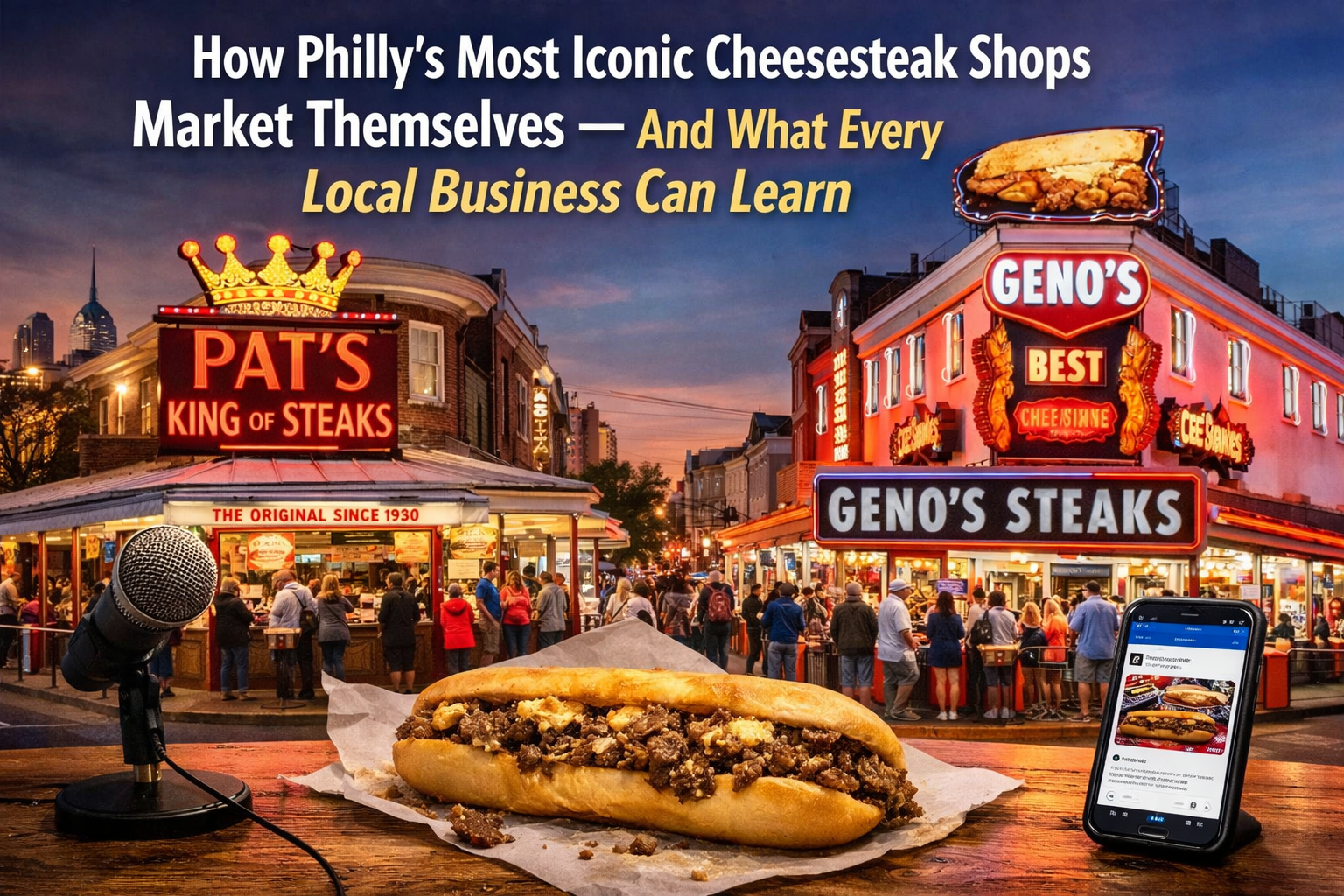
Today is National Cheesesteak Day. And if you're reading this anywhere near South Jersey or the Philadelphia metro area, you already know this isn't some made-up holiday dreamed up by a marketing department at a snack food company. This is real. This is sacred. This is an event that shuts down offices, starts arguments at lunch counters, and sends people standing in lines that wrap around corners in South Philly on a Tuesday afternoon.
The Philly cheesesteak is one of the most recognized regional foods in America — a sandwich so culturally loaded that it has its own etiquette, its own vocabulary, and its own decades-long rivalries that play out on street corners and in comment sections with equal ferocity. The shops that make them have become institutions. Their names — Pat's, Geno's, Jim's, Tony Luke's, Dalessandro's, John's Roast Pork, Steve's Prince of Steaks, Campo's, and the explosive newcomer Skinny Joey's — carry the kind of brand weight that most businesses spend millions trying to build.
At Ritner Digital, we think about marketing the way other people think about cheesesteaks — obsessively, with strong opinions, and always looking for what separates the great from the merely good. So in honor of National Cheesesteak Day 2026, we did a deep dive into how Philadelphia's most famous steak shops actually market themselves. What are they doing right? What are they leaving on the table? And what can every local business — whether you're a restaurant in South Philly or a landscaper in Turnersville — learn from the way these legendary spots have built and maintained their brands?
Let's get into it.
Pat's King of Steaks: The Original and the Blueprint for Legacy Marketing
There is no conversation about Philly cheesesteaks that doesn't start with Pat's. Founded in 1930 by Pat Olivieri — who, according to the story, threw beef on his hot dog grill one afternoon and accidentally invented one of America's great sandwiches — Pat's King of Steaks at 9th and Passyunk is the originator. The godfather. The one that made everything else possible.
From a pure marketing standpoint, Pat's has something that money genuinely cannot buy: provenance. They invented the thing. Every single time anyone anywhere talks about the history of the Philly cheesesteak, Pat's gets mentioned first. That is earned media of the highest order, and it has been compounding for nearly a century.
Brand identity and storytelling. Pat's leans into its origin story without apology. The "King of Steaks" name is not subtle — it is a declaration of dominance backed by 96 years of operation at the same corner. The neon signs, the 24-hour operation, the outdoor seating on metal tables under the night sky — everything about the physical experience of Pat's reinforces the brand narrative that this is where it began and nothing has changed because nothing needs to. That consistency is itself a marketing strategy. Pat's is not trying to be trendy. It is trying to be eternal.
Google presence and local SEO. Pat's benefits enormously from the volume of organic search traffic generated by its legendary status. Searches for "best Philly cheesesteak," "Pat's King of Steaks," and "cheesesteak Philadelphia" collectively generate enormous traffic, and Pat's shows up consistently across review platforms, food publications, travel guides, and media coverage. Their Google Business Profile benefits from thousands of reviews from tourists and locals alike — the kind of review volume that most businesses spend years trying to build. The lesson here is that earned media — press coverage, word of mouth, cultural significance — is the most powerful SEO signal there is, and it compounds over decades.
The rivalry as marketing. Pat's relationship with Geno's — located directly across the intersection — is one of the most effective ongoing marketing stunts in the history of local business. The two shops facing off at the corner of 9th and Passyunk generates endless media coverage, social media debate, tourist pilgrimage, and organic content from every food writer, travel blogger, and casual visitor who makes the trip. Neither shop has to manufacture that tension — it's baked into the geography. But both benefit from it. For Pat's specifically, being one half of the great cheesesteak debate has kept them in national conversations for sixty years.
What Pat's could improve. For all its legend, Pat's social media presence is relatively modest compared to what a brand of its stature could command. A 24-hour cheesesteak shop at the birthplace of the sandwich, with a story that stretches back to 1930, has extraordinary content potential — late-night regulars, the ritual of ordering, the history embedded in every corner of that intersection. More consistent, high-quality social content would allow Pat's to reach younger audiences who experience food culture primarily through their phones before they ever experience it in person.
Geno's Steaks: Neon, Personality, and the Power of Being the Rival
If Pat's is the king, Geno's has spent sixty years being the loudest, most unapologetic challenger to the throne — and that positioning has made it one of the most recognizable cheesesteak brands in the world.
Geno's was founded in 1966 by Joey Vento across the intersection from Pat's. The Philadelphia Inquirer The orange-and-white stand wrapped in neon that glows 24 hours a day on Passyunk Avenue is one of the most photographed food destinations in Philadelphia. Joey Vento was famously outspoken — he donated heavily to local charities, took strong public positions on various issues, and was never shy about his opinions. That personality shaped the Geno's brand in ways that outlasted him.
Brand identity through visual distinctiveness. Geno's neon aesthetic is immediately recognizable. In an era before Instagram, before food photography was a cultural phenomenon, Geno's figured out that a visually striking physical environment generates its own word of mouth. People don't just eat at Geno's — they photograph it, they share it, they use it as a backdrop. The visual identity of the shop is inseparable from the brand identity of the shop, and that's not an accident.
Social media and community engagement. Geno's is active on social media under the handle @genossteaks The Philadelphia Inquirer and maintains a presence that reflects the brand's personality — opinionated, Philly-proud, and unafraid of a little bravado. For a cheesesteak shop, social media serves a specific purpose: keeping the brand top of mind for both locals who eat there regularly and the enormous tourist audience that plans Philadelphia visits partly around the cheesesteak experience. Geno's leverages both. Their content tends to lean into the rivalry with Pat's, the spectacle of their neon-lit corner, and the broader identity of South Philly pride.
Capitalizing on National Cheesesteak Day. Geno's has historically used National Cheesesteak Day to run promotions — offering discounts during specific hours NBC10 Philadelphia to drive traffic and generate social media conversation. This is smart tactical marketing: a food holiday that already has cultural momentum becomes an opportunity to create urgency, reward loyal customers, and generate coverage from local media outlets looking for a hook. Every local restaurant should be thinking this way about food holidays relevant to their menu.
Delivery and online ordering. Geno's is available on Uber Eats, GrubHub, and DoorDash The Philadelphia Inquirer, which represents a significant evolution for a shop that built its reputation on the walk-up window experience. The tension between the ritual of ordering at the window and the convenience of delivery app orders is real — part of what makes Geno's great is the experience of being there, which doesn't translate to a delivery bag. But the pragmatic reality is that delivery app presence expands the addressable market beyond people who can physically make the trip to 9th and Passyunk, and for a brand of Geno's stature, that reach matters.
Jim's Steaks: Resilience, Reinvention, and Earning Your Second Chapter
Jim's Steaks on South Street has one of the more remarkable recent stories in Philadelphia's food scene — not because of a marketing campaign, but because of what happened in the summer of 2022 and what came after.
Jim's South Street suffered a significant fire in 2022 that shut down the landmark for nearly a year and a half. The Philadelphia Inquirer When it reopened, it came back with a renovated space, an expanded footprint that absorbed the neighboring storefront, and new mosaic artwork created by artist Isaiah Zagar. The reopening was a genuine community event — covered extensively by local media, celebrated on social media, and welcomed back by a South Street neighborhood that had genuinely missed it.
The marketing power of a comeback story. Jim's reopening generated more media coverage and community goodwill than most planned marketing campaigns ever could. The lesson for any local business is profound: how you handle adversity defines your brand as much as how you handle success. Jim's didn't just reopen — it came back better. That narrative of resilience, commitment to the community, and investment in the space resonated deeply with both longtime customers and new ones who had never been before but showed up because the story moved them.
Local SEO and review volume. Jim's benefits from being one of the four or five names that come up in virtually every list of best Philly cheesesteaks, which means its organic search presence is substantial and largely self-sustaining. Tourists planning Philadelphia trips find Jim's through travel guides, food publications, and review aggregators — an enormous source of traffic that requires no paid advertising to maintain. What Jim's has to do is ensure that the in-store experience consistently justifies the reputation, because in the age of Google reviews, every single customer is a potential publisher.
South Street location as a marketing asset. Jim's location on South Street — one of Philadelphia's most visited corridors — means foot traffic marketing is built into the real estate. The line that regularly forms outside Jim's is itself a marketing signal to passersby: something worth waiting for is happening here. That's a form of social proof that no ad can replicate.
Tony Luke's: The Franchise Model and the Power of TV-Driven Brand Building
Tony Luke's represents a different archetype among Philly's great cheesesteak shops — it's not just a beloved local institution, it's a brand that has actively pursued national and international expansion through franchising, and its marketing strategy reflects that ambition.
Tony Luke's has been featured extensively on national food television, including the Travel Channel's Man v. Food and the competitive series Food Wars, Wikipedia where it went head-to-head with Pat's King of Steaks in a battle for best cheesesteak in Philadelphia. That kind of national television exposure is worth millions of dollars in advertising equivalent and it creates a durable, searchable record of media coverage that drives organic traffic for years after the original broadcast.
PR and media coverage as the primary growth engine. Tony Luke's approach to marketing has always leaned heavily on earned media — getting featured by journalists, TV producers, food writers, and travel guides rather than buying ads. The restaurant hosted international food personalities and television hosts Wikipedia who brought their own audiences to the brand. For an independent restaurant without a national advertising budget, this is exactly the right approach: invest in being worth covering, make yourself accessible to media, and let the coverage do the work.
Franchise expansion and brand consistency. Tony Luke's has grown beyond its South Philly roots through a franchise model that brings the brand to markets outside Philadelphia. From a marketing standpoint, this creates both opportunity and risk. The opportunity is obvious — wider distribution means more brand awareness and more revenue. The risk is that the authenticity and local specificity that made Tony Luke's compelling in the first place can get diluted when the brand is replicated in contexts far removed from South Philly. The shops that navigate franchise expansion best are the ones that codify and protect the elements of their brand identity that matter most — the food quality, the attitude, the story — while allowing appropriate flexibility in everything else.
Online ordering and delivery infrastructure. As a brand with multiple locations, Tony Luke's has more to gain from robust digital ordering infrastructure than a single-location shop. A seamless online ordering experience, consistent presence on delivery platforms, and a loyalty program that works across locations are all table stakes for a brand operating at Tony Luke's scale.
Dalessandro's: The Insider's Choice and the Marketing Power of Authenticity
If Pat's and Geno's are the famous ones that tourists seek out, Dalessandro's is the one that Philadelphians argue is actually the best — and that positioning is itself a powerful marketing strategy, even if it was never deliberately engineered.
Dalessandro's has been on a busy Roxborough corner since 1961 The Philadelphia Inquirer, and it has accumulated a devoted local following that treats it as a point of local pride distinct from the tourist circuit. Food writers have described Dalessandro's as the "Thinking Philadelphian's Cheesesteak" — the choice of someone who knows Philly well enough to go beyond the obvious options. PhillyVoice That framing, repeated across food publications and local conversations for years, has given Dalessandro's a brand identity that is genuinely differentiated from the more famous shops.
The insider brand. There is enormous marketing value in being the thing that locals recommend to people who want to get beyond the tourist version of a city. Dalessandro's has cultivated that position not through advertising but through consistent quality and word of mouth among people whose opinions carry weight — food critics, local journalists, longtime Philadelphians who care deeply about the subject. When the Philadelphia Inquirer, Bon Appétit, or a respected local food writer names Dalessandro's as a top pick, that credibility transfers to everyone who reads it and recommends it in turn.
What Dalessandro's teaches about niche positioning. For any local business, the lesson from Dalessandro's is that you don't have to compete for the mass market to build a powerful brand. Owning a specific, well-defined niche — in this case, the serious cheesesteak for people who care about quality over spectacle — can be more durable and more valuable than chasing broader recognition. The customers Dalessandro's attracts are exactly the customers it wants: people who have sought it out specifically, who appreciate what makes it different, and who become evangelists rather than one-time visitors.
Michelin recognition as a marketing milestone. When the Michelin Guide made its Philadelphia debut in 2025, Dalessandro's was among the three cheesesteak-related establishments recognized with the prestigious Bib Gourmand award. Visit Philadelphia That kind of third-party validation from one of the world's most respected culinary authorities is marketing gold — it legitimizes the insider reputation with a global stamp of approval and opens the brand to an entirely new audience of food-focused travelers who use the Michelin Guide to plan their dining experiences.
John's Roast Pork: The Reluctant Legend and the Power of Earned Reputation
John's Roast Pork is perhaps the most fascinating marketing case study in Philadelphia's food scene precisely because it has done almost no active marketing — and is still widely considered one of the best cheesesteak destinations in the city.
John's Roast Pork has been on the corner of Weccacoe and Snyder Avenue since 1930, when Domenico Bucci started the family business. Goldbelly The restaurant remained largely a neighborhood secret until 2002, when Philadelphia Inquirer food critic Craig LaBan conducted a comprehensive cheesesteak ranking and John's won in a landslide — generating nationwide notoriety almost overnight. Goldbelly The establishment was subsequently named an American Classic by the James Beard Foundation in 2006, Wikipedia cementing its status as one of the genuinely important cheesesteak destinations in the country.
Earned media as the entire marketing strategy. John's has never needed a marketing budget because the quality of the product attracted exactly the kind of attention that money can't buy. A James Beard award, consistent top rankings from serious food critics, and endorsements from respected food media personalities like Andrew Zimmern have created a self-sustaining reputation engine that keeps John's relevant and sought-after despite limited hours, a somewhat out-of-the-way location, and virtually no social media presence to speak of.
The lesson about quality as marketing. John's Roast Pork is the ultimate argument that product quality is the foundation of all marketing. No SEO strategy, no social media campaign, no advertising budget produces the kind of sustained reputation that John's has built simply by being genuinely excellent for decades and allowing that excellence to be discovered and shared organically. For any local business owner, this is both inspiring and instructive: before you invest in marketing, make sure what you're marketing is worth the investment.
Goldbelly and national reach. John's Roast Pork is available for nationwide shipping through Goldbelly, Goldbelly the food e-commerce platform that allows iconic regional restaurants to ship their products across the country. This is a smart digital extension of the brand that creates revenue from customers who cannot physically travel to South Philly and generates ongoing awareness among food enthusiasts nationwide who discover the brand through the platform.
Steve's Prince of Steaks: Neighborhood Institution and the Multi-Location Challenge
Steve's Prince of Steaks was born in 1980 on Bustleton Avenue in Northeast Philadelphia, and now operates multiple locations. Visit Philadelphia Steve's occupies an interesting position in the cheesesteak landscape — it's not a tourist destination in the way Pat's and Geno's are, but it commands fierce loyalty from Northeast Philly residents and is consistently ranked among the city's best.
Hyperlocal brand loyalty. Steve's primary marketing asset is the deep loyalty of a specific geographic community — Northeast Philadelphia — where it has been a fixture for over four decades. That kind of neighborhood loyalty is built through consistency, quality, and genuine community embeddedness rather than advertising. Steve's regulars don't just eat there — they identify with the place. That identity connection is more durable than any promotional campaign.
Multi-location brand consistency. Managing brand consistency across multiple locations is one of the central challenges of expansion for any local food business. What makes Steve's great at its original Bustleton Avenue location — the specific thick-cut ribeye, the cash-only neon diner aesthetic, the neighborhood feel — needs to be protected and replicated authentically at each additional location. The businesses that expand successfully are those that have codified exactly what makes them special and refused to compromise it in the interest of operational convenience.
The cash-only experience as a brand statement. Steve's cash-only policy is a detail that tells you something important about the brand identity — it's a deliberate choice to maintain a certain kind of old-school, no-frills experience that a significant segment of customers actively value. In an era of tap-to-pay and digital wallets, a cash-only operation is a statement about priorities. It creates mild friction but also signals authenticity in a way that a digital payment terminal simply doesn't. For the right brand and the right audience, that kind of intentional friction reinforces rather than undermines the customer relationship.
Campo's: Center City Access and the Digital-First Approach
Campo's Deli on Market Street represents a different kind of cheesesteak destination — not a South Philly institution or a neighborhood corner shop, but a Center City operation positioned to serve the lunch crowd, the tourist who doesn't want to make the Passyunk trip, and the sports fan heading to or from an event.
Location as a marketing strategy. Campo's location in Center City puts it in front of enormous foot traffic — office workers, tourists, convention attendees, event crowds from the nearby stadium corridor. That foot traffic is a form of passive marketing that generates awareness without paid advertising, and Campo's has built its digital presence to capture the intent that foot traffic generates. When someone walks past Campo's, looks it up, and checks the reviews, Campo's needs its Google Business Profile and review presence to be strong enough to convert that passive awareness into an active visit.
Online presence and delivery optimization. Campo's has invested more deliberately in its digital ordering and delivery infrastructure than some of the older, more traditionally minded shops in Philly's cheesesteak landscape. For a deli in a dense urban environment serving a lunch-heavy customer base, online ordering for pickup is not optional — it's essential. Office workers pre-ordering for pickup, delivery orders to nearby hotels and offices, and a streamlined digital experience that reduces friction at every step are all table stakes for a business in Campo's position.
Positioning for the informed visitor. Campo's occupies an interesting SEO niche — it shows up regularly in "best cheesesteak beyond Pat's and Geno's" type roundups, which drives traffic from exactly the kind of informed visitor who has done their research and wants to go somewhere slightly off the tourist circuit without trekking to Roxborough or Northeast Philly. That positioning — legitimate, quality-driven, convenient — is well-suited to Campo's market and reflects a clear understanding of who their customer actually is.
Skinny Joey's Cheesesteaks: The Most Remarkable Brand Launch in Modern Philly Food History
And then there's Skinny Joey's — the newest entry on this list, and arguably the most instructive marketing case study of all.
Skinny Joey's Cheesesteaks opened its doors on March 29, 2025, at 3020 South Broad Street, just steps from Philadelphia's sports stadiums — and it made Philadelphia history with what the shop describes as the biggest grand opening the city has ever seen, with over 10,000 people showing up from morning to night. Skinny Joeys
The founder, Joseph "Skinny Joey" Merlino, is a South Philadelphia native who has reinvented himself as an entrepreneur and cultural figure, building the brand around themes of loyalty, resilience, and Philly pride. Skinny Joeys
The podcast-to-restaurant pipeline. Skinny Joey's was built on the foundation of an existing audience cultivated through The Skinny with Joey Merlino podcast Skinny Joeys — a loyal following that was already emotionally invested in Joey's story before the restaurant ever opened. When the podcast teased the idea of a cheesesteak shop, the audience responded with enough enthusiasm to make the opening a guaranteed cultural event. This is a masterclass in audience-first brand building: develop a community around your personality and values, then offer that community something to buy. The restaurant became the product of an already loyal audience, not a product in search of an audience.
Organic buzz without paid advertising. The grand opening generated no celebrity endorsements and no paid ad campaigns — just organic buzz fueled by reputation, curiosity, and street-level loyalty. Skinny Joeys Over 2,200 custom Aversa rolls were used that first day, and the shop had to close early because they ran out of ingredients. Skinny JoeysFans reportedly traveled from Virginia, New York, and Miami for the opening. That level of organic demand is the result of years of community building through the podcast and social media — not a marketing spend.
Athlete and celebrity engagement as social proof. Skinny Joey's has attracted notable sports figures including members of the Kelce family and active NFL players, with social media content featuring these visits generating significant online buzz. GetRentacar For a new restaurant trying to establish credibility in one of the most competitive food markets in the country, that kind of high-profile social proof — real people with real audiences choosing to associate with your brand — is worth more than any paid endorsement.
Community giving as brand building. The Skinny Joey's team organized a Thanksgiving Turkey Drive that raised over $100,000 to help local families, Skinny Joeys demonstrating a commitment to community investment that deepens the brand's roots in South Philadelphia beyond just the food. This kind of community giving is marketing in the truest sense — not promotion, but genuine relationship building that earns goodwill and loyalty at a scale that advertising cannot replicate.
Merchandise and brand extension. Skinny Joey's has extended the brand beyond the restaurant into merchandise — apparel, wall art, and branded items that allow fans to carry a piece of the brand identity into their daily lives. For a personality-driven brand like Skinny Joey's, merchandise is a natural extension that generates both revenue and walking advertising in the form of customers wearing the brand in public.
Franchise ambitions and the scaling challenge. Skinny Joey's has already opened a second location in Delaware County, with franchise expansion plans in motion across the region and ultimately nationwide, Skinny Joeys with the stated goal of scaling without losing the South Philly authenticity that made the brand compelling. This is the central challenge of every successful local food brand that attempts to grow: how do you replicate the thing that made you special in contexts that are nothing like the original? The answer, as always, lies in identifying exactly which elements of the brand are non-negotiable and protecting them at every location while allowing everything else to adapt.
What Every Local Business Can Learn From Philly's Cheesesteak Legends
After going deep on nine of Philadelphia's most iconic cheesesteak brands, several patterns emerge that apply far beyond the food industry — to landscapers, pizza shops, contractors, retailers, and service businesses of every kind across South Jersey and beyond.
Your origin story is a marketing asset. Pat's has been leveraging its 1930 origin story for nearly a century. John's Roast Pork's James Beard American Classic designation pays dividends every time it's mentioned in a review or article. Skinny Joey's reinvention narrative drives every piece of media coverage the brand receives. Every business has a story — the year it was founded, the person who started it, the problem it was built to solve, the community it serves. That story, told consistently and compellingly, is one of the most durable marketing assets you can build.
Authenticity compounds over time. Dalessandro's and John's Roast Pork built their reputations not through marketing but through decades of consistent excellence and genuine community roots. The customers they attract are disproportionately loyal because they feel like they've discovered something real. In an era of manufactured brand authenticity, the actual thing — a business that has been genuinely part of a community for years — is extraordinarily rare and valuable.
Earned media is more powerful than paid media. The shops on this list that have the strongest brands — Pat's, Geno's, Jim's, John's, Dalessandro's — have spent relatively little on traditional advertising. Their brand equity has been built through press coverage, word of mouth, critical recognition, and the kind of cultural resonance that money can't manufacture. Invest in being worth covering, and let the coverage do the work.
Community giving and local involvement are not optional extras. From Geno's donations to local causes in Joey Vento's era to Skinny Joey's Turkey Drive, the brands on this list that have built the deepest community loyalty are the ones that have invested in the community beyond the transaction. Local businesses are embedded in neighborhoods, schools, sports leagues, and community organizations in ways that national chains never can be. That embeddedness is a competitive advantage — but only if it's active, visible, and genuine.
Digital presence matters even for legendary brands. Even a shop with Pat's legacy or John's critical reputation leaves business on the table with a weak social media presence or an outdated website. In 2026, the first place most people encounter a brand is online — on Google, on Instagram, on TikTok, on Yelp. The in-person experience still has to deliver, but the digital experience is what gets people in the door.
The rivalry dynamic creates value for everyone. Pat's and Geno's facing off across an intersection for sixty years has made both of them more famous than either would be alone. Jim's and Tony Luke's being named in the same breath as the best South Street versus South Philly options elevates both. Competitive positioning — being clear about who you are and what you stand for, even in implicit contrast to competitors — sharpens brand identity and generates more interesting conversations than trying to be everything to everyone.
Happy National Cheesesteak Day From Ritner Digital
Today, go get a cheesesteak. Go to Pat's and Geno's and have the argument. Make the trip to Dalessandro's or John's if you want to feel like a local. Stand in whatever line has formed outside Skinny Joey's on Broad Street and understand what happens when a brand story connects with a community that was ready to believe in it.
And if you're a local business owner in South Jersey or the Philadelphia area thinking about what it would take to build the kind of brand loyalty that these shops have built — let's talk. At Ritner Digital, hyperlocal marketing for businesses that are serious about growing in this specific region is exactly what we do.
Contact Ritner Digital Today →
Frequently Asked Questions
What is the single biggest marketing lesson a local business can take from the great Philly cheesesteak shops?
The most important lesson is that product quality and genuine community roots are the foundation of everything else. Every shop on this list — from Pat's to John's Roast Pork to Skinny Joey's — built its reputation first and its marketing second. No amount of Google Ads, social media content, or email campaigns will sustain a business that doesn't deliver on its core promise consistently. The cheesesteak shops that have lasted decades have done so because they give people a genuinely compelling reason to come back, tell their friends, and feel a sense of loyalty that goes beyond convenience. Before any local business invests seriously in marketing, the most important question to ask is: is what we're offering actually worth talking about? If the answer is yes, marketing amplifies it. If the answer is no, marketing just accelerates the discovery of the problem.
What does "brand identity" actually mean for a small local business, and how do the cheesesteak shops demonstrate it?
Brand identity is the collection of signals — visual, verbal, experiential, and emotional — that tell people who you are, what you stand for, and why you're different from everyone else doing something similar. For Pat's, brand identity is built around origin and legacy — being first, being the king, never needing to change because you invented the thing everyone else is trying to replicate. For Geno's, it's personality and visual boldness — the neon, the 24-hour operation, the willingness to take a stance and be unapologetic about it. For Dalessandro's, it's the insider's choice — quality over spectacle, beloved by people who actually know the city. For Skinny Joey's, it's reinvention and loyalty — a story about second chances, South Philly pride, and building something real from the ground up. Every local business has the raw material for a genuine brand identity — the founder's story, the neighborhood it serves, the values it holds, the specific thing it does better than anyone else nearby. The businesses that articulate that identity clearly and reinforce it consistently at every touchpoint are the ones that build the kind of loyalty the cheesesteak shops have.
What is earned media and why is it more valuable than paid advertising for local businesses?
Earned media is any coverage, mention, or attention your business receives that you didn't pay for — a review in a local newspaper, a feature on a food blog, a mention in a travel guide, a social media post from a customer, a word-of-mouth recommendation between neighbors. Paid media is anything you pay for — Google Ads, Facebook ads, sponsored posts, billboards. Earned media is more valuable for several reasons. First, it carries third-party credibility — when the Philadelphia Inquirer names John's Roast Pork the best cheesesteak in the city, that endorsement is worth infinitely more than any ad John's could buy because readers trust the Inquirer's food critic in a way they never trust an advertisement. Second, earned media compounds — a James Beard award, a Michelin Bib Gourmand recognition, or a viral moment continues to pay dividends in search traffic, referrals, and reputation for years or decades after the original coverage. Third, earned media is often discovered at the moment of highest relevance — someone planning a Philadelphia trip searches for the best cheesesteak, finds a food guide that mentions Dalessandro's, and shows up as a customer already convinced. The implication for local businesses is clear: invest in being genuinely worth covering, develop relationships with local journalists and bloggers, do things in your community that generate authentic attention, and let the coverage work for you over time.
How did Skinny Joey's build such massive buzz without a traditional advertising budget?
Skinny Joey's is one of the most instructive marketing case studies in recent Philadelphia food history precisely because it grew from an existing audience rather than trying to build one from scratch through advertising. Joey Merlino and his business partner Joe Perri had already cultivated a loyal following through their podcast before the restaurant ever opened — a community of people who were emotionally invested in Joey's story of reinvention and South Philly pride. When they announced the cheesesteak shop on the podcast, the audience that showed up on opening day was already primed to believe in it. On top of that foundation, the brand leveraged organic social media content, athlete and celebrity visits that generated their own coverage, genuine community giving through initiatives like the Turkey Drive, and a location near Philadelphia's sports stadiums that put them in front of enormous game-day crowds. The lesson for any local business is that building an audience before you launch — or deepening your relationship with your existing customer base through content, community involvement, and authentic storytelling — is the highest-leverage marketing investment you can make. The brands that show up with an existing community behind them don't have to buy attention. They already have it.
What role does social media play for established local brands that already have strong word-of-mouth reputations?
Even for brands with strong organic reputations, social media serves several critical functions that word of mouth alone cannot fulfill. First, it captures the next generation of customers — younger audiences who discover restaurants and local businesses primarily through Instagram, TikTok, and Google before they experience them in person. A legendary reputation among people over 45 doesn't automatically transfer to people in their 20s who are scrolling food content on their phones and making decisions based on what they see there. Second, social media keeps existing customers engaged between visits — a customer who follows your account and sees your content regularly is more likely to think of you the next time they're deciding where to eat or who to call. Third, strong social content generates its own earned media — a great piece of food video content can be picked up by food publications, local news outlets, and influencer accounts, amplifying your reach far beyond your existing followers. The cheesesteak shops that have the most durable long-term futures are the ones that honor their legacy while building digital presence that connects with new audiences on their terms.
What does "community involvement as marketing" actually look like in practice for a local business?
At its best, community involvement as marketing doesn't feel like marketing at all — it feels like a business being a genuine member of the community it operates in. Skinny Joey's Turkey Drive that raised over $100,000 for local families is a powerful example — it generated press coverage, social media content, and community goodwill, but more importantly it demonstrated that the brand's commitment to South Philadelphia goes deeper than selling cheesesteaks. For a local business in Turnersville, Washington Township, or anywhere in Gloucester County, community involvement looks like: sponsoring a little league team and showing up at the games, partnering with local schools for fundraiser nights, donating to community organizations and being visible about it, participating in local festivals and events, joining the chamber of commerce and being active in it, and engaging authentically in community social media groups rather than just posting promotions. The businesses that do this consistently build a layer of community loyalty that competitors cannot replicate through advertising. When a neighborhood feels like a business is genuinely invested in the community's wellbeing — not just its wallets — the loyalty that generates is extraordinarily durable.
How important are online reviews for food businesses specifically, and what do the cheesesteak shops teach us about managing reputation?
For food businesses, online reviews are among the most critical factors in whether a new customer chooses you over a competitor — arguably more important than any other single marketing element. When someone is deciding where to eat, they are almost always making that decision with at least partial reference to star ratings and review counts on Google, Yelp, and whatever delivery platform they're using. The cheesesteak shops illustrate two distinct paths to review dominance. The first is volume through fame — Pat's and Geno's have accumulated thousands of reviews simply because of the enormous volume of customers they serve and the tourist attention they attract. The second is quality through devotion — John's Roast Pork and Dalessandro's have deeply positive review profiles built from customers who sought them out specifically and arrived already inclined to love the experience. For most local businesses, the path to a strong review profile is systematic and deliberate: ask every satisfied customer to leave a review, make the process as easy as possible with a direct link, respond to every review professionally and specifically, and treat negative reviews as operational intelligence rather than just reputation damage to be managed. A business with 150 reviews averaging 4.8 stars will win the decision moment almost every time over a better business with 20 reviews and a 4.3 average.
What can local service businesses like landscapers and contractors learn from how food businesses use social media?
The core principle is identical even if the content looks different: show the work, show the people, show the transformation, and do it consistently in a way that is visually compelling and geographically targeted to your service area. Food businesses have an advantage in that food photography is inherently appetizing and shareable — but service businesses have their own version of the same dynamic. A landscaping before-and-after is satisfying in the same way a great food photo is satisfying — it shows a problem being solved and a result being delivered. A kitchen renovation reveal, a driveway being sealed, a lawn being transformed from patchy and overgrown to pristine and manicured — these are all content opportunities that perform well on social platforms because they demonstrate tangible value in a visually compelling way. The cheesesteak shops that use social media most effectively tell stories — about their food, their people, their process, their community. Service businesses should do the same. Show the crew at work. Tell the story of a particularly challenging job done well. Feature a long-time customer. Post the before-and-after with a sentence about what made the project interesting. That kind of content builds the same kind of community connection that keeps Skinny Joey's lines long and Dalessandro's regulars loyal.
How should a local business approach online ordering and delivery without destroying its margins?
The cheesesteak shops that have navigated delivery most thoughtfully are the ones that treat third-party apps as a customer acquisition channel rather than a primary revenue stream. The commission structures on DoorDash, Uber Eats, and Grubhub — typically 15 to 30 percent per order — make it genuinely difficult to operate profitably on these platforms alone, particularly for food businesses with already thin margins. The strategic approach is threefold. First, be present on the major platforms to capture customers who are already using them and would otherwise order from a competitor — but price your delivery menu appropriately to account for the commission. Second, invest in a first-party ordering solution — your own website ordering system or a lower-commission platform like Slice for pizza or Toast for restaurants — that captures direct orders at meaningfully better margins. Third, actively migrate delivery app customers to your direct channel over time through packaging inserts, follow-up texts, and direct-order incentives. The goal is to use the apps to acquire customers and then convert them to direct relationships that you own and control. Every customer whose contact information you have is a customer you can market to directly — every customer who only orders through DoorDash is a customer DoorDash owns.
What does "scaling a local brand" without losing authenticity actually require?
Every brand on this list that has attempted to grow beyond its original location has faced the same fundamental challenge: the thing that made the original special is often inseparable from the specific context — the neighborhood, the founder's presence, the particular energy of that corner on that street. Tony Luke's franchise expansion, Steve's multi-location model, and Skinny Joey's ambitious national franchise plans all represent different answers to the same question: which elements of the brand are truly portable, and which ones only exist at the original? The businesses that scale successfully are the ones that have done the hard work of identifying exactly what their brand non-negotiables are — the specific food quality standards, the attitude toward customers, the visual identity, the story — and then built operational systems that protect those elements at every location. The ones that fail treat expansion as primarily a real estate and operations problem rather than a brand problem, and end up with locations that carry the name but not the soul. For any local business considering growth — opening a second location, adding a franchise, expanding to a new market — the first question should always be: what specifically makes us who we are, and how do we make sure that travels with us?
How can a brand-new local business compete with established institutions that have decades of reputation behind them?
Skinny Joey's answers this question better than any marketing textbook could. When it opened in March 2025, it was walking into a market dominated by shops that had been operating for 60 to 90 years, with loyal customer bases, deep community roots, and national reputations. By any conventional analysis, the odds against a new cheesesteak shop establishing itself in that competitive landscape were steep. What Skinny Joey's understood — and executed on brilliantly — is that established institutions, for all their advantages, cannot easily change their story. Pat's story is Pat's story. Geno's story is Geno's story. A new brand has the freedom to tell a story that is more relevant, more emotionally resonant, or more compelling to a specific audience that the legacy brands aren't reaching as effectively. Skinny Joey's story — reinvention, loyalty, South Philly pride, building something real from nothing — connected with an audience that was ready to invest in a new chapter. For any new local business competing against established players, the path forward is not to out-legacy them — you can't — but to out-story them for the audience that legacy brands are leaving underserved. Find the people who want something the incumbents aren't giving them, tell them a story they can believe in, and deliver on it consistently. That is how new brands break through in markets that seem locked up by incumbents, and it is why the cheesesteak landscape in Philadelphia is richer and more interesting today than it was five years ago.
What is the most important digital marketing step a local food business in South Jersey should take right now, today?
Claim, complete, and actively manage your Google Business Profile. The same answer we give landscapers, the same answer we give pizza shops, the same answer we give every local business regardless of industry — because it is consistently the single highest-leverage digital action available at zero cost. For a restaurant or food business specifically, make sure your menu is fully loaded with photos and descriptions, your hours are accurate including any holiday variations, your ordering link is prominent and functional, and your photo gallery is deep and genuinely appetizing. Then immediately implement a systematic review generation process — because in the decision moment when a new customer is choosing between you and a competitor, your review count and average rating is often the deciding factor. Everything else in your digital marketing strategy builds on top of this foundation. Get it right first, then layer in social media, paid advertising, email marketing, and everything else covered in this blog. The businesses that win locally are the ones that execute the fundamentals consistently and completely — not the ones chasing the latest platform or tactic while neglecting the basics.