HubSpot's AEO Tracker Has a UX Problem Nobody's Talking About
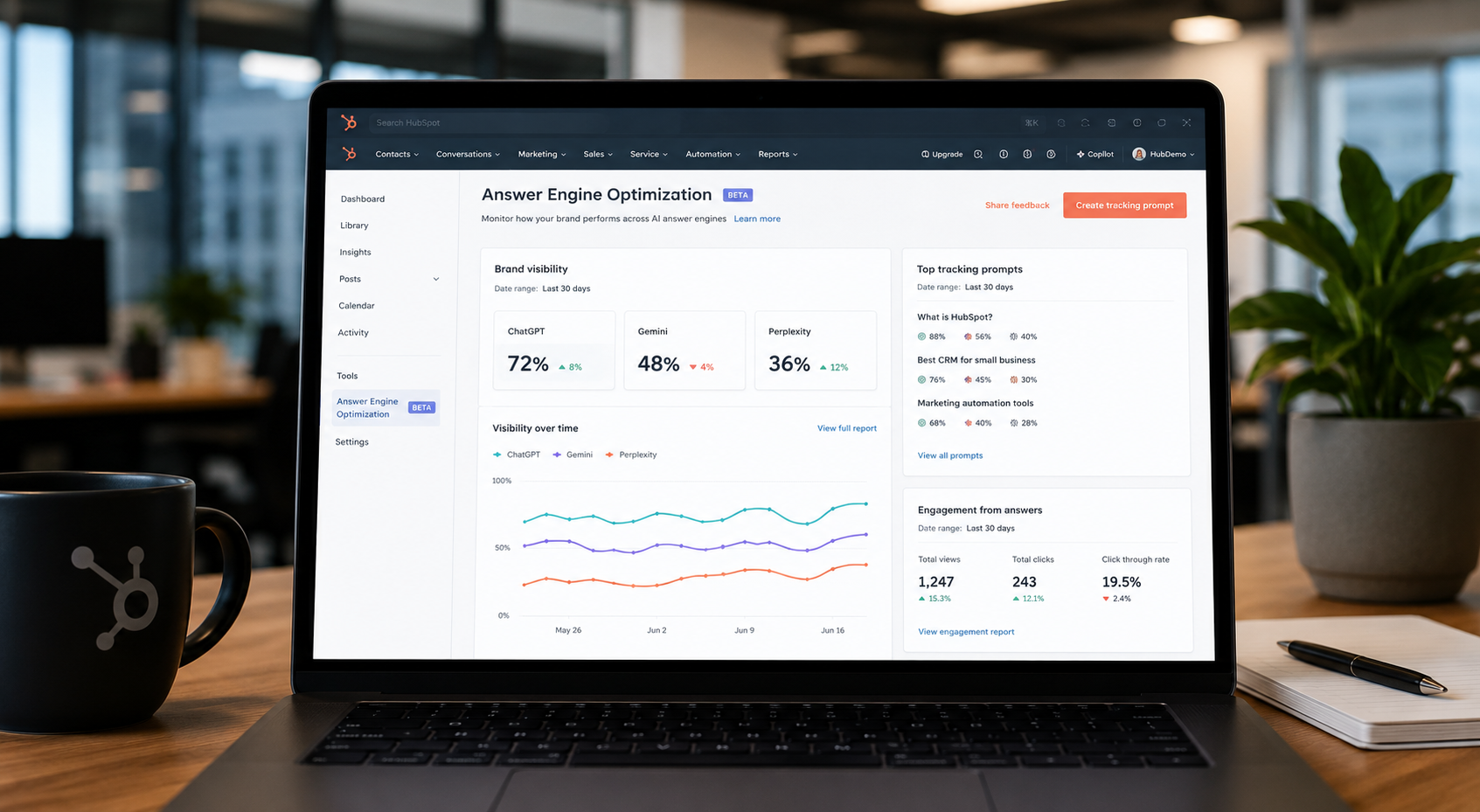
AEO — Answer Engine Optimization — is the most important new discipline in digital marketing right now. If your brand isn't showing up when someone asks ChatGPT, Gemini, or Perplexity to recommend a solution in your space, you're invisible to a growing chunk of your buyers. That's not hyperbole. HubSpot's own data shows that organic traffic for its customers has fallen 27% year-over-year, driven by a structural shift in how people search — AI platforms are increasingly intercepting queries before users ever reach a company's website. PPC Land
So when HubSpot launched its dedicated AEO tracker at its Spring 2026 Spotlight event, I was genuinely excited. I cleared time, logged in, and went to work.
What I found was one of the most frustrating tool experiences I've had in years. Not because the concept is wrong — the concept is very right. But because the execution gave me flashbacks to building a website in Drupal circa 2013. And coming from HubSpot, that stings.
Let me walk you through what happened.
The Promise Was Real
To understand why the disappointment hit so hard, you have to understand what HubSpot said this tool would do.
The AEO tracker was announced on April 14, 2026, as part of the company's Spring 2026 Spotlight, and was positioned as a direct response to declining organic search traffic and the growing share of buyer research conducted inside conversational AI platforms. The tool is designed to track and analyze how your brand surfaces in responses from ChatGPT, Gemini, and Perplexity — the three platforms that have become the new front door for a lot of B2B buying decisions. PPC Land
HubSpot reported that AI-referred sessions represent approximately 1% of traffic but saw a 527% year-over-year increase. That number tells you everything. The percentage is small. The trajectory is not. AEO is where SEO was in 2004 — the people who figured it out early built lasting advantages. CMSWire
HubSpot's pitch for what made its AEO tool different was CRM-powered prompt suggestions: instead of manual guesswork, HubSpot would suggest prompts based on what it already knows about your business and buyers. That's a genuinely smart differentiator. Your CRM holds years of customer data — the questions they ask, the language they use, the problems they're trying to solve. Using that to surface the right AEO prompts automatically? That's the kind of tight integration that should make HubSpot the obvious choice for this. HubSpot
Should. Let's talk about what actually happened.
What I Found When I Logged In
I want to be fair here. I'm not a casual user. I've been in HubSpot regularly for years. I know the platform. I went in with reasonable expectations and an open mind. I came out confused and annoyed in equal measure.
Competitors are a mess to manage.
One of the core functions of any AEO tracker is competitive benchmarking — understanding not just how you show up in AI answers, but how you show up relative to the other brands in your space. HubSpot's own AEO Grader emphasizes competitive intelligence, noting that understanding how answer engines characterize your competitors — their market position, sentiment patterns, and recognition depth — gives you a point of comparison for your own scores. HubSpot
Great in theory. In practice, when I tried to adjust the competitor list I'd initially set up, the process was anything but intuitive. There's no clean, centralized view where you can see all your tracked competitors at a glance, edit them, or swap one out without hunting through settings that feel like they were designed by committee. For a tool that's supposed to make competitive AEO tracking accessible to marketing teams, this is a significant gap.
Adding prompts requires more effort than it should.
Prompts are the foundation of how AEO tracking works. You define the questions your buyers might ask an AI — "What's the best [your category] software for mid-market teams?" — and the tool monitors whether your brand surfaces in the answers. Getting this prompt list right is iterative. You'll add some, remove others, refine the language as you learn more.
That process should be frictionless. In HubSpot's AEO tracker, it's not. Adding prompts feels like a secondary feature — tucked away, not surfaced prominently, and without the kind of smart suggestions or templates that would help a marketer who's new to AEO get oriented quickly. The CRM-powered suggestions HubSpot touted are there, but they don't compensate for the clunkiness of the surrounding interface.
The overall navigation feels like something designed for engineers, not marketers.
HubSpot built its reputation on being the tool that actually made sense to use. The kind of platform where you could onboard a new marketing hire and have them productive within a week. That's not what this feels like. This feels like a powerful engine inside a dashboard that someone forgot to finish. Settings are scattered. Flows aren't obvious. The feedback you get from the tool — what's working, what to do next — requires too much digging to surface.
HubSpot Used to Be Beautiful to Use
I don't say this to be nostalgic for nostalgia's sake. I say it because it's relevant to why this matters so much.
HubSpot built its market position on usability. When it launched, it was the antithesis of Salesforce — powerful enough to do real marketing work, approachable enough that teams could actually use it without an admin army. That was the value proposition. Ease and power in the same package.
That reputation has been eroding. Multiple reviewers across the web now cite complexity as a primary frustration — noting that HubSpot tries to be everything to everyone, which means the interface can feel cluttered, and users report spending significant time learning where features live and how to configure them properly. La Growth Machine
Across 19,000+ reviews, HubSpot holds a weighted average rating of 4.37/5 — users love its depth and automation, and they hate its price, learning curve, and occasional customer-support issues. tl;dv
The AEO tracker isn't a one-off slip. It's symptomatic of what happens when a platform grows by acquisition and feature addition without enough investment in experience cohesion. HubSpot acquired XFunnel — an answer engine optimization platform — and folded that capability into the product. Acquisitions are a legitimate way to move fast. But when the seams show in the UI, users pay the price. CMSWire
What we're left with in 2026 is a platform that, in places, genuinely gives Drupal energy. Not the powerful, customizable Drupal that developers love. The Drupal that non-technical marketing teams would encounter and immediately want to walk away from.
Why This Matters Beyond Just Annoyance
If this were just an inconvenient interface, it would be a minor complaint. But the stakes around AEO are high enough that a clunky tool isn't just frustrating — it's actively costly.
Prospects now form opinions about brands through conversations with answer engines, not by scanning search results. And unlike SEO, which evolved over decades, AEO is developing on a compressed timeline. The brands that get their AEO foundations right in 2026 are positioning themselves for compounding returns. The brands that struggle with their tools, set up their prompt lists wrong, miss competitors, or can't iterate quickly because the UX is fighting them — they're falling behind. HubSpot
In March 2026, analysis found that the average unique domains cited per ChatGPT response fell roughly 20%, compounding the scarcity of AI-referred traffic further. There are fewer slots in AI answers, not more. Getting into those slots requires precision, consistency, and the ability to move fast as the landscape shifts. PPC Land
A tool that makes you slow is not a tool that helps you win.
What Good AEO Tooling Actually Needs to Do
For what it's worth, here's what I think the baseline requirements are for any AEO tracker worth using in 2026:
Competitor management needs to be front and center. You should be able to see every competitor you're tracking, edit that list, and compare your AI visibility scores side-by-side without navigating through multiple settings screens.
Prompt management needs to be fast and guided. The tool should surface suggested prompts based on your category, your existing CRM data, and what's actually being asked in your market. Adding, editing, and prioritizing prompts should take seconds, not minutes.
The feedback loop needs to be immediate and clear. When HubSpot monitors your brand across ChatGPT, Gemini, and Perplexity, what it learns should surface in plain language with clear next steps. Not buried in a sub-tab under a settings menu.
It needs to feel like the HubSpot that made HubSpot famous. Intuitive. Opinionated. Built for marketers, not for people who read API documentation for fun.
HubSpot recommends at minimum monthly AEO analysis to track sentiment trends and competitive positioning, plus quarterly deep-dives for strategic planning. That's solid advice. But following it requires a tool you actually want to open — not one that makes you dread the session before you've even logged in. HubSpot
The Bottom Line
HubSpot AEO is tracking the right thing. The underlying data — AI platforms intercepting buyer research, organic traffic falling 27% for HubSpot's own customers, and the structural shift away from traditional search — is real and it matters. The problem isn't the vision. The problem is the execution. PPC Land
Right now, the tool is worth exploring if you're already on Marketing Hub Pro or Enterprise and the AEO capability is included in your plan. At $50/month standalone, it's harder to recommend when the experience creates friction at every step that should be simple.
More importantly: don't let a clunky tool be your reason for not doing AEO. The work still needs to happen. Whether you use HubSpot's tracker, a standalone tool, or a manual monitoring setup paired with the right strategy, your brand's visibility in AI answers is not optional in 2026. It's where attention is going.
If you need help building an AEO strategy that doesn't depend on any single platform's UI getting its act together, that's exactly what we do.
Want to Know How Your Brand Actually Shows Up in AI Search?
At Ritner Digital, we help brands understand and improve their visibility in AI-generated answers — not just in theory, but with a clear strategy, measurable benchmarks, and the kind of hands-on execution that actually moves the needle.
Let's talk about your AEO strategy →
Whether you're starting from zero or trying to make sense of what tools like HubSpot's AEO tracker are telling you, we can help you cut through the noise and build something that works.
Sources: HubSpot Spring 2026 Spotlight announcement (April 14, 2026) · ppc.land · CMSWire · Vantage Point · HubSpot AEO Grader · LaGrowthMachine HubSpot Review · tldv.io HubSpot Review 2026
Frequently Asked Questions
What is HubSpot AEO?
HubSpot AEO is HubSpot's Answer Engine Optimization tool, launched at the Spring 2026 Spotlight event. It tracks and analyzes how your brand appears in AI-generated responses across ChatGPT, Gemini, and Perplexity. It's available as a standalone product for $50/month or included with Marketing Hub Pro and Enterprise plans.
What is Answer Engine Optimization (AEO)?
AEO is the practice of optimizing your brand so it surfaces accurately and favorably when people ask AI tools questions related to your product or service. Think of it as SEO — but instead of ranking in Google's blue links, you're showing up in the answers ChatGPT, Gemini, and Perplexity generate for your buyers.
Why does AEO matter right now?
Buyer research behavior is shifting fast. AI-referred traffic saw a 527% year-over-year increase, and 42% of CRM software buyers already use AI search as part of their evaluation process. At the same time, traditional organic traffic is declining — HubSpot's own customer data shows a 27% drop year-over-year. If your brand isn't optimized for AI answers, you're missing buyers at the research stage before they ever visit your site.
Is HubSpot's AEO tracker worth the $50/month?
That depends on your situation. If you're already on Marketing Hub Pro or Enterprise, it's included and worth exploring despite the UX friction. As a standalone purchase at $50/month, it's harder to recommend in its current state — the competitor management and prompt setup experience create enough friction that you may spend more time fighting the tool than acting on its insights.
What should a good AEO tool be able to do?
At minimum, it should give you a clear view of how your brand is described across major AI platforms, let you track and edit competitors easily, help you build and manage a prompt list without unnecessary complexity, and surface actionable recommendations in plain language. Speed and clarity matter — AEO is iterative work, and a slow or confusing interface will cause you to fall behind.
Can I do AEO without HubSpot?
Absolutely. AEO is a strategy, not a platform. The fundamentals — publishing authoritative content, maintaining consistent messaging across channels, earning mentions on reputable third-party sites, and structuring content so AI engines can parse and cite it — can be executed without any single tool. What matters is having a clear strategy, measurable benchmarks, and a process for monitoring and adjusting over time.
How do I know if my brand is showing up in AI answers?
You can start with HubSpot's free AEO Grader, which gives you a one-time snapshot of how ChatGPT, Gemini, and Perplexity currently represent your brand. For ongoing monitoring, you'll want either a paid tool or a manual process of running key prompts regularly and tracking what comes back. Working with an agency that specializes in AEO is the fastest way to get a complete picture and a plan.
How is AEO different from SEO?
SEO is focused on driving traffic — you rank in search results and hope people click through to your site. AEO is focused on brand representation — you optimize for how AI describes your business, your positioning, and your capabilities in generated answers. The goal isn't necessarily a click. It's being the brand the AI recommends, cites, or describes favorably when your buyer is in research mode.
How often should I be monitoring my AEO performance?
Monthly analysis is the recommended minimum to catch sentiment shifts and competitive changes. Quarterly deep-dives make sense for strategic planning — adjusting your prompt list, reviewing competitor positioning, and updating your content strategy based on what the data shows. Given how quickly AI models update their training and citation behavior, waiting longer than that means flying blind.
Where can I get help with AEO strategy?
That's what we do at Ritner Digital. If you want to understand where your brand stands in AI search, build a strategy that doesn't depend on any single tool's roadmap, and get hands-on help executing it — reach out here.