"No, It's Just the Schema": Anatomy of the Conversation That Decides Whether a Business Grows
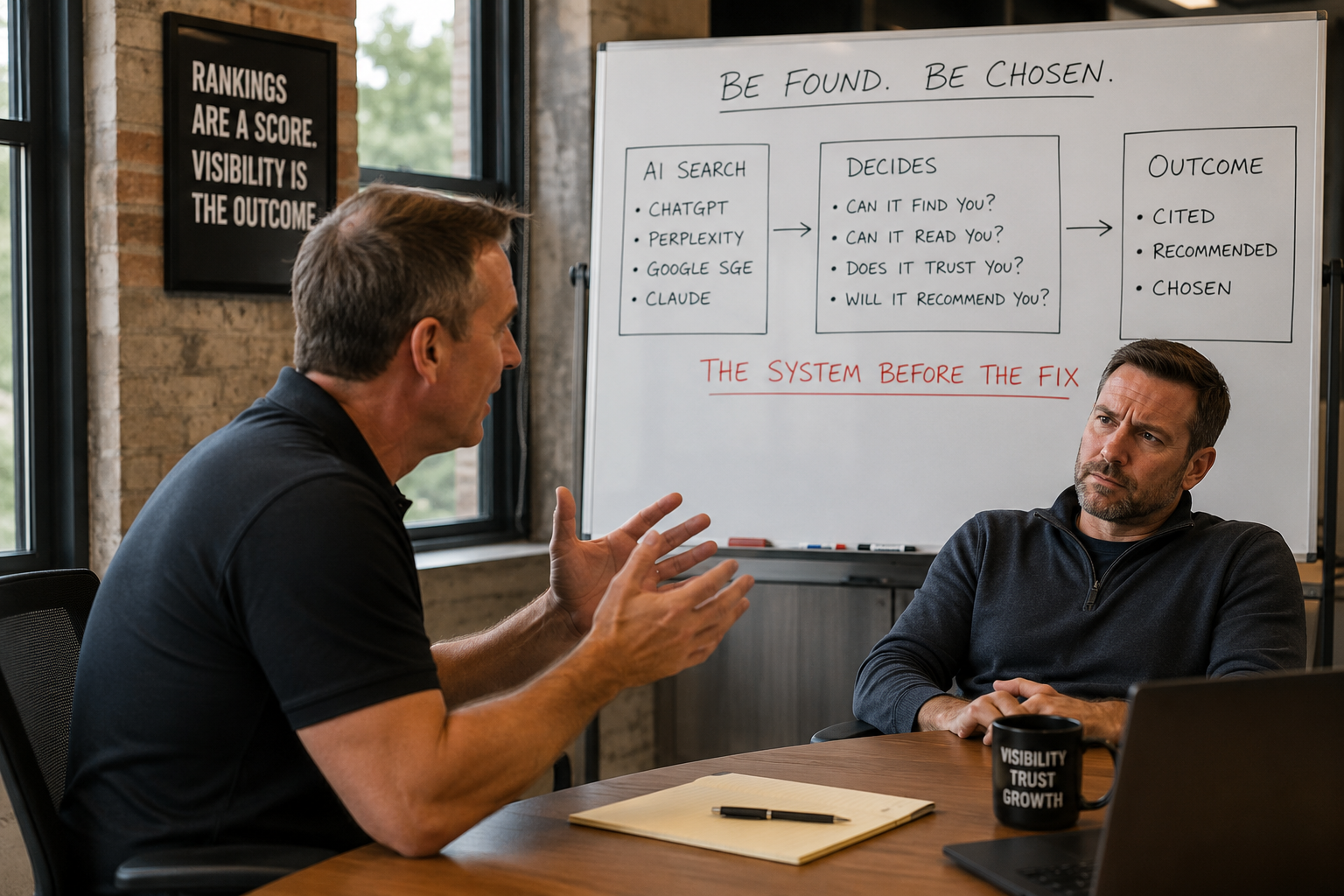
Let me tell you about a conversation that plays out more often than you'd think, almost word for word. I've changed every identifying detail, but the shape of it is real, and the shape is the whole point.
A business owner reaches out. By any reasonable standard, this is a successful operation — a genuinely great product, a roster of recognizable clients, glowing testimonials, years of real-world reputation. Not a struggling company looking for a lifeline. A good one, looking for an edge.
The owner has noticed something. He's tried asking an AI assistant about his category and he's invisible. The thing doesn't seem to "see" his website. He's sharp enough to have caught this early, before most of his competitors have even thought to look. And he arrives with a diagnosis already in hand, delivered with the confidence of a man who has done his homework:
"I just need schema markup. The AI can't read my site. Add the tags and we're good."
Everything that happens next — whether this business pulls ahead or quietly stalls — is decided not by the schema. It's decided by how the next ten minutes of conversation go.
The diagnosis arrives pre-packaged
The first thing worth noticing is that the owner isn't asking a question. He's issuing a work order. He has already moved from symptom ("I'm invisible") to cause ("the site isn't machine-readable") to cure ("schema"), and he's compressed all three into a single confident sentence.
You can understand exactly why. The schema story is comforting. It's small. It's mechanical. It's a switch someone flips while he gets back to running his actual business. It carries no implication that anything he's been doing is wrong, and it promises a fast result for a small effort. Of all the possible explanations for "why am I invisible," he has — understandably, human-ly — gravitated to the one that costs him the least, emotionally and practically.
There's a useful truth buried in why this happens. Clients in a specialized field are like someone whose car is making a noise under the hood. As one consultant puts it, they're an expert in their own area, but they don't fix cars — so when they sit down with you, the words they use are some version of "noise under hood," a blocky, non-savvy description, because they don't actually know what the problem is. "I just need schema" is this owner's "noise under the hood." It's not a wrong observation. It's an untrained guess at what the noise means. Coveted Consultant
The reframe — and the exact moment it gets resisted
So the expert does the responsible thing. They look under the hood properly, and they come back with the honest version: "I don't think this is a schema problem. Schema is a symptom. The real issue is that your site doesn't have enough clear content and enough authority for these engines to trust and cite you. Adding tags to thin pages just neatly labels thin pages."
And here is the moment. The pushback. It's almost reflexive, and it usually sounds like one of these:
"No — I've read about this. It's specifically the structured data. That's what AI reads."
"My product is great and my clients are huge. The content's fine. It's a technical issue."
"I don't want to do some big content overhaul. I just need the one fix."
This resistance isn't stupidity or stubbornness, and it's crucial to understand that, because dismissing it is how the conversation fails. The resistance is predictable, and it comes from somewhere specific. As one consultant who specializes in reframing client problems explains, a reframe can be liberating — but it can also be terrifying and threatening. When an executive realizes that the relatively simple task of putting in a new IT system is not going to fix the problem without a host of other changes, it can be pretty jarring. The owner asked for a garden-hose fix and is being told the house needs rewiring. Of course he flinches. Andrew Sobel
There's a self-image mechanism underneath it too. Accepting the bigger diagnosis means accepting that his own read of the problem was wrong — and quietly, that the strength of his offline reputation hasn't translated online the way he assumed it had. The mind resists conclusions that implicate the self. As the research on this kind of resistance notes, abandoning a chosen path feels like an admission that the original decision was wrong, and the mind resists this because it implicates the self — so defending the original frame becomes a way of protecting it. Ipsychology
And there's a knowledge asymmetry that makes it worse, not better. The owner has read a few articles. He has absorbed the vocabulary — "schema," "structured data," "machine-readable" — and vocabulary feels like understanding. This is the trap of knowing just enough: the confident, specific wrongness of someone who has learned the words but not the weights. He genuinely believes he's the informed party in the room, which is exactly why being told otherwise lands as an argument to win rather than information to absorb.
Why the pushback is the expensive part — not the schema
Here's what makes this conversation so high-stakes. The schema itself is cheap and basically harmless. The resistance is what costs the business its future, through two distinct failure modes.
Failure mode one: he wins the argument. The expert, wanting the work or wanting to avoid friction, caves. "You're the boss — we'll add the schema." The tags go on. Months pass. Nothing moves, because the actual levers — content depth and earned authority — were never touched. And now the truly damaging thing happens: the owner concludes "this AI search stuff doesn't work for businesses like mine," and abandons the channel entirely. The misdiagnosis didn't just waste a little money. It inoculated him against the correct solution. He'll sit out the one race he was perfectly positioned to win.
Failure mode two: he digs in deeper because he's already committed. If he's already spent money or time pointed at the wrong fix, sunk cost takes over, and it's vicious precisely because he chose the direction. The research is clear that personal responsibility magnifies the sunk cost effect substantially — if you are the one whose judgment is implicitly on trial, expect to feel the pull. So instead of changing course, he doubles down on the swim he's already swimming, defending the wrong direction with the energy he should be spending on the right one. Ipsychology
Either way, the business loses — not because the owner is incapable, but because the conversation broke at the reframe.
How the conversation actually gets saved
The fix for this isn't to argue harder or to flash credentials. Arguing harder triggers more defense; that's well established. What actually works is two things, and they're worth naming because they're the difference between a stalled client and a thriving one.
First, the owner has to come to own the new frame — it can't be forced. As one reframing specialist puts it bluntly, your client must have ownership of the new frame; you can't push it down their throat — you have to work with them so they embrace it and become a proponent of it. That means the expert leads with agreement and respect for what the owner got right — "you noticed this early, that instinct is genuinely sharp, and you're right that something on the technical side matters" — and then expands the frame rather than negating it. The technique even has a name: agreeing with a twist, where agreement with the client is combined with a shift in direction, because agreeing first increases the likelihood they'll accept what comes next. Andrew SobelFinancial Planning Association
Second, the owner has to do the one hard internal move: treat his own confident diagnosis as a hypothesis, not a verdict. The most reliable debiasing question in the literature is forward-looking: "If I were starting from scratch today, with my current resources and the current state of this, what would I choose?" Applied here: forget what I assumed the problem was — given where I actually stand, what would actually get me found? Ipsychology
When the conversation survives the reframe, something genuinely good happens — the same writers note that a reframe, once accepted, can bring a great sense of relief and restored purpose, like realizing the ladder you were climbing was leaning against the wrong wall. The owner stops swimming hard in the wrong direction and points all that capability at the thing that'll actually move. Andrew Sobel
The real lesson
This was never really a story about schema. Schema is just the costume the real issue wore.
It's a story about the moment a capable, successful owner is handed a diagnosis bigger than the one he wanted — and what he does in the three seconds after. The instinct to notice the problem: keep that, it's valuable. The instinct to pre-package the solution and then defend it against the person you hired because they know more than you: that's the one that quietly caps businesses that had every other ingredient to grow.
The hardest, most valuable skill an owner can develop isn't technical. It's the ability to hold their own confident conclusion loosely enough to let an expert move it. Because the most expensive thing in that whole conversation is never the fix you end up paying for. It's the better fix you talked yourself out of.
Been told your problem is bigger than the quick fix you were hoping for — and not sure whether to believe it? That reaction is normal, and the answer matters. We'll give you a straight, no-jargon diagnosis of what's actually keeping your business from being found — even if it's not what you expected to hear. Let's talk it through.
Frequently Asked Questions
Why do business owners arrive with the solution already decided instead of asking what's wrong?
Because in a specialized field they don't live in, they reach for the explanation that costs them the least — emotionally and practically. A small, mechanical fix like "just add schema" feels fast, cheap, and implies nothing they've done is wrong. It's the equivalent of describing a car problem as "a noise under the hood": as one consultant notes, clients are experts in their own area, but they don't fix cars, so they describe the issue in blocky, non-savvy terms — an untrained guess at what the symptom means, packaged as a confident conclusion. Coveted Consultant
Why do owners push back so hard when told the real problem is bigger?
It's predictable, not stubborn. A reframe that expands a "quick fix" into a real project is genuinely jarring — as one reframing specialist puts it, it can be terrifying and threatening when an executive realizes the simple task won't fix the problem without a host of other changes. There's also self-image at stake: accepting the bigger diagnosis means accepting their own read was wrong, and the mind resists conclusions that implicate the self. Andrew SobelIpsychology
Is the pushback a sign the expert is wrong?
Not usually. The pushback is a normal emotional response to a frame changing, not evidence about which frame is correct. The two are separate questions. A useful tell: if the resistance is mostly "but I read that it's the tags" or "I don't want a big overhaul," that's the discomfort of the reframe talking — a reaction to scope and self-image — rather than a substantive technical counter-argument about what actually drives the result.
What's the real danger — the wrong fix, or the resistance to the right one?
The resistance, by far. The wrong fix (schema alone) is cheap and harmless on its own. The damage comes in two ways. If the owner "wins" and only the quick fix gets done, nothing moves, and he wrongly concludes "this doesn't work for businesses like mine" — inoculating himself against the correct solution. Or, if he's already invested, sunk cost digs him in deeper, since personal responsibility magnifies the sunk cost effect substantially. Ipsychology
How can an expert actually get through without just arguing harder?
Arguing harder backfires — it triggers more defense. What works is helping the owner own the new frame rather than having it forced on them; as one specialist says, you can't push it down their throat — you have to work with them so they embrace it and become a proponent of it. A proven technique is "agreeing with a twist," where agreement with the client is combined with a shift in direction, because agreeing first increases the likelihood they'll accept what comes next. Andrew SobelFinancial Planning Association
As an owner, how do I tell if I'm defending a wrong diagnosis?
Treat your confident conclusion as a hypothesis, not a verdict, and run the most reliable debiasing question in the research: "If I were starting from scratch today, with my current resources and the current state of things, what would I choose?" Forget what you assumed the problem was; given where you actually stand, what would genuinely get you found? If your answer leans entirely on the fix you walked in wanting, that's worth a second look. Ipsychology
Doesn't trusting the expert's bigger diagnosis just mean a bigger, more expensive project?
Sometimes the right scope is bigger — but bigger-but-correct beats small-but-useless every time, and a good expert sizes it to what actually moves the needle, not to the invoice. There's also an upside people underestimate: once a reframe is accepted, it often brings a great sense of relief and restored purpose — like realizing the ladder you were climbing was leaning against the wrong wall. You stop spending energy in the wrong direction. Andrew Sobel
What's the single most useful skill an owner can develop here?
Holding your own confident conclusion loosely enough to let an expert move it. The instinct to notice a problem is valuable — keep it. The instinct to pre-package the solution and then defend it against the very person you hired because they know more is the one that quietly caps otherwise-capable businesses. The most expensive thing in the conversation is never the fix you pay for; it's the better fix you talk yourself out of.
Sources
Andrew Sobel, How to Powerfully Reframe Client Issues for Maximum Impact (Part I & II) — https://andrewsobel.com/article/how-to-powerfully-reframe-client-issues-for-maximum-impact-part-i/
Coveted Consultant, How to Deal With Difficult Consulting Clients — https://covetedconsultant.com/deal-with-difficult-consulting-clients/
Financial Planning Association, Understanding and Dealing with Client Resistance to Change — https://www.financialplanningassociation.org/article/journal/NOV13-understanding-and-dealing-client-resistance-change-0
iPsychology, Sunk Cost Fallacy: Definition, Examples & How to Avoid It — https://ipsychology.net/sunk-cost-fallacy/
Consultant's Mind, Why Clients Don't Implement — https://www.consultantsmind.com/2023/01/15/why-clients-dont-implement/