Why We Stopped Measuring "Keyword Rankings" and Started Measuring "Answer Share"
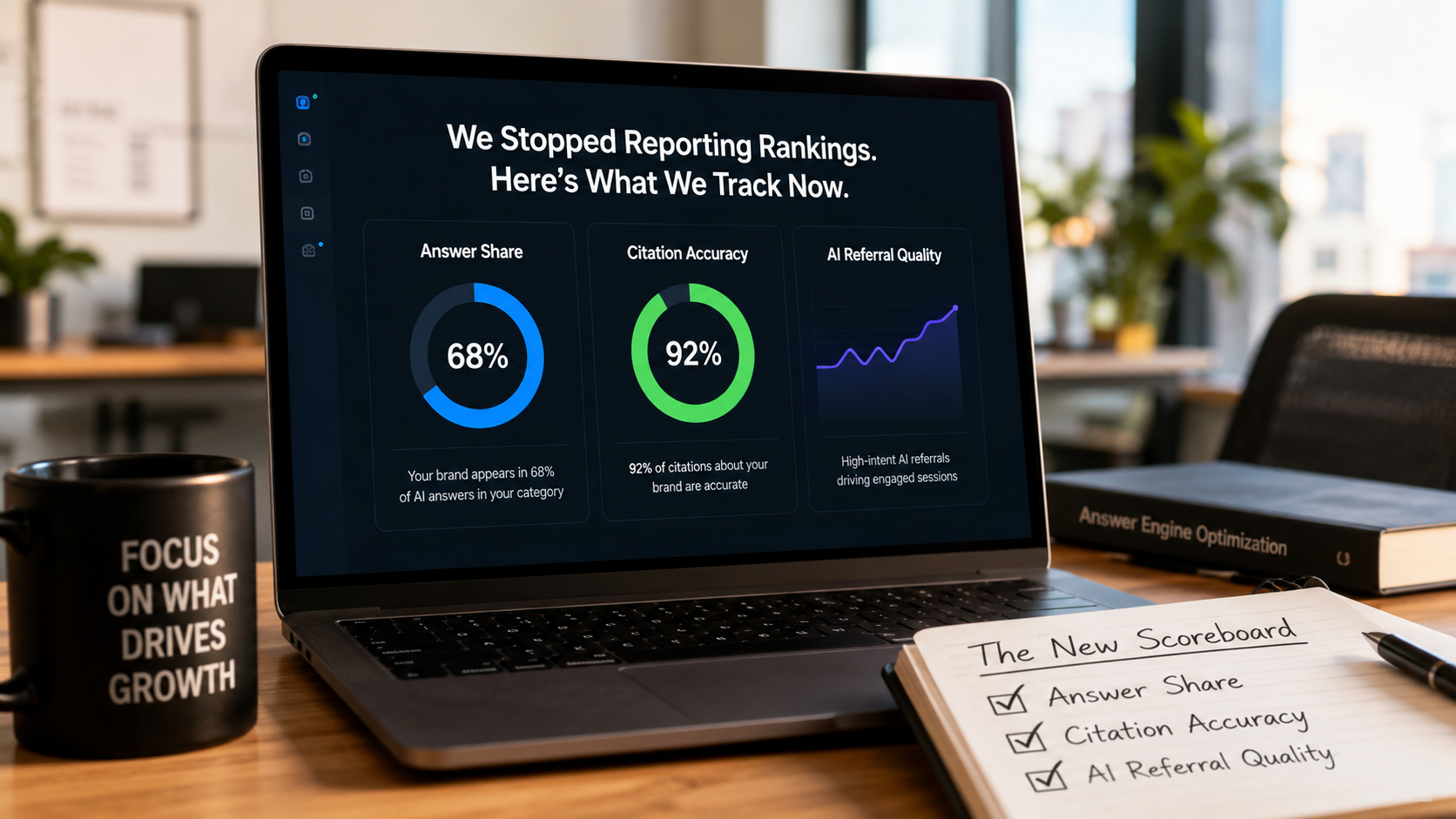
For years, the monthly client report told a simple story: here are your keyword rankings, here's how many moved up, here's the traffic that followed. It was clean, it was satisfying, and — increasingly — it was a lie. Not because the numbers were wrong, but because they had quietly stopped measuring the thing that actually determines whether buyers find and choose you. So we changed what we report. We stopped leading with keyword rankings and started leading with answer share: whether, and how often, the AI engines your prospects now ask are naming you when it counts.
This isn't a cosmetic relabeling. It's a different scoreboard, built for a world where the buying decision increasingly happens inside an AI answer the user never clicks away from. Here's why we made the switch, and the three metrics that replaced the old ones.
The problem with rankings: they measure a system fewer people use
A keyword ranking answers one question: where does your page sit in a list of ten blue links? That question used to be everything. Now it describes a shrinking slice of how people discover you. As one analysis put it plainly, if your dashboard still equates "page-one rankings" with "visibility," it is now measuring a minority of how buyers discover you. Digital Applied Team
The most jarring evidence is how little ranking on Google now predicts visibility inside AI. A per-engine audit found that only around 2.1% of pages ranking in Google's top 10 also appear among ChatGPT's citations — ranking on page one of Google guarantees almost nothing inside ChatGPT. A rank tracker, in other words, has become a partial-coverage instrument: it measures one retrieval system while buyers increasingly use four or five. Digital Applied TeamDigital Applied Team
The "best ranking, invisible to AI" scenario plays out constantly. As one breakdown describes it: your team ranks #1 on Google for "best [category] software," traffic looks solid — then your sales director mentions prospects keep choosing competitors because "ChatGPT recommended them." You check, and your brand appears nowhere in the answer. The ranking report would have shown green all the way down. It just wasn't measuring the room where the decision got made. Discovered Labs
The new scoreboard, metric one: Share of Voice (Answer Share)
The headline replacement for keyword rankings is AI Share of Voice — what we call answer share. It measures how much of the AI answer you occupy versus your competitors. The formula is straightforward: your brand's citations across all models for a query set, divided by the total citations for all tracked brands, times 100. Put simply, as one guide frames it: if 100 relevant AI answers are generated in your space and your brand appears in 28 of them, your AI Share of Voice is 28%. AuthorityTechOptimizeGEO
What makes it a far better North Star than rankings is that it captures both absolute and relative performance at once. A brand can have a perfectly optimized website and still have 5% AI Share of Voice if a competitor is doing the same thing better and more consistently — and SOV surfaces that gap in a way page rankings simply can't. OptimizeGEO
We measure it the way it has to be measured to be honest. First, against real buyer questions, not vanity keywords — a mix of informational, comparison, and recommendation queries that mirror real user intent. Second, per engine, never as a single blended number, because the engines barely agree: only 11% of domains cited by ChatGPT overlap with those cited by Perplexity. A blended score is dangerous precisely because a 20% blended SOV hides a 35% on Perplexity and 3% on ChatGPT — and the per-engine breakdown is where the strategy actually lives. OptimizeGEO + 2
Third, and this is the part most "rank tracker for AI" tools get wrong: we sample each prompt many times. AI outputs are probabilistic, not fixed. One large study found less than a 1-in-1,000 chance of two AI runs producing the same ordered brand list, and citations can shift 40–60% month-to-month for identical queries. So we report ranges and confidence, not a single false-precision number. As one framework notes, the confidence bands are the primary deliverable, not the point estimate. TurboAudit + 2
Metric two: Citation Accuracy (and what AI actually says about you)
The second metric the old report never had: are the engines citing you, and are they getting you right? Being named is good. Being named with the wrong pricing, an outdated product description, or a misattributed claim is its own problem — and it's invisible if you only track rankings.
There's a subtler trap here too, which is why we track citation distinct from mention. They aren't the same thing: a brand can be mentioned without being cited, and a URL can be cited without the brand name appearing in the answer text. And the commercial weight differs: revenue impact correlates more strongly with citation, which drives referral traffic, than with mention, which drives awareness. We watch for the "ghost citation" gap — where AI uses your content but never says your name — because that's a hidden loss of credit that traditional referral tracking won't catch. AuthorityTech + 2
Accuracy and sentiment round it out. We log not just whether you appear, but how the engine characterizes you, so we can catch and correct misinformation before it costs a deal. This is the qualitative layer keyword rankings could never touch.
Metric three: AI Referral Traffic (the small channel that converts like nothing else)
The third metric reframes what "traffic" even means. AI referral volume is still small in absolute terms — typically around 1% of total website traffic across most B2B sites. If you judged it the way you judge organic volume, you'd ignore it. That would be a serious mistake, because the conversion quality is in a different league. Authoritytech
The measured multiples are striking. Seer Interactive found ChatGPT referrals converting at 15.9%, roughly 4.4x the organic average, and Ahrefs found that visitors from AI search platforms generated 12.1% of signups despite accounting for only 0.5% of overall traffic — meaning AI search visitors convert 23 times better than traditional organic search visitors. The reason is structural, not lucky: AI search users arrive pre-qualified — they described their problem, received a synthesized answer evaluating multiple sources, and chose to click through, passing a trust filter organic search doesn't provide. Authoritytech + 2
The catch is that this channel is badly undercounted by default, which is the other reason answer share matters as a leading indicator. Most analytics tools misclassify AI referrals as "Direct" traffic due to referrer stripping, and one estimate suggested as much as 70.6% of AI traffic may arrive without attribution. So part of our switch was technical: setting up a dedicated AI channel group in GA4 to separate sessions from chat.openai.com, perplexity.ai, gemini.google.com, and claude.ai out of the "Direct" bucket, and pairing that with self-reported "how did you hear about us" attribution to catch what referrer data misses. When referral data can't be fully trusted, answer share becomes the leading indicator that the referral numbers later confirm. Data-Mania, LLC + 2
Why this is the harder — and more honest — way to report
Let's be candid about the trade-off. Keyword rankings were easy: deterministic, cheap to pull, comforting to look at. The new scoreboard is harder. It's probabilistic, it requires per-engine measurement, the attribution is imperfect by design, and the right answer is often a range rather than a tidy number. As one measurement guide acknowledges, the attribution workarounds are imperfect on purpose — the goal is directional clarity, not accounting precision. Norg
But here's the thing: a precise measurement of the wrong thing is worse than a directional measurement of the right one. The old report could show every keyword climbing while a competitor quietly captured the AI answer that actually drove the category's buying decisions. The fact that so few teams have made this shift — by most counts, only about 14% of marketers currently track AI visibility at all — is exactly why it's an advantage. The measurement gap is the opportunity. The brands measuring answer share now are the ones building the institutional knowledge to win a channel their competitors can't even see. Digital Applied Team
We didn't stop caring about rankings because rankings became worthless. We stopped leading with them because they stopped telling the truth about visibility. Answer share, citation accuracy, and AI referral quality tell that truth — and they point at revenue, not vanity. That's the scoreboard we report on now, because it's the one our clients are actually being judged on.
Wondering what your answer share actually is right now — and what AI says about you when a buyer asks? We measure it across ChatGPT, Perplexity, Gemini, and Google's AI, track citation accuracy and AI referral quality, and show you exactly where you stand against competitors. Let's build you a real scoreboard.
Frequently Asked Questions
What is "answer share" or AI Share of Voice?
It's a metric that measures how much of the AI answer your brand occupies versus competitors when buyers ask AI engines questions in your category. The formula is simple: your brand's citations across all models for a query set, divided by the total citations for all tracked brands, times 100. In plain terms, if 100 relevant AI answers are generated in your space and your brand appears in 28 of them, your AI Share of Voice is 28%. It captures both whether you're cited at all and whether you're cited more than rivals. AuthorityTechOptimizeGEO
Why aren't keyword rankings enough anymore?
Because ranking measures one retrieval system while buyers now use several, and a top Google ranking barely predicts AI visibility. A per-engine audit found only around 2.1% of pages ranking in Google's top 10 also appear among ChatGPT's citations. The result is the common, painful scenario where your team ranks #1 on Google, traffic looks solid, but prospects keep choosing competitors because "ChatGPT recommended them." The ranking report shows green while the decision happens somewhere it can't see. Digital Applied TeamDiscovered Labs
Why do you measure each AI platform separately instead of one overall score?
Because the engines barely cite the same sources — only 11% of domains cited by ChatGPT overlap with those cited by Perplexity. A single blended number is actively misleading: a 20% blended SOV hides a 35% on Perplexity and 3% on ChatGPT. The per-engine breakdown is where the strategy lives, because being dominant in one engine tells you nothing about whether you're invisible in another. Digital Applied TeamAuthorityTech
Why do you report ranges instead of a single number?
Because AI outputs are probabilistic, not fixed. One large study found less than a 1-in-1,000 chance of two AI runs producing the same ordered brand list, and citations can shift 40–60% month-to-month for identical queries. Running a prompt once would give a false reading, so we sample each many times and report confidence bands. As one framework puts it, the confidence bands are the primary deliverable, not the point estimate. TurboAudit + 2
What is "citation accuracy" and why track it?
It's whether AI engines cite you and get you right — correct pricing, current product details, accurate claims. Being named with wrong information is its own risk that rankings never surface. We also separate citation from mention, because they aren't the same: a brand can be mentioned without being cited, and a URL can be cited without the brand name appearing in the answer. It matters commercially, since revenue impact correlates more strongly with citation, which drives referral traffic, than with mention. AuthorityTechAuthorityTech
AI referral traffic is tiny. Why does it matter?
Because it converts at a rate nothing else does. AI referrals are typically around 1% of total website traffic, but Seer Interactive measured ChatGPT referrals converting at 15.9%, roughly 4.4x the organic average, and Ahrefs found AI visitors generated 12.1% of signups while accounting for only 0.5% of traffic — converting 23 times better than organic. The reason is structural: these users were pre-qualified by the AI before they ever clicked. Authoritytech + 3
Why does my analytics tool show almost no AI traffic?
Because most tools misclassify it. AI referrals frequently get bucketed as "Direct" traffic due to referrer stripping, and one estimate suggested as much as 70.6% of AI traffic may arrive without attribution. The fix is a dedicated AI channel group in GA4 that separates sessions from chat.openai.com, perplexity.ai, gemini.google.com, and claude.ai out of the Direct bucket, paired with a "how did you hear about us" field on forms to catch what referrer data misses. Data-Mania, LLC + 2
Isn't this measurement approach less precise than keyword rankings?
Yes — and that's an acceptable trade. The attribution workarounds are imperfect by design; as one guide notes, the goal is directional clarity, not accounting precision. But a precise measurement of the wrong thing is worse than a directional read on the right one. The bigger point is opportunity: only about 14% of marketers currently track AI visibility at all, so the measurement gap itself is a competitive edge for the brands that close it first. NorgDigital Applied Team
Sources
OptimizeGEO, AI Share of Voice (SOV): A Guide to Measuring Brand Visibility — https://www.optimizegeo.ai/blog/ai-share-of-voice
AuthorityTech, AI Share of Voice Measurement Guide 2026 — https://authoritytech.io/blog/ai-share-of-voice-measurement-guide-2026
AuthorityTech, AI Search Traffic Converts 4–23x Better Than Organic — https://authoritytech.io/curated/ai-search-traffic-conversion-measurement-2026
Data-Mania, AI Search Visibility Benchmarks 2026 — https://www.data-mania.com/blog/ai-search-visibility-benchmarks-2026-citation-rates-share-of-voice-b2b-saas/
Cassie Clark Marketing, AI Share of Voice: How to Measure It in 2026 — https://cassieclarkmarketing.com/ai-share-of-voice/
Digital Applied, AI Share of Voice: Tracking Brand Citations Framework 2026 — https://www.digitalapplied.com/blog/ai-share-of-voice-tracking-brand-citations-framework-2026
TurboAudit, AI Share of Voice: 2026 B2B Marketing Metric Guide — https://turboaudit.ai/ai-share-of-voice
Norg.ai, AEO Metrics and Measurement — https://home.norg.ai/digital-marketing-search-optimization/answer-engine-optimization-aeo/aeo-metrics-and-measurement-how-to-track-ai-visibility-citations-and-business-impact/
Discovered Labs, AEO Performance Metrics: What to Measure — https://discoveredlabs.com/blog/aeo-performance-metrics-what-to-measure-and-how-to-track-ai-citations
Goodie, 2026 AI Search Traffic Report — https://higoodie.com/blog/ai-search-traffic-report-2026/