Inside Our Proprietary "Answer Engine" Audit
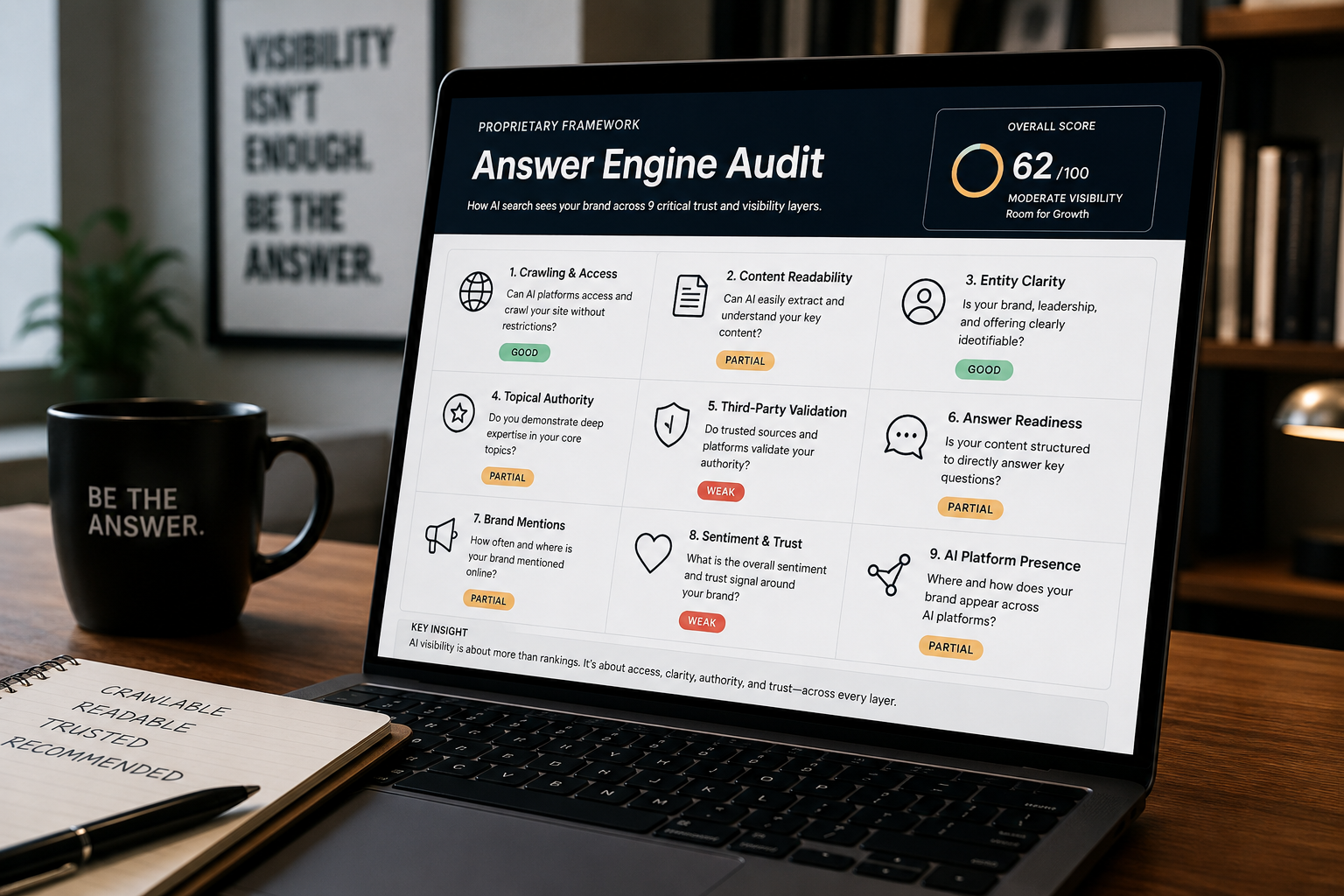
Most businesses we talk to have the same blind spot. They can tell you their Google ranking for a key term down to the position. Ask them what ChatGPT says when a prospect requests a recommendation in their category, or whether Perplexity can even read their website, and the room goes quiet. That gap — between how visible you think you are and how visible you actually are to the engines now shaping buying decisions — is exactly what our Answer Engine Audit was built to close.
It's a nine-point diagnostic that examines your brand the way an AI system does: not as a homepage to admire, but as an entity to verify, retrieve, and decide whether to cite. Below is what each point checks and, more importantly, why it matters — because the value isn't the checklist, it's understanding what's quietly costing you visibility. Here's the whole thing, with nothing held back.
Point 1: Crawler Accessibility
We start at the most basic and most frequently broken layer: can AI engines even reach your content? This is where we find the single most damaging, most invisible problem — sites that have accidentally locked the door.
The critical thing most teams miss is that the major AI companies now run separate bots for training versus search. As the documentation makes explicit, OAI-SearchBot powers ChatGPT Search citations while GPTBot is about training — allowing one does not require allowing the other. That distinction matters enormously, because blocking a search crawler is one of the most common reasons a site is absent from AI answers, and it usually happens by accident. Many popular SEO plugins added "block AI bots" toggles in 2024 and 2025 with the toggle enabled by default — we've seen stores that updated a plugin and unknowingly cut themselves off from ChatGPT, Claude, and Perplexity overnight. Okara + 2
We also check the layer beneath robots.txt, because the block can hide deeper: some bot-protection services block AI crawlers by default at the network level, which overrides robots.txt. A blocked search crawler is a single line of config that can cost you an entire engine and go unnoticed for months. Okara
Point 2: Render Accessibility (the JavaScript trap)
Reaching your page isn't the same as reading it. Unlike Google, most AI crawlers don't run your site's code. As the research bluntly states, 69% of AI crawlers cannot execute JavaScript — if your site relies on client-side rendering, AI bots see a blank page regardless of your robots.txt settings. OpenAI's bots, for instance, only see what's present in the initial HTML; if your product pages load content dynamically, display pricing behind a "Load More" button, or render testimonials via React components, AI crawlers see a blank page. Mersel AIDiscovered Labs
So we run a simple but revealing test: disable JavaScript in the browser and reload your key pages — whatever remains visible is what AI sees. When the answer is "almost nothing," we've found a problem no keyword strategy could ever fix, and the remedy (server-side rendering or pre-rendering) is concrete. Discovered Labs
Point 3: Entity Consistency
Now we move from "can AI read you" to "can AI understand who you are." This is the heart of modern AI visibility, because models don't discover brands so much as recognize them — and recognition requires a coherent, consistent identity across the web.
When your name, category, descriptions, and details vary from your site to your LinkedIn to your directory listings, you create what's called ambiguous entity resolution. As one analysis puts it, the same brand narrative needs to appear consistently across every surface AI crawls — site, Reddit, LinkedIn, YouTube, third-party media — because inconsistency creates ambiguous entity resolution. The failure mode is concrete: when a model cannot tell exactly who a company is, what it offers, where it operates, or how its naming relates across sources, recommendation quality weakens. We map every place your entity appears and flag every inconsistency that's blurring the picture. FancyAIALM Corp
Point 4: Third-Party Validation
Your website is the least trusted source AI has about you, and the audit treats it that way. Roughly 85% of AI citations trace back to external sources — publications, forums, review platforms, and industry databases — while your homepage barely registers. The reason is independence: a brand that only appears on its own website has no corroborating signal, while third-party sources provide independent evidence a brand's own site cannot. Swaragh TechnologiesSemrush
So we inventory your off-site footprint — the reviews, mentions, press, and category-relevant coverage that AI uses as proof you're real and credible. This is the single strongest signal in the entire audit: external brand mentions correlate with AI visibility roughly three times more strongly than backlinks do. Where that footprint is thin, we know exactly why you're not getting recommended, and where to build.
Point 5: Platform-Specific Presence
There is no such thing as "ranking in AI search," because each engine reads a different web. A citation study found only 11% of domains are cited by both ChatGPT and Perplexity for the same query, and 71% of all cited sources appear on only one platform. Their tastes diverge sharply: ChatGPT favors Wikipedia, Perplexity favors Reddit, Google AI Overviews favor YouTube, and Claude favors blogs. ZiptieZiptie
We don't audit "AI" as a monolith. We check your presence against the specific sources each engine trusts, so we can tell you not just that you're invisible, but invisible where — and what platform-appropriate presence would change it.
Point 6: Content Extractability
Even with access and authority, AI has to be able to lift a clean answer from your pages. Engines don't quote whole articles; they extract fragments. The unit of competition is no longer the page — it's the passage. The best-performing structure is specific: self-contained passages of roughly 40 to 150 words that answer one question completely, with no "as mentioned above" dependencies, because those passages are the literal unit an extraction model copies into an answer. WitsCode
We assess whether your content is built for this — clear question-based headings, direct answers up front, scannable structure — or whether your best insights are buried in long, dependent prose that no model can cleanly excerpt. Bloated, weakly-structured content is an extractability problem, and it's why good content sometimes never gets cited.
Point 7: Evidence and Sourcing Density
AI preferentially quotes content that looks verifiable. The guidance is consistent: every important claim should carry a number and a named source — a model is far more likely to quote "INP at or below 200 milliseconds, per Google's Core Web Vitals thresholds" than a vague "make your site fast." Specific, attributed, data-dense content reads as trustworthy; vague marketing copy reads as noise. WitsCode
We score your key pages on this dimension — original data, named sources, concrete figures, transparent methodology — because these are the signals that move a passage from "ignored" to "cited." This is also where original research earns its keep: proprietary, crawlable data is one of the most reliable ways to get attributed by name rather than ghost-cited.
Point 8: Freshness
AI systems prize current content because stale information makes their answers worse. Freshness directly affects citation eligibility — pages not kept current are roughly 3x more likely to lose AI citations, and updated content consistently out-prioritizes the same content last touched years earlier. There's also a technical layer here most people overlook: getting cited from fresh content requires that real-time fetcher bots can reach you. As one audit reference notes, a brand with only indexing access gets cited from cached snapshots, while a brand with both indexing and real-time access gets cited from fresh, up-to-the-minute content — and the most common gap is sites that allow training crawlers but accidentally block the real-time fetchers. We check both your update cadence and your fetcher access. theStacc + 2
Point 9: Schema and Structured Signals
Finally — and deliberately last — we check your structured data. We're candid with clients about this: schema is useful infrastructure, not a magic citation lever. The honest guidance is to prioritize crawler access and content structure first, and not to over-invest in things like llms.txt, where there's no clear evidence engines use it for ranking yet. OkaraOkara
What schema does earn its place doing is reinforcing entity clarity — particularly Organization and sameAs markup that links your site to verified entities about you, such as Wikipedia, LinkedIn, or Crunchbase, plus clean FAQ and how-to structure on the right pages. We make sure your markup is clean, accurate, and pointed at the entity connections that actually help, rather than padded with structured data that does nothing. It's the seasoning on a meal the other eight points have to cook first. Search Engine Land
Why these nine, in this order
The sequence isn't arbitrary. Each point builds on the one before it: there's no value in perfect schema if a crawler can't reach you, no value in great content if AI can't render it, and no value in being readable if the wider web has given engines no reason to trust you. Most "AI optimization" advice fixates on the cosmetic, easy-to-bill items at the bottom of this list while the expensive, invisible failures sit unaddressed at the top. We work from the foundation up.
The output isn't a vanity score. It's a prioritized map: here's where you're invisible, here's exactly why, and here's the order to fix it for the fastest return. Most businesses are surprised by at least one finding — and it's almost never the one they expected.
Curious what our Answer Engine Audit would surface about your brand? We'll run all nine points and show you precisely where AI engines can't find you, can't read you, or won't trust you yet — and what to do about it first. Request your audit.
Frequently Asked Questions
What is an Answer Engine Audit?
It's a diagnostic that examines your brand the way an AI system does — not as a website to look at, but as an entity to verify, retrieve, and decide whether to cite. Ours runs nine points across three layers: whether AI can reach and read your content (crawler and render access), whether it understands and trusts you (entity consistency, third-party validation, platform presence), and whether it can use you (extractability, sourcing, freshness, and schema). The output is a prioritized map of where you're invisible and why.
Why can't I just rely on my Google rankings?
Because ranking in Google and getting cited by AI are different systems with overlapping but distinct signals. Search rewards on-page optimization and backlinks; AI citation rewards entity recognition, cross-platform presence, and content that can be cleanly extracted as a standalone answer. You can rank well and still never appear in AI answers — and most businesses have no idea what ChatGPT, Perplexity, or Gemini actually say about them. Semrush
What's the most common problem the audit finds?
A blocked or partially blocked crawler — usually accidental. The major AI companies run separate bots for training and search, so OAI-SearchBot powers ChatGPT Search citations while GPTBot handles training, and allowing one does not require allowing the other. Blocking a search crawler is one of the most common reasons a site is absent from AI answers, and it often happens because an SEO plugin shipped a "block AI bots" toggle enabled by default. It's a one-line problem that can cost you an entire engine. Okara + 2'
My content looks fine to me. Why would AI see a blank page?
Because most AI crawlers don't run JavaScript. Research shows 69% of AI crawlers cannot execute JavaScript, so if your site relies on client-side rendering, AI bots see a blank page regardless of your robots.txt. OpenAI's bots only see what's present in the initial HTML. The quick test: disable JavaScript in your browser and reload your key pages — whatever remains visible is what AI sees. Mersel AI + 2
Why does the audit care so much about other websites instead of my own?
Because your own site is the least trusted source AI has about you. Roughly 85% of AI citations trace back to external sources, while your homepage barely registers, since a brand that only appears on its own website has no corroborating signal. Independent reviews, press, and category coverage are what AI uses to verify you're real and credible — which is why third-party validation is one of the strongest signals we measure. Swaragh TechnologiesSemrush
Is "entity consistency" really that important?
Yes — it's how AI connects all those scattered mentions back to you. Inconsistency creates ambiguous entity resolution, and when a model cannot tell exactly who a company is, what it offers, or where it operates, recommendation quality weakens. If your name, category, and details vary across your site, profiles, and listings, AI can't build a confident picture of you — and an uncertain entity rarely gets recommended. FancyAIALM Corp
Why is schema ranked last if everyone says it matters for AI?
Because the evidence says it's useful infrastructure, not a citation lever — and fixing it before the foundation is backwards. The honest guidance is to prioritize crawler access and content structure first, and not to over-invest in things like llms.txt where there's no clear evidence engines use it for ranking yet. Schema earns its place reinforcing entity clarity (Organization and sameAs markup), but it can't compensate for a blocked crawler or thin authority. Seasoning, not the meal. OkaraOkara
How long does it take to see results after fixing what the audit finds?
It varies by which points are failing. Technical fixes — unblocking a crawler, adding server-side rendering, correcting schema — can restore eligibility quickly, sometimes within a crawl cycle or two. The authority-building work (third-party validation, entity consistency, platform presence) compounds over months, not days. That's exactly why the audit prioritizes findings: we sequence the fast, foundational unblocks first, then the durable authority work that keeps you cited over the long term.
Sources
Okara, robots.txt for AI Crawlers: The 2026 Setup — https://okara.ai/blog/robots-txt-for-ai-crawlers
Discovered Labs, Crawlability & Indexing for AI Search — https://discoveredlabs.com/blog/crawlability-indexing-for-ai-search-ensuring-llms-can-access-and-understand-your-content
Mersel AI, How to Block AI Bots in robots.txt: GPTBot, ClaudeBot & More — https://www.mersel.ai/blog/how-to-block-or-allow-ai-bots-on-your-website
EvolveAMZ, AI Crawler List 2026: Complete Bot Reference — https://evolveamz.com/ai-crawler-list-2026-ecommerce/
WitsCode, AI Search Optimization: The 2026 LLM SEO Guide — https://witscode.com/guides/ai-llm-seo
Search Engine Land, Technical SEO for Generative Search: Optimizing for AI Agents — https://searchengineland.com/technical-seo-generative-search-optimizing-ai-agents-473039
Swaragh, Why 85% of AI Brand Mentions Come from Third-Party Sites — https://www.swaragh.com/blog/ai-brand-mentions-from-third-party-sites/
Semrush, Why AI Is Citing Third-Party Sources Instead of Your Site — https://www.semrush.com/blog/ai-citing-my-site-vs-third-party-sources/
ALM Corp, What Drives AI Recommendations? — https://almcorp.com/blog/what-drives-ai-recommendations/
ZipTie, How Different AI Platforms Cite the Same Source Differently — https://ziptie.dev/blog/how-different-ai-platforms-cite-the-same-source-differently/
FancyAI, AI Is Now Citing AI: The 91.4% Problem — https://www.getfancy.ai/article-the-content-collapse