The "Dark" Side of AI Search: What You Don't Know About Who AI Cites
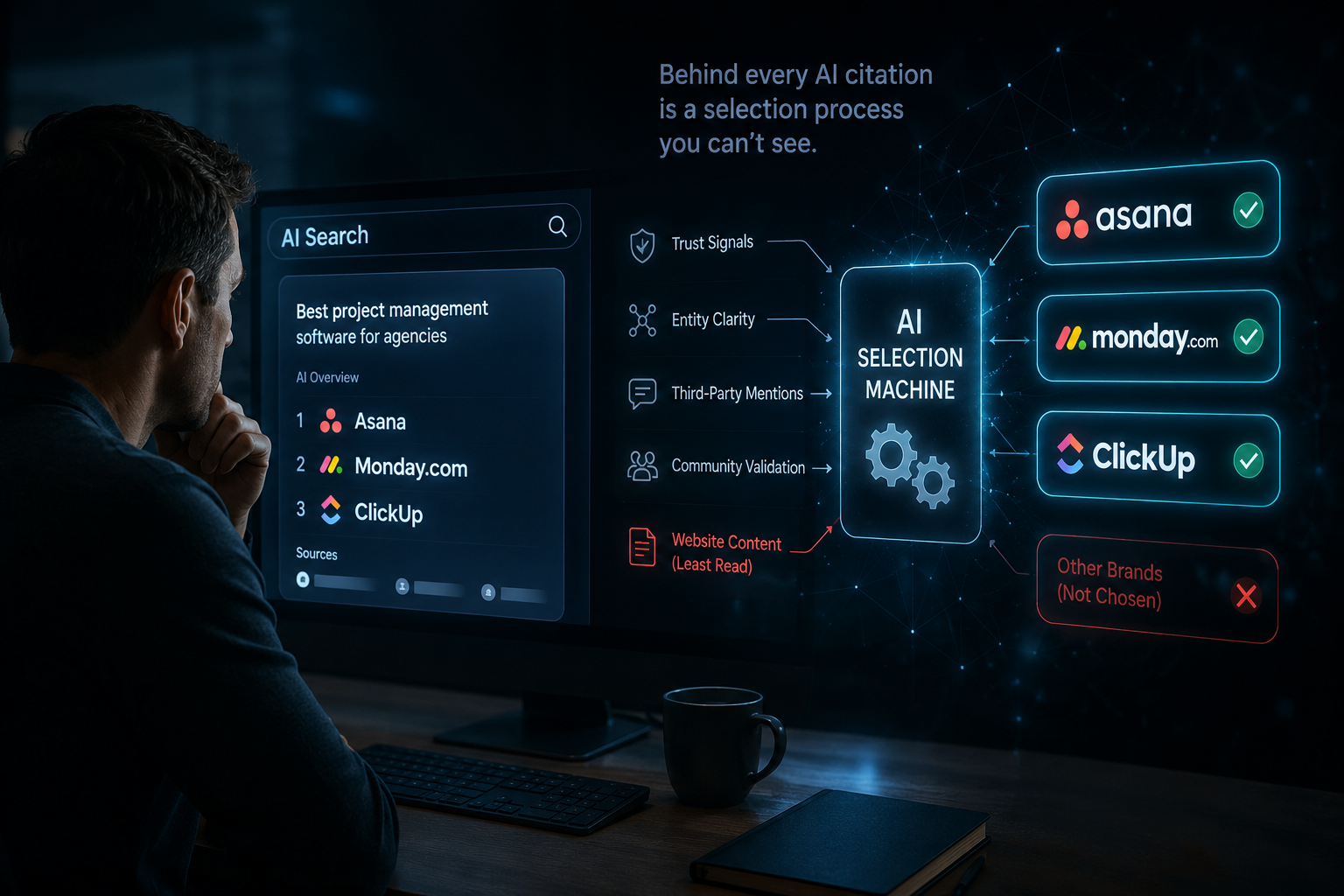
When you ask ChatGPT, Perplexity, or Google's AI for a recommendation, the answer arrives clean and confident — a tidy shortlist of brands, maybe a few cited sources at the bottom. What you don't see is the selection process that produced it: a hidden machinery of trust scoring, entity matching, and third-party validation that decided, long before you asked, which brands were even eligible to be named. Most business owners assume their own website is what AI reads to learn about them. It mostly isn't. And once you understand what AI is actually reading, the rules of visibility look very different — and a lot less in your direct control than the old SEO playbook promised.
This is the part of AI search nobody puts in the sales deck. Let's pull back the curtain.
AI doesn't discover brands. It selects from ones it already knows.
Start with the single most important idea, because it reframes everything else. As one search strategist summarized a widely-discussed 2026 industry session, AI doesn't discover new brands — it selects from known entities. The implication is blunt: if you haven't built entity recognition across the web's key reference points — Wikipedia, Reddit, LinkedIn, authoritative press coverage — you don't get selected. Search Engine LandSearch Engine Land
This is the "dark side": there's a gate, and it sits before the answer is generated. A model can only name and recommend brands it already understands to be real, credible, and relevant. If the wider web hasn't taught it who you are, you're not in the running — no matter how good your website is. You don't lose the comparison; you were never entered into it.
What AI actually reads: the 85–95% you don't own
Here's the statistic that tends to stop business owners cold. According to GEO research, roughly 85% of AI citations trace back to external sources — publications, forums, review platforms, and industry databases — while your homepage barely registers. Other analyses put the range even higher, with 90–95% of AI citations coming from external sources, not your own website. Swaragh TechnologiesZiptie
Why does AI lean so heavily on everyone except you? Because independence is the whole point. As one analysis explains, a brand that only appears on its own website has no corroborating signal — third-party sources seem more trustworthy to AI because they provide independent evidence something a brand's own website cannot. Put simply: a product page that says "we're the best solution for X" is promotional copy, while a G2 review, an analyst writeup, or a journalist's comparison that reaches the same conclusion is independent validation. AI is built to synthesize across many independent sources, so it systematically discounts the one source with the most obvious bias — you talking about yourself. SemrushSemrush
This is the mechanism behind the line you've probably heard: third-party validation is the new backlink. The off-site mention — linked or not — is what AI uses to verify you're credible. As one researcher put it bluntly, the mention is the signal; the link is almost irrelevant. FancyAI
Why entity clarity is the new backlink
Mentions only work, though, if AI can connect them back to you. This is where the second hidden layer comes in — entity resolution — and it's where most brands quietly fail without realizing it.
When AI encounters your name across the web, it has to resolve a basic question: who exactly is this, and is this the same company being mentioned over here, and over there? If your brand presents itself inconsistently — different descriptions, mismatched details, an unclear category — the model can't stitch those signals together. As one breakdown notes, inconsistency creates ambiguous entity resolution; the same brand narrative needs to appear consistently across every surface AI crawls — site, Reddit, LinkedIn, YouTube, third-party media. Another puts the failure mode plainly: when a model cannot tell exactly who a company is, what it offers, where it operates, who its customers are, or how its naming relates across sources, recommendation quality weakens. FancyAIALM Corp
That's why entity clarity functions like backlinks did in the old era. In 2016, links were the currency of trust — votes that told Google you were credible. In 2026, the currency is a coherent, corroborated entity: a brand whose identity is consistent across your site, your profiles, your leadership pages, and the third-party places AI trusts, so the model can confidently say "this is who they are and this is what they're good at." Without that clarity, even mentions that exist don't help, because AI can't attribute them to you.
The platform problem: there's no single "AI search"
Here's another thing the simple narrative hides: "optimizing for AI search" isn't one target. Each engine reads a different slice of the web and trusts different sources, so being visible in one tells you almost nothing about the others. A study of citation behavior found that only 11% of domains are cited by both ChatGPT and Perplexity for the same query, and 71% of all cited sources appear on only one platform. Ziptie
Their preferences diverge sharply. The same study found ChatGPT favors Wikipedia (47.9% of top citations), Perplexity favors Reddit (46.7%), Google AI Overviews favor YouTube (23.3%), and Claude favors blogs (43.8%). Reddit in particular has become unavoidable: it's the number-one most-cited source for Perplexity at 46.7% of citations, with LinkedIn second — neither of which was ever an SEO priority. The takeaway is that a single-platform strategy isn't a strategy, because each model has its own retrieval logic, trust signals, and recency weighting. ZiptieFancyAI
The "ghost citation" — when you do the work and get none of the credit
Now the darkest corner. Even when AI does use your content, you may get no recognition for it. Researchers at Semrush, working with Kevin Indig, coined the term "ghost citation" for this gap, and the data is sobering: 62% of AI citations are ghost citations — your site gets a source link, but the AI never says your name in the answer. Across their dataset, 74.9% of brand appearances included a citation, but only 38.3% included an actual brand mention. SemrushSemrush
Worse than invisible attribution is being the source that hands your competitor the win. The pattern, as one analysis describes it: a prospect asks for the best software, the AI names three competitors in its answer, and at the bottom it cites your comparison guide as a source. Your content did the work. Your competitors got the recommendation. This "mention-source divide" is common — one study found brands are 3x more likely to be cited alone than to earn both a citation and a mention. If your domain shows up in citations but your brand never appears in the answer text, you have a brand-positioning problem, not a content problem. RankScienceRankScience
The uncomfortable bias: AI prefers brands it's already heard of
Finally, the part that's genuinely hard for smaller players. There's a documented big-brand bias baked into how these systems score sources. AI is, in the words of one breakdown, overwhelmingly biased toward earned media and authoritative third-party sources, with mentions in news sites, research papers, and industry blogs outweighing owned content every time. And citations concentrate: ChatGPT only cites about 15% of the pages it retrieves, with citations concentrated among a small set of high-visibility domains that pass authority checks faster. The honest conclusion for everyone who isn't already a household name: smaller brands need stronger signals, not just better content. Sudha Solutions + 2
A necessary reality check
It would be easy to read all this as "manufacture a thousand Reddit mentions and buy a Wikipedia page." Don't — that's the trap, and AI is increasingly good at catching it. As one measured analysis cautions, brands confuse visible platforms with causal drivers; seeing Reddit or Wikipedia cited often does not mean a brand should center its strategy on manufacturing mentions there. Coordinated or inauthentic placements may even create negative trust if they look coordinated. A Wikipedia page is not a requirement for recommendation visibility, and the most-cited community discussions are often older, lower-profile, more specific conversations that answer a question plainly and credibly — not viral stunts. ALM Corp + 3
The real principle underneath the machinery is reassuringly old-fashioned: models recommend what appears most useful, most grounded, most clearly explained, and most consistently reinforced across the right digital neighborhood for a specific query. Category authority beats platform obsession. Genuine third-party validation beats self-promotion. Niche relevance beats raw scale. ALM Corp
What this actually means for you
The "dark side" of AI search isn't sinister — it's just invisible, and that's what makes it dangerous to ignore. The decisions about whether you get cited and named are being made in a layer you can't see and don't own, driven by what the rest of the web says about you and how clearly AI can tell who you are. The brands winning aren't the ones with the slickest homepage. They're the ones who built a coherent entity, earned genuine third-party validation in their category, and made their identity legible across the specific platforms each AI engine trusts.
That's harder than stuffing keywords or chasing a ranking. It's also far more durable — because it's built on real reputation, not algorithmic tricks. The question to sit with isn't "does our website look good?" It's "when an AI is deciding who to recommend in our category, has the web given it enough reason to know us, trust us, and say our name?"
Want to know what AI actually says about your brand right now — and why? We audit how ChatGPT, Perplexity, Gemini, and Google's AI see you, find the entity and validation gaps holding you back, and build the third-party credibility that gets you named, not just used. Let's see where you stand.
Frequently Asked Questions
Does AI actually read my website to decide whether to recommend me?
Mostly no — and this surprises most business owners. Roughly 85% of AI citations trace back to external sources like publications, forums, review platforms, and industry databases, while your homepage barely registers, with some analyses putting it as high as 90–95% from external sources. AI leans on third parties because a brand that only appears on its own website has no corroborating signal — independent sources provide evidence a brand's own site cannot. Swaragh Technologies + 2
What does "AI doesn't discover brands, it selects from known entities" mean?
It means there's a gate before the answer is generated. As one strategist summarized, AI doesn't discover new brands — it selects from known entities, so if you haven't built entity recognition across the web's key reference points — Wikipedia, Reddit, LinkedIn, authoritative press — you don't get selected. A model can only name brands it already understands to be real and credible. If the wider web hasn't taught it who you are, you're never entered into the comparison. Search Engine LandSearch Engine Land
Why is "entity clarity" being called the new backlink?
Because it's now the currency of trust the way links once were. AI has to resolve who you are by stitching together mentions across the web, and it can't do that if your identity is inconsistent. As one analysis notes, inconsistency creates ambiguous entity resolution — the same brand narrative needs to appear consistently across every surface AI crawls. When a model cannot tell exactly who a company is, what it offers, or where it operates, recommendation quality weakens. A coherent, corroborated entity is what lets AI confidently name you. FancyAIALM Corp
Why do different AI tools recommend completely different brands?
Because there is no single "AI search" — each engine reads a different slice of the web. A citation study found only 11% of domains are cited by both ChatGPT and Perplexity for the same query, and 71% of all cited sources appear on only one platform. Their preferences diverge sharply: ChatGPT favors Wikipedia, Perplexity favors Reddit, Google AI Overviews favor YouTube, and Claude favors blogs. Being visible in one engine tells you little about the others. ZiptieZiptie
What is a "ghost citation"?
It's when AI uses your content as a source but never names your brand in the answer — you do the work, the reader never learns who you are. Researchers found that 62% of AI citations are ghost citations, and across their dataset 74.9% of brand appearances included a citation but only 38.3% included an actual brand mention. Worse, you can be the source that hands a competitor the recommendation while only your link appears at the bottom. SemrushSemrush
Is AI biased toward big, well-known brands?
Yes, measurably. AI scoring is overwhelmingly biased toward earned media and authoritative third-party sources, with mentions in news sites, research papers, and industry blogs outweighing owned content every time. Citations also concentrate among a few trusted domains — ChatGPT only cites about 15% of the pages it retrieves. The practical consequence for everyone who isn't a household name: smaller brands need stronger signals, not just better content. Sudha Solutions + 2
Should I just buy a Wikipedia page and flood Reddit with mentions?
No — that's the trap, and AI increasingly filters it out. Brands often confuse visible platforms with causal drivers; seeing Reddit or Wikipedia cited often does not mean you should center your strategy on manufacturing mentions there, and coordinated placements may even create negative trust if they look inauthentic. A Wikipedia page is not a requirement for recommendation visibility. Genuine, sustained participation and category authority beat manufactured noise. ALM Corp + 2
So what actually earns AI recommendations?
The underlying principle is refreshingly old-fashioned: models recommend what appears most useful, most grounded, most clearly explained, and most consistently reinforced across the right digital neighborhood for a specific query. In practice that means a coherent, consistent brand entity; genuine third-party validation in your category (reviews, press, expert coverage); and a legible presence across the specific platforms each AI engine trusts — built on real reputation rather than tricks. ALM Corp
Sources
Semrush, Why AI Is Citing Third-Party Sources Instead of Your Site — https://www.semrush.com/blog/ai-citing-my-site-vs-third-party-sources/
Semrush / Kevin Indig, Why 62% of AI Citations Don't Lead to Brand Mentions (The Ghost Citations Study) — https://www.semrush.com/blog/the-ghost-citations-study/
Swaragh, Why 85% of AI Brand Mentions Come from Third-Party Sites — https://www.swaragh.com/blog/ai-brand-mentions-from-third-party-sites/
Search Engine Land, Why AI Visibility Starts Before Search and Ends with Citations — https://searchengineland.com/ai-visibility-starts-before-search-ends-with-citations-476308
ZipTie, How Different AI Platforms Cite the Same Source Differently — https://ziptie.dev/blog/how-different-ai-platforms-cite-the-same-source-differently/
RankScience, AI Citations vs Mentions: Why AI Picks Competitors Over You — https://www.rankscience.com/blog/ai-citations-brand-mentions-visibility-gap
Sudha Solutions, AI Citations Explained: Why Some Brands Get Picked — https://www.sudhasolutions.com/blog/how-ai-decides-which-brands-to-cite-and-why-most-dont-make-it/
ALM Corp, What Drives AI Recommendations? The Real Role of Reddit, Wikipedia, and Topical Authority — https://almcorp.com/blog/what-drives-ai-recommendations/
FancyAI, AI Is Now Citing AI: The 91.4% Problem — https://www.getfancy.ai/article-the-content-collapse