Why Being #1 on Google No Longer Guarantees Traffic
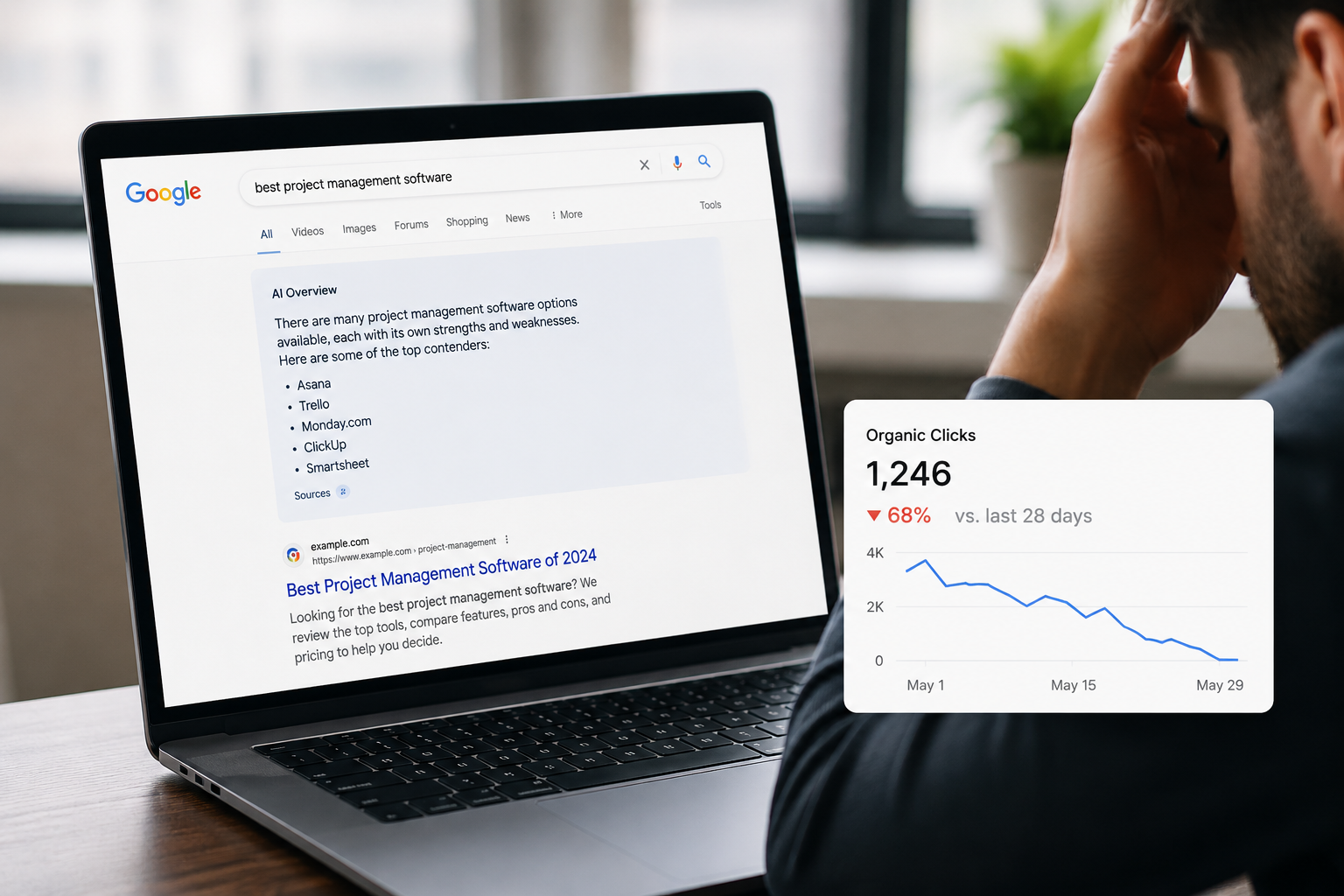
For twenty years, the entire logic of SEO rested on one assumption so obvious nobody questioned it: get to the top of the search results, and the traffic follows. Position one was the prize, the gold standard, the thing every campaign was secretly chasing. That assumption is now broken. You can hold the number-one organic ranking for a valuable keyword today and watch your click volume fall off a cliff — not because you slipped in the rankings, but because the page above your ranking changed shape. The link is still there. The clicks are not.
This is the most disorienting shift in search right now, because it breaks the cause-and-effect relationship businesses have relied on for two decades. Ranking and traffic used to be the same conversation. They aren't anymore.
From ten blue links to an answer at the top
To understand why, look at what now sits above your hard-won ranking. For most of search history, the results page was a clean list — ten blue links, ranked in order, and your job was to climb that list. As one analysis describes it, organic click-through rate used to behave like a clean, predictable curve: rank higher, get more clicks. Indexsy
That page barely exists anymore. Today the top of the results is increasingly occupied by an AI Overview — Google's AI-generated answer that synthesizes information from multiple sources and resolves the query right there, before the user ever reaches a blue link. As the same analysis puts it, a number-one blue link can now be visually displaced by AI Overviews, featured snippets, local packs, "People Also Ask," video blocks, and shopping units — which changes user attention, scrolling patterns, and the share of searches that end with no click at all. Indexsy
And these aren't a fringe feature anymore. AI Overviews now appear on roughly 48% of search queries as of March 2026, a 58% increase year over year. On informational and question-based queries — the bread and butter of content marketing — the coverage runs far higher still. Layer in the rise of chat-based search entirely outside Google, where users ask ChatGPT or Perplexity and never see a results page at all, and the picture is clear: the search experience has shifted from navigating links to consuming answers. theStacc
What that does to your #1 ranking
Here's where it gets concrete, and painful. When an AI Overview appears above your top-ranked result, it doesn't just nudge your clicks down — it takes most of them.
The most rigorous measurement comes from Ahrefs, which compared position-one click-through rates before and after AI Overviews rolled out. Their finding: as of December 2025, AI Overviews reduce the organic click-through rate for position-one content by 58%. They put it bluntly: for every 100 clicks you could historically earn for a top-ranking page, Google now keeps 58. That's nearly double the 34.5% drop they measured just a year earlier — the trend is accelerating, not stabilizing. AhrefsAhrefs
This isn't one outlier study. The same effect shows up across independent research. Ahrefs notes its finding is corroborated by Seer Interactive (organic CTR down between 49% and 65%), Kevin Indig (over 50%), Authoritas (47.5%), and even the Daily Mail (reporting 80–90% lower CTR). A separate study of more than 200,000 keywords found position-one CTR dropped 32% year-over-year, from 28% to 19%. In Germany, Sistrix measured position-one organic CTR falling from 27% to 11% — about a 60% drop — when an AI Overview is present. Ahrefs + 2
The practical translation of all this is a phenomenon thousands of site owners are seeing in their own dashboards and finding inexplicable: rankings stable, impressions up, clicks down. One documented case showed impressions up 27.56% year-over-year while clicks dropped 36.18% and CTR fell from 5.98% to 3.35% — despite average rankings actually improving 14%. If you've been staring at a report like that wondering what you did wrong, the answer is probably nothing. The page around your ranking changed. IndexsyDataslayer
The zero-click reality
Step back and the trend has a name: zero-click search, where the user gets their answer and never visits any website. The numbers are stark. Around 60% of searches now end without a click, framed as the new default for most informational queries, and on searches that specifically trigger an AI Overview, 83% end in zero clicks. AI summaries don't just absorb the click — they end the session: a Pew-style panel found users ended their session after a search with an AI summary 26% of the time, versus 16% without one. Slatehq + 2
For publishers who lived entirely on informational traffic, the consequences have been brutal — the Reuters Institute captured a 33% global Google traffic decline across 2,500 publisher sites between November 2024 and November 2025. Ranking number one did not save them, because ranking number one no longer does what it used to. Digitalstrategyforce
But "worthless" is the wrong conclusion
Here's the part the doom headlines miss, and it's the most important thing in this article. The collapse of position-one click-through rate does not mean ranking number one is worthless. It means position one now does a different job than it used to.
The shift is from a click slot to a citation slot. As one analysis frames it, ranking number one in 2026 is no longer a click-monetization slot — it is a citation-seeding instrument, a branded-search compounder, and a buyer-quality filter. The reason that matters: the sources an AI Overview pulls from are disproportionately the pages that already rank well. Ranking high is increasingly how you earn the citation — and being cited is the new prize. Digitalstrategyforce
And citation pays, even in a zero-click world. Multiple studies confirm that brands cited in AI Overviews earn 35% more clicks than those that aren't. Seer Interactive's full-year analysis found that throughout 2025, being cited in an AI Overview delivered two to five times the organic CTR of not being cited. Crucially, Seer's data also revealed that AI Overview presence isn't the real mover — whether or not a brand is cited in that overview is. When a brand was not cited, CTRs declined 67% over 2025 across 311 million organic impressions — roughly 13,000 fewer organic clicks for every million impressions. theStacc + 3
So the question worth asking isn't "are we ranking number one?" It's "when the AI answers this query, are we one of the three to five sources it cites and names?" That's the position that now drives traffic, authority, and trust.
The new hierarchy of search visibility
This reframes what a winning strategy even looks like. One useful model describes four levels of brand visibility in the AI era. At the bottom is the click-chaser — the brand still optimizing exclusively for CTR and organic sessions, reading the 58% decline as failure rather than a signal that the instrument has changed. Above that sits the snippet-earner, whose content is structured to be extracted; then the AI-citable brand, whose pages routinely appear in AI Overview and ChatGPT citations; and at the top, the presence-compounder — the brand that owns its entity across the open web and treats organic ranking, snippets, and citations as a single integrated visibility instrument. The warning is direct: the bottom levels are now the dangerous places to live — a click-chaser keeps the same KPIs and watches them decline through 2026 with no recovery mechanism. Digitalstrategyforce + 2
There's nuance worth holding onto, too. The damage is uneven. AI Overviews appear on more than 88% of informational queries, but commercial and transactional searches — people ready to buy — trigger them far less often, so if your traffic is lower-funnel, the impact is softer. And aggregate benchmarks can mislead: Seer's own guidance is that your own data is the strategic input, because citation status, query format, and intent type are doing more work than AI Overview presence alone. PsykeSeer Interactive
What to actually do about it
The mistake is to keep optimizing for a metric that's being structurally eroded. The fix is to widen what you measure and what you're aiming at. Stop treating the number-one ranking as the finish line and start treating it as one input into a bigger goal: being the cited, named, recommended source across Google's AI Overviews, AI Mode, and chat-based engines alike. That means tracking new things — AI Overview appearance rate, citation frequency, and brand mentions across LLMs — alongside your rankings. It means structuring content so it's easy for an AI to extract and quote. And it means building the kind of topical authority and brand presence that makes engines trust you enough to cite you in the first place.
Ranking number one still matters. It's just no longer the destination — it's the on-ramp to the visibility that actually drives traffic now. The businesses that understand that distinction are quietly pulling ahead. The ones still measuring success by a ranking position and wondering where their clicks went are optimizing for a search engine that no longer exists.
If your rankings are holding but your traffic is sliding, you're not imagining it — and you're not stuck with it. We help businesses move from chasing rankings to earning citations: the visibility that actually converts in an AI-first search world. Let's figure out where your traffic is really going.
Frequently Asked Questions
Why is my Google ranking stable but my traffic dropping?
This is the single most common symptom of the AI Overview shift, and it confuses almost everyone who sees it. The pattern is rankings stable, impressions up, clicks down — and it's not a contradiction or a mistake on your end. When an AI Overview appears above your result, users get their answer without clicking through. One documented case showed impressions up 27.56% year-over-year while clicks dropped 36.18%, despite average rankings improving 14%. The page around your ranking changed, not your ranking. IndexsyDataslayer
How much traffic does the #1 spot actually lose to AI Overviews?
Roughly half or more, on affected queries. Ahrefs found that as of December 2025, AI Overviews reduce the click-through rate for position-one content by 58% — for every 100 clicks you could historically earn, Google now keeps 58. The finding is corroborated across studies: Seer Interactive (down 49–65%), Kevin Indig (over 50%), and Authoritas (47.5%). In Germany, Sistrix measured position-one CTR falling from 27% to 11% when an AI Overview is present. Ahrefs + 2
Does this mean ranking #1 is now worthless?
No — it means position one does a different job. It has shifted from a click slot to a citation slot. As one analysis frames it, ranking number one is now a citation-seeding instrument, a branded-search compounder, and a buyer-quality filter rather than a pure traffic source. AI Overviews disproportionately pull from pages that already rank well, so a high ranking is increasingly how you earn the citation — and citation is the new prize. Digitalstrategyforce
What is zero-click search?
It's a search that resolves without the user visiting any website — they read the answer on the results page (or in a chatbot) and stop. It's now the default for many queries: around 60% of all searches end without a click, and on searches that trigger an AI Overview specifically, 83% end in zero clicks. AI summaries don't just absorb the click — they end the session more often: users ended their session after a search with an AI summary 26% of the time, versus 16% without one. Slatehq + 2
Is being cited in an AI Overview actually worth anything if people don't click?
Yes, significantly. Multiple studies show brands cited in AI Overviews earn 35% more clicks than uncited ones, and Seer Interactive found that being cited delivered two to five times the organic CTR of not being cited throughout 2025. The reverse is brutal: when a brand was not cited, CTRs declined 67% over 2025 across 311 million impressions. Citation status, not AI Overview presence alone, is the real driver. theStacc + 2
Are all types of searches affected equally?
No — the impact is highly uneven by intent. AI Overviews dominate informational queries, appearing on more than 88% of them, which is why guides, how-tos, and definitions took the hardest hit. Commercial and transactional queries — people ready to buy — trigger AI Overviews far less often, so lower-funnel and local content is more protected. The right benchmark depends on your specific query mix, not a generic average. Psyke
How do I tell if my traffic loss is from AI Overviews or a normal ranking drop?
Diagnose it query by query. Check Google Search Console first: if impressions are stable but clicks are falling, that's the classic sign of zero-click searches; if impressions are also falling, it's more likely a separate ranking issue. Tools like Ahrefs and Semrush now flag which of your keywords trigger an AI Overview, so you can isolate AI-affected queries from genuine ranking declines and respond to each correctly. Pasquale Pillitteri
What should I be measuring and optimizing for now?
Widen both your metrics and your target. Beyond rankings and clicks, track your AI Overview appearance rate, citation frequency, and brand mentions across LLMs like ChatGPT and Perplexity. The strategic move is climbing what one model calls the visibility ladder — from click-chaser, to snippet-earner, to AI-citable, to presence-compounder, the brand that treats organic ranking, snippets, and citations as a single integrated visibility instrument. Structure content for easy extraction, and build the topical authority that earns the citation. Digitalstrategyforce
Sources
Ahrefs, Update: AI Overviews Reduce Clicks by 58% — https://ahrefs.com/blog/ai-overviews-reduce-clicks-update/
Decoding, Google's Organic Click-Through Rate by Search Position: The 2026 Reality — https://trydecoding.com/blog/googles-organic-click-through-rate-by-search-position/
Digital Strategy Force, Is Ranking #1 on Google Still Worth Anything After AI Overviews? — https://digitalstrategyforce.com/journal/is-ranking-1-on-google-still-worth-anything-after-ai-overviews/
Seer Interactive, AIO Impact on Google CTR: 2026 Update — https://www.seerinteractive.com/insights/aio-impact-on-google-ctr-2026-update
Slate, Google AI Overviews Statistics: CTR, Usage & Traffic — https://slatehq.com/blog/google-ai-overviews-statistics
Indexsy, Google CTR by Ranking Position Statistics in 2026 — https://indexsy.com/ctr-statistics/
Psyke, Google AI Overviews: Key CTR and Traffic Insights — https://psyke.co/google-ai-overviews-statistics
Dataslayer, AI Overviews Killed CTR 61%: 9 Strategies to Show Up — https://www.dataslayer.ai/blog/google-ai-overviews-the-end-of-traditional-ctr-and-how-to-adapt-in-2025
The Stacc, Google AI Overviews in 2026: 48% of Searches Have Them — https://thestacc.com/blog/google-ai-overview-statistics/