Is Your SEO Strategy Built for 2016 or 2026?
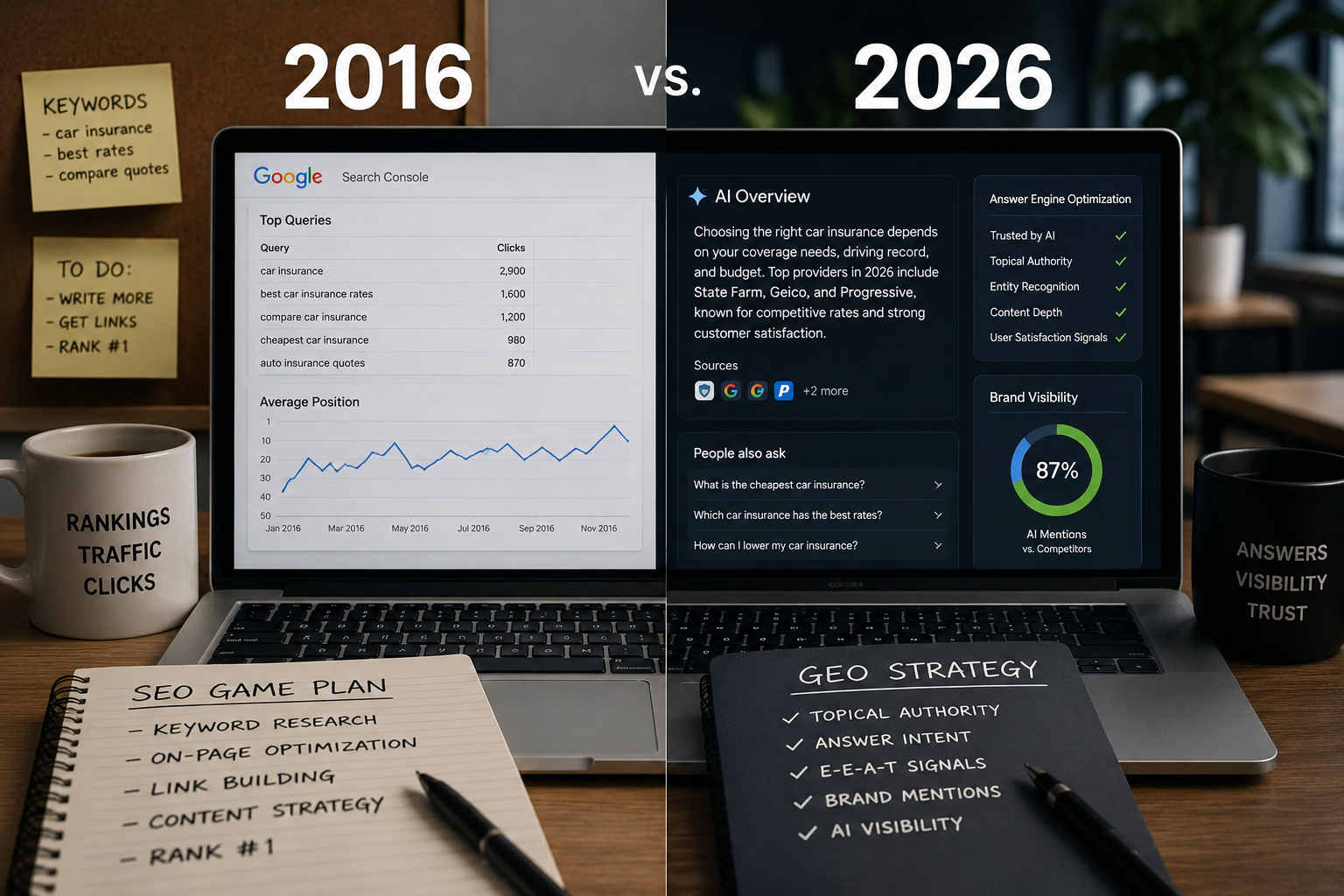
Open your current SEO playbook and ask yourself one question: would it look out of place in 2016? If the plan still revolves around picking a keyword, hitting a word count, sprinkling that phrase through the page, and chasing the number-one ranking, then you're running a decade-old strategy in a search environment that no longer rewards it. The mechanics of how people find information have changed more in the last twenty-four months than in the previous ten years, and the businesses still optimizing for the old game are quietly losing ground to competitors who understood that the game itself changed.
This isn't a "SEO is dead" piece. SEO is very much alive. But a specific version of SEO — the 2016 version — is dying in real time, and confusing the two is the most expensive mistake a business can make right now.
The 2016 model: rank, click, repeat
For roughly two decades, search optimization ran on a simple, reliable loop. You found a keyword with search volume, you built a page targeting it, you earned some links, and you climbed the rankings. The higher you ranked, the more clicks you got, and clicks were the whole point. As one industry analysis put it, for the past two decades the goal of SEO was to rank — get to page one, get to position one — and the higher you ranked, the more clicks you got. Unodeskly
That model had a clear villain and a clear hero. The villain was the cheap tactic: keyword stuffing, thin content built to hit a word count, link farms, exact-match anchor text manipulation. The hero was the page that ranked first and captured the traffic. It worked because the search results page was, fundamentally, a list of ten blue links, and your job was to be near the top of that list.
That world is gone. As one writer summarized the long history of "SEO is dead" predictions, what actually died each cycle wasn't SEO — it was a specific version of SEO. Keyword stuffing died. Link farms died. Thin content farms died. The practice of getting found in search results just keeps growing. We're now living through the most dramatic version of that cycle yet. Savo Group
What broke: the click itself
The single biggest shift is that the click — the metric the entire 2016 model was built around — is disappearing for huge categories of search.
Google's AI Overviews, the AI-generated answer boxes that now sit above the organic results, have rewritten the math. When one appears, the traffic impact is severe: Ahrefs found that reaching position one, the gold standard of SEO for two decades, now earns less than half the traffic that same ranking would have generated in 2024, with a roughly 58% drop in click-through rate for the number-one position when an AI Overview appears above it. A Seer Interactive study tracking thousands of search terms found that organic click-through rate for queries with AI Overviews fell 61%, from 1.76% down to 0.61%. Unodeskly + 2
And these aren't rare. For the kind of informational content that powered the old blog-traffic model, AI Overviews are now nearly universal: Ahrefs data shows 99.9% of informational keywords now trigger an AI Overview. The zero-click reality is stark. Industry figures put it at 60% of traditional Google searches ending without a click, 83% of searches that trigger AI Overviews ending without a click, and 93% of searches in AI Mode ending without a click. Pasquale PillitteriPasquale Pillitteri
If your strategy depends on someone reading your answer, clicking through, and landing on your page, that strategy is being intercepted before the click ever happens. The Pew Research Center, tracking real browsing behavior, found that users clicked a traditional result just 8% of the time when an AI Overview appeared, compared to 15% when it didn't. Pixels Corp
But here's the part the panic headlines get wrong
This is where most "the sky is falling" articles overreach — and where you should be skeptical of anyone telling you to abandon search entirely. The data does not support a catastrophe.
Organic search is still the largest traffic channel most businesses have. Per BrightEdge, organic search still accounts for 53% of all trackable website traffic globally — the single largest channel for most businesses, a figure that has remained remarkably stable even as AI search tools have gained adoption. The decline in actual organic traffic has been far gentler than the headlines suggest: a January 2026 Graphite report found organic search traffic declined by only 2.5% between February 2024 and November 2025 — not the catastrophic 25–50% some panic-driven headlines predicted. In fact, the total search pie got bigger, with combined usage of search engines and AI tools increasing 26% worldwide. Indexed + 2
The impact is also wildly uneven by query type. Informational content got hammered, but commercial and local searches barely felt it: e-commerce queries only trigger AI Overviews about 3–4% of the time, so if you're a local service business or selling products online, the impact is smaller than the headlines suggest. Savo Group
So the accurate statement isn't "SEO is dead." It's this: the 2016 tactics are dead, the value of being discoverable is higher than ever, and the rules for capturing that value have fundamentally changed.
The 2026 model: from "rank" to "be the answer"
Here's the mental shift that separates a modern strategy from a legacy one. In 2016, the goal was to rank. In 2026, the goal is to be the answer — to be the source the AI quotes, names, and recommends.
That changes everything downstream. When AI Overviews cite an average of five sources per query, they compress the visibility that previously spread across ten organic results into a curated shortlist. You're no longer competing for a top-ten slot; you're competing to be one of five sources the AI trusts enough to cite. And being cited is worth fighting for, because the brands that earn it win the remaining clicks: brands actually cited inside the AI Overview earn 35% more organic clicks than those who aren't cited at all. IndexedPixels Corp
This is why the discipline has a new name — Generative Engine Optimization, or GEO — and a new center of gravity. The dead tactics are explicit. As multiple analyses agree, what no longer works is keyword stuffing, thin content produced at scale without expertise, exact-match anchor text link schemes, and content designed to rank for a keyword without actually answering the user's question. Worse than ineffective, some are now actively penalized: Google's scaled content abuse policies now specifically target AI-generated content published at volume without editorial oversight. IndexedSavo Group
What replaces them is a different kind of work. AI systems are more discerning about content quality than traditional algorithms — they evaluate depth, originality, factual accuracy, and source credibility, and thin, generic content that could apply to any business is less likely to be cited. Brand signals now matter enormously, because, as one strategist notes, Google updates primarily affect websites with a lot of organic traffic but a relatively weak brand; an extensive digital footprint signals to Google that it's a relevant brand. And visibility now lives across platforms, not just on Google — your presence on Reddit, LinkedIn, and industry-specific forums, where LLMs get their knowledge, feeds directly into whether you show up in AI answers. Indexed + 2
So: 2016 or 2026?
Run the honest audit. A 2016 strategy obsesses over keyword rankings and treats a top-three position as the finish line. A 2026 strategy treats rankings as one input and asks a harder question: when someone searches our category — on Google, in ChatGPT, in Perplexity — are we the answer they get handed? A 2016 strategy publishes a high volume of keyword-targeted blog posts. A 2026 strategy builds deep, interconnected topical authority that AI systems recognize as expertise and that earns citations across the web. A 2016 strategy measures success in clicks and rankings alone. A 2026 strategy also tracks AI Overview appearance rate, brand mention frequency across LLMs, and citation share — and most businesses can't, because, as one report found, only 16% of brands currently have a systematic way to track AI search performance, making it a genuine competitive advantage. Pixels Corp
The window here matters. AI referral traffic is still small today but compounding fast, and the businesses that build authority and citation-worthy content now are the ones AI engines will reference when that volume becomes decisive. The companies clinging to the old playbook aren't wrong that something is dying. They're just wrong about what. It isn't search. It's their strategy.
The good news is that the fix isn't mysterious, and the competitive field is unusually open — because most of your competitors are still optimizing for 2016.
Not sure whether your SEO is built for the world that exists or the one that ended years ago? We help businesses retool from the old rank-and-click model to a modern answer-authority strategy that gets them cited, mentioned, and found across Google and AI search alike. Let's audit where you actually stand.
Frequently Asked Questions
Is SEO dead in 2026?
No — but a specific version of it is. The principle of being discoverable when people search for what you offer is more valuable than ever; organic search still drives 53% of all trackable website traffic globally, the single largest channel for most businesses. What's dying are the old tactics. As one analysis put it, every time search changes, what actually dies isn't SEO — it's a specific version of SEO. Keyword stuffing died. Link farms died. Thin content farms died. The practice of getting found just keeps growing. IndexedSavo Group
What old SEO tactics no longer work?
The ones built on gaming the algorithm rather than serving the searcher. Across multiple 2026 analyses, the dead list is consistent: keyword stuffing, thin content produced at scale without expertise, exact-match anchor text link schemes, and content designed to rank for a keyword without actually answering the user's question. Some are now actively risky — Google's scaled content abuse policies specifically target AI-generated content published at volume without editorial oversight. IndexedSavo Group
How much have AI Overviews actually hurt organic traffic?
A lot for some queries, far less overall than the headlines claim. When an AI Overview appears, Ahrefs found a roughly 58% drop in click-through rate for the number-one position, and a Seer Interactive study saw organic CTR for affected queries fall 61%, from 1.76% down to 0.61%. But site-wide, a January 2026 Graphite report found organic traffic declined only 2.5% between February 2024 and November 2025 — not the catastrophic 25–50% some panic headlines predicted. The damage is concentrated in informational content. Savo Group + 2
Which businesses are most and least affected?
It depends heavily on query type. Informational content took the biggest hit — 99.9% of informational keywords now trigger an AI Overview. Commercial and local searches are far more protected: e-commerce queries only trigger AI Overviews about 3–4% of the time, so for a local service business or online store the impact is smaller than the headlines suggest. If your traffic was mostly top-of-funnel guides and how-tos, you're in the highest-risk category. Pasquale PillitteriSavo Group
What does "be the answer instead of ranking" actually mean?
It's the core mental shift from the 2016 model to the 2026 one. The old goal was to rank in the top results so users would click through. The new goal is to be one of the sources the AI cites in its answer. AI Overviews cite an average of five sources per query, compressing the visibility that once spread across ten organic results into a curated shortlist. Being on that shortlist pays: brands cited inside the AI Overview earn 35% more organic clicks than those who aren't cited at all. IndexedPixels Corp
What is GEO, and how is it different from traditional SEO?
GEO — Generative Engine Optimization — is the practice of optimizing to be cited and recommended by AI answer engines like ChatGPT, Perplexity, Gemini, and Google's AI features, rather than purely to rank in blue links. It leans on deeper signals: AI systems are more discerning about content quality than traditional algorithms, evaluating depth, originality, factual accuracy, and source credibility. Brand strength matters more too — Google updates primarily affect websites with a lot of organic traffic but a relatively weak brand. IndexedEvergreen
Should I stop doing traditional SEO and switch entirely to AI optimization?
No. The mature answer is that the two layers work together, and abandoning Google would be premature — it still commands roughly 90% of search, processing over 5 trillion searches a year, up from 2 trillion in 2016. The technical foundations still matter: fast, crawlable, well-structured websites remain the baseline for visibility in both traditional and AI search. The shift is additive — AI search adds a new layer above traditional search, not a replacement for it. Savo GroupIndexed
How do I know if my current strategy is outdated?
Audit what it optimizes for. A legacy strategy fixates on keyword rankings as the finish line, publishes high volumes of keyword-targeted posts, and measures success in clicks alone. A modern one builds interconnected topical authority, aims to be cited across Google and AI engines, and tracks new metrics — AI Overview appearance rate, LLM brand mentions, and citation share. Most businesses can't track those yet: only 16% of brands currently have a systematic way to track AI search performance, making it a genuine competitive advantage. Pixels Corp
Sources
Pixels Corp, Is Traditional SEO Dead? AI Search Changes 2026 — https://pixelscorp.com/blog/is-traditional-seo-dead/
Savo Group, Is SEO Dead in 2026? What the Data Actually Shows — https://savogroup.com/blog/is-seo-dead/
Unodeskly, Google AI Overviews Killed 58% of SEO Clicks — https://unodeskly.com/blog/google-ai-overviews-killing-seo-traffic-2026.html
Pasquale Pillitteri, Google AI Mode and Zero-Click: 93% of Searches No Longer Generate Clicks — https://pasqualepillitteri.it/en/news/811/google-ai-mode-zero-click-seo-2026-en
Joined Indexed, Is SEO Dead or Evolving in 2026? The Real Answer — https://www.joinindexed.com/blog/is-seo-dead-or-evolving-in-2026
Evergreen Media, SEO Trends 2026: Developing Strategies for the AI Era — https://www.evergreen.media/en/guide/seo-this-year/
Neil Patel, Is SEO Dead in 2026? (A Data-Driven Answer) — https://neilpatel.com/blog/seo-dead/
Orangemonke, Is SEO Dead in 2026? — https://orangemonke.com/blogs/is-seo-dead/