Schema Markup Is Overhyped: Why a Real Content System Beats Structured Data in AI Search Every Time
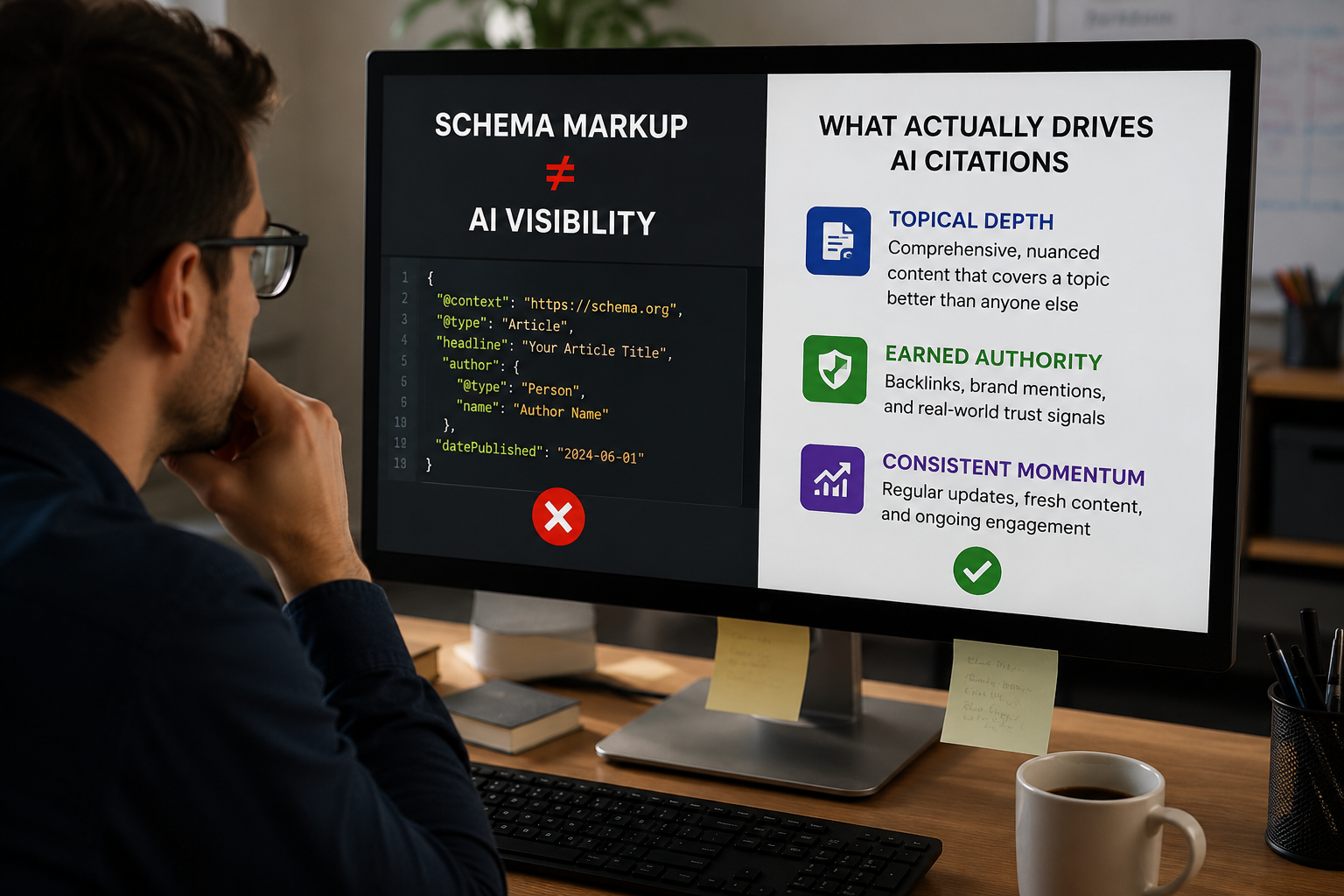
There's a comforting story making the rounds in marketing circles right now: bolt enough JSON-LD onto your site, declare your entities, wire up your FAQPage and Organization schema, and the AI engines will reward you with citations. It's comforting because it's tidy. Schema is code. Code can be implemented in an afternoon, checked off a list, and billed as a deliverable. The problem is that the evidence doesn't support the promise. Schema markup is useful infrastructure, but as a strategy for winning visibility in ChatGPT, Perplexity, Gemini, and Google's AI features, it's badly oversold. A site with a strong content system — real topical depth, earned authority, and consistent publishing momentum — will outpace a schema-obsessed competitor with thin or nonexistent content every single time. This post lays out why, with the data behind it.
The hype, stated plainly
If you've read much about "optimizing for AI search," you've seen the numbers. Pages with comprehensive schema are supposedly 36% more likely to appear in AI-generated summaries and citations compared to unstructured content. You've probably also seen the scare version: without proper schema implementation, your site could lose up to 60% of its visibility by 2026 as AI search continues growing. WPRidersWPRiders
These figures get repeated endlessly. They are also, on inspection, nearly unsourced. As one careful review of the field found, claims like "36% more likely to appear in AI summaries," "60% visibility loss without schema," and "30% higher citation rates" almost never have a credible source behind them. When you trace them back, they dissolve. That should be the first warning sign. Belmore Digital
What the actual studies show
When researchers have tried to measure schema's effect on AI citations directly, the result is consistently underwhelming.
The most rigorous test to date comes from Ahrefs. They tracked 1,885 web pages that added JSON-LD schema between August 2025 and March 2026, matched them against 4,000 control pages, and measured citation changes across Google AI Overviews, AI Mode, and ChatGPT. The finding: adding schema produced no major uplift in citations on any platform. Using their most reliable difference-in-differences analysis, both AI Mode and ChatGPT treated pages performed slightly better than control pages on average, but the differences were small enough that they could easily be random noise across thousands of URLs, while AI Overviews showed a small but statistically significant 4.6% decline. Their honest conclusion: we can't tell whether the schema did a tiny bit of good or nothing at all. Ahrefs + 4
An earlier analysis found the same thing. A Search Atlas study analyzed schema coverage against LLM citation rates across OpenAI, Gemini, and Perplexity and found no correlation — domains with comprehensive schema performed no better than those with minimal or none. Belmore Digital
Then there's the mechanical question of whether the engines even read it. An experiment by searchVIU tested whether five major AI systems — ChatGPT, Claude, Perplexity, Gemini, and Google AI Mode — actually used schema markup when fetching a page in real time. None of them did. During direct retrieval, every system extracted only visible HTML content; JSON-LD, hidden Microdata, and hidden RDFa were all ignored. Ahrefs
Even the famous study that schema advocates love to cite turns out not to be about schema at all. As one analysis pointed out, the 2024 GEO study from Princeton and Georgia Tech, which gets cited constantly in schema discussions, didn't actually test schema — it tested in-content strategies like adding citations and statistics. Those worked. Schema was never part of the experiment. Belmore Digital
Follow the incentives
Here's a detail worth sitting with. The loudest voices insisting schema is essential frequently have something to sell. As one reviewer bluntly noted, the most vocal advocate for schema's importance sells schema implementation as a service — their revenue depends entirely on schema being valuable. That doesn't make them wrong, but it does mean the confident claims deserve scrutiny they rarely get. The current honest state of the evidence is summed up well: there's one confirmed platform statement (Bing), one null-result empirical study, zero peer-reviewed research, and a lot of vendor-funded claims. Belmore DigitalBelmore Digital
What schema actually does (and it's not nothing)
To be fair and accurate: schema isn't worthless, and this isn't an argument to rip it out. Its real job is disambiguation. As one balanced take put it, schema does not replace content quality, does not turn a weak page into a strong one, and does not guarantee citations — but it does reduce ambiguity, and ambiguity is a tax on discoverability. It helps search engines and knowledge graphs resolve who you are, who wrote a piece, and how your pages connect. Those structured understandings can feed indirectly into AI systems. The cost is low and the downside is essentially zero, which is exactly why the sensible recommendation is to implement it — the cost is low, the downside is zero, and the potential upside exists across multiple pathways — but don't let anyone tell you it's a citation guarantee or the difference between being found and being invisible. ALM CorpBelmore Digital
In other words: schema is the seasoning, not the meal. The trouble starts when people serve seasoning and call it dinner.
What actually gets you cited
If schema isn't the lever, what is? The 2026 data points overwhelmingly toward off-site authority and content depth — the things a content system produces and schema cannot fake.
The single most striking finding comes from Ahrefs' study of 75,000 brands: branded web mentions correlate 0.664 with AI Overview visibility versus 0.218 for backlinks — the top three signals are all off-site brand signals, not link metrics. The gap is enormous. The top quartile of brands by mentions averages 169 AI Overview mentions versus 14 for the next tier. A meta-analysis by Cyrus Shepard of Zyppy, which synthesized 54 experiments, patents, and case studies into a single scored ranking of 23 factors, reached a coherent conclusion: AI engines cite pages they can reach, that already rank, and that match the query closely — none of which is a schema problem. Digital Applied Team + 3
Topical authority — the hallmark of a content system — is repeatedly identified as decisive. AI systems build a mental model of your site's expertise, and shallow coverage signals that you're a generalist, not an authority. The mechanism is what the industry calls query fan-out: AI engines expand a query into many sub-queries and pull from a wider SERP, and only 38% of AI Overview citations now come from the top 10, down from 76% in mid-2025. The practical consequence is direct: ranking across a cluster beats ranking once for a head term. You cannot mark up your way into that. You have to build it, cluster by cluster. Backlink Exchange + 2
And it compounds. As one practitioner's guide notes, publishing one article per week on a specific topic for six months produces 26 interconnected articles, and most sites begin seeing measurable ranking improvements for their target cluster after three to four months of consistent publishing. That is the momentum advantage. It's slow, it's cumulative, and it's exactly the kind of work that a "just add schema" approach skips. Pravinkumar
Authority signals reinforce the same point. Domains with over 32,000 referring domains are 3.5x more likely to be cited by ChatGPT than those with up to 200 referring domains, and domains with millions of brand mentions on Quora and Reddit have roughly 4x higher chances of being cited than those with minimal activity. Distribution matters too: distributing content to a wide range of publications can increase AI citations by up to 325% compared to only publishing on your own site. Every one of those levers is an authority-and-content lever, not a markup lever. Position Digital + 2
The honest synthesis: it's not either/or, but the weighting is clear
None of this means backlinks, schema, and structure are irrelevant. The mature view is that these layers work together — backlinks remain the prerequisite for AI citation, because without page-one rankings most AI systems won't pull your content, and without structured, entity-rich content written for extraction, backlinks alone won't get you into AI answers. Content still needs to be extractable: AI retrieval systems pull paragraph-level chunks, so each paragraph must function as a standalone answer, and entity-dense writing that names real people, real organizations, and real products gets extracted while vague content gets skipped. Vefogix + 2
But notice what that structure actually is. It's clear writing, named sources, specific claims, and self-contained answers — the properties of good content, produced by a content system. It is not JSON-LD. You can have flawless schema and still be invisible if the page underneath is thin, and you can have modest schema and get cited heavily if the content is authoritative and well-structured. As one analysis put it, a clearly written page can be quoted even with a modest backlink count, while a page can hold a strong link profile and still be invisible inside an AI answer if its content is hard to extract. Contently
So the choice isn't schema or content. It's where you put your finite time and budget. And the data says: a team pouring its energy into a content system — deep topic clusters, earned mentions, consistent publishing, real authority — will beat a team that implemented immaculate schema on top of a hollow site. Every time. Schema rewards the content that already exists; it doesn't manufacture the authority that gets you cited.
What to actually do
If you're allocating effort for the rest of 2026, the priority order that the evidence supports looks like this. Build topical authority through interconnected content clusters, not one-off pages. Earn brand mentions and editorial coverage across the web, since off-site brand signals correlate with AI visibility roughly three times more strongly than backlinks. Publish consistently so authority compounds over months rather than stalling. Write for extraction with clear, self-contained, source-grounded passages and named authors. And yes — implement clean schema, because it's cheap insurance that reduces ambiguity. Just don't mistake the insurance for the engine.
The uncomfortable truth for anyone selling schema as a shortcut is that there is no shortcut. The brands winning in AI search are the ones doing the patient, compounding work of building genuine authority. That's harder to sell than a one-time JSON-LD audit. It's also what actually works.
If your AI search strategy starts and ends with structured data, you're optimizing the wrong layer. We build the content systems — topical depth, earned authority, and the publishing momentum — that actually get brands cited and recommended by AI. Let's talk about what that looks like for your site.
Frequently Asked Questions
Does schema markup help you get cited by AI search engines?
The evidence says barely, if at all. Ahrefs tracked 1,885 pages that added JSON-LD schema, matched them against 4,000 control pages, and found adding schema produced no major uplift in citations on Google AI Overviews, AI Mode, or ChatGPT. An earlier Search Atlas study found no correlation between schema coverage and LLM citation rates across OpenAI, Gemini, and Perplexity. Schema reduces ambiguity and is worth implementing, but it does not function as a citation lever on its own. AhrefsBelmore Digital
Do AI engines even read schema markup?
During live page retrieval, mostly no. An experiment by searchVIU tested whether ChatGPT, Claude, Perplexity, Gemini, and Google AI Mode used schema when fetching a page in real time — none of them did, and every system extracted only visible HTML content while ignoring JSON-LD, hidden Microdata, and hidden RDFa. Structured data can still feed search engines and knowledge graphs that AI systems draw on indirectly, but the engines aren't parsing your markup at the moment they answer. Ahrefs
Where do the "36% more citations" and "60% visibility loss" schema stats come from?
Largely nowhere verifiable. A review of the field found that claims like "36% more likely to appear in AI summaries," "60% visibility loss without schema," and "30% higher citation rates" almost never have a credible source behind them. Worth noting too: the most vocal advocate for schema's importance sells schema implementation as a service, so the loudest claims often come with a commercial incentive attached. Belmore DigitalBelmore Digital
If not schema, what actually drives AI citations?
Off-site authority and content depth. Ahrefs' study of 75,000 brands found branded web mentions correlate 0.664 with AI Overview visibility versus 0.218 for backlinks, with the top three signals all being off-site brand signals rather than link metrics. Authority compounds the effect: domains with over 32,000 referring domains are 3.5x more likely to be cited by ChatGPT than those with up to 200 referring domains. These are content-and-authority levers, not markup levers. Digital Applied TeamPosition Digital
Why does topical authority matter so much for AI search?
Because of query fan-out. AI engines expand a query into many sub-queries and pull from a wider SERP, and only 38% of AI Overview citations now come from the top 10, down from 76% in mid-2025. That means ranking across a cluster beats ranking once for a head term. A site that covers a topic comprehensively gets pulled into far more of those expanded queries than a site with one strong page and good schema. Digital Applied TeamDigital Applied Team
Is it schema versus content, or do I need both?
Both, but weighted heavily toward content. The layers work together — backlinks remain the prerequisite for AI citation, and without structured, entity-rich content written for extraction, backlinks alone won't get you into AI answers. But "structured for extraction" means clear, self-contained, source-grounded writing, not JSON-LD. A clearly written page can be quoted even with a modest backlink count, while a page can hold a strong link profile and still be invisible inside an AI answer if its content is hard to extract. VefogixContently
How long does a content-system approach take to show results?
Months, and it compounds. One practitioner guide notes that publishing one article per week for six months produces 26 interconnected articles, and most sites begin seeing measurable ranking improvements for their target cluster after three to four months of consistent publishing. That slow accumulation is precisely the advantage a "just add schema" approach skips — and precisely why it wins over time. Pravinkumar
Should I bother implementing schema at all?
Yes. The sensible position is to implement it — the cost is low, the downside is zero, and the potential upside exists across multiple pathways — but don't let anyone tell you it's a citation guarantee or the difference between being found and being invisible. Treat it as cheap insurance that helps disambiguate your entities, then put your real time and budget into the content system that actually earns citations. Belmore Digital
Sources
Ahrefs, We Tracked 1,885 Pages Adding Schema. AI Citations Barely Moved. — https://ahrefs.com/blog/schema-ai-citations/
Belmore Digital, Does Schema Markup Help LLMs? What the Evidence Actually Shows — https://www.belmoredigital.com/tvfmw/geo/does-schema-markup-help-llms-what-the-evidence-actually-shows-20260512
Search Engine Land, How schema markup fits into AI search — without the hype — https://searchengineland.com/schema-markup-ai-search-no-hype-472339
ALM Corp, Schema Markup for AI Search: What It Actually Helps With — https://almcorp.com/blog/schema-markup-ai-search/
WPRiders, Schema Markup: 8 Tactics to Boost AI Citations (source of the unverified hype stats) — https://wpriders.com/schema-markup-for-ai-search-types-that-get-you-cited/
Digital Applied, What Actually Gets You Cited in AI Search (2026 Data) — https://www.digitalapplied.com/blog/ai-search-citation-ranking-factors-2026-data-study
Pravin Kumar, What Is Topical Authority and Why Does It Matter More Than Keywords in 2026? — https://www.pravinkumar.co/blog/topical-authority-vs-keywords-seo-ai-2026
Vefogix, AI Citations vs Backlinks: What Builds Search Authority in 2026? — https://www.vefogix.com/blogs/how-ai-citations-and-backlinks-build-authority/
Contently, AI Citations vs Backlinks: What Matters More in 2026 — https://contently.com/2026/05/12/ai-citations-vs-backlinks/
Backlink Exchange, How AI Search Engines Rank Websites in 2026 — https://backlinkexchange.org/blog/how-ai-search-engines-rank-websites-in-2026
Position Digital, 150+ AI SEO Statistics for 2026 — https://www.position.digital/blog/ai-seo-statistics/