Stop Waiting for the Phone to Ring: How Experiential Event Vendors Get Found by Corporate Buyers in 2026
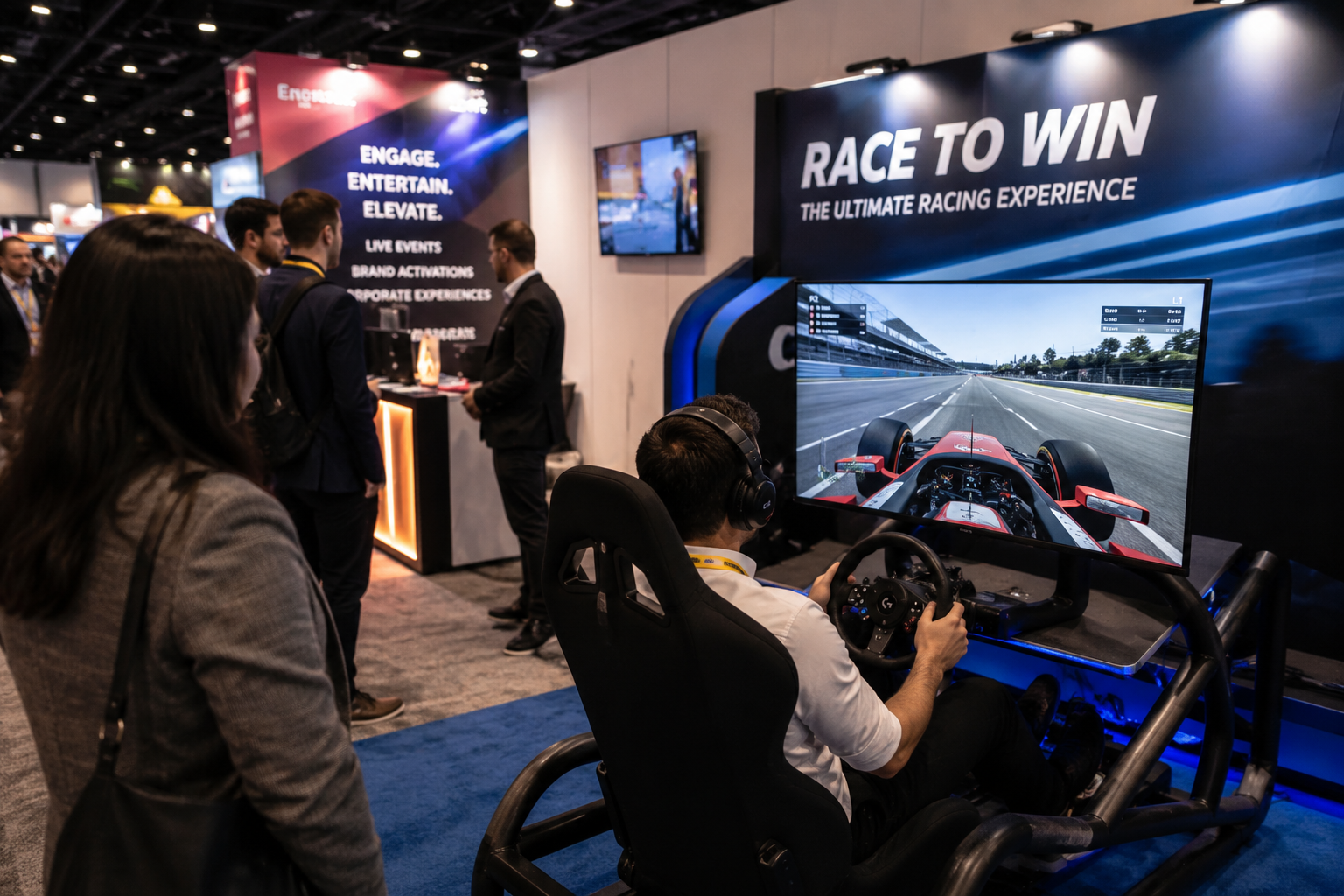
The way corporate buyers find experiential entertainment vendors changed faster than most owners realize, and the businesses that adjusted are pulling away from the ones still waiting for the phone to ring. If you run a racing-simulator activation, an RC-car experience, a slot-car track, a photo booth, or any other interactive attraction that ends up in trade-show booths and corporate events, this is for you. The demand is there and growing. The only question is whether buyers can find you at the exact moment they're deciding who to call.
The market is expanding, and the money is moving toward what you do
Start with the macro picture, because it's unusually favorable. Global B2C and B2B experiential marketing spending grew 8.3% to $138.94 billion in 2025 and is on pace to post accelerated growth of 10.3% in 2026, according to PQ Media. The even-year bump is partly driven by the Winter Olympics, the World Cup, and record political spending, but the underlying trend is structural, not cyclical. PRWeb
What matters most for activation vendors is where inside that number the growth is concentrated. B2B experiential marketing grew faster than its B2C counterpart in 2025, rising 9.7% to $41.74 billion, and a meaningful chunk is going straight to the trade-show floor. Fueling B2B experiential growth is an increase in exhibit booth rentals, as fees increase and trade show promotions become more elaborate. In the U.S. specifically, exhibit space rentals was the largest of the four US B2B channels at $10.11 billion in 2025, as well as the fastest growing, rising 10.8%. PRWeb + 2
Layer on the budget commitments. 74% of Fortune 1000 marketers plan to increase their experiential marketing budgets, and 86% of B2B marketers will increase event spending in 2026. Across companies broadly, 80% of companies have increased experiential marketing budgets, which now represent 10–30% of their total marketing spend. Translation: your customers are being handed bigger budgets and explicit instructions to spend more on exactly the kind of in-person, interactive experiences you provide. Revenue Memo + 2
And buyers want the hands-on stuff specifically. 64% of attendees prefer immersive, hands-on experiences at live events over technological elements like apps and digital displays. A custom track, an RC course, or a racing sim isn't a gimmick competing against digital — it's the thing the data says people actually remember and prefer. Revenue Memo
Why interactive activations win on the floor (and why that's your sales pitch)
There's a hard reason corporate buyers keep coming back to activation vendors: the engagement math runs heavily in your favor. Industry analysis of booth performance found that a 10-second booth conversation converts to lead capture at about 10%, while a 3-minute interactive experience converts at 85%+. The difference is engagement — and engagement is the entire product you sell. Simrentalpros
That's why racing simulators and similar attractions sit at the top of ranked lists of booth activations. One breakdown describes the racing-cockpit setup — where attendees register before racing and a real-time leaderboard keeps people engaged and drives repeat visits — as delivering 50 to 150+ qualified leads per day at mid-size trade shows. Interactive content also dramatically outperforms passive displays, outperforming static displays by 5x in memory recall. Simrentalpros + 2
The broader trade-show numbers back up the value you create. 48% of exhibitors believe eye-catching displays are the best way to attract booth traffic, and exhibitors are advised to budget at least 40% of total spend toward booth experience and interactive elements — the line item that converts walk-bys into conversations. Meanwhile the cost story is strong: the average cost per lead at trade shows is $112, significantly cheaper than traditional field sales calls at $259, and converting a trade show lead is 38% less expensive than relying on sales calls alone. Amra & Elma + 3
Here's the strategic point: you already have the testimonials, the crowd-drawing proof, and the ROI story. Your problem almost certainly isn't the product. It's that the corporate event planner with a budget and a date never finds you in the first place.
The discovery problem nobody warns you about
The way vendors get found has quietly flipped. Across event services, 72% of event planners now discover event services through online marketplaces or AI search before they ever pick up the phone, and platform choice determines which planners ever see you. More striking still, a 2026 benchmark of thousands of event-related queries found that over 60% of vendor searches now start in a generative AI engine and roll into a marketplace only after the AI suggests one. Events In MinutesEvents In Minutes
For service businesses generally, 60–80% of customers research vendors online before making contact. The buyer journey is now: search, shortlist, then contact. If you're not in the search results or the AI-generated shortlist, you are invisible at the start of the journey — and being invisible early means you never get the inquiry, no matter how good your activation is. SEOTakeoff
This is the gap that costs activation vendors the most money, and it's almost entirely fixable.
Where corporate buyers actually look
Three channels do most of the work, and they reinforce each other.
Google Business Profile and local search. For "near me" and location-based vendor searches, the map pack is decisive. Over 70% of local searches now result in a Google Business Profile interaction. Google ranks local results on relevance, distance, and prominence — and a partially completed or neglected profile can hold back local visibility no matter how much effort goes into the website. A fully built-out profile — accurate categories, service areas, real photos from recent events, regular posts, and a steady flow of reviews — is often the fastest path to more inbound inquiries. If you serve multiple cities (the way many activation companies do), service-area settings and city-specific presence matter enormously. Dietz GroupBig Red SEO
Organic search and content built around buyer intent. Corporate buyers don't search for "fun." They search for specific, intent-rich phrases like "corporate event entertainment," "trade show booth attraction," or "team building activity" with a city attached. The vendor who ranks for those phrases isn't just getting a website visit; they're getting a qualified lead who has already decided they need a vendor and is now choosing which one to contact first. This is why dedicated service pages — one for corporate events, one for trade shows, one for team building, one for each city you cover — outperform a single catch-all homepage. Buyers in each category use different language and need different proof. Skyfield DigitalCateringrewards
AI-driven results (the newest, and most overlooked). Generative engines increasingly pull from your structured data to decide whether to recommend you. As one local-search guide puts it, AI search systems increasingly pull from your business profile to describe what you do, and if your profile data is thin, AI may misrepresent you or skip you entirely. Keeping your website schema in sync with your profile, publishing detailed service descriptions, and answering real customer questions in plain language all feed the systems now doing the recommending. Gravitas Vision
What actually converts the visitor once they land
Getting found is half the battle. The other half is making it effortless to inquire. Every service page should have a visible, low-friction inquiry path — a short form, a prominent phone number, and ideally a quote or booking option — because the fewer steps between a visitor's first impression and their ability to contact you, the higher your conversion rate. Cateringrewards
And speed matters more than most owners think — not just for your buyers, but for you. Once an inquiry comes in, treat it like a trade-show lead: response rates drop more than 60% after the 48-hour mark. The vendor who replies within hours, with a specific reference to the event the buyer described, wins against the three competitors still sitting on the inquiry. Lensmor
A few practical priorities that compound over time:
Publish seasonal content ahead of demand. Corporate event articles published in advance of conference season capture planners while they're still researching, producing a reliable annual lead cycle that grows every year the content exists. Cateringrewards
Answer the questions you hear on sales calls. The questions buyers ask repeatedly on inquiry calls are the exact searches they're making beforehand — turning each one into a page or FAQ shortens your sales cycle and improves lead quality. Cateringrewards
Make the site fast and mobile-first. Planners and office managers research vendors on their phones, and Google uses mobile performance as a direct ranking signal, so a poor mobile experience hurts conversion and visibility at the same time. Cateringrewards
Keep gathering reviews. Reviews feed prominence in local rankings and trust in AI summaries simultaneously — they're one of the highest-leverage assets you own.
The opportunity, stated plainly
Put the two halves together. Demand for interactive event activations is growing at double digits, corporate budgets are expanding, and buyers explicitly prefer the hands-on experiences you build. At the same time, those buyers have moved their entire discovery process online — to search, local profiles, and AI — and most activation vendors haven't built the digital presence to match. That mismatch is the whole opportunity. The companies that show up where buyers are now looking are quietly capturing the inbound inquiries their competitors never even know they missed.
You already have the hard part handled: an activation people line up for and remember. The missing piece is making sure the planner with a budget, a date, and a booth to fill finds you first — and finds it easy to say yes.
Ready to turn search traffic into booked events? If you run an experiential or event-activation business and want a steady stream of qualified corporate inquiries coming to you, let's talk about building the digital presence that makes it happen.
Frequently Asked Questions
How are corporate buyers finding event-activation vendors in 2026?
Mostly online, and earlier in the process than most owners assume. Across event services, 72% of event planners now discover event services through online marketplaces or AI search before they ever pick up the phone. A 2026 benchmark of thousands of event-related queries found that over 60% of vendor searches now start in a generative AI engine and roll into a marketplace only after the AI suggests one. More broadly, 60–80% of customers research vendors online before making contact. The practical takeaway: buyers search, shortlist, and then call — so if you're not visible in search, local profiles, and AI results, you never enter the conversation. Events In Minutes + 2
Is the experiential and event-activation market actually growing?
Yes, at double digits. Global experiential marketing spending grew 8.3% to $138.94 billion in 2025 and is on pace to grow 10.3% in 2026. The trade-show side is especially strong: U.S. exhibit space rentals reached $10.11 billion in 2025 and were the fastest-growing B2B channel, rising 10.8%. On top of that, 74% of Fortune 1000 marketers plan to increase their experiential marketing budgets, and 80% of companies have increased experiential budgets, which now represent 10–30% of total marketing spend. PRWeb + 3
Why do interactive activations like racing sims and RC cars perform so well at events?
Because engagement drives lead capture, and interactive experiences hold attention far longer than anything passive. Booth analysis shows a 10-second conversation converts to a captured lead at about 10%, while a 3-minute interactive experience converts at 85%+. Racing-cockpit and similar setups can deliver 50 to 150+ qualified leads per day at mid-size trade shows, and interactive content outperforms static displays by 5x in memory recall. Buyers know this — 64% of attendees prefer immersive, hands-on experiences over digital elements like apps and displays. Simrentalpros + 3
What's the single most important thing I can do to get found locally?
Build out and actively manage your Google Business Profile. Over 70% of local searches now result in a Google Business Profile interaction, and Google ranks local results on relevance, distance, and prominence — a neglected profile holds back visibility no matter how strong your website is. Accurate categories, defined service areas, recent event photos, regular posts, and a steady stream of reviews are usually the fastest path to more inbound inquiries. Dietz GroupBig Red SEO
I serve multiple cities. How should I structure my website?
Build dedicated pages rather than one catch-all homepage. Corporate buyers search with specific, intent-rich phrases like "corporate event entertainment" or "trade show booth attraction" plus a city name, and the vendor who ranks for those phrases gets a qualified lead who has already decided they need a vendor and is choosing who to contact first. Create separate pages for each service (corporate events, trade shows, team building) and for each city you cover — buyers in each category use different language and need different proof. Cateringrewards
How does AI search change how I should market my business?
AI engines increasingly decide who gets recommended, and they pull from your structured data to do it. As one local-search guide notes, AI systems pull from your business profile to describe what you do, and if your profile data is thin, AI may misrepresent you or skip you entirely. Keep your website schema in sync with your Google Business Profile, publish detailed service descriptions, and answer real customer questions in plain language — that's the natural-language content these systems use to summarize and recommend you. Gravitas Vision
Once someone finds me, how do I turn the visit into an inquiry?
Remove friction and respond fast. Every service page should have a visible, low-friction inquiry path — a short form, a prominent phone number, and ideally a quote or booking option. Then move quickly once an inquiry lands: like trade-show leads, response rates drop more than 60% after the 48-hour mark. A fast, specific reply that references the buyer's actual event beats competitors still sitting on the same inquiry. CateringrewardsLensmor
Is SEO worth it compared to paid ads for an event vendor?
For most activation businesses, organic search is the higher-return long-term play. A page that ranks today keeps generating inquiries next month and next year without spending another dollar to maintain it — a compounding effect paid ads never deliver. The lead economics are favorable too: at trade shows, the average cost per lead is $112 versus $259 for traditional field sales calls. Many vendors run both, using ads for immediate visibility while SEO and local presence build a durable pipeline underneath. CateringrewardsAmra & Elma
When should I publish content to capture seasonal demand?
Ahead of the buying window. Content published in advance of conference and event season captures planners while they're still researching, producing a reliable annual lead cycle that grows every year the content stays live. A strong shortcut: the questions buyers ask repeatedly on your inquiry calls are the exact searches they're making beforehand — turn each one into a page or FAQ and you shorten the sales cycle while improving lead quality. CateringrewardsCateringrewards
Sources
PQ Media, Global B2C & B2B Experiential Marketing Forecast 2026–2030 — https://www.prweb.com/releases/global-experiential-marketing-grew-8-to-139-billion-in-2025--will-surge-10-in-2026-fueled-by-winter-olympics-world-cup--political-spend-in-13-top-markets-worldwide-302793218.html
Cvent, 40+ Experiential Marketing Statistics You Need to Know in 2026 — https://www.cvent.com/en/blog/events/experiential-marketing-statistics
Kande Photo Booths, Experiential Marketing Statistics 2026 — https://www.kandephotobooths.com/blog/experiential-marketing-statistics/
Revenue Memo, Experiential Marketing Statistics for 2026 — https://www.revenuememo.com/p/experiential-marketing-statistics
SimRentalPros, 15 Interactive Trade Show Booth Ideas That Actually Generate Leads — https://simrentalpros.com/blog/interactive-trade-show-booth-ideas
Lensmor, Trade Show Lead Generation — https://www.lensmor.com/blog/trade-show-lead-generation
Trade Show Labs, 150+ Trade Show Statistics for 2026 — https://www.tradeshowlabs.com/blog/trade-show-stats
Amra & Elma, Top 20 Booth Marketing Statistics 2026 — https://www.amraandelma.com/booth-marketing-statistics/
Events in Minutes, Where to List Your Event Service in 2026 — https://www.eventsinminutes.com/blog/where-to-list-event-security-service-2026/
SEO Takeoff, SEO for Event Planning Companies: The Complete Guide — https://www.seotakeoff.com/blog/seo-event-planning-companies-guide
Skyfield Digital, Why Your Catering Business Needs SEO — https://skyfielddigital.com/why-your-catering-business-needs-seo-to-get-more-bookings/
Catering Rewards, How to Get More Catering Clients Using SEO — https://cateringrewards.com/blog/how-to-get-more-catering-clients-using-seo
The Dietz Group, Google Business Profile Management Guide for 2026 — https://dietzgroup.us/2026/01/google-business-profile-management/
Gravitas Vision, The 2026 Google Business Profile Playbook — https://www.gravitasvision.com/post/the-2026-google-business-profile-playbook-beyond-basic-listings
Big Red SEO, Google Business Profile in 2026 — https://www.bigredseo.com/google-business-profile-local-seo/