How to Win "CD Rates" and "High-Yield Savings" Searches from Fintech Competitors
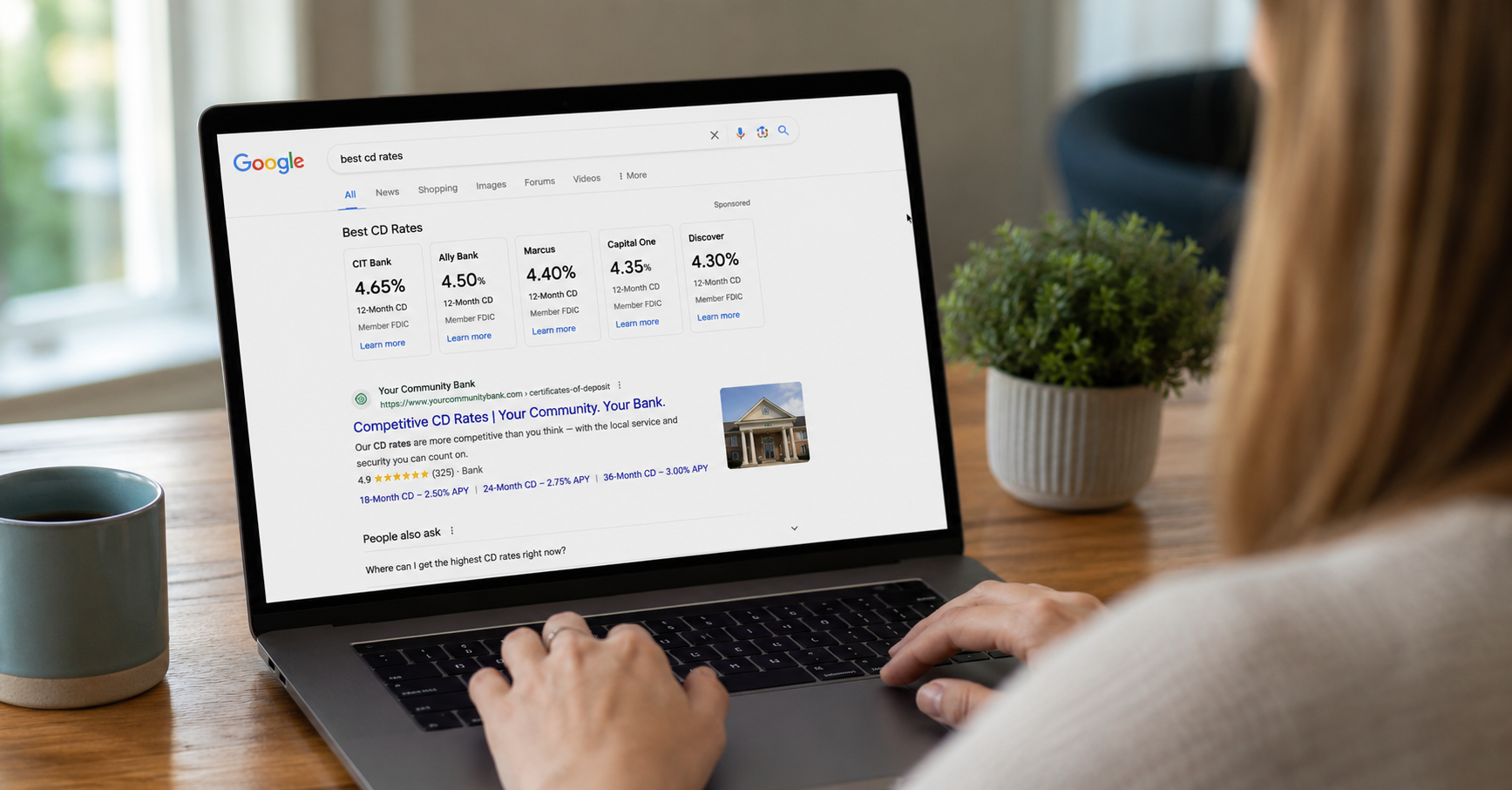
Deposit search is where community banks and credit unions feel the fintech squeeze most acutely. When someone searches "best CD rates" or "high-yield savings account," they're met with a roster of online-only banks — Marcus, Ally, CIT, Discover, Synchrony — and the aggregators ranking them. These institutions have a real cost advantage: by operating exclusively online, they reduce overhead compared with banks maintaining physical locations, which lets them advertise eye-catching APYs that a branch-based institution can't always match dollar-for-dollar. Authorityspecialist
But the situation is far from hopeless. The search landscape has exploitable gaps, your products are often more competitive than savers realize, and the trust and local relevance you bring are advantages no fintech can manufacture. This guide shows how to win — or at least meaningfully compete for — CD rates and high-yield savings searches against fintech competitors.
Step 1: Understand Who You're Actually Competing Against
The first move is to map the battlefield honestly. For deposit terms, you face two distinct competitors: the aggregators who own the SERP, and the fintechs and online banks they rank.
The aggregators are formidable and rate-obsessed. NerdWallet's scoring rubric weights APYs most heavily, and Bankrate independently tracks hundreds of APYs and validates the information regularly, with rates updated within days. Sites like DepositAccounts (itself owned by LendingTree) and comparison tables drawing from 475 banks and credit unions sorted by APY mean the national "best CD rates" term is effectively unwinnable for a single institution. Ritner Digital + 2
The fintechs win on raw rate, but they have real, nameable weaknesses you can exploit: thin or nonexistent customer service, no local presence, withdrawal hoops, and confusing structures. One reviewer notes the friction directly: some high-yield accounts set up hoops you must jump through to access your money, and may intentionally delay processing deposits, earning extra money on your cash rather than paying you interest. Your strategy is built on competing where rate isn't the only factor. Authorityspecialist
Step 2: Skip the National Term — Win Local and Specific Deposit Searches
Don't burn budget on "best high-yield savings account." Instead, target the deposit searches where you can actually rank and convert:
Local deposit terms: "CD rates [city]," "best CD rates near me," "high-yield savings [region]" — these often trigger the Local Pack, where your branch beats an online-only bank with no local address.
Institution-type terms: "credit union CD rates," "credit union high-yield savings," "community bank CD rates" — lower volume, but the searcher is specifically seeking what you are.
Term-specific CD searches: "12-month CD rates [city]," "best 5-year CD," "no-penalty CD" — specific terms aggregators cover shallowly.
Rate-match and relationship searches: searches from savers who want to keep their money local but earn a competitive rate.
This mirrors the proven financial-SEO pattern: you can't out-authority the aggregators on the head term, but you can own the specific and local long-tail they leave open.
Step 3: Lead With Your Genuine Rate Advantages (They Exist)
Savers wrongly assume only fintechs offer good deposit rates. In reality, your products are often right in the competitive range — and in some cases ahead. Make this explicit on your pages.
Credit unions and community banks frequently appear on the very "best of" lists savers trust. As of late May 2026, the best CD rates hover between 4.00% and 4.10% for short- and mid-term CDs, mostly from online banks and credit unions, and online banks and credit unions tend to offer some of the most competitive rates, especially compared to national averages. Credit unions specifically earn placement for low minimums and solid yields — NerdWallet highlights one credit union for its wide range of certificate terms and a low $500 minimum deposit. RankWriters + 2
You also have a competitive tool fintechs rarely offer: rate matching. CD rate matching is more common at credit unions than at banks, as credit unions tend to be more flexible in competing for deposits — large national banks rarely offer it, while smaller community banks may match rates to retain customers. If you offer this, build content around it ("ask us to match a CD rate"), because it's a differentiator no aggregator table captures. Chatter Buzz Media
A compliance note runs through all of this: deposit content is intensely rate-sensitive, so every APY claim needs accurate, current figures and proper disclosures, routed through compliance before publishing.
Step 4: Win on Trust, Insurance, and the Local Relationship
This is your deepest moat. Deposit decisions are fundamentally about trust — savers are choosing where to park money they can't afford to lose — and that plays directly to your strengths.
Make federal insurance prominent and reassuring. Every saver wants to know their money is safe, and the messaging is identical to the fintechs': deposits are insured by the FDIC for up to $250,000 (or by the NCUA for the same amount at a credit union). The difference is that you can pair that insurance with a local name, a real branch, and a person to call — something the fintechs structurally cannot. RankWriters
The market itself acknowledges this trust gap works both ways. The reason fintech intermediaries exist is precisely that smaller institutions are trusted but under-marketed: Raisin is a fintech that partners with local and regional banks to offer top rates, driving customers and deposits to banks that can't necessarily compete on a national advertising scale, so it offers some of the best rates on the market to attract customers. That's a tell — your rates can compete; what you've lacked is visibility. SEO closes exactly that gap, letting you capture the saver directly instead of through an intermediary that inserts itself between you and your depositor. Authorityspecialist
Branch-based institutions increasingly win by combining rate with service: many brick-and-mortar banks now compete by pairing strong rates with mobile convenience and personal service. Lead with that combination. Agency 102
Step 5: Build Deposit Pages That Match Saver Decision Criteria
Savers weigh a consistent checklist when choosing a CD or HYSA. Build your product pages to answer each point directly, since matching intent is what signals relevance to Google and converts the reader. Address:
Competitive APY clearly stated and kept current.
Low or no minimums and fees — call these out, since low or no minimums make accounts accessible, and fee-free is a top saver priority. OMNICOMMANDER
Insurance (FDIC/NCUA) stated plainly.
Access terms — for CDs, be transparent about early withdrawal penalties; for HYSAs, about transfer limits.
Digital tools — highlight your app and online account opening so savers know they don't sacrifice convenience.
A practical content win for CDs is education that captures researchers: explainer content on CD laddering, choosing a term, and the current rate environment. When choosing a CD, savers want the highest APY for their needed term and want to understand the early withdrawal penalty, and rate-environment context matters now because with the Federal Reserve expected to ease rates, deposit yields may gradually decline, which makes locking in a CD timely. Content that helps savers think this through builds authority and funnels toward your products. WebFXAgency 102
Step 6: Keep Rate Content Fresh — This Is Non-Negotiable
Deposit SEO lives or dies on accuracy, because rates move constantly. In 2026 so far, the Fed has kept the fed funds rate steady, but competitive CD rates have still inched down slowly, and HYSA rates are variable by nature. The aggregators win partly through relentless updating — Bankrate stamps each rate with a "last updated" date and refreshes continuously. WebFX
To compete, build a process that updates your rate pages the moment your APYs change, and display a visible "rates current as of [date]" stamp to build trust and signal freshness to Google. A page showing a stale CD rate is both a conversion killer and a compliance liability. Freshness is also a ranking advantage: regularly updated rate pages signal active maintenance that static brochure pages don't.
Step 7: Optimize for AI Search and the Local Pack
Two channels deserve specific attention. First, the Local Pack for "near me" deposit searches — driven by a fully optimized Google Business Profile per branch, consistent NAP, and fresh reviews. This is where a local institution structurally outranks a fintech with no physical footprint.
Second, AI search. Savers increasingly ask ChatGPT or Perplexity "what's the best CD rate for a 1-year term?" To be surfaced, structure deposit content with clear, extractable answers — FAQ blocks, direct one-sentence rate statements, and structured data on your products. An AI weighing options on substance (competitive APY, low minimum, FDIC/NCUA insurance, rate-match availability) may surface your institution even when a saver would never have found you through the aggregator-dominated Google results.
Step 8: Measure Deposits, Not Just Traffic
Track what ties SEO to deposit growth: account openings and CD funding sourced from organic and local search, cost per acquired depositor versus paid channels, and total deposit dollars attributable to organic. Deposit relationships are high-value and sticky — a saver who opens a CD with you is a candidate for checking, savings, and lending relationships over years. That lifetime value is what justifies sustained investment, and it's the argument that protects your SEO budget internally.
Frequently Asked Questions
Can a community bank or credit union rank for "best CD rates" or "high-yield savings"?
Not for the broad national terms — those are owned by aggregators like NerdWallet and Bankrate who track hundreds of APYs and update constantly. But you can win local terms ("CD rates [city]"), institution-type terms ("credit union CD rates"), and specific term searches, plus get surfaced in AI search on the merits of your actual products. WebFX
Are credit union and community bank deposit rates actually competitive with fintechs?
Often yes. The best CD rates hover between 4.00% and 4.10%, mostly from online banks and credit unions, and credit unions tend to offer some of the most competitive rates compared to national averages. Credit unions also more frequently offer CD rate matching, which national banks rarely do. The gap has usually been visibility, not rate. RankWriters + 2
What's our advantage over fintech deposit accounts?
Trust, local presence, and service paired with competitive rates. Fintech accounts can involve hoops to access your money and delayed deposit processing, while branch-based institutions compete by pairing strong rates with mobile convenience and personal service. You also offer the same FDIC/NCUA insurance with a real name and a person to call. AuthorityspecialistAgency 102
How important is keeping rate pages updated?
Critical. CD and HYSA rates move with the Fed, and deposit yields may gradually decline as the Fed eases. A stale APY is both a conversion killer and a compliance risk. Build a process to update rate pages immediately when rates change, and display a "rates current as of [date]" stamp to signal freshness. Agency 102
Does AI search matter for deposit products?
Increasingly, yes. Savers ask AI assistants for the best CD and savings rates, and structuring your content with clear, extractable answers and product schema gives you a chance to be cited on substance — potentially surfacing your competitive, insured products to savers who'd never have scrolled past the aggregators in traditional search.
Ready to Win Deposit Searches from the Fintechs?
Your CD and savings rates are likely more competitive than savers in your market realize — they just can't find you past the wall of online-only banks and aggregators. Ritner Digital helps community banks and credit unions rank for the local, specific, and AI-driven deposit searches that turn rate-shopping savers into funded accounts and lasting relationships.
Get in touch with Ritner Digital → to build a deposit SEO strategy that puts your rates in front of savers before the fintechs do.
Sources
NerdWallet — Best CD Rates of June 2026
NerdWallet — Best High-Yield Savings Accounts of June 2026
Bankrate — Best CD Rates of June 2026
CNBC Select — 13 Best CD Rates of June 2026
DepositAccounts — Best High-Yield Savings Accounts
Fortune — Top High-Yield Savings Rates
Clark.com — 16 of the Best High-Yield Online Savings Accounts in June 2026
The Annuity Expert — Compare the Best CD Rates of June 2026