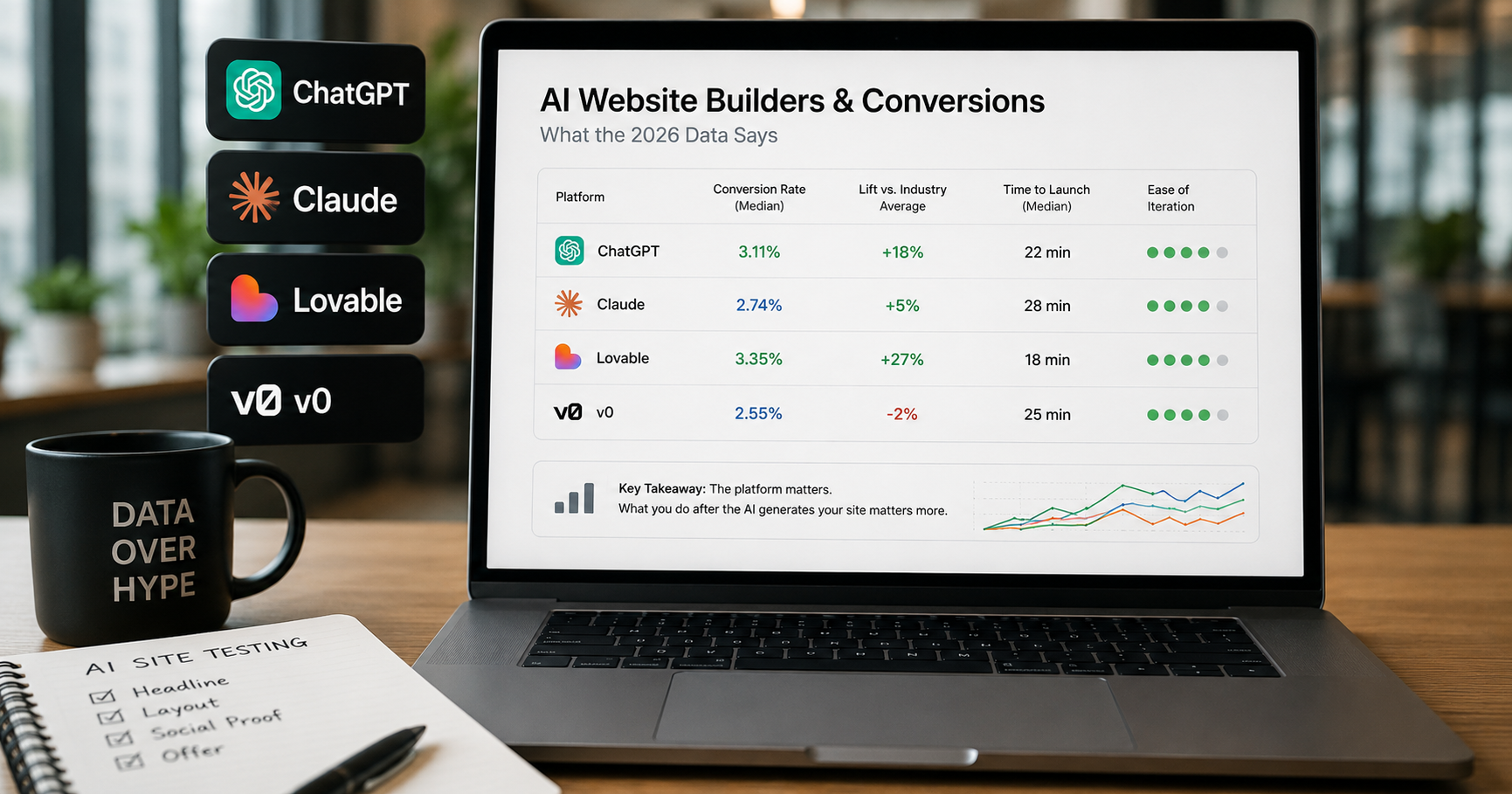
Eighteen months ago, building a business website meant one of two things: hiring an agency for $5,000 to $50,000 and waiting six weeks, or wrestling with a drag-and-drop builder yourself over a few painful weekends. Today you can type a paragraph describing what you want into ChatGPT, Claude, Lovable, or v0, and watch a functioning site assemble itself in front of you in minutes.
This is genuinely new, and the market knows it. The global AI website builder market is projected to reach somewhere between $3.2 billion and $6.3 billion in 2026 depending on which analyst you trust, with most estimates putting growth at roughly 20% year over year and trajectories pointing toward $17 billion or more by the mid-2030s. The global AI website builder market is projected to reach $3.24 billion in 2026, up from $2.69 billion in 2025, and expand to $17.43 billion by 2035 at a compound annual growth rate of 20.55%, according to Precedence Research. Small and medium businesses are driving the bulk of that adoption, not enterprises, which makes sense: the people who couldn't previously afford a custom site are the ones with the most to gain. Hostinger
But here's the question almost nobody is asking with rigor: when these tools all promise a beautiful site in minutes, does the platform you choose actually change whether that site turns visitors into customers? Or is conversion determined by something else entirely?
We dug into the available 2026 data to find out. The short version: there is early data, it's messier than the marketing suggests, and the platform matters far less than what you do after the AI hands you a draft.
First, the headline numbers everyone is quoting
Let's start with the optimistic figures, because they're real and worth understanding before we complicate them.
Multiple industry reports now claim AI-built sites outperform manually designed ones on conversion. As of 2026, platforms report that AI-assisted websites achieve 18 to 35% higher conversion rates compared to manually designed equivalents. That's a wide range, and the phrase "platforms report" should make you raise an eyebrow — these are often the platforms' own numbers. But the underlying mechanism is plausible and shows up across independent sources. Dataintelo
The reason AI-generated sites can convert well isn't magic. It's that the models were trained on enormous quantities of existing web design, including a lot of high-performing layouts. One analysis of over 500 AI-generated websites built across 2025 and 2026 found the common advantages were structural: built-in best practices because the AI was trained on high-converting patterns, mobile-first responsive design by default, optimized load times from modern frameworks, and tested layouts where the AI suggests what works rather than what's novel. In other words, AI tools are good at not letting you shoot yourself in the foot with an obviously bad layout. Nxcode
The same analysis surfaced the single most important finding in this entire space, and I want to flag it now because everything else hangs off it: AI's biggest advantage is iteration speed, and companies that test five or more variations consistently outperform those who set and forget. Hold that thought. Nxcode
There's also a frequently cited case study that gets passed around as proof AI sites convert: a SaaS startup tested 12 landing page variations with AI versus 2 with an agency and improved conversion from 8.2% to 18.7% — a 128% boost where the ROI was in finding the winning message. Notice what actually drove that result. It wasn't the AI's design taste. It was that the AI made it cheap to test twelve versions instead of two. The platform was a means to volume, not the cause of the lift. Nxcode
So which platform converts best? Here's the honest answer
This is the part you came for, so let me be direct: there is no credible, independent, head-to-head dataset in 2026 ranking ChatGPT vs. Claude vs. Lovable vs. v0 by the conversion rate of their finished sites. Anyone who tells you "Lovable sites convert 22% better than ChatGPT sites" is making it up or extrapolating from a sample of one.
What does exist is a growing body of side-by-side build comparisons that test the tools on speed, design quality, and code output — the upstream factors that influence conversion. Those comparisons are useful, and they reveal real personality differences between the platforms.
A widely discussed 2026 experiment built the identical website four times for a 15-person French business — using ChatGPT-5, Claude Code, Lovable Pro, and a traditional agency — and scored them on eight criteria. The Lovable version's design was significantly more contemporary than the ChatGPT version, with real visual consistency, smooth animations, polished transitions, and impeccable responsive behavior, though pure design remained its relative weakness. The takeaway from that and similar tests is that the tools have distinct profiles rather than a clear overall winner. Synerium
Here's how the major prompt-to-website tools break down based on the 2026 comparison data:
Lovable has become the commercial phenomenon of the category. Lovable hit $400 million in annual recurring revenue in February 2026, a fourfold increase in eight months. Its signature move is a planning phase before it builds. Lovable takes a more methodical approach, creating a plan that includes features, design, style, and color palette before starting, whereas v0's immediate implementation allows for quick adjustments. For a non-developer building a marketing site or simple web app, that structured approach tends to produce a more coherent result on the first pass. SyneriumNo Code MBA
v0 by Vercel is the speed play and is specialized for React and Next.js component generation. v0 might be more approachable for beginners due to its speed and immediate results, while Lovable's planning phase could help beginners understand the design process better. v0 shines when you know roughly what you want and need it rendered fast. Website PromptsNo Code MBA
Claude (the assistant, distinct from Claude Code) is repeatedly characterized as the reasoning specialist. It's noted as excellent for complex reasoning and long prompts. Where it earns its keep is the thinking around the build — architecture decisions, debugging, and working through why one structure beats another — rather than one-shotting the prettiest landing page. Website Prompts
ChatGPT is positioned as the generalist. OpenAI positions ChatGPT as an accessible, multimodal AI assistant designed for everyday users who need help with writing, coding, and content creation. It will produce a working site from a prompt, but in head-to-head design tests it tends to lose on visual polish to the purpose-built tools. Lovable
Bolt.new rounds out the category as a full-stack app builder with AI assistance. Website Prompts
The practical pattern across all the comparison data: the dedicated builders (Lovable, v0, Bolt) win on out-of-the-box design and front-end polish, while the general assistants (Claude, ChatGPT) win on reasoning, customization logic, and getting you unstuck. None of this maps cleanly to "this platform's sites convert X% better," because conversion isn't decided at the moment of generation.
What actually determines whether an AI-built site converts
If the platform choice is a minor variable, what are the major ones? The 2026 data is unusually consistent here, and it points at three things.
1. Speed — and AI builders have a known weakness
Page performance has a direct, measured line to revenue. In a Google web.dev case study, Rakuten 24 ran an A/B test and found that good Largest Contentful Paint scores led to a 53.37% increase in revenue per visitor and a 33.13% increase in conversion rate. The thresholds have also tightened — the March 2026 core update raised the bar, with the LCP threshold now at 2.0 seconds and INP scores above 200ms treated as a primary ranking risk. Idea FueledIdea Fueled
The catch for AI builders is the layer underneath them. Many prompt-to-website tools and AI WordPress plugins generate heavy JavaScript and bloated assets. Too much JavaScript can slow down how quickly a page reacts to clicks, which directly hurts the INP metric that matters for Core Web Vitals. WordPress-based AI builds are especially prone to this — WordPress sites commonly struggle with Core Web Vitals due to plugin bloat and heavy themes. A gorgeous AI-generated site that loads in four seconds will lose to an ordinary one that loads in 1.5. The platform that generates leaner code has a real conversion edge, but you usually can't tell which one that is until you measure the output. SEO DiscoverySky SEO Digital
2. Iteration volume beats first-draft perfection
This is the throughline of the entire dataset and the closest thing to a law in this space. The best ROI comes from getting to market quickly, then optimizing based on real data, not perfecting before launch. The 128% SaaS conversion jump came from testing 12 variations. The e-commerce wins in the same research came from the same behavior. The AI's job isn't to hand you a perfect site — it's to make twelve good sites cheap enough that you can let your actual visitors pick the winner. Nxcode
This reframes the entire platform question. Don't ask "which tool makes the best site?" Ask "which tool lets me spin up and test variations fastest?" By that measure the speed-focused builders have an advantage, but the discipline of actually running the tests matters more than the tool.
3. Performance is now table stakes for visibility, not a bonus
The role of speed has shifted in 2026. Core Web Vitals are no longer a shortcut to higher rankings; instead they establish a baseline for credibility, usability, and reliability — a fast, stable site enables success but does not guarantee it. And as AI-generated search answers eat more of the results page, the stakes compound: as AI Overviews take up more SERP real estate, slow sites lose both organic and AI-cited traffic. A slow website is less likely to be cited in AI-generated answers. Unfoldmart + 2
The same caution applies to content. Excellent Core Web Vitals will not rescue thin content, and poor Core Web Vitals will hold back excellent content — the relationship is both-and, not either-or. An AI can generate your pages in minutes, but if every business in your category is generating the same generic copy from the same prompts, none of it differentiates you. The conversion advantage goes to whoever pairs AI speed with a genuine, specific message. Idea Fueled
The risks nobody mentions in the demo videos
Two things deserve a flag before you commit to building your business on one of these platforms.
First, lock-in. No-code AI builders can trap your site inside their ecosystem. The recommended protections are concrete: regularly export the source code to your own GitHub, keep a complete copy of your database, and maintain up-to-date architecture documentation. If a tool won't let you export your code and data, that's a strategic risk regardless of how nice the output looks. Synerium
Second, ranking timelines don't bend to AI speed. You can build in minutes, but you can't rank in minutes. Ranking time depends on competition for your keywords, not the tool used to create the site — figure 3 to 6 months on low-to-medium keywords and 6 to 12 months on competitive ones, and a well-optimized AI-built site will rank as fast as an agency site if the content is equivalent. The AI removed the build bottleneck. It did not remove the trust-and-authority bottleneck. Synerium
So what should you actually do?
Pulling the threads together, here's the honest state of play in 2026:
The platform you pick — ChatGPT, Claude, Lovable, v0, Bolt — affects your starting point: how polished the first draft looks, how clean the code is, how fast you can iterate. The dedicated builders tend to win on design out of the box; the general assistants tend to win on reasoning and customization. But none of these tools has proven, independently verified superiority on the metric that actually matters to your bottom line: whether the finished site converts.
What converts is everything the AI doesn't decide for you. A genuinely fast site that passes Core Web Vitals. A specific, differentiated message instead of generic AI filler. And above all, a willingness to launch quickly and test variations against real visitors instead of polishing one version forever. The businesses winning with AI websites aren't winning because they picked the magic platform. They're winning because they treat the AI as a way to test more, faster — and then they do the measuring.
That last part is where most DIY AI projects quietly fall apart. Generating the site is now the easy 20%. Knowing which version to ship, getting it fast enough to rank and convert, writing copy that doesn't sound like everyone else's prompt output, and running the tests that actually move your numbers — that's the 80% that still takes expertise.
That's exactly the gap we close at Ritner Digital. AI can hand you a website in minutes — we make sure it's one that loads fast, ranks, and turns visitors into customers. If you've built something with AI and you're not seeing the conversions, or you want it done right from the start, let's talk.
Book a free consultation → https://www.ritnerdigital.com/#contact
Frequently Asked Questions
Which AI platform builds the highest-converting websites — ChatGPT, Claude, Lovable, or v0?
There's no honest, independently verified answer to this yet. As of 2026, no credible head-to-head dataset ranks these platforms by the conversion rate of their finished sites. The comparison data that does exist measures upstream factors — design polish, code quality, build speed — where the dedicated builders like Lovable and v0 tend to win on out-of-the-box visual design, while general assistants like Claude and ChatGPT win on reasoning and customization. But conversion is decided after the AI hands you a draft, by your site speed, your message, and how many variations you actually test. Pick the tool that fits your workflow, then do the optimization work that actually moves the numbers.
Do AI-built websites really convert better than ones built the traditional way?
Some data suggests they can. Industry reports claim AI-assisted sites achieve 18–35% higher conversion rates than manually designed equivalents, though many of those figures come from the platforms themselves. The real mechanism isn't the AI's design taste — it's that AI makes it cheap to test many versions. The standout case study in this space (a SaaS startup going from 8.2% to 18.7% conversion) came from testing 12 landing page variations instead of 2. The lift was in finding the winning message, not in the tool.
How much does it cost to build a website with AI versus hiring an agency?
Dramatically less upfront. AI builders typically run $0–$500 versus $15,000–$50,000+ for traditional custom development, with launch times measured in minutes to hours rather than weeks. But "cheaper to build" isn't the same as "cheaper overall." The cost shows up later in optimization, SEO, and the strategic work the AI doesn't do — so factor in what it takes to make the site actually perform, not just exist.
If I build my site with AI, do I own it? Can I move it later?
This is one of the biggest risks people overlook. Many no-code AI builders can lock your site inside their ecosystem. Before committing, make sure you can export your source code to your own repository, keep a full copy of your database, and maintain your own architecture documentation. If a platform won't let you take your code and data with you, that's a strategic liability regardless of how good the output looks.
Will an AI-built website rank on Google?
It can, but not faster just because you built it faster. Ranking time depends on keyword competition, not the tool you used — generally 3–6 months for low-to-medium competition keywords and 6–12 months for competitive ones. A well-optimized AI-built site ranks as quickly as an agency-built one if the content is equivalent. The AI removed the build bottleneck; it did not remove the authority-and-trust bottleneck.
Why does my beautiful AI-generated site load slowly?
Because many AI builders generate heavy JavaScript and bloated assets, and AI-assisted WordPress sites in particular tend to suffer from plugin and theme bloat. This directly hurts your Core Web Vitals — and speed is tied straight to revenue. In one Google case study, good Largest Contentful Paint scores drove a 53% increase in revenue per visitor and a 33% increase in conversion rate. A gorgeous site that loads in four seconds will lose to an ordinary one that loads in 1.5. If your AI-built site looks great but isn't converting, performance is the first place to check.
Does the content the AI writes for my site actually help?
Only if it's specific to you. AI can generate pages in minutes, but if everyone in your category prompts the same tools, you all get the same generic copy — and none of it differentiates you. Performance and content work together: excellent page speed won't rescue thin content, and great content gets held back by a slow site. The conversion advantage goes to whoever pairs AI's speed with a genuine, specific message.
I built a site with AI but I'm not getting leads. What now?
This is the most common situation we see, and it's almost never a "rebuild from scratch" problem. Generating the site is the easy 20%. The other 80% — getting it fast enough to rank and convert, writing copy that doesn't sound like everyone else's AI output, and running the tests that actually move your numbers — is where DIY projects stall. That's exactly the gap we close.
Ready to turn your AI-built site into one that actually converts? Whether you've already built something and the leads aren't coming, or you want it done right from day one, Ritner Digital makes sure your site loads fast, ranks, and turns visitors into customers.
Book a free consultation → https://www.ritnerdigital.com/#contact