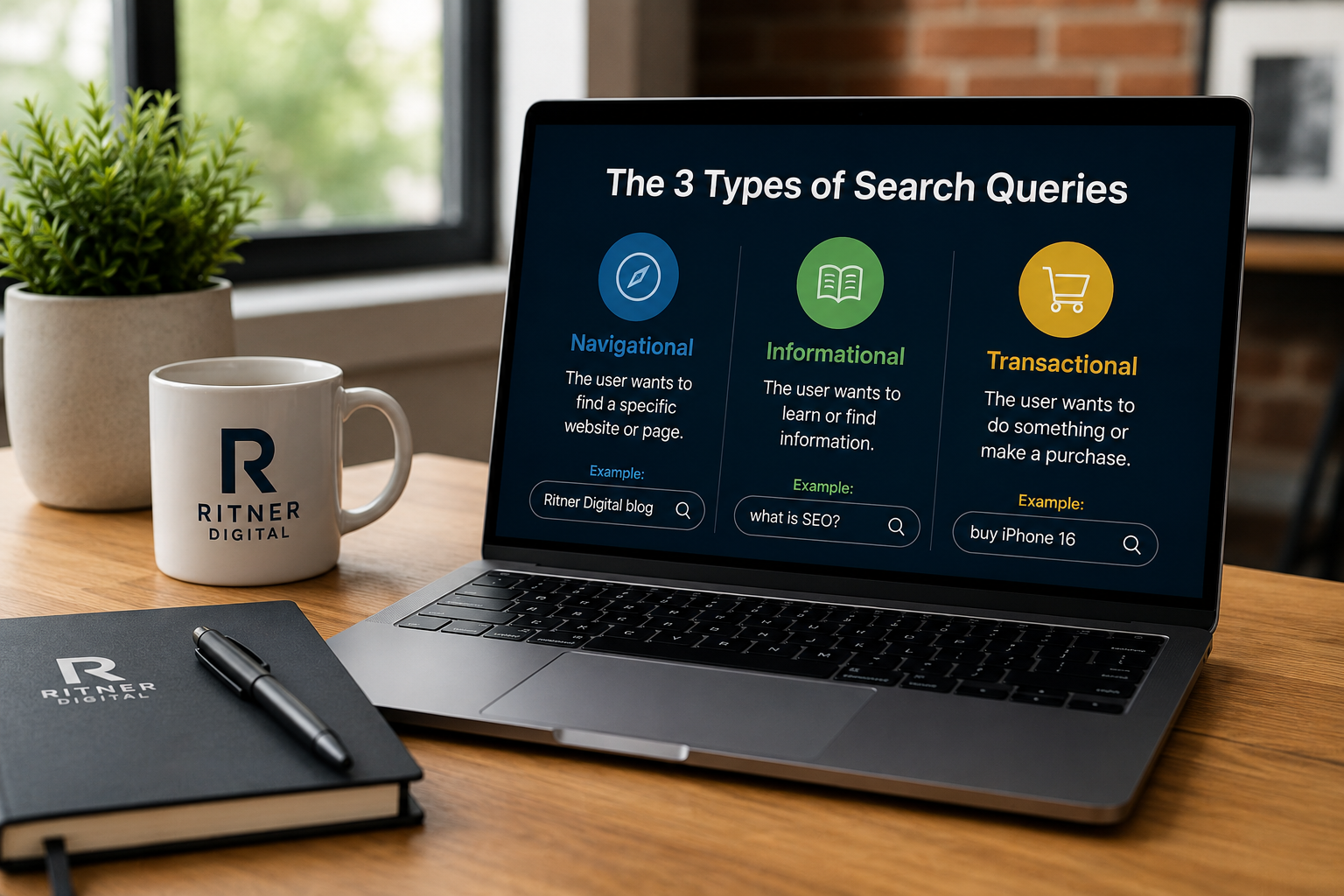
Every search starts with a goal. Someone wants to find a specific website, learn something, or buy something. For more than two decades, that simple observation has been the backbone of search marketing, and it's usually summarized in three words: navigational, informational, and transactional. These are the three classic types of search queries, and understanding them is still one of the highest-leverage things any brand can do to win visibility.
But here's the part most "three types of search queries" articles skip: the framework was built for a world of ten blue links, and that world is dissolving. AI Overviews, ChatGPT, Perplexity, and Gemini are now answering a growing share of queries before anyone clicks anything. So the question isn't just "what are the three query types?" It's "what does each type look like when an AI is doing the answering?"
This guide covers both. We'll define the three (really four) query types, show how to map each to the right content and page, and then explain how search intent works in a search landscape where the results page is increasingly the destination rather than the doorway.
What "search query" actually means
A search query is the literal string of words a person types or speaks into a search engine. Search intent is the underlying goal behind those words. The two aren't the same thing, and the gap between them is where most SEO strategy lives. A query like "apple" is famously ambiguous: it could be navigational intent aimed at Apple Inc.'s website, informational intent about the fruit or the company, or even transactional intent for either apples or AirPods. Search engines resolve that ambiguity using the query string itself, its format, and accumulated behavioral data about what people who type "apple" tend to click.
The reason this matters for your business is blunt: search engines reward content that matches what the user is actually trying to do. As one 2025 analysis of search intent put it, ranking for keywords alone no longer guarantees clicks, because mismatching intent means your page might rank but won't convert. Get the intent right and everything downstream gets easier. Get it wrong and you can do everything else perfectly and still lose.
The three core query types
Most searches fall into three buckets that have been used to classify search behavior since the early academic work on web search. One frequently cited study of natural-language queries estimated that informational queries make up roughly 60% of all searches, transactional around 27%, and navigational about 12%, with a small remainder unclassifiable. The exact percentages vary by source and have surely shifted over the years, but the rough proportions still hold up: most people are looking for information, a meaningful chunk are ready to act, and a smaller slice already know exactly which website they want.
1. Navigational queries
A navigational query is one where the user already knows where they want to go and is using the search engine as a shortcut to get there. Instead of typing the full URL, people search "Facebook," "YouTube," or "Textbroker" and click the first result. These are sometimes called "go" queries because the intent is to navigate to a specific destination the searcher already has in mind.
The strategic implication is that you need to own your own brand's navigational queries. If someone searches your company name and your competitor's paid ad sits above your organic listing, you're leaking your most qualified traffic. The classic example here is a retailer running both a sponsored ad and the organic listing for its own brand name, so that searchers always land on the official site no matter which result they pick. The best practices are straightforward: make sure your brand, contact, and location pages are crawlable and well-optimized; keep your Google Business Profile accurate; and consider a branded paid search campaign to defend the top of the page.
Navigational queries are hard to grow directly, because their volume is a function of how many people already know your brand. That's why they're best understood as a downstream signal: as your brand recognition improves through informational and transactional content, your navigational query volume tends to rise with it.
2. Informational queries
Informational queries are searches where the user wants to learn something. They span everything from a precise question ("how long does it take to become a doctor") to a broad topic that returns thousands of relevant results ("childhood socialization" or "trucks"). The searcher generally isn't looking for a specific site and isn't trying to buy anything yet. They just want an answer or want to understand a subject.
This is the largest category by volume, and it's where content marketing does its most important work. Blog posts, guides, tutorials, FAQs, and explainers are the natural fit. Google frequently answers specific informational questions with featured snippets, the highlighted boxes at the top of the results page, so structuring content to be snippet-eligible (clear questions, concise direct answers, logical headings) is a core tactic.
Informational content rarely converts on the first visit, and that's fine. Its job is to build awareness, demonstrate expertise, and earn trust so the searcher returns later when they're closer to a decision. In the funnel language many SEOs use, informational intent dominates the top of the funnel, where the goal is education, not conversion.
3. Transactional queries
A transactional query signals that the user is ready to act, usually to buy a product or pay for a service. Sometimes the intent is unmistakable ("buy PlayStation 5," "buy iPhone"), and sometimes it's implied by the query format ("women's jeans," "iced coffee maker"). It can include explicit terms like buy, order, or purchase, or it can simply be a product or category name with obvious commercial weight.
People running transactional searches are often on the verge of converting, which makes these queries enormously valuable, and also competitive and expensive in paid search. The right destination for a transactional query is almost never a blog post; it's a product page, a category page, or a high-intent landing page. The optimization checklist is practical: relevant product keywords in title tags and on-page content, descriptive image alt text, clear and compelling calls to action, trust signals like reviews and security badges, and a checkout or contact flow with as little friction as possible.
The fourth type: commercial investigation
The classic model has three categories, but most modern practitioners add a fourth that sits between informational and transactional: commercial investigation (sometimes called commercial intent). This is the user who has essentially decided to buy but is still comparing options before committing. These searches carry telltale modifiers: best, top, review, compare, alternatives, vs. Think "best AI search agency" or "best content-strategy tools for 2025."
Commercial investigation maps to the middle of the funnel, and the content that wins it is comparison-driven: listicles, "best of" roundups, side-by-side comparisons, honest reviews, and alternatives pages. If you look at the actual results for these queries, they're almost always dominated by comparison pages and roundups rather than straight product pages or pure how-to guides, which tells you exactly what the search engine thinks the user wants.
This fourth type matters more than ever, for a reason we'll get to in a moment: AI tools lean heavily on exactly this kind of third-party comparison content when they generate recommendations.
Mapping query types to content (the part that actually drives results)
The single most useful exercise you can run is to align each page on your site to the intent it should serve:
Navigational → brand, contact, and location pages; a defensible branded SERP.
Informational → guides, tutorials, FAQs, and explainer blog posts engineered for featured snippets.
Commercial investigation → comparison guides, listicles, reviews, and alternatives pages.
Transactional → product pages, category pages, and conversion-focused landing pages.
A transactional keyword like "buy headphones" should lead to a product page, not an article; sending that searcher to a blog post is one of the most common and costly intent mismatches in SEO. The reverse is just as damaging: trying to force a sale on someone running a purely informational query usually drives them away.
A practical way to verify intent before you commit to a content format is to read the SERP itself. Search the keyword and look at what's already ranking. If the page-one results are how-to guides, the intent is informational. If they're product and category pages with shopping features, it's transactional. If they're listicles and comparisons, it's commercial investigation. Google has effectively already told you what it believes the searcher wants; your job is to match it.
Where this framework breaks: the AI search shift
Here's where most query-type guides stop, and where 2026 reality begins. The three-types model assumes the searcher will leave the results page and visit a website. Increasingly, they don't.
Zero-click searches, where the user gets their answer without clicking through to any external site, have been climbing for years and accelerated sharply once Google rolled out AI Overviews in 2024. By 2025, multiple analyses put the share of U.S. Google searches ending in zero clicks at roughly 58–60%, and some estimates that account for voice and in-app searches push the true figure higher still. Semrush data showed AI Overviews appearing on a rapidly growing share of queries, jumping from about 6.5% of queries in January 2025 to over 13% by March, and peaking near 25% in mid-2025 before settling back. One analysis of more than 10 million keywords found that around 88% of the queries triggering AI Overviews were informational in nature.
That last statistic is the crucial one for anyone using the query-type framework: the AI answer revolution is hitting informational queries hardest. When someone asks "what is" or "how to," the AI summary often satisfies them completely. Studies have found click-through rates on AI Overview queries dropping dramatically, with various analyses reporting organic CTR declines ranging from roughly 35% to over 60% on affected queries, and some research finding that the vast majority of informational queries in AI-mode interfaces produce no external click at all. The estimates differ because methodologies differ, but the direction is unanimous: informational traffic is eroding fast.
Transactional and commercial queries are more resilient, because users often still need to leave the SERP to actually complete a purchase or evaluate a specific vendor. But even there, the behavior is changing. AI tools increasingly recommend "best" products and services directly, and that research is shifting inside the AI tools themselves. As one 2026 analysis noted, those tools pull heavily from third-party listicles and comparison pages, so if you want to show up in an AI recommendation, you need to be included in the sources the AI reads.
What the three query types look like in an AI-first world
The framework doesn't die in the AI era. It evolves. Here's how each type translates:
Navigational queries become even more about entity clarity. AI systems need to confidently understand who your brand is, what it does, and how it relates to other entities before they'll surface or recommend it. Structured data, consistent brand information, and a clean entity footprint are what make an AI answer name you specifically.
Informational queries require a strategic mindset shift: assume a large share of them will be answered on the results page, and optimize to be the cited source inside that answer rather than chasing the click. Concise, well-structured, genuinely authoritative content is what AI systems extract and attribute. Visibility and citation become the KPI, not raw sessions.
Commercial investigation queries are arguably the highest-value battleground in AI search, precisely because AI recommendation engines synthesize their answers from comparison content, reviews, and roundups. Earning a place in those third-party sources, and publishing your own credible comparison content, is how you get pulled into an AI's "here's who I'd recommend" response.
Transactional queries remain the closest thing to a safe harbor for clicks, since conversion still happens off-SERP. The fundamentals hold: fast, frictionless, trustworthy pages with clear calls to action. But trust signals and structured product data increasingly determine whether you're the option an AI surfaces in the first place.
The throughline is that intent still rules, but satisfying intent now sometimes means being the trusted source an answer engine quotes, not just the page a human visits. Click-through rate is becoming an incomplete measure of success, because a brand can influence a buying decision through an AI citation without ever recording a click.
The takeaway
The three types of search queries, navigational, informational, and transactional, plus the commercial-investigation layer in between, are still the cleanest way to understand what searchers want and to map your content to it. That part hasn't changed. What's changed is the surface where intent gets satisfied. More and more of it happens inside AI Overviews and answer engines, which means the brands that win are the ones structured to be understood, trusted, and cited across every place discovery now happens, from Google's blue links to ChatGPT, Perplexity, and Gemini.
Optimizing for all of these intents at once, across both traditional search and AI answer surfaces, is exactly the kind of integrated visibility system that separates brands that compound authority from those that quietly lose traffic they can't explain.
Ready to win across every type of search?
Understanding query types is step one. Building the content, technical foundation, and entity authority to actually capture navigational, informational, commercial, and transactional intent, across Google and AI search, is where the real work begins.
Ritner Digital builds AI-era search visibility systems that earn organic traffic, AI citations, and compounding brand authority. Book your AI Search Audit → and we'll show you exactly where your brand is showing up, where it isn't, and how to fix it, with clear next steps within one business day.
Sources: marketinginasia.com, textbroker.co.uk, wordstream.com, webfx.com, mirasvit.com, arxiv.org (Broder query taxonomy research), yoast.com, respona.com, seranking.com, Semrush AI Overviews research, Ahrefs and Seer Interactive CTR studies, and Similarweb / Workshop Digital zero-click analyses.
Frequently Asked Questions
What are the three types of search queries?
The three core types of search queries are navigational, informational, and transactional. A navigational query is when someone is trying to reach a specific website they already have in mind (like searching "YouTube" instead of typing the URL). An informational query is when someone wants to learn something or find an answer ("how does SEO work"). A transactional query is when someone is ready to act, usually to buy a product or pay for a service ("buy running shoes"). Many modern SEO practitioners add a fourth type, commercial investigation, which sits between informational and transactional.
What is the difference between a search query and search intent?
A search query is the literal string of words someone types or speaks into a search engine. Search intent is the underlying goal behind those words. The two aren't always the same, and the gap between them is where most SEO strategy lives. For example, the query "apple" could reflect navigational intent (Apple Inc.'s website), informational intent (the fruit or the company), or transactional intent (buying apples or AirPods). Search engines work to resolve that ambiguity, and your job is to match the real intent behind a query, not just the words in it.
Which type of search query is most common?
Informational queries are the most common by volume. Early academic research on web search estimated that roughly 60% of queries are informational, about 27% are transactional, and around 12% are navigational, with a small unclassifiable remainder. The exact percentages have shifted over the years, but the rough proportions still hold: most people are searching to learn, a meaningful share are ready to act, and a smaller slice already know exactly which site they want.
What is commercial investigation intent?
Commercial investigation (sometimes called commercial intent) is the fourth query type that sits between informational and transactional. It describes a user who has essentially decided to buy but is still comparing options before committing. These queries carry telltale modifiers like best, top, review, compare, alternatives, and vs — for example, "best AI search agency." The content that wins these queries is comparison-driven: listicles, "best of" roundups, side-by-side comparisons, honest reviews, and alternatives pages. This intent matters more than ever because AI tools lean heavily on exactly this kind of comparison content when generating recommendations.
How do I match content to each type of search query?
Align each page on your site to the intent it should serve. Navigational queries map to brand, contact, and location pages. Informational queries map to guides, tutorials, FAQs, and explainer blog posts. Commercial investigation maps to comparison guides, reviews, and alternatives pages. Transactional queries map to product pages, category pages, and conversion-focused landing pages. The most common and costly mistake is intent mismatch — for example, sending a "buy headphones" searcher to a blog post instead of a product page.
How can I tell what intent a keyword has?
Read the search results page itself. Search the keyword and look at what's already ranking. If page one is dominated by how-to guides, the intent is informational. If it shows product and category pages with shopping features, it's transactional. If it's filled with listicles and comparisons, it's commercial investigation. Google has effectively already told you what it believes the searcher wants, so your job is to match the format that's already winning.
How are AI Overviews and zero-click search changing query types?
The traditional three-types model assumes searchers will leave the results page and visit a website, but increasingly they don't. Zero-click searches have climbed sharply since Google rolled out AI Overviews in 2024, with various 2025 analyses putting the share of U.S. Google searches ending in zero clicks at roughly 58–60%. The impact falls hardest on informational queries — one analysis of over 10 million keywords found about 88% of AI Overview-triggering queries were informational. Transactional and commercial queries are more resilient because users often still need to leave the SERP to buy or evaluate a vendor, but even there, AI tools increasingly recommend products directly by pulling from third-party comparison content.
Do search query types still matter in the age of AI search?
Yes — the framework evolves rather than dies. Intent still rules; what's changed is the surface where intent gets satisfied. More of it now happens inside AI Overviews and answer engines, which means satisfying intent sometimes means being the trusted source an answer engine cites, not just the page a human visits. Navigational queries now hinge on entity clarity, informational content should be optimized to be the cited source, commercial investigation has become a high-value battleground for AI recommendations, and transactional queries remain the closest thing to a safe harbor for clicks. Click-through rate is becoming an incomplete measure of success, because a brand can influence a buying decision through an AI citation without ever recording a click.