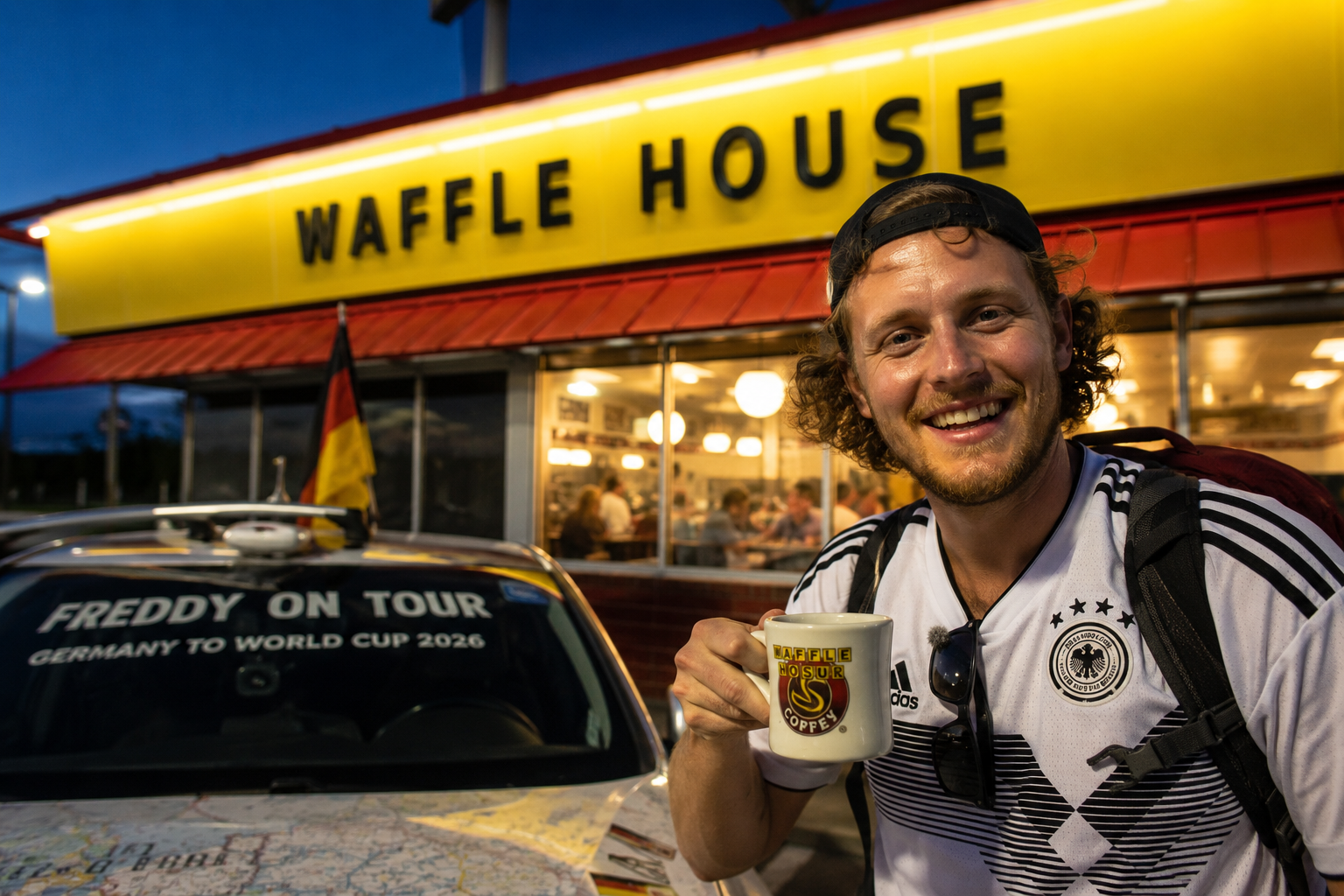
There's a German soccer fan named Freddy road-tripping through the American South ahead of the 2026 World Cup, and in the span of a few days he has become the internet's main character. He called Taco Bell "the holy land." He reviewed Waffle House at 1 a.m. ("Great food, great prices, and friendly staff. 10/10, we will be coming back"). He marveled that Atlanta is "so green it's crazy, it feels like you're in a forest the whole time," did a Walmart haul for water, socks, and USA Soccer merch, watched the NBA Finals at a Chili's, tubed down the Chattahoochee, rode a mountain coaster, and stumbled onto a fake Bavarian village in the north Georgia mountains where he said he felt right at home. Hundreds of thousands of fans are descending on host cities, and somehow this one guy with a phone is enjoying it more than anyone.
It's a delightful story. It's also, if you run a business, a free and very loud lesson about how discovery actually works in 2026, across both traditional search and AI answer engines. The mechanics behind why Freddy blew up — and why certain brands cashed in while others watched — map almost perfectly onto the things that determine whether your business gets found when it matters. Let me walk through what Freddy is accidentally teaching every brand in America.
The brands that won the Freddy moment were the ones already paying attention
When Freddy posted about Wendy's, the brand's account replied almost instantly: "WHERE IS THE FROSTY." When he raved about Waffle House at one in the morning, the chain jumped into his comments with "Thanks for visiting, Freddy!" His audience flooded him with suggestions — so many telling him to visit a strip club that he had to ask, genuinely confused, whether that was "a normal activity to do in America." Local businesses, Alabama burger chains, and Texas travel-stop legends like Buc-ee's all got name-dropped as people competed to script his itinerary.
None of this was a campaign. Nobody planned for a German tourist to go viral. The brands that capitalized did so because they were positioned to react — they had active accounts, a clear voice, and the reflexes to show up in a moment they didn't create and couldn't have forecast.
That's the entire game now. You cannot predict which moment will explode. You can only build the infrastructure that lets you be present, findable, and trusted when one does. Freddy's six-week trip across the U.S. and Canada is generating millions of impressions and a steady flood of searches in its wake — "where to eat near Mercedes-Benz Stadium," "Waffle House near me," "best things to do in Atlanta World Cup," "Buc-ee's location," and yes, "what is a Frosty." Every one of those searches is a door. The only question is whether your business is standing on the other side of it when someone knocks.
The World Cup is a search-demand tidal wave, and most local businesses are unprepared
Step back from the memes and look at the scale. The 2026 World Cup spans three host countries, 48 teams, and 104 matches, with millions of visitors funneling through host-city corridors in tightly compressed windows. This isn't a gentle, gradual uptick that businesses can adapt to in real time. What a global event like this actually creates is compression: enormous numbers of people moving through the same areas, at the same time, within very short windows. Restaurants fill instantly. Transit surges. Hospitality hits its ceiling. And search volume spikes across the board — for game times, rosters, restaurants, bars, merch, and above all "where do I go right now."
Here's the part that matters for anyone who isn't Coca-Cola or McDonald's: the official partners have locked in mid-eight-figure sponsorship deals for premium global access. But the spike in intent-rich local search is wide open territory. A visitor in your city searching "sports bar showing Germany match near me" or "late night food downtown" or "best tacos near the stadium" is not looking for an official FIFA partner. They're looking for whoever shows up as the trusted, relevant, nearby answer in that exact moment of need.
This is the asymmetry small and mid-sized businesses should be exploiting. Big budgets win broadcast and out-of-home domination. Smart positioning wins the long tail of high-intent, hyper-local queries that the giants overlook entirely. A neighborhood restaurant will never outspend a global sponsor, but it can absolutely out-rank and out-recommend them for "where to watch the World Cup in [neighborhood]" — a query no national brand is optimizing for. That's the opening. But capturing it requires understanding that "showing up" no longer means simply ranking on Google.
Search now happens in two places at once
If Freddy's followers want to know where to eat near a stadium, they're increasingly not scrolling ten blue links and weighing the options themselves. They're asking Google's AI Overview, ChatGPT, Perplexity, or Gemini — "where should I eat near Atlanta Stadium after the match?" — and acting on a single synthesized recommendation. During major events, Google has already been visibly reshaping its results pages around this behavior, pushing traditional organic links further down in favor of its own schedules, standings, predictions, and "what people are saying" boxes that pull user-generated content from X, Reddit, YouTube, and Instagram. The blue links are getting buried beneath the answers.
This is the shift we talk about constantly at Ritner Digital: discovery is becoming recommendation infrastructure. There are now two distinct surfaces you have to win simultaneously, and they don't operate the same way.
The first is traditional search — rankings, local SEO, your Google Business Profile, the structured signals that still drive clicks for transactional and "near me" queries where someone needs to actually go somewhere or buy something. This surface is far from dead, especially for local and transactional intent, but it's increasingly crowded by Google's own features at the top of the page.
The second is AI answers — whether ChatGPT, Perplexity, Gemini, and Google's AI Overviews understand your business well enough to recommend it by name when a visitor asks for help. This is the surface most businesses haven't even begun to think about, and it's the one quietly absorbing more and more of the decisions that used to happen on a results page.
Winning the first and ignoring the second means you're optimizing for a results page that fewer and fewer people are actually clicking through. Winning both is how you turn a demand surge into actual customers walking through your door.
What "being citable" actually requires
Here's the uncomfortable truth: AI systems can only recommend a business they understand and trust. When Perplexity or ChatGPT answers "best places to watch the World Cup in [your city]," it isn't pulling from thin air — it's synthesizing from sources. Local listicles and "best of" roundups. Reviews. Structured business data. Mentions and citations spread across the web. Content that clearly and directly answers the question being asked.
If your business isn't structured to be understood as a clear entity, and isn't present in the sources these systems draw from, you simply don't exist in the answer. This is the trap that catches even competent businesses off guard: you can rank perfectly well on Google and still be completely invisible inside the AI recommendation that's actually shaping the decision. The customer never sees you, never clicks you, never knows you exist — because the answer engine never had a reason to mention you.
This is what we call the AI citation gap, and a tidal-wave moment like the World Cup makes it brutally visible. When demand spikes and everyone is asking AI tools for recommendations, the gap between "ranks fine" and "gets recommended" becomes the difference between a packed house and an empty one. The businesses that get named in AI answers aren't necessarily the biggest or the oldest. They're the ones with clear entity signals, accurate structured data, genuine topical authority for their niche, strong local presence, and content that directly answers the questions visitors are asking in the language they're asking it.
None of those signals appear overnight. Entity authority compounds. Structured content has to be built and crawled. Reviews and citations accumulate over time. Which is exactly why the brands that prepared months ago are the ones cashing in now — the same way Wendy's was ready to fire off a Frosty joke the second Freddy gave them the opening. Readiness is built in advance and spent in the moment.
The Freddy playbook for your business
So what do you actually do with this? Treat the World Cup — and every predictable demand surge in your market — the way the smart brands are treating Freddy: as a moment you build toward, not one you scramble to catch.
Start by creating timely, genuinely useful content that targets the real-time, high-intent local searches the event will generate: the "where to watch," "best near the stadium," "open late," and "things to do" queries that spike during the tournament. Don't publish and hope — build content that maps to how people actually search during the event. Then structure it so both Google and AI systems can read it cleanly: clear headings, direct answers near the top, FAQ formatting, and schema markup that explicitly tells search and answer engines what you offer, where you are, and who you serve.
Next, tighten your entity signals. Make it unambiguous to AI systems who your business is, what category you belong to, and how you relate to the places and topics around you, so they can confidently recommend you by name rather than skipping you for a competitor they understand better. Keep your Google Business Profile, reviews, hours, and local citations accurate and active, because a large share of this demand is local and "near me," and voice assistants and AI tools won't surface a business with stale or unclear information. And don't neglect the basics that quietly disqualify you: a slow or non-mobile-friendly page won't get cited or spoken aloud, because answer engines need fast, clean, crawlable pages to pull from confidently.
Then, when the moment comes, be present and human — the way Wendy's and Waffle House were in Freddy's mentions. Respond. Engage. Show personality. Visibility creates the opportunity; responsiveness and voice are what convert it. The infrastructure gets you into the conversation, but people still do business with brands that feel alive.
The moment is the lesson
Freddy didn't go viral because of a marketing budget or a media plan. He went viral because he was authentic, present, and documenting something real — and the brands that benefited were the ones already built to show up alongside him without warning. The World Cup will create thousands of these micro-moments across every host city, each one sending a surge of searchers and AI queries looking for somewhere to eat, drink, shop, watch, and explore.
The businesses that win those moments won't be the ones that wake up mid-tournament and wish they'd prepared. They'll be the ones who already made themselves discoverable and citable across Google, AI Overviews, and the answer engines visitors are actually using to make decisions. Attention is the easy part — it shows up on its own when the world's biggest sporting event rolls into town. Being the answer when that attention turns into a search: that's the work, and it's work that has to be done before the whistle blows.
Don't watch the demand surge pass you by.
The 2026 World Cup is sending a wave of high-intent searches through every host city — and your buyers are asking Google, ChatGPT, Perplexity, and Gemini where to go next. The question is whether your brand shows up as the answer.
Ritner Digital builds the search and AI visibility infrastructure that gets you found, recommended, and cited across Google and AI search — not just during big moments, but as compounding authority that lasts. Book your AI Search Audit → and we'll show you exactly where your brand appears, where it doesn't, and how to fix it, with clear next steps within one business day.
Frequently Asked Questions
Who is Freddy, the viral German World Cup tourist?
Freddy (@FreddyLA7) is a German soccer fan road-tripping through the American South ahead of the 2026 World Cup, documenting the journey on X. He went viral for his enthusiastic takes on American staples — calling Taco Bell "the holy land," reviewing Waffle House at 1 a.m. with a "10/10," doing a Walmart haul, watching the NBA Finals at Chili's, and marveling at how green Atlanta is. His six-week trip follows Germany's matches while he explores the U.S. and Canada, and brands like Wendy's and Waffle House jumped into his comments in real time.
Why is a viral tourist story relevant to SEO and AI search?
Because it's a live demonstration of how discovery works now. Freddy's virality is generating a flood of searches — "Waffle House near me," "where to eat near Atlanta Stadium," "things to do in Atlanta World Cup" — and the brands that benefited were the ones already positioned to show up. You can't predict which moment goes viral, but you can build the search and AI visibility infrastructure that lets your business be found and recommended when demand spikes.
How does the 2026 World Cup affect local search demand?
The tournament spans three countries, 48 teams, and 104 matches, funneling millions of visitors through host-city corridors in compressed windows. Rather than a gradual uptick, it creates compression: huge numbers of people moving through the same areas at the same time. Search volume surges for game times, rosters, restaurants, bars, "where to watch," and merch — and nearly all of it starts with a search query or a social scroll. Restaurants and venues fill instantly, which makes high-intent, hyper-local searches enormously valuable for any business in or near a host city.
Can small businesses compete with official World Cup sponsors?
Yes. The official partners (Coca-Cola, McDonald's, Visa, and others) dominate broadcast and global sponsorship with mid-eight-figure budgets, but the surge in intent-rich local search is wide open. A visitor searching "sports bar showing Germany match near me" isn't looking for a FIFA partner — they want whoever shows up as the trusted, relevant, nearby answer. Smart positioning around long-tail, hyper-local queries that big brands overlook is how smaller businesses win their share of the demand without trying to outspend anyone.
What is the "AI citation gap"?
The AI citation gap is the difference between having search presence and actually being recommended by AI answer engines. AI systems like ChatGPT, Perplexity, Gemini, and Google's AI Overviews can only recommend a business they understand and trust, synthesizing answers from structured data, reviews, local listicles, and content that clearly answers the question. If your business isn't structured as a clear entity and isn't present in the sources these systems pull from, you can rank perfectly well on Google and still be invisible inside the AI recommendation that's actually shaping the decision.
How do I make my business "citable" by AI search engines?
Build clear entity signals so AI systems can confidently identify who you are, what category you belong to, and where. Create content that directly answers the questions visitors are asking, structured with clean headings, direct answers near the top, FAQ formatting, and schema markup. Keep your Google Business Profile, reviews, hours, and local citations accurate and active, since much of this demand is local and "near me." And make sure your pages are fast and mobile-friendly, because answer engines and voice assistants won't surface a slow or unclear page. These signals don't appear overnight, which is why preparation ahead of a big moment matters far more than scrambling once it arrives.
Why isn't ranking on Google enough anymore?
Because fewer people are clicking through to websites. During big events, Google has been reshaping its results pages — pushing traditional organic links down in favor of its own schedules, standings, predictions, and "what people are saying" boxes that pull from X, Reddit, YouTube, and Instagram. At the same time, more visitors are asking AI tools directly for a single recommendation instead of comparing blue links themselves. Winning traditional rankings while ignoring AI answers means optimizing for a results page that fewer and fewer people actually click.
When should a business start preparing for a demand surge like the World Cup?
As far in advance as possible. The brands that capitalized on the Freddy moment — and on the broader tournament — were built to show up before the moment arrived, not scrambling mid-event. Entity authority, structured content, reviews, citations, and local visibility all take time to establish and compound. The businesses that win these moments are the ones that made themselves discoverable and citable ahead of time, so when attention turns into a search, it turns into a customer instead of a missed opportunity.