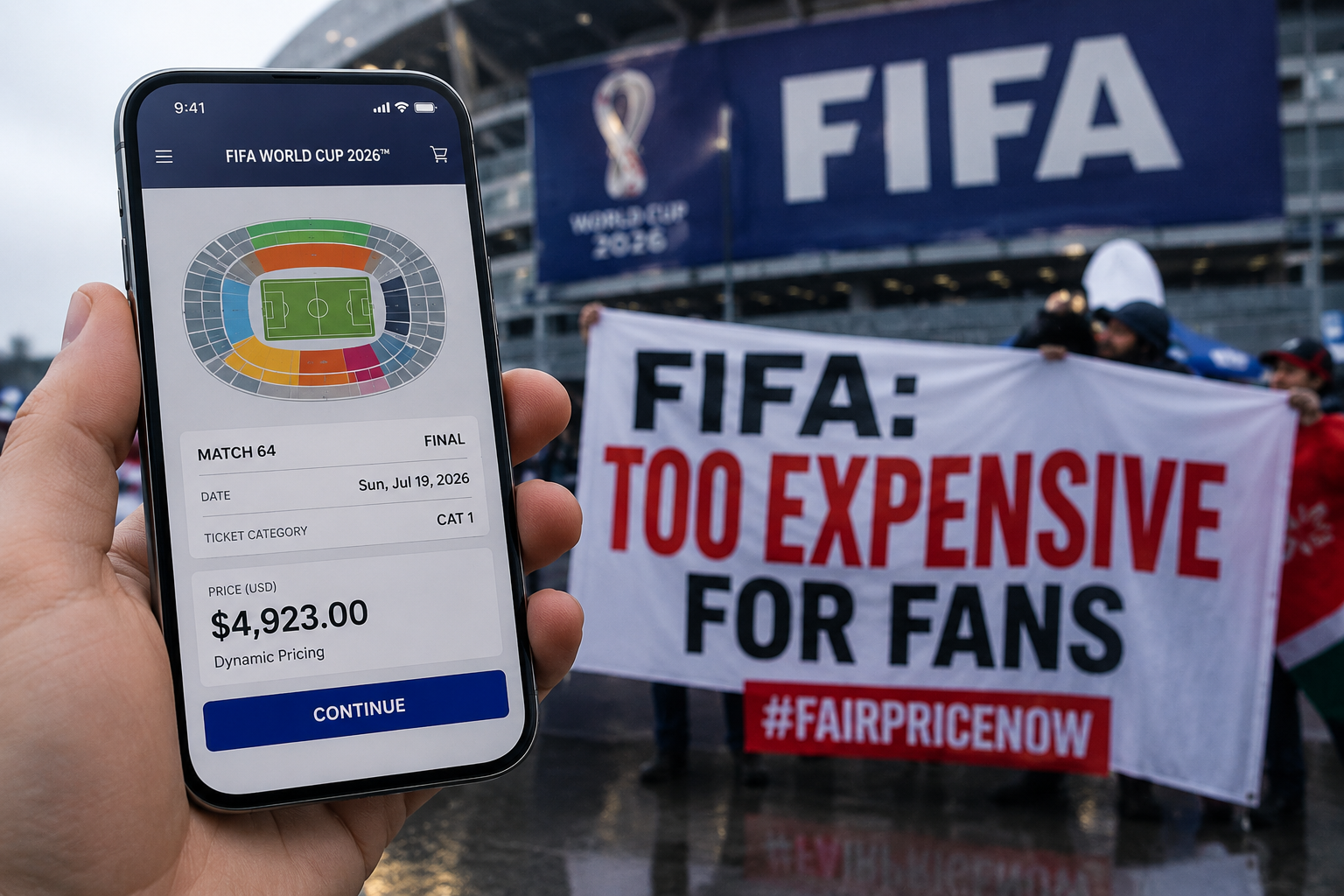
It's World Cup eve, and the soccer world is united in a way it rarely is: everyone is furious at FIFA. On the eve of the 2026 tournament, the outrage is aimed squarely at the governing body's new ticket-pricing model, which made seats so expensive that — in a stunning irony for the most popular sporting event on earth — thousands remain unsold. Nearly 180,000 tickets sat on FIFA's official resale portal in the days before kickoff, including thousands for the U.S. team's opener against Paraguay in Los Angeles.
The story has everything: a powerful organization, a beloved event, sky-high prices, accusations of artificial scarcity, and two state attorneys general issuing subpoenas. But underneath the soccer drama is a lesson that applies to every business, whether you sell tickets, software, or sandwiches. FIFA's fiasco is a live demonstration of how brand reputation gets formed, distributed, and cemented in 2026 — and the engine doing the cementing is increasingly search and AI.
Let me explain why this is a marketing story as much as a sports one, and what it teaches you about controlling your own narrative in the age of answer engines.
What actually happened
For the first time at a World Cup, FIFA used dynamic pricing — the same demand-based model airlines and concert platforms use, where prices float up and down based on real-time interest. Between October 2025, when tickets went on sale, and April 2026, FIFA raised prices for more than 90 of the tournament's 104 matches by an average of roughly 34 to 35 percent. At the extreme, the best seats for the final reportedly tripled to around $33,000 at one point. Even the cheapest seats for the final and group-stage matches landed at several times the cost of the cheapest Qatar 2022 tickets.
FIFA president Gianni Infantino defended the prices as a simple reflection of North American demand. But the data undercut the argument. Median prices on the resale portal fell roughly 20 percent in the month before the tournament, the lowest available price dropped for the vast majority of U.S. matches, and in nearly half of the group-stage games, tickets were available on the secondary market for below FIFA's own face value. Most resellers were poised to lose money. The "demand" justification looked shaky when the market itself was sliding.
Did the plan backfire? Reputationally, badly. Financially, probably not — FIFA is projected to pull in around $11 billion from the 2026 tournament, with roughly $3 billion from ticketing alone, a massive jump from the roughly $930 million tickets generated in 2022. But the legal exposure is real: New York and New Jersey attorneys general launched a joint investigation and subpoenaed FIFA over allegations of artificial scarcity and price deception, and fan organizations in Europe filed formal complaints accusing FIFA of abusing a monopoly position.
So FIFA may win the revenue battle while losing the reputation war. And here's the thing most organizations don't think about until it's too late: in 2026, the reputation war is fought and recorded in search results and AI answers.
Reputation is now an indexed, summarized, machine-readable asset
Think about what happens next. For months and years, anyone curious about the 2026 World Cup ticket situation will search for it. They'll type "why were World Cup 2026 tickets so expensive" or "FIFA dynamic pricing controversy" into Google. Increasingly, they'll ask ChatGPT, Perplexity, or Gemini directly: "What happened with FIFA's World Cup ticket pricing?"
And those AI systems will answer with a synthesized narrative built from the very coverage being published right now — the Financial Times, The Athletic, The Economist, the attorney-general investigations, the fan-group complaints. The story being written this week is the story the machines will tell for years. AI answer engines don't just retrieve a single source; they compress the weight of available coverage into a confident summary. When the overwhelming weight of that coverage is "FIFA used opaque dynamic pricing, fans felt betrayed, and regulators got involved," that becomes the canonical answer served to everyone who asks.
This is the part businesses routinely underestimate. Your reputation is no longer just what people say about you at the dinner table or even what ranks on page one of Google. It's what AI systems conclude about you when they read the web and distill it into a recommendation or summary. Reputation has become an indexed, summarized, machine-readable asset — and once a narrative solidifies across enough trusted sources, it's extraordinarily hard to dislodge.
The same mechanism that buries FIFA can bury you
You're not FIFA. You don't have an $11 billion revenue cushion to absorb a reputational hit. For most businesses, the narrative that AI systems form about you isn't a footnote — it's the deciding factor in whether a prospect ever reaches out.
Consider how this plays out at normal-business scale. A potential customer asks ChatGPT, "Is [your company] worth it?" or "What are people saying about [your product]?" or "Best [your category] companies — and which ones to avoid." The answer they get is assembled from reviews, news mentions, forum threads, comparison articles, and whatever structured information exists about your brand. If the loudest, most repeated signals about you are negative — billing complaints, a botched launch, a pricing controversy of your own — that's the summary the prospect receives, often before they ever visit your website. The AI has effectively pre-screened you, and you weren't in the room.
FIFA's situation is the dramatic, billion-dollar version of a dynamic that affects every brand. The mechanics are identical: a moment generates coverage, the coverage gets indexed and summarized, and the summary becomes the default truth that search and AI hand to the next person who asks. The only differences are scale and whether you have the resources to ride it out.
Dynamic pricing, trust, and the cost of opacity
There's a second lesson buried in the FIFA story, and it's about trust as a search-and-AI asset. The core accusation against FIFA isn't just that prices were high — it's that the pricing was opaque. Fans couldn't see seat locations, couldn't predict availability, and felt the algorithm was working against them. Fan groups specifically demanded transparency: advance notice of availability, clarity on what people were actually buying.
Trust and transparency aren't just nice values; they're increasingly the signals that determine whether AI systems treat you as a credible source and whether customers choose you over a competitor. The brands that win in AI search are the ones whose information is clear, consistent, and verifiable — businesses that publish honest, structured, accessible information about what they offer and how they operate. Opacity creates a vacuum, and vacuums get filled by other people's narratives: the critic's review, the angry forum post, the investigative article. When you don't clearly tell your own story in a way machines can read and trust, the machines tell someone else's version of it.
This is why, at Ritner Digital, we treat transparency as part of the strategy rather than a slogan. Clear, structured, honest information isn't only good ethics — it's what makes you legible and trustworthy to the systems now mediating discovery.
What this means for your business
You can't control every news cycle, and you can't always control which moments go viral or sour. But you can control how prepared you are to shape the narrative that search and AI systems form about you. Here's how to think about it.
First, audit what AI systems currently say about you. Ask ChatGPT, Perplexity, Gemini, and Google's AI Overviews the questions your prospects ask — about your company, your products, your category, your reputation. The answers you get are, in a real sense, your brand's first impression now. Most businesses have never even looked, which means they have no idea what's being said about them in the place decisions are actually made.
Second, make sure the truthful, favorable story about your business is well-sourced and well-structured across the web. AI systems weight credible, consistent, corroborated information. That means accurate structured data, a clean entity footprint, genuine third-party mentions, honest reviews, and your own published content that clearly answers the questions people ask. If the only detailed information about a topic comes from a critic, the critic wins by default.
Third, build authority before you need it. FIFA's reputation problem is acute right now, but a brand with deep, longstanding goodwill absorbs a bad moment far better than one with a thin or contested footprint. The time to establish topical authority, entity clarity, and trust signals is before a crisis, not during one. Reputation, like authority, compounds — and you want that compounding working in your favor when the moment comes.
Fourth, treat transparency as a competitive advantage. The brands that publish clearly, document honestly, and make their information easy for both humans and machines to verify are the ones AI systems learn to trust and surface. In a landscape where opacity invites suspicion and regulatory scrutiny, being the clear, credible source is a genuine moat.
The whistle is about to blow
FIFA will almost certainly make its money this World Cup. The stadiums will mostly fill, the matches will be spectacular, and the revenue will roll in. But the story of how it priced its tickets — the betrayal fans felt, the investigations, the unsold seats that contradicted the demand narrative — is now permanently woven into how search engines and AI systems will describe the 2026 tournament for years to come. That narrative was written by the coverage of the moment, and it will be served, on demand, to everyone who ever asks.
Your business operates under the same rules, just at a different scale. Every moment that generates coverage, every review, every mention is raw material that search and AI systems will compress into the answer people receive when they look you up. The question isn't whether that narrative is being formed. It's whether you're shaping it on purpose or leaving it to chance.
Find out what AI search is saying about your brand.
FIFA learned the hard way that reputation in 2026 is written by search engines and AI answer systems — and that the narrative the machines tell can outlast the moment that created it. The brands that win are the ones who shape that story deliberately, with clear, credible, well-structured information across every surface where discovery happens.
Ritner Digital helps you see exactly how your brand appears across Google, AI Overviews, ChatGPT, Perplexity, and Gemini — and builds the entity authority, structured content, and trust signals that make the right story the one people find. Book your AI Search Audit → and we'll show you where your brand stands and how to fix it, with clear next steps within one business day.
Frequently Asked Questions
What is the FIFA 2026 World Cup ticket controversy about?
For the first time at a World Cup, FIFA used dynamic pricing — a demand-based model where ticket prices float up and down like airline or concert tickets. Between October 2025 and April 2026, FIFA raised prices for more than 90 of the 104 matches by an average of roughly 34–35 percent, with the best final seats reportedly hitting around $33,000 at one point. The high prices triggered widespread fan backlash, left nearly 180,000 tickets unsold on the official resale portal before kickoff, and prompted investigations from New York and New Jersey attorneys general over allegations of artificial scarcity and price deception.
Did FIFA's dynamic pricing strategy backfire?
Reputationally, yes — but financially, probably not. The pricing alienated much of the traditional fan base, left large blocks of seats unsold, and drew regulatory subpoenas and formal complaints. Median resale prices fell about 20 percent in the month before the tournament, and in nearly half of group-stage games tickets were available on the secondary market below FIFA's own face value, undercutting the "high demand" justification. That said, FIFA is still projected to generate around $11 billion overall from the 2026 tournament, including roughly $3 billion from ticketing — a major jump from the roughly $930 million tickets brought in for 2022.
What does a sports ticketing story have to do with SEO and AI search?
It's a high-profile example of how brand reputation gets formed and distributed in 2026. For years, anyone curious about the controversy will search "why were World Cup 2026 tickets so expensive" or ask ChatGPT and Perplexity directly. Those systems will answer with a synthesized narrative built from the coverage being published right now. The story written in the moment becomes the canonical answer machines serve for years — and that same mechanism shapes how every business gets described.
How do AI search engines form a brand's reputation?
AI answer engines don't just retrieve a single source; they compress the weight of available coverage — news, reviews, forum threads, comparison articles, structured data — into a confident summary. When a prospect asks "Is [company] worth it?" or "best [category] companies," the AI assembles an answer from those signals and presents it as the default truth, often before the person ever visits your website. Reputation has effectively become an indexed, summarized, machine-readable asset, and once a narrative solidifies across enough trusted sources, it's very hard to dislodge.
Can a reputation problem in AI search actually hurt a small business?
Yes — arguably more than it hurts a giant like FIFA. A small or mid-sized business doesn't have a multi-billion-dollar revenue cushion to absorb a reputational hit. If the loudest, most repeated signals about your brand are negative, that's the summary a prospect receives when they ask an AI about you — and the AI has effectively pre-screened you out of consideration before you ever had a chance to make your case.
Why does transparency matter for AI visibility?
The core accusation against FIFA wasn't just high prices — it was opacity around availability, seat locations, and how the algorithm worked. Trust and transparency are increasingly the signals that determine whether AI systems treat you as a credible source and whether customers choose you. The brands that win in AI search publish clear, consistent, verifiable information about what they offer. Opacity creates a vacuum that gets filled by other people's narratives — the critic's review, the angry post, the investigative article.
How can I find out what AI systems say about my brand?
Ask them directly. Pose the questions your prospects ask — about your company, products, category, and reputation — to ChatGPT, Perplexity, Gemini, and Google's AI Overviews, and read the answers carefully. Those responses are effectively your brand's first impression in the place where decisions are increasingly made. Most businesses have never looked, which means they have no idea what's being said about them where it matters most.
How do I shape the story AI search tells about my business?
Make the truthful, favorable story about your brand well-sourced and well-structured across the web, since AI systems weight credible, consistent, corroborated information. That means accurate structured data, a clean entity footprint, genuine third-party mentions, honest reviews, and your own published content that clearly answers the questions people ask. Build authority and trust signals before you need them — reputation compounds, and a brand with deep goodwill absorbs a bad moment far better than one with a thin or contested footprint.