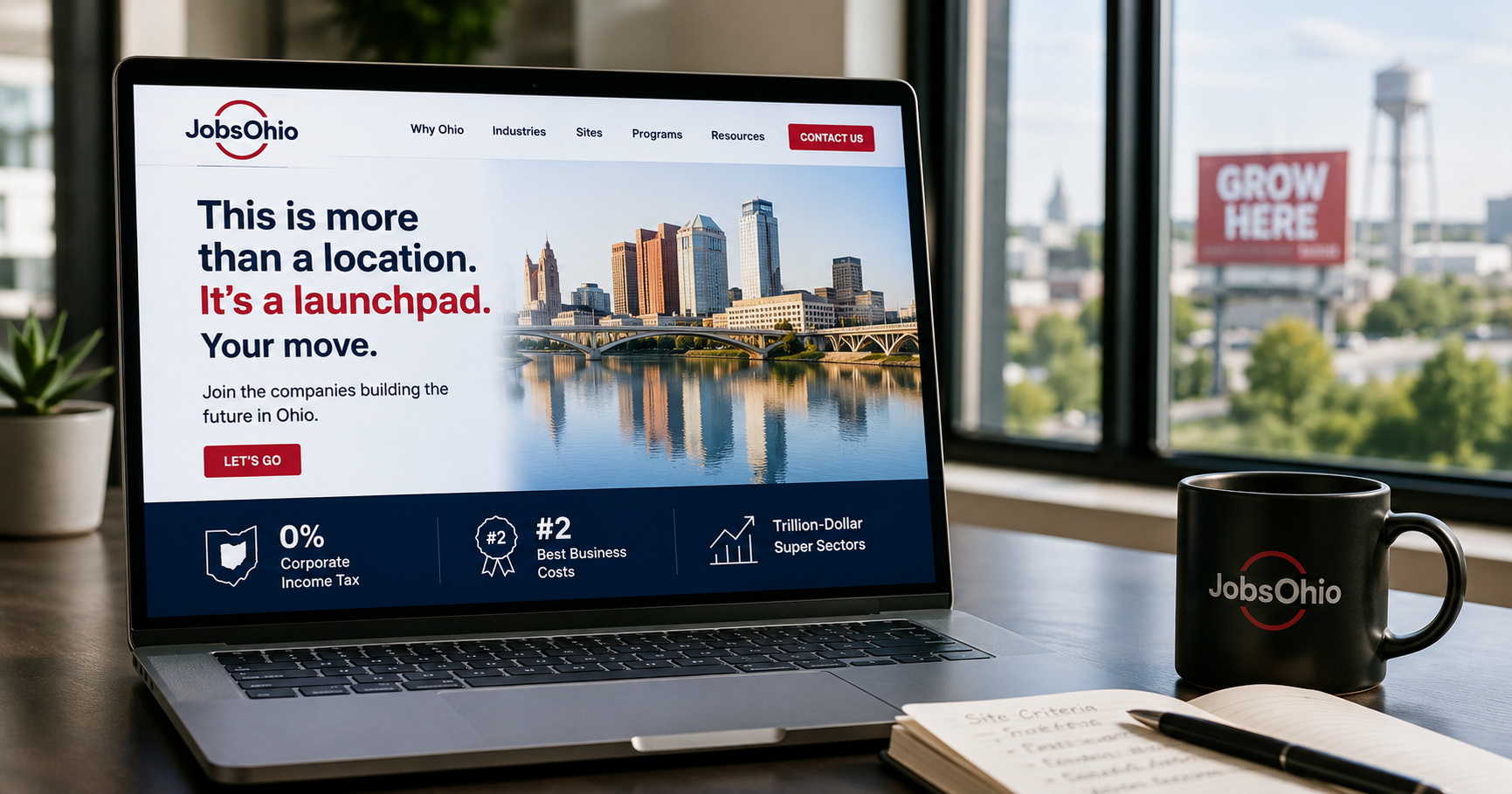
If you read enough business newsletters, you've seen the ad. JobsOhio, the state's economic development corporation, makes a confident pitch: zero percent corporate income tax, the #2 lowest business costs in the U.S., within a day's drive of 60% of the U.S. and Canadian population, super sectors spanning semiconductors, AI, aerospace, and life sciences. "This is more than a location," it says. "It's a launchpad." Then the kicker: "Your move."
It's polished, benefit-dense place marketing — the kind states spend millions on to attract companies, capital, and jobs. And it raises a question that goes far beyond Ohio: when a company actually decides where to build its next factory, headquarters, or data center, where does that decision start? Increasingly, the answer is a search bar — and more and more, an AI answer engine. Which means the entire discipline of economic development marketing is colliding with the same shift reshaping every other industry: discovery is moving from ten blue links to AI-generated recommendations.
For states, cities, and the businesses competing inside them, that shift is enormous. Let me unpack what the Ohio pitch gets right, where the real battlefield is moving, and what any organization can learn from how places sell themselves in the age of AI search.
Place marketing is high-stakes discovery marketing
Economic development is one of the most consequential forms of marketing that exists. A single landed project — a chip fab, a logistics hub, a corporate campus — can mean thousands of jobs and billions in investment. The "customers" are corporate executives, CFOs, and site-selection consultants making decisions with extraordinarily long timelines and high costs of being wrong.
And the way those decisions get made is changing fast. Site selection in 2026 is being reshaped by trade policy, reshoring, energy availability, and — critically — AI-powered analysis. Modern site selection increasingly leans on AI platforms to pull together and analyze vast data sets: real estate costs, labor metrics, logistics networks, utility infrastructure, incentive profiles, and more. The early stages of a location search that once meant flipping through brochures and calling consultants now often begin with a query: "best states for semiconductor manufacturing," "lowest business costs in the US," "where to build a data center with cheap power."
That's exactly the territory JobsOhio's ad is trying to own. Every claim in it — zero corporate income tax, #2 business costs, central logistics, trillion-dollar super sectors — is engineered to be the answer to a question a relocating company is asking. The ad is, in effect, a set of talking points hoping to be repeated. The question is where and by whom they'll be repeated. Because the entity doing the repeating is increasingly an AI.
The uncomfortable truth: AI doesn't yet know what the experts know
Here's where it gets interesting, and where there's a genuine opportunity for whoever moves first. When researchers tested general AI tools against expert site-selection recommendations, the results were striking: for industrial projects, popular tools like ChatGPT showed almost no overlap with expert-generated location lists, and for office relocations, earlier ChatGPT versions identified only about half of the locations experts recommended.
Read that again, because it's the whole ballgame for place marketing right now. The AI systems that a growing number of decision-makers consult early in their process do not reliably reflect what the experts know. They reflect what's been published, structured, corroborated, and made legible across the web. If a state's genuine advantages aren't well-represented in the sources AI systems draw from, those advantages effectively don't exist in the AI's answer — no matter how real they are on the ground.
This is the AI citation gap applied to entire economies. Ohio can have the #2 lowest business costs in the country, but if the web's structured, authoritative content about "lowest business costs in the US" is dominated by Texas, Tennessee, and the Carolinas, then that's who the AI names when an executive asks. The truth on the ground and the truth in the answer engine are two different things, and only one of them shows up in the prospect's first impression.
For economic development organizations, this is both a warning and an opening. The warning: a great pitch deck and a polished ad campaign don't automatically translate into AI visibility. The opening: because most places haven't figured this out yet, the ones that deliberately build their presence in AI answers can leapfrog competitors with bigger budgets but weaker digital authority.
What the Ohio ad does well — and what it can't do alone
Give JobsOhio credit. The messaging is doing several things that matter for search and AI visibility, whether or not that was the intent.
First, it leads with specific, quantified claims — 0% corporate income tax, #2 business costs, 60% of the population within a day's drive. Specificity is exactly what AI systems latch onto and reproduce, because concrete, verifiable facts are more citable than vague boosterism. "Business-friendly" is forgettable; "0% corporate income tax" is quotable.
Second, it ties the location to named high-growth sectors — semiconductors, AI, aerospace, life sciences. This is entity association in action: linking the Ohio "entity" to the trillion-dollar industry entities a company might be searching within. When an AI is asked about semiconductor-friendly states, the places that have clearly and repeatedly associated themselves with that sector across credible sources are the ones that surface.
Third, it has a clear, repeatable narrative — "a legacy of manufacturing strength meets cutting-edge infrastructure." A consistent story, told the same way across many surfaces, is what helps both search engines and AI systems form a coherent understanding of what a place is.
But here's what the ad alone can't do: it can't guarantee that any of this reaches the AI systems forming the shortlist. An ad in a newsletter is a broadcast moment. It creates an impression, maybe a click. What it doesn't do is build the durable, structured, corroborated web presence that determines whether "Ohio" comes up when a site-selection consultant asks Perplexity to compare states for an advanced-manufacturing project. The ad is the pitch. The infrastructure behind it is what makes the pitch survive the trip through an answer engine.
The lesson scales down to every business
You might be thinking this is interesting if you run a state's economic development agency, but you don't. Stay with me, because the JobsOhio dynamic is just the most dramatic version of a problem every business faces.
Any organization competing for high-consideration, high-value decisions is in the same position as Ohio. A B2B software company hoping to land enterprise contracts. A law firm wanting to be the name that comes up for complex litigation in its region. A manufacturer bidding for a place in a supply chain. A consultancy competing for retainers. In every one of these cases, the buyer's journey increasingly starts with a search or an AI query — "best [category] for [specific need]," "top [service] companies in [region]," "who specializes in [problem]" — and the answer they get shapes the shortlist before a single sales conversation happens.
And just like Ohio's genuine advantages, your real strengths only count if they're legible to the systems doing the answering. You can be the best option in your category and still be absent from the AI's recommendation because your expertise lives in your founder's head, your sales deck, and a handful of unstructured web pages instead of in the credible, structured, corroborated sources AI systems trust. Being great isn't the same as being found — and in 2026, being found means being citable.
How to win the AI-search version of place marketing
So whether you're marketing a state or a small consultancy, the playbook for being the answer rhymes. Here's how to think about it.
Start by claiming your specific, quantifiable advantages in language built to be repeated. Ohio says "0% corporate income tax," not "tax advantages." Find the concrete, verifiable facts that make your case — numbers, rankings, named capabilities — and publish them clearly and consistently. Vague superlatives don't get cited; specific claims do.
Next, build strong entity associations between your brand and the categories, sectors, and problems you want to be found for. AI systems work through relationships between entities, so the more clearly and repeatedly you connect yourself to the topics your buyers search within, the more likely you are to surface when those topics come up. This is deliberate work: structured content, consistent positioning, and genuine third-party mentions that reinforce the association.
Then make your information machine-legible. Structured data, clean entity signals, content formatted to directly answer the questions buyers ask, and accurate, consistent details across every surface. The goal is to make it effortless for both search engines and AI systems to understand who you are, what you offer, and why you're a credible answer. The places and businesses that win aren't always the strongest on paper — they're the ones whose strengths are easiest for the machines to read and trust.
Finally, audit what the AI actually says about you today. Ask ChatGPT, Perplexity, Gemini, and Google's AI Overviews the questions your prospects ask — about your category, your region, your specialty. If you're missing from the answers, or if the answer names your competitors, that's your gap, made visible. Ohio could run this exact test: ask an AI "best states for advanced manufacturing" and see whether the pitch is landing where it counts. So can you.
Your move
The JobsOhio ad ends with a challenge: "Your move." It's a good line, and it's a fitting one for this whole conversation. Ohio has made its move — it has a genuine value proposition and the budget to broadcast it. But broadcasting a pitch and owning the answer are no longer the same thing. The decisions that matter now route through search engines and AI systems that build their recommendations from the structured, credible, corroborated web — not from the cleverness of any single ad.
That's true for a state competing for a chip fab, and it's true for your business competing for its next customer. The organizations that win the next decade of high-stakes discovery will be the ones who treat AI visibility as infrastructure, not an afterthought — who make sure their real advantages are legible, citable, and present in the exact moment a decision-maker goes looking. The pitch gets you noticed. Being the answer is what gets you chosen.
Your move.
Make sure you're the answer, not the afterthought.
Whether you're selling a region or a service, the buyers who matter most are starting their search in Google and AI answer engines like ChatGPT, Perplexity, and Gemini — and they're building their shortlist before they ever contact you. The question is whether your real advantages show up where the decision gets made.
Ritner Digital builds the entity authority, structured content, and AI search visibility that turn your genuine strengths into the answer decision-makers find. Book your AI Search Audit → and we'll show you exactly where your brand appears across AI search, where it doesn't, and how to fix it — with clear next steps within one business day.
Frequently Asked Questions
What is JobsOhio and what is it advertising?
JobsOhio is the state of Ohio's economic development corporation, and its marketing pitches Ohio as a destination for companies looking to relocate or expand. The ad highlights specific advantages: 0% corporate income tax, the #2 lowest business costs in the U.S., a central location within a day's drive of 60% of the U.S. and Canadian population, and "super sectors" spanning semiconductors, AI, aerospace, and life sciences. It's a polished example of economic development marketing — states competing for companies, capital, and jobs.
What does economic development marketing have to do with AI search?
When a company decides where to build a factory, headquarters, or data center, that decision increasingly starts with a search bar or an AI answer engine. Executives and site-selection consultants now ask questions like "best states for semiconductor manufacturing" or "lowest business costs in the US," and the answers shape the shortlist before any formal process begins. That puts economic development squarely in the same shift reshaping every industry: discovery is moving from blue links to AI-generated recommendations.
Do AI tools like ChatGPT give accurate site-selection recommendations?
Not reliably, at least not yet. When researchers tested general AI tools against expert recommendations, the results were striking: for industrial projects, tools like ChatGPT showed almost no overlap with expert-generated location lists, and for office relocations, earlier ChatGPT versions identified only about half of the locations experts recommended. AI answers reflect what's been published, structured, and corroborated across the web — not necessarily what the experts actually know. That gap is both a risk and an opportunity for any place or business trying to be found.
What is the "AI citation gap" for a place or region?
It's the difference between a location's real advantages and how those advantages are represented in AI answers. A state can genuinely have the lowest business costs in the country, but if the web's authoritative content about "lowest business costs in the US" is dominated by other states, that's who the AI names when an executive asks. The truth on the ground and the truth in the answer engine become two different things — and only the answer-engine version shapes the prospect's first impression.
What does the JobsOhio ad do well from a search and AI standpoint?
Several things. It leads with specific, quantified claims (0% corporate income tax, #2 business costs) that are far more citable than vague boosterism. It ties Ohio to named high-growth sectors like semiconductors and AI, building entity associations that help it surface when those topics are searched. And it tells a consistent, repeatable narrative, which helps both search engines and AI systems form a coherent understanding of what the place is. Specificity, entity association, and a consistent story are exactly what AI systems latch onto and reproduce.
Can an ad campaign alone make a brand visible in AI search?
No. An ad creates a broadcast moment — an impression, maybe a click — but it doesn't build the durable, structured, corroborated web presence that determines whether your brand surfaces when someone asks an AI for a recommendation. The pitch is the message; the infrastructure behind it is what makes that message survive the trip through an answer engine. Without structured data, entity signals, and credible third-party corroboration, a polished campaign can still leave a brand absent from the AI's shortlist.
How does this apply to a regular business, not just a state?
Any organization competing for high-consideration, high-value decisions faces the same dynamic — B2B software firms, law firms, manufacturers, consultancies. The buyer's journey increasingly starts with a search or AI query like "best [category] for [need]" or "top [service] companies in [region]," and the answer shapes the shortlist before any sales conversation. Just like a state's advantages, your real strengths only count if they're legible to the systems doing the answering. Being the best option isn't the same as being the one that gets found.
How can I find out whether my business shows up in AI answers?
Run the test yourself. Ask ChatGPT, Perplexity, Gemini, and Google's AI Overviews the questions your prospects actually ask — about your category, your region, and your specialty. If you're missing from the answers, or if the AI names your competitors instead, that's your visibility gap made visible. From there, the work is making your specific advantages citable: clear quantified claims, strong entity associations with the topics you want to win, machine-legible structured content, and consistent, corroborated information across the web.