Orlando Is Approaching 3 Million People. Is Your Marketing Keeping Up With Who's Actually Moving Here?
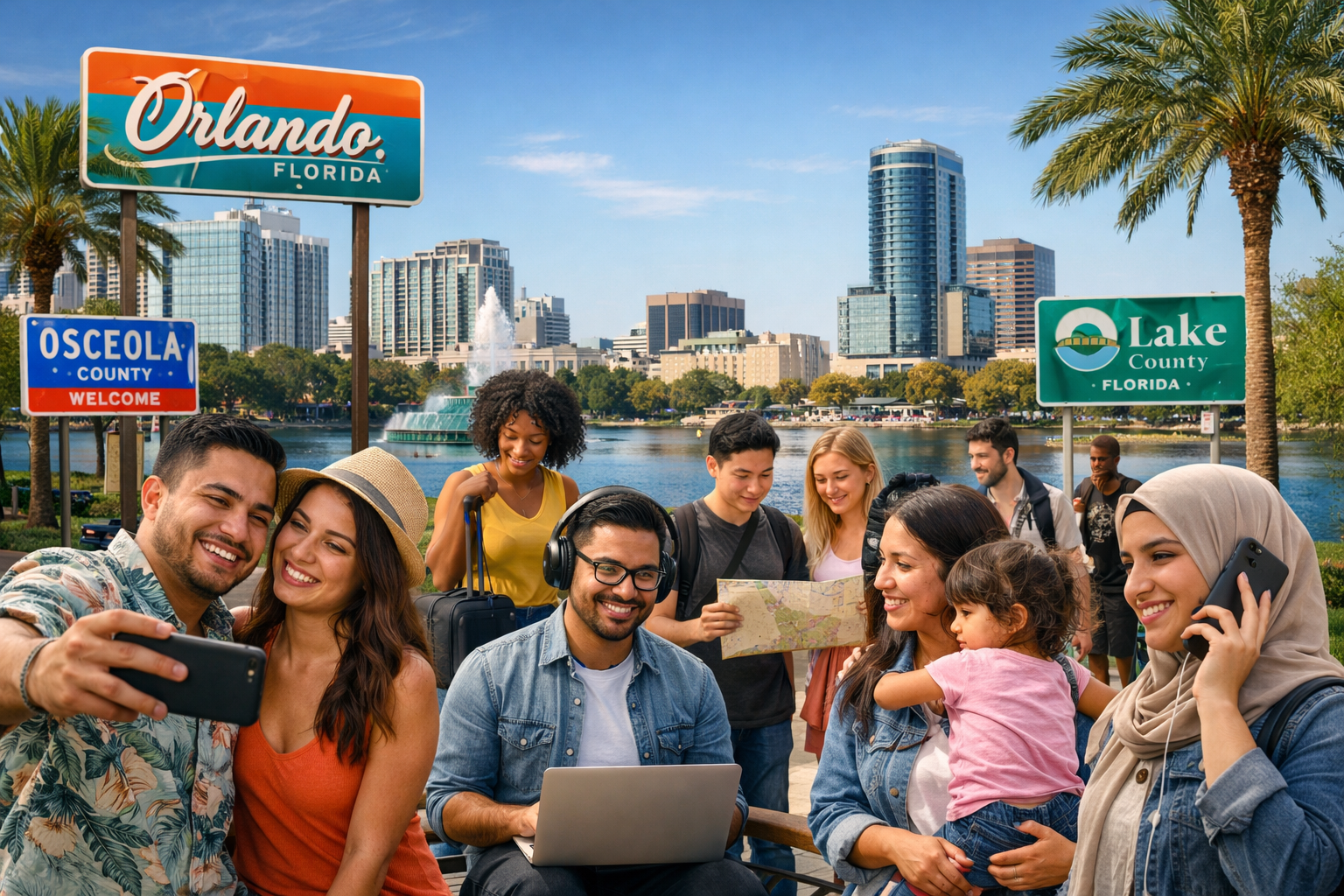
There's a number that should be on the radar of every business marketing to Orlando consumers right now.
The Orlando region's population reached 2,957,672 at mid-year 2025 — adding 37,690 new residents in the year ending July 1, 2025, or approximately 725 new residents per week. Orlando Economic Partnership
Three million people. A threshold the region is on the verge of crossing, and one that would have seemed extraordinary just a decade ago. But the headline number isn't actually the most important part of the story for Orlando businesses. The most important part is who those people are — because the composition of Orlando's population has shifted dramatically over the past five years in ways that most local marketing strategies haven't caught up with.
The customer base your business was built to serve looks meaningfully different today than it did in 2020. The question is whether your targeting, your messaging, your ad spend, and your content reflect that shift — or whether you're still marketing to an Orlando that no longer exists.
The Numbers Behind the New Orlando
To understand why the demographic shift matters so much for marketing strategy, you need to understand what's actually driving Orlando's growth — because it isn't who most people assume.
Despite falling 36% from 2024, international migration was again the key driver of Orlando's population growth in 2025 — contributing 82% of the total gain, or 29,000 new residents — and more than offsetting a net domestic loss of 1,785 residents. Orlando Economic Partnership
Read that carefully. More domestic residents left the Orlando region than arrived in 2025. The growth is almost entirely international. And it has been for years. Since 2020, the region has gained a total of 267,126 new residents, with nearly 65% of that growth attributed to international migration. Orlando Economic Partnership
This is not a minor footnote in the population story. It is the population story. Orlando is not primarily growing because Americans are relocating here from other states anymore. It is growing because people from other countries are choosing Central Florida as their destination — and that has profound implications for who your customer actually is, where they discover businesses, how they prefer to communicate, and what they respond to in marketing.
The geographic distribution of this growth adds another layer of complexity that most marketing strategies fail to account for. Almost two-thirds of all net migration to the region since 2020 has been to Lake or Osceola County, despite the two counties accounting for just 32% of the region's population. That share rose to 75% in 2025. Orlando Economic Partnership Meanwhile, Orange and Seminole — where most established Orlando businesses are concentrated — are experiencing net domestic outflows. Osceola County grew 4.7% and Lake County grew 4.1% between 2023 and 2024, with both ranking among the nation's 25 fastest-growing counties. RealPage
If your marketing is geographically concentrated in the parts of Orlando that have been growing most slowly, and not reaching the parts of the region that are expanding most rapidly, you're systematically missing the market's growth edge.
Who the New Orlando Resident Actually Is
The demographic profile of Orlando's newcomers differs from the existing population in ways that have direct marketing implications.
Early data from the Census Bureau's American Community Survey suggests that those moving to Orlando are younger, more diverse, and more educated than those already living here. Orlando Economic Partnership Forty-one percent of Orlando residents hold a college degree, and the median age is 35.1 years — a young, educated population with a strong concentration of people in their prime working and spending years. Rathly
Over one-third of those moving into the region are Hispanic or Latino, and nearly 8% are Asian — two times higher than Orlando's overall demographics where Asians make up 4% of the population. Orlando Economic Partnership These numbers have only grown since that data was compiled. The largest ethnic group in Orlando today is Hispanic at 35.4%, followed by White at 31.2% and Black at 22.2%. Florida Demographics
The highest proportions of Orlando's international-born population come from South America, Central America, and the Caribbean, adding up to approximately 66% of the foreign-born population. Orlando Economic Partnership Venezuela, Colombia, Brazil, Puerto Rico, and Cuba are among the primary origin communities — each with distinct cultural identities, communication preferences, and consumer behaviors that are not interchangeable and not captured by generic English-language marketing.
The domestic newcomers add another layer of complexity. The greatest domestic sources of new residents for Orlando are South Florida and New York, with Puerto Rico also a key contributor. Orlando Economic Partnership These aren't retirees seeking a quieter pace of life. They are working-age professionals and families bringing urban consumer expectations, digital-first discovery habits, and zero prior loyalty to any established Orlando business.
The combined result is a consumer population that is younger, more diverse, more digitally native, more multilingual, and more likely to have discovered your business through online channels than through any legacy awareness built over decades of local presence. Marketing strategies built for the Orlando of 2015 are not built for this customer.
The Marketing Gap Most Orlando Businesses Are Living In
Here's the uncomfortable reality for many established Orlando businesses: their marketing was designed for a customer base that is now a minority of the region's actual population and an even smaller minority of its growth population.
A marketing strategy that speaks exclusively in English, runs ads targeted to the geographic areas of lowest growth, assumes a domestic-born consumer with established familiarity with the brand, and distributes content through channels that skew toward older demographics is not reaching the people who are actually moving to and spending money in Orlando right now.
This isn't a values argument. It's a math argument. If 65% of Orlando's population growth since 2020 is international migration, and a significant portion of those residents are Spanish-speaking, Portuguese-speaking, or speak English as a second language — and if those residents are concentrated in the fastest-growing parts of the region — then a marketing strategy that doesn't account for any of this is systematically missing the most dynamic segment of the local customer base.
The gap shows up in several specific ways that Orlando businesses can audit in their own marketing right now.
Geographic ad targeting that doesn't reflect where the growth is. If your Google and Meta campaigns are targeting Orlando broadly or concentrating spend in zip codes you've historically served, you may be significantly underspending on the Osceola and Lake County markets that are growing fastest. The consumer density in these areas has shifted dramatically since 2020, and ad targeting that hasn't been updated to reflect that shift is leaving reach on the table in exactly the markets where new customer acquisition opportunity is highest.
English-only content and messaging that excludes a significant portion of the market. The U.S. Hispanic community now represents 19% of the U.S. population, up 23% over the past decade, with purchasing power of $4.1 trillion Nielsen — and in Orlando specifically, Hispanic residents represent over a third of the population. A business whose website, social content, Google Business Profile, and advertising exists exclusively in English is invisible to a meaningful segment of this audience. Not because they don't have money to spend, but because the business hasn't signaled that it's for them.
Ad creative and imagery that doesn't reflect who the customer actually is. Representation matters in advertising — not as a philosophical position but as a practical one. Research consistently shows that younger Latino consumers have high expectations of brands when it comes to authentic representation, and will dismiss marketing that they perceive as surface-level or inauthentic. Hispanicmarketingcouncil Businesses whose advertising visuals and messaging reflect an older, more demographically homogeneous customer base are sending an implicit signal to newer residents that this business isn't for them.
Digital discovery gaps that new residents can't bridge. A newcomer to Orlando — arriving from Venezuela, from Colombia, from New York, from South Florida — forms their entire understanding of the local market through digital discovery. They have no prior word-of-mouth from friends and neighbors who know the local landscape. They search Google, they scroll Instagram, they check reviews, and they form their first impressions of local businesses based entirely on what they find. A business that shows up well in those discovery channels — strong local SEO, active social presence, robust Google Business Profile, positive reviews in multiple languages — is accessible to this audience. A business that doesn't is invisible to them, permanently.
The Spanish-Language Opportunity Nobody Is Competing For
Of all the demographic shifts reshaping the Orlando customer base, the Spanish-language marketing opportunity is the most significant and the most systematically underexploited.
Hispanic consumers in the U.S. wield over $2 trillion in purchasing power Hispanicmarketingfirm — a number that has grown consistently and is projected to continue growing. In Orlando specifically, where Hispanic residents represent over a third of the population and an even larger share of recent population growth, this purchasing power is concentrated and local.
The competitive dynamic around Spanish-language marketing in Orlando is striking. Despite the size and spending power of the Spanish-speaking consumer base, most local businesses have made little or no investment in reaching this audience in their preferred language. The businesses that do — Spanish-language content on their website, Spanish-language Google Business Profile descriptions, Spanish responses to Spanish-language reviews, Spanish-language social media posts or stories — are operating in a competitive environment that is dramatically less crowded than the English-language marketing landscape.
The Hispanic market is uniquely complex to engage, given its cultural diversity — immigrants from Mexico, Cuba, Venezuela, Colombia, Puerto Rico, and many other countries are included, with dialects, cultures, behaviors, interests, and values varying considerably among them. The Financial Brand This means that effective Spanish-language marketing isn't simply translating existing English content. It requires an understanding of which specific communities make up the local Hispanic population — and in Orlando, that means primarily Venezuelan, Colombian, Brazilian, Puerto Rican, and Cuban communities, each with their own cultural reference points and communication preferences.
The baseline investment, however — Spanish-language content on key website pages, bilingual Google Business Profile, Spanish responses to reviews, Spanish-language social posts for high-engagement content — is accessible to virtually any Orlando business and creates an immediate signal of cultural relevance that competitors who haven't made this investment simply cannot match.
The Geographic Targeting Recalibration Every Orlando Business Needs
Beyond the demographic composition of who is moving to Orlando, the geography of where they're landing has shifted significantly enough to warrant a recalibration of virtually every Orlando business's geographic marketing approach.
Osceola County stands out as the region's growth champion, seeing a 13% population increase in just three years, adding over 50,000 new residents. Rathly Kissimmee — Osceola County's largest city — is not a suburb of Orlando in the traditional sense. It is a rapidly expanding, majority-Hispanic community with its own commercial corridors, consumer behavior patterns, and digital discovery ecosystem. Businesses that have historically focused their marketing on Winter Park, Dr. Phillips, or downtown Orlando and have never seriously invested in reaching Osceola County consumers are missing a market that has grown by tens of thousands of high-spending households in the past five years.
Lake County — home to Clermont, Winter Garden, and the rapidly expanding communities along the I-4 and Highway 27 corridors — is experiencing similar dynamics. Several cities in Lake County saw population booms above 20% since 2020, making it one of the state's fastest-growing areas. Rathly The consumer base in these communities is newer, younger, and more likely to discover businesses through digital channels than through legacy word-of-mouth — which means digital marketing reach into these zip codes is disproportionately valuable for businesses that make the investment.
The practical implication for ad spend is straightforward: an Orlando business that hasn't reviewed its geographic targeting parameters in the past 12 to 18 months is almost certainly operating with a targeting footprint that doesn't reflect where the addressable customer base has grown. Updating that footprint — expanding reach into Osceola and Lake County zip codes, adjusting budget allocation to reflect population density shifts — is one of the highest-ROI marketing adjustments available to any established local business right now.
The Zero-Loyalty New Resident Problem — and Opportunity
Perhaps the most consequential marketing implication of Orlando's growth isn't demographic at all. It's behavioral.
Every resident who moves to Orlando from another country or another state arrives with zero prior loyalty to any local business. They don't know which HVAC company is the most trusted. They haven't heard from neighbors that a particular restaurant is the neighborhood institution. They have no prior relationship with any local attorney, accountant, doctor, or contractor. They are starting from scratch — and the businesses they build relationships with in their first months in the region will earn years of retention and referrals.
The businesses that win with this audience are the ones that show up first and most credibly in digital discovery. First search result when they search for what they need. First impression when they look up the category on Google Maps. First business whose Google Business Profile looks complete, active, and reviewed by people who look like them. First social media presence that appears when they're exploring local options on Instagram or Facebook.
Residents who have moved to the Orlando region since 2020 now account for 8.1% of the population — the highest share among the country's 30 most populous regions. Orlando Economic Partnership That's a meaningful segment of the local consumer base that is actively forming its first relationships with local businesses right now. The marketing investment required to be visible to these new residents is the same investment required for strong local digital presence generally — but the payoff is compounded by the loyalty duration of a new resident who has just picked their favorite local business for the first time.
What Updating Your Marketing Strategy for the New Orlando Actually Looks Like
The gap between where most Orlando marketing strategies are and where they need to be isn't insurmountable — but it requires intentional, specific changes rather than incremental adjustments to existing approaches.
The first priority is audience research. Understanding which specific communities make up your current customer base, which communities represent untapped opportunity given the region's demographic shifts, and where those communities are geographically concentrated is the foundation for every other marketing decision. This isn't a one-time exercise — given the pace of Orlando's demographic change, it's something that should inform marketing strategy on an annual basis at minimum.
The second priority is geographic targeting recalibration. Reviewing paid advertising targeting parameters — geographic footprint, zip code inclusion, radius settings — against current population data, with specific attention to whether Osceola and Lake County markets are being reached at a level proportional to their consumer density and growth trajectory.
The third priority is digital accessibility for a multilingual audience. This doesn't require a full website translation as a starting point. It requires an audit of the key touchpoints where Spanish-speaking and other non-English-speaking residents first encounter the business — Google Business Profile, social media, review responses, landing pages — and a systematic effort to make those touchpoints accessible and welcoming to the communities that make up a growing share of the local consumer base.
The fourth priority is content and creative that reflects who the customer actually is. This is less about a checkbox exercise in representation and more about a clear-eyed assessment of whether your marketing visuals, language, and cultural references speak to the customer base you're actually trying to reach in 2026 — rather than the customer base you were serving in 2018.
At Ritner Digital, we help Orlando businesses update their marketing strategy for the market as it actually exists — not as it looked five years ago. If your targeting, messaging, and content haven't kept pace with who's actually moving to Orlando, let's talk.
Frequently Asked Questions
Does the demographic shift in Orlando really affect my business if I'm not in Osceola or Lake County?
Yes, and the effect is more direct than most business owners realize. The demographic shifts reshaping Orlando's consumer base aren't contained within county lines — they're reshaping the customer pool across the entire region. The Spanish-speaking population, the internationally-born resident community, and the wave of new arrivals with zero prior brand loyalty are distributed across Orange, Seminole, Osceola, and Lake Counties, with different concentrations in different areas. Even if your business is based in Winter Park, downtown Orlando, or the I-Drive corridor, the customers walking through your door or searching for your services online in 2026 are demographically different from the ones who found you in 2018. The specific geographic concentration of growth in Osceola and Lake is relevant for businesses that want to expand their reach — but the broader demographic shift in who the Orlando consumer is affects every business in the region regardless of where it's physically located.
We serve everyone — why do we need to think about specific demographic groups?
Serving everyone is a service philosophy, not a marketing strategy. Marketing works by reaching specific people with specific messages through specific channels at specific moments. A business that markets to "everyone" is effectively marketing to no one in particular — which means it's reaching the people who already know it exists and missing the people who don't. The demographic shift in Orlando isn't an argument for narrowing your customer base. It's an argument for expanding the channels, languages, and cultural contexts through which you're visible to the full range of people who could become your customers. A Spanish-language Google Business Profile doesn't exclude English-speaking customers. A geographically expanded ad targeting footprint doesn't stop serving existing customers. Making your marketing more accessible to a broader demographic makes your business more discoverable to more people — which is the entire point of marketing investment.
How much of my marketing budget should go toward Spanish-language content and outreach?
There's no universal formula, but a useful starting point is to calibrate your Spanish-language marketing investment to the proportion of Spanish-speaking residents in your specific service area — and then consider whether that community represents an underserved opportunity relative to your current customer mix. In Orlando's core counties, Spanish speakers represent over a third of the population. In Osceola County specifically, that proportion is significantly higher. If your current customer base doesn't reflect that composition, and if you've made little investment in Spanish-language marketing, the opportunity cost is real and the competitive landscape for that audience is significantly less crowded than the English-language market. The practical starting point for most businesses isn't a major budget reallocation — it's a baseline investment in the highest-leverage touchpoints: a bilingual Google Business Profile, Spanish-language responses to Spanish reviews, and Spanish-language social content for the highest-engagement post types. These are relatively low-cost investments that signal cultural accessibility to a large and growing consumer segment.
How do we know if our current geographic ad targeting is missing where the growth is?
The most direct way to audit your current geographic targeting is to pull your campaign data and compare where your ads are currently running against where Orlando's population growth has actually been concentrated. If your campaigns are targeting Orlando broadly or focused on the zip codes you've historically served — which tend to be concentrated in Orange County's established commercial corridors — and you haven't specifically included high-growth Osceola and Lake County zip codes, you're almost certainly underinvesting in the fastest-growing consumer markets in the region. A more rigorous audit compares your current customer geographic distribution against the population distribution and growth data from the Census Bureau, and identifies the specific zip codes where your addressable customer base has grown but your marketing presence hasn't followed. Most businesses that do this exercise discover a meaningful gap between where they're spending and where the growth opportunity actually is.
Is it enough to just add Spanish to our Google Business Profile, or does authentic Hispanic marketing require more than that?
A bilingual Google Business Profile is a meaningful starting point — and for many businesses, it's the highest-ROI first step because it's the most visible touchpoint where Spanish-speaking residents first encounter the business in search. But authentic Hispanic marketing does require more than a translation layer on existing assets. Research consistently shows that Hispanic consumers, particularly younger generations, respond to cultural authenticity rather than surface-level inclusion. That means imagery and creative that reflects the actual diversity of the community, messaging that acknowledges cultural values and communication norms specific to the communities you're trying to reach, and a sustained presence in the channels those communities actually use rather than a one-time translation effort. The distinction to keep in mind is between being findable and being relevant. A bilingual Google Business Profile makes you findable. Content and marketing that reflects genuine cultural understanding makes you relevant — and relevant businesses earn trust and loyalty, while findable-but-generic businesses earn a click that doesn't convert.
What channels are most effective for reaching Orlando's internationally-born resident population?
The channel mix that works best varies by community of origin, but several platforms consistently over-index with internationally-born and Spanish-speaking audiences in Central Florida. Instagram is particularly important — it functions as a primary discovery and recommendation platform for many Latin American communities, with a visual format that transcends language barriers and a sharing culture that amplifies local business discovery through personal networks. WhatsApp is widely used for community communication and business referrals in Venezuelan, Colombian, and Brazilian communities specifically, though it's a relationship channel rather than a paid advertising channel. Facebook remains significant for the 35-plus age cohort of internationally-born residents, particularly for community groups where local business recommendations circulate organically. Google search in Spanish is an underutilized opportunity — relatively few local businesses have invested in Spanish-language content that ranks for Spanish-language queries, which means the competitive landscape for this channel is considerably less crowded than English-language local search.
How should we think about the new residents who just moved to Orlando with no prior brand awareness of local businesses?
New residents represent one of the highest-value customer acquisition opportunities available to any local business — because the customer relationships formed in the first months after relocation tend to be durable and referral-generative once established. The window for winning a new resident's first choice in any category is concentrated in the early months after their arrival, when they're actively researching and forming preferences without any prior loyalty anchoring them to an existing provider. The businesses that show up most credibly in digital discovery during that window — first in search results, most complete and active on Google Maps, best reviewed by people who reflect the new resident's own background and experience — are the ones that win relationships that can last years. For businesses thinking about this strategically, it means treating digital presence investment not just as a channel for reaching existing demand, but as the primary mechanism for capturing first-choice consideration from a population that is perpetually renewing as new residents arrive every week. The 725 new residents arriving in Orlando per week aren't evenly distributed across existing businesses. They go to whoever shows up first, looks most credible, and communicates in a way that feels relevant to them.
What's the risk of not updating our marketing strategy to reflect these demographic shifts?
The risk is slow, largely invisible erosion — which is the most dangerous kind because it doesn't trigger an urgent response until the damage is already significant. A business whose marketing doesn't reflect the evolving Orlando demographic won't lose its existing customers overnight. Those relationships are sticky and self-sustaining for a time. What it will lose is the acquisition of new customers from the communities that represent the region's growth — the Spanish-speaking residents who searched in Spanish and found a competitor who showed up, the Osceola County newcomer who discovered a competitor that ran ads in their area, the new arrival from Colombia who chose a business whose Instagram reflected their community. Each of these missed acquisitions is invisible individually. Cumulatively, over two or three years, they represent a meaningful gap in growth that compounds as the demographic shift continues. The businesses that look back in 2028 and wonder why their customer base has aged without replenishing, or why competitors who were smaller than them five years ago have pulled ahead, will almost always trace the divergence back to a marketing strategy that didn't evolve with the market it was supposed to be serving.